

Judicial Reform Commitments Compared | Judicial Reform Foundation Publishes Responses to Seven Questions on Judicial Reform from Various Parties
Last edited: 2026-11-03
(Responses from the Democratic Progressive Party updated in red on the morning of January 11.)
With only five days remaining before the January 13 presidential and legislative elections, the Judicial Reform Foundation held a press conference on the first day of legislative candidate registration to release the Seven Questions on Judicial Reform (press release), hoping that all political parties would provide concrete responses to judicial issues and human rights policies so that voters can cast their ballots based on the values upheld by each party.
As of January 5, the Foundation has received responses from 5 political parties: the Kuomintang (KMT), the Taiwan People's Party (TPP), the New Power Party (NPP), the Green Party Taiwan, and the Okhaba Taiwan (Minority People's Party). All responding parties hold a positive and supportive attitude, showing a high degree of consensus between political parties and society across 7 major directions. The Democratic Progressive Party (DPP) is currently processing its response; the Foundation will update this article immediately once their response is received. For now, their policy positions and responses during their term in power are used for comparison. (Update: The DPP submitted its response on January 10, but the version publicly released on January 8 is currently retained for the graphic illustrations.)
Regarding the two questions on "Promoting the Convention against Torture" and "Police Performance and Education/Training," the Foundation has also compiled relevant content from the responses given by the Democratic Progressive Party, Statebuilding Party, Taiwan Bilingual Cannot Party, and Taiwan Reform to the Taiwan Association for Human Rights for public reference.
Today (January 8), the Central Election Commission will hold a televised policy presentation for party-list proportional representation. It is hoped that all political parties will incorporate judicial and human rights issues into their party platforms, and we call upon all parties to actively support the 7 major reforms if they win seats in the legislature.
[Complete Responses from Political Parties]
- New Power Party's Response to the Seven Questions on Judicial Reform
- Taiwan Green Party's Response to the Seven Questions on Judicial Reform
- Taiwan People's Party's Response to the Seven Questions on Judicial Reform
- Chinese Nationalist Party (KMT) Response to the Seven Questions on Judicial Reform
- Okhaba Taiwan's Response to the Seven Questions on Judicial Reform
- Democratic Progressive Party's Response to the Seven Questions on Judicial Reform(Submitted on January 10, 2024)
I. To protect the voting rights of inmates, do political parties support the establishment of polling stations within correctional institutions and the implementation of transfer voting, ensuring that all inmates can vote inside correctional institutions?
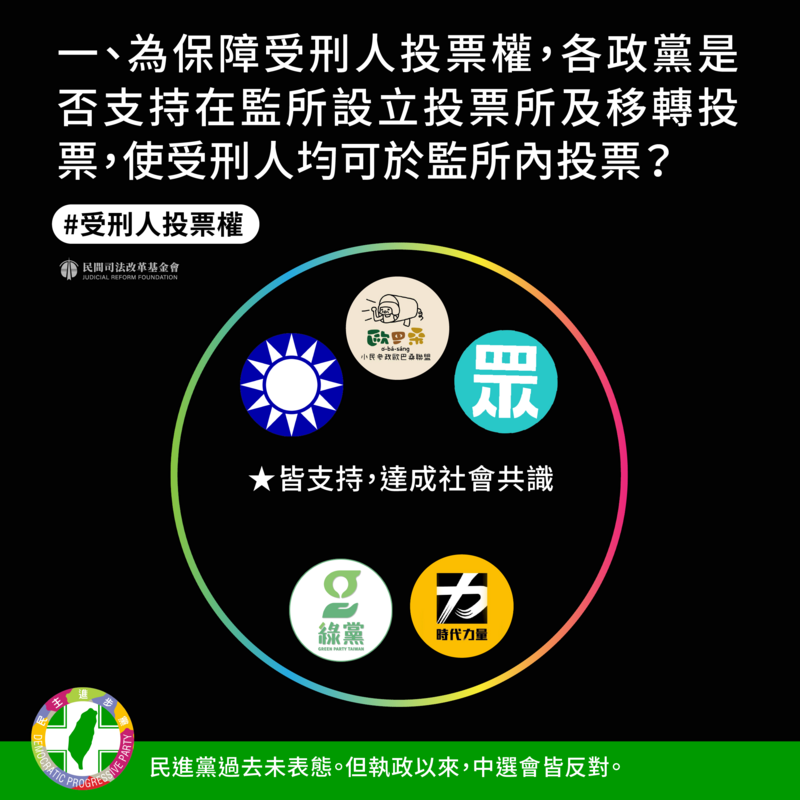
Reviewing the responses of various parties regarding the voting rights of inmates, the Green Party, TPP, NPP, KMT, and Okhaba Taiwan all expressed support for inmate voting rights, establishing polling stations and transfer voting within correctional institutions, and pledged to continue relevant reforms in the future. Below are quotes from the responses of parties that put forward specific policies.
Green Party: Implement "absentee voting" in national-level elections, with an expanded scope of eligible individuals, including those performing electoral duties on election day, military personnel on active duty, police officers on duty, people working outside their registered domicile, people studying outside their registered domicile, people unable to move freely due to illness, physical or mental disability, childbirth, or injury, and those serving sentences in correctional institutions whose civil rights have not been deprived. However, the Green Party explicitly excludes "overseas and cross-strait absentee voting" for Taiwanese businesspeople abroad to ensure the fairness of voting and the legitimacy of the election.
Okhaba Taiwan: Okhaba Taiwan agrees with establishing polling stations and transfer voting within correctional institutions. Valuing the human rights of children and adolescents, Okhaba Taiwan holds that young offenders aged 18–23 housed in juvenile correctional schools should also be able to exercise their right to vote in accordance with current regulations regarding voting age. In addition, for inmates with disabilities, immigrant inmates, psychiatric patients, or those with substance addictions, correctional facilities or juvenile correctional units must provide sufficient assistance such as physical and mental assessments, assistive devices, translation, and professional personnel. At the same time, Okhaba Taiwan also values inmates' "right to know political information," ensuring that inmates have time, channels, and supporting measures that take their labor conditions into consideration.
New Power Party (NPP): During its tenure in the Legislative Yuan, the NPP has repeatedly utilized Central Election Commission personnel reviews, budget reviews, and interpellation opportunities to demand that the state comply with the requirements of the Constitution and the International Covenant on Civil and Political Rights (ICCPR) to protect inmates' voting rights, and has already proposed amendments to election laws regarding the transfer voting system.
Kuomintang (KMT): During budget reviews, the KMT legislative caucus has repeatedly proposed primary resolutions on this issue, demanding that executive agencies accelerate research and improvements, and has also repeatedly proposed absentee voting to concretely protect citizens' political participation rights. However, all these proposals were voted down by the DPP government relying on its majority advantage.
During the DPP's term in office, the Executive Yuan proposed an amendment draft to the Central Election Commission's "Act Governing Absentee Voting in National Referendums" in 2021, proposing transfer voting as an absentee voting method, but opposed the setup of dedicated polling stations due to concerns over information monopoly and the secrecy of the ballot.
DPP Response on January 10: Supported. However, major controversies such as custody/escort, ballot secrecy, and fairness require prudent research and planning.
II. To eradicate torture and establish a National Preventive Mechanism (NPM) against torture, do political parties pledge to support the passage of the Enforcement Act of the Convention against Torture in the Legislative Yuan within one year after taking office?
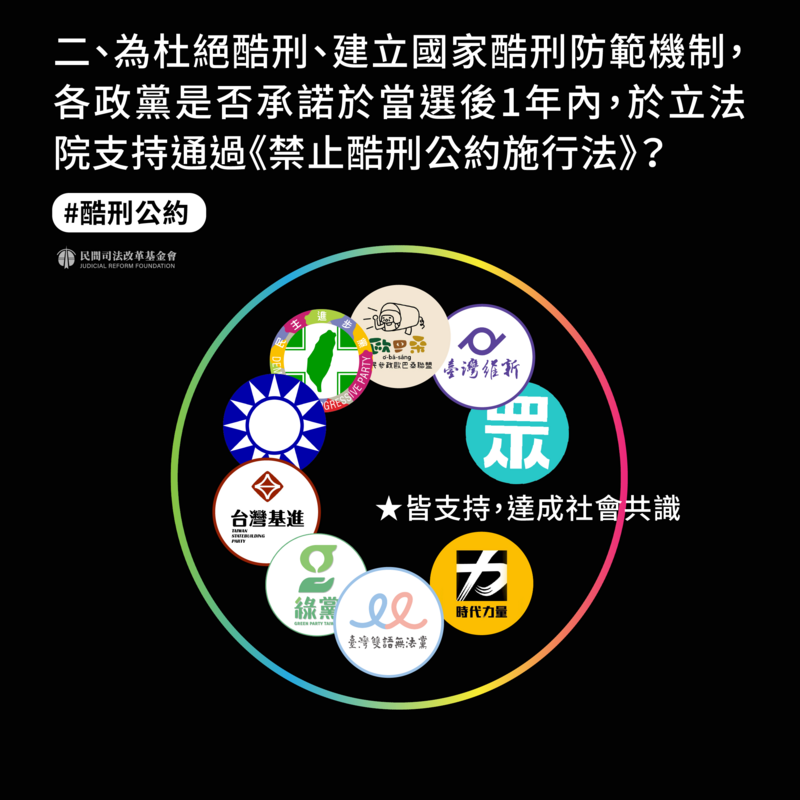
Reviewing the responses of various parties regarding the promotion of the Enforcement Act of the Convention against Torture, Okhaba Taiwan, the Green Party, the NPP, the TPP, and the KMT all expressed support and pledged to support the passage of the Enforcement Act of the Convention against Torture in the Legislative Yuan within one year after taking office.
During the DPP's term in office, the Executive Yuan submitted the draft Enforcement Act of the Convention against Torture to the Legislative Yuan for deliberation and expressed its expectation for its prompt passage, but the 10th Legislative Yuan did not deliberate on it.
DPP Response on January 10: Supported, hoping for its prompt passage.
According to the responses of the Statebuilding Party, Taiwan Reform, and the Taiwan Bilingual Cannot Party to the Taiwan Association for Human Rights' eight human rights questions, they also pledged to continue existing international human rights conventions and prioritize promoting UN core human rights conventions that have not yet been domesticated.
Through the responses of the above political parties, anti-torture enjoys a high degree of social consensus. Once the election results are announced, the elected president and legislators should promptly pass the Enforcement Act of the Convention against Torture within one year of taking office to eradicate torture and establish a national preventive mechanism against torture.
III. To prevent the leakage of personal data collected and managed in state information databases, do political parties pledge to complete a comprehensive revision of the Personal Data Protection Act within one year after taking office? Should there be an independent external investigative unit to clarify leaks of personal data collected and managed by government agencies, and to establish complete review and prevention mechanisms?
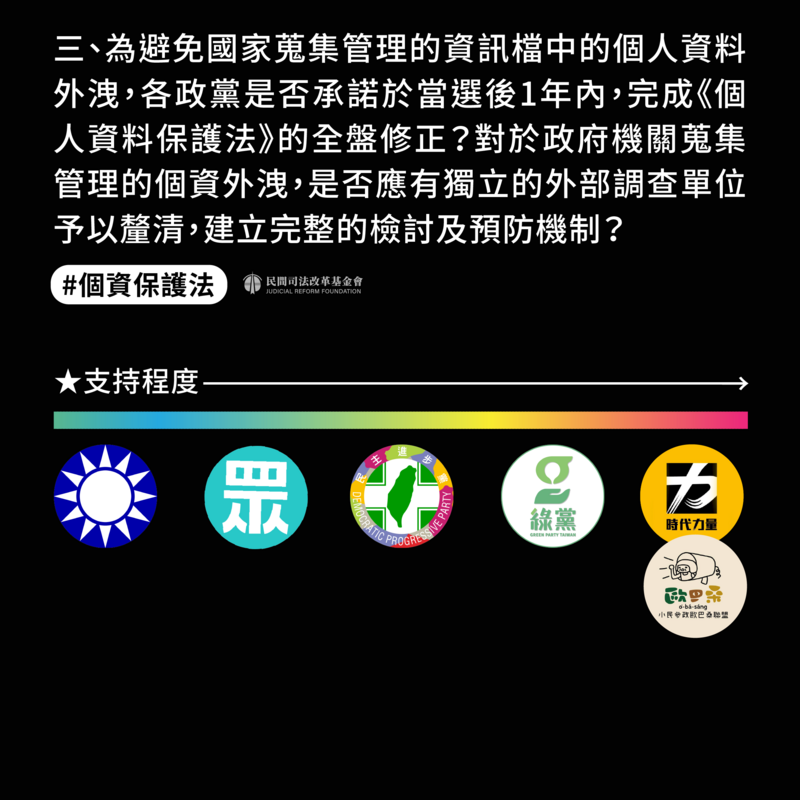
Reviewing the responses of various parties regarding the review and prevention of personal data protection, the NPP, Okhaba Taiwan, the Green Party, the TPP, and the KMT all expressed that they attach importance to the significance of personal data protection. Below are quotes from the responses of parties that put forward specific policies.
(1) Comprehensive revision of the Personal Data Protection Act
The NPP, TPP, Green Party, and Okhaba Taiwan all agree that the Personal Data Protection Act (hereinafter referred to as the Personal Data Protection Act) should be comprehensively reviewed and amended. The NPP further pointed out that when public sectors collect and process data, they must present clearer and more concrete purposes and reasons to implement the principle of data minimization, reducing situations where people provide excessive personal data at the source. Furthermore, regarding collected data, the state and enterprises should ensure that collected data will not be arbitrarily provided or leaked to third parties or other unauthorized information handlers without the consent of the data subject or without a legal basis.
Although the KMT did not directly respond in agreement to the comprehensive amendment of the Personal Data Protection Act, it specifically pointed out that last year the Personal Data Protection Act only increased penalties for "non-public" agencies without simultaneously regulating public agencies; in the future, it will reference other countries' experiences to propose amendments to perfect regulations on public agencies.
DPP Response on January 10: Establishing the "Preparatory Office of the Personal Data Protection Commission" as the starting point for the next stage of legislative amendments.
(2) Review and prevention mechanism for personal data leaks
Regarding the review and prevention mechanism for personal data leaks collected and managed by government agencies, all political parties expressed agreement. Below are quotes from the responses of parties that put forward specific policies.
New Power Party: Data subjects should be able to be actively informed of how their data is processed and utilized, and should be promptly notified especially when data is leaked. A dedicated, independent regulatory unit with appropriate authority should be established, and the NPP has already introduced a draft Organic Act of the Personal Data Protection Commission.
Okhaba Taiwan: Ensure that the composition of the dedicated agency, the "Personal Data Protection Commission," possesses gender and human rights awareness, so that citizens' personal data is protected and supervised from a human rights perspective rather than leaning too heavily toward national security, public interests, or masking secondary uses under the name of academic freedom. The Commission's supervisory methods should include "personal data protection impact assessments," explicitly defining the right to consent and the right to opt out, and practicing procedures for deliberating public interests. Okhaba Taiwan will also continue to monitor and track the progress of the administrative unit's drafting of the "Regulations on Secondary Uses and Opt-out Rights of National Health Insurance Data."
Green Party: An independent investigation unit for personal information protection should be established. The mission of this unit will include clarifying potential leak incidents while simultaneously establishing review and prevention mechanisms to guard against future information security risks.
Taiwan People's Party: Although the competent authority under the current Personal Data Protection Act is designated as the "Personal Data Protection Commission," investigations into the leakage of personal data by public and non-public agencies still rely on the respective agencies themselves. Because various agencies lack sufficient skills and experience in this area, they often fall short in management and auditing. Therefore, it is believed that the Ministry of Digital Affairs should integrate the work of various ministries and formulate guidelines or templates for ministries to follow.
Kuomintang: Will supervise the acceleration of the independent preparation progress of the Personal Data Protection Commission, strengthen its independence, and review the handling mechanism of government agencies when encountering information security incidents.
During its term in office, the DPP failed to handle the Ministry of the Interior's household registration data leak incident completely and actively to dispel doubts from all sectors; however, it established the Preparatory Office of the "Personal Data Protection Commission" last December and responded to the eight human rights questions of the Taiwan Association for Human Rights, stating that it will promote the next stage of amendments to the Personal Data Protection Act in the future.
DPP Response on January 10: Establishing an independent supervisory mechanism is the best way to protect people's personal data.
IV. To build a clean government and protect whistleblowers, do political parties pledge to support the passage of the Whistleblower Protection Act in the Legislative Yuan within one year after taking office? Do you support remedial measures for whistleblowers who were unprotected in the past?
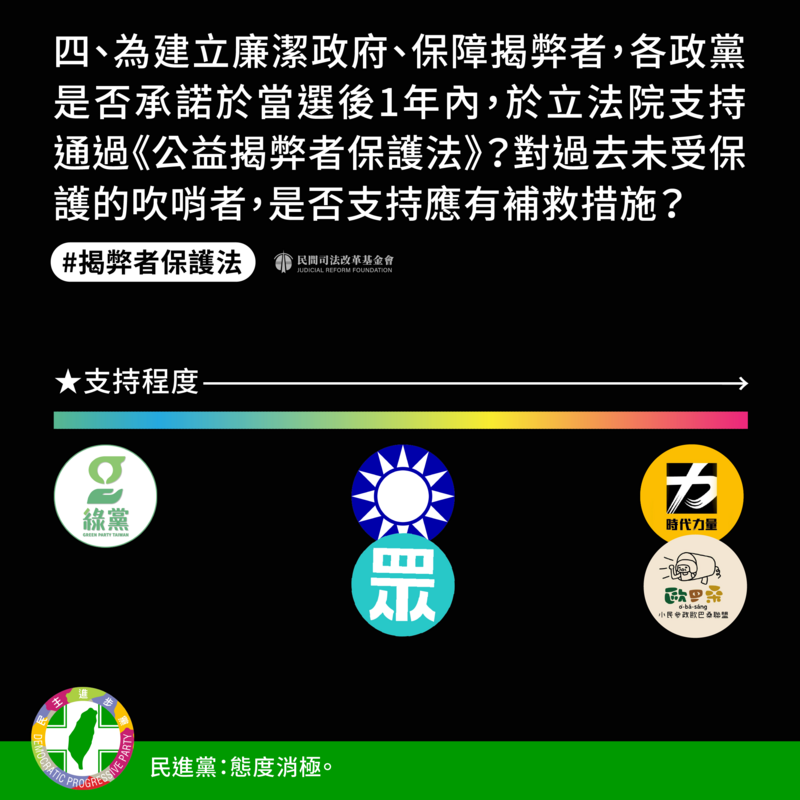
Reviewing the responses of various parties regarding the promotion of the Whistleblower Protection Act, Okhaba Taiwan, the NPP, the KMT, the TPP, and the Green Party all expressed support and pledged to support the passage of the Whistleblower Protection Act in the Legislative Yuan within one year after taking office. Below are quotes from the responses of parties that put forward specific policies.
Okhaba Taiwan: Regarding labor-management disputes in the private sector, Okhaba Taiwan advocates that this Act should be better integrated with labor and trade unions' "collective bargaining rights," rather than simply "competing" and adopting the more favorable Act, in order to prevent whistleblowing matters from being individualized or even dividing the strength of labor and unions. Furthermore, the government should match whistleblowers with employment, establish reserved employment quotas for whistleblowers in public and private sectors, provide career transition training counseling for whistleblowers, and provide friendly employment environments that allow them to display their strengths.
New Power Party: Has proposed legislative drafts for many years and constantly used actions to urge the government and the ruling party to initiate the legislative process. The NPP's proposed version balances legal stability and the legislative purpose of whistleblower protection, enacting a retroactive provision in Article 31. Will continue to supervise the government's legislative progress.
Taiwan People's Party: On the principle of separating public and private sectors, we believe that the Whistleblower Protection Act should be enacted as soon as possible with adequate supporting measures.
Kuomintang: The enactment of this Act will help our country build a clean and competent government and a regular business environment from top to bottom, from the public sector to the private sector. The KMT legislative caucus has repeatedly held press conferences and passed budget primary resolutions demanding that the Executive Yuan draft a version as soon as possible and submit it to the Legislative Yuan for deliberation, but unfortunately there has been no news to this day.
During the current term of the Legislative Yuan, due to disputes over its applicability to the private sector, the Executive Yuan has delayed submitting a proposal to the Legislative Yuan, resulting in lagging legislative progress under the DPP.
DPP Response on January 10: Under prudent deliberation. Legislation should avoid the occurrence of "going to extremes" in the future; in addition to considering that small companies and other private sectors lack professional legal affairs departments and are inadequate to cope with related situations (thereby only including publicly listed companies within the scope of regulation), the regulatory responsibility for "whistleblowing trolls" should also be incorporated into the regulations simultaneously.
V. To improve the shortcomings in forensic science that currently lack unified standards and processes, and to avoid miscarriages of justice, do political parties support the prompt establishment of a "National Forensic Science Commission"?
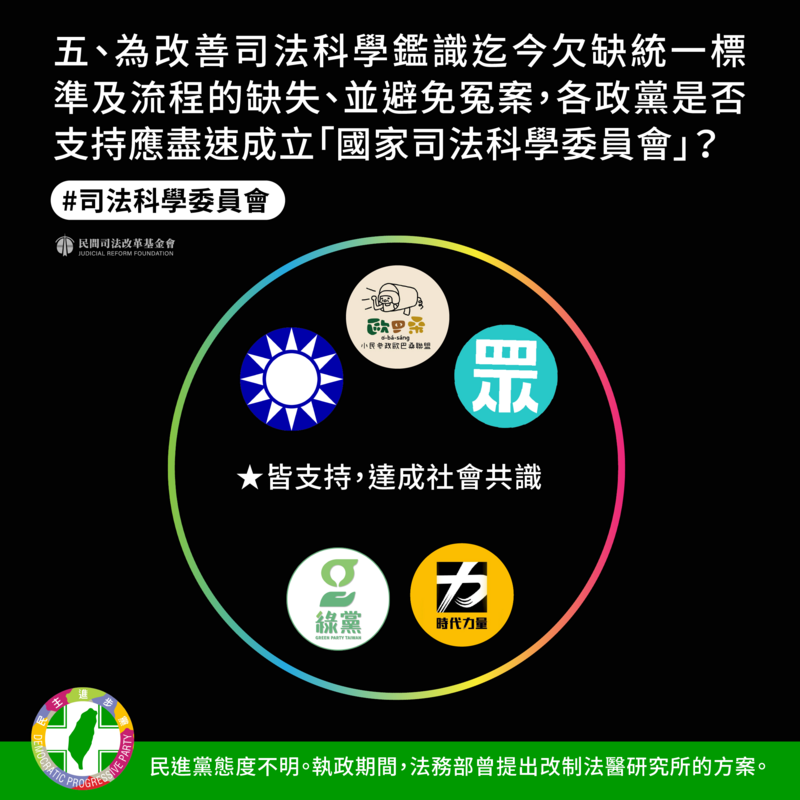
Reviewing the responses of various parties regarding the promotion of a National Forensic Science Commission, Okhaba Taiwan, the Green Party, the TPP, the NPP, and the KMT all expressed support for the prompt establishment of a "National Forensic Science Commission."
During the DPP's term in office, the Ministry of Justice once proposed the direction of reorganizing the Institute of Forensic Medicine into the "National Institute of Forensic Science," but its direction and progress were quite limited.
DPP Response on January 10: The Ministry of Justice has the direction of reorganizing the Institute of Forensic Medicine into the "National Institute of Forensic Science" and is still widely gathering opinions from all parties.
Through the responses of the above political parties, establishing a National Forensic Science Commission enjoys a high degree of social consensus. Once the election results are announced, the elected president and legislators should promptly promote the establishment of a "National Forensic Science Commission" after taking office to implement the resolutions of the National Customs on Judicial Reform, improve the shortcomings in forensic science that currently lack unified standards and processes, and avoid miscarriages of justice.
VI. To improve the problem of improper police enforcement, reform police education, and enhance enforcement efficacy and quality, do political parties support the establishment of a "Police Special Project and Performance Management Commission" to establish a reasonable and scientific performance system?

Reviewing the responses of various parties regarding the Police Special Project and Performance Management Commission, the NPP, the Green Party, Okhaba Taiwan, the TPP, and the KMT all expressed support. Below are quotes from the responses of parties that put forward specific policies.
New Power Party: The current review mechanism has too low a frequency, is insufficiently systematic, and lacks milestones to more accurately measure results. It is necessary to adopt more effective management reform measures from the perspective of problem-solving, and for this purpose establish a dedicated unit that has a certain degree of independence relative to management units, can review and analyze the rationality of management measures based on a human rights perspective and frontline experience, and subsequently establish improvement plans and track their implementation, such as a Police Special Project and Performance Management Commission or other suitable mechanisms.
Okhaba Taiwan: Agrees with the proposal of the Judicial Reform Foundation and will demand that the National Police Agency establish a "Police Special Project and Performance Management Commission" to institutionalize, rationalize, and enhance the supervision of police performance. At the same time, Okhaba Taiwan also places great importance on reforming police education, especially children's human rights, diverse gender, ethnicity, and disability equality education, akin to the "unbiasing training" currently promoted by US police, and enhancing enforcement efficacy and quality. Okhaba Taiwan advocates strengthening the social-structural perspective in police qualification exams and education and training, understanding that "criminals" such as delinquent youths, runaway migrant workers, and drug addicts are also structural victims beneath the surface of their behavior. Police officers must also be capable of breaking away from the binary opposition mindset of "perpetrator/victim" and "guilty/innocent," and be able to properly handle situations such as "marital violence combined with child abuse" (e.g., a father abusing the mother while the mother abuses the child) and "trauma-induced drug addiction" (e.g., victims of sexual assault or domestic violence using drugs to alleviate psychological trauma). Law enforcement processes must comply with various human rights indicators; otherwise, they will not be counted toward performance metrics.
Green Party: A "Police Special Project and Performance Management Commission" should be established (with at least 1/2 of the committee members being external members such as frontline police representatives, human rights experts, and social science researchers). The management committee will formulate rules and performance principles so that units at all levels can formulate special projects and performance measures based on these principles. If the management committee can make good use of technology to establish a big data database to flexibly arrange special duty items and set performance goals based on the professionalism and talents of each police officer, it will prevent police officers from being exhausted by coping with performance evaluations. Establishing scientific and reasonable performance evaluation standards can evaluate police enforcement performance while also paying attention to the risks police officers face when performing duties.
In addition, regarding the police performance system, the DPP responded in the eight human rights questions of the Taiwan Association for Human Rights that regarding performance review, it strictly requires the National Police Agency to strictly adhere to the 2017 official letter abolishing criminal points scoring and investigative performance scoring, conduct pragmatic duties with meticulous investigations, and avoid increasing police working hours and workloads caused by pursuing performance figures.
DPP Response on January 10: Will thoroughly review the police performance system to avoid lengthening and increasing police working hours and workloads due to pursuing performance figures, and improve the predicament of insufficient police capacity.
Statebuilding Party, Taiwan Reform, and the Taiwan Bilingual Cannot Party also pledged to carry out four major reforms: police cultivation education, police labor rights, the police performance system, and external police monitoring mechanisms.
VII. To systematically prevent and reduce misconduct by judges and prosecutors, do political parties support amending the Judges Act to strengthen the supervisory responsibility of judicial heads over their subordinate judges or prosecutors?
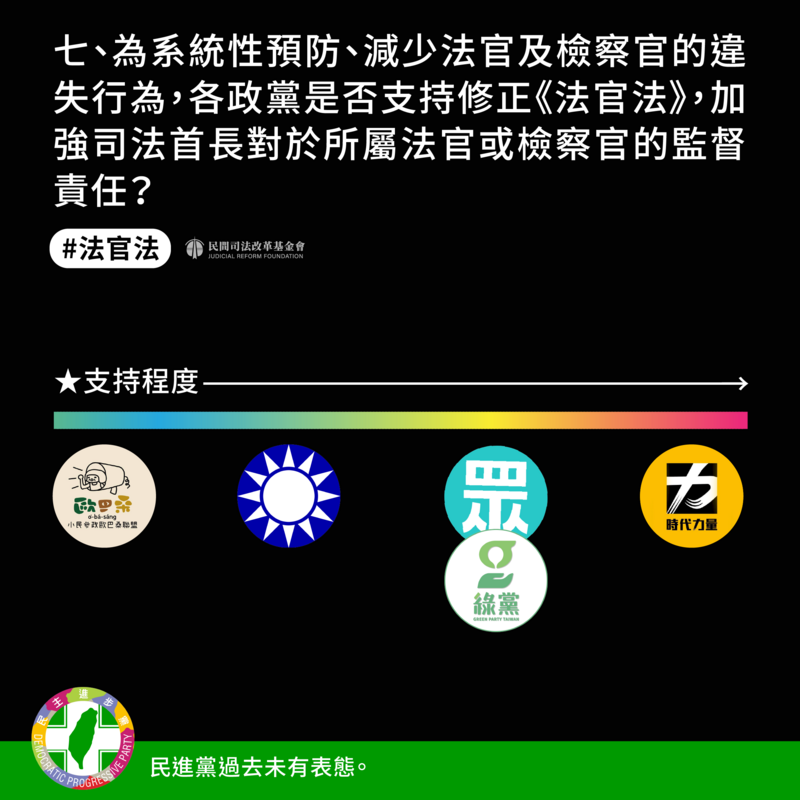
Reviewing the responses of various parties regarding the supervisory responsibility of judicial heads, the NPP, the Green Party, the TPP, the KMT, and Okhaba Taiwan all expressed support for amending the Judges Act in the Legislative Yuan to systematically prevent and reduce misconduct by judges and prosecutors and strengthen official supervisory responsibilities. Below are quotes from the responses of parties that put forward specific policies.
New Power Party: Under the premises of not intervening in the purely private aspects of judges' lives, not hindering judicial independence, and fully protecting the right of complained judges and prosecutors to express dissenting views, establishing a more active mechanism to ensure that situations where judges and prosecutors fail to meet corresponding ethical codes of conduct or even violate the law to infringe upon the rights of colleagues or parties in the workplace can be discovered and proactively handled by persons with official supervisory powers will help enhance public trust in the judiciary.
Green Party: Regarding the amendment of the Judges Act, strengthen the top-down supervisory responsibility of judicial heads over subordinate judges under the premise of restraining official powers. In addition, stronger mechanisms should also be established to parallelly or bottom-up leverage systems to prevent and reduce judge misconduct. Supervision of prosecutors can be revised and implemented according to practical needs after referencing the Court Organization Act and the Organization Regulations of the Prosecutor Evaluation Commission.
Taiwan People's Party: Believes that after the 2017 National Customs on Judicial Reform, although the DPP has amended laws regarding some aspects of prosecutors and judges, overall it still leans toward judges, and more legal amendments are still needed regarding prosecutors. For example, the current prosecutorial personnel review system should be reformed toward internal and external democratization. Second, the binding efficacy of individual case evaluation resolutions by the Prosecutor Evaluation Commission should be enhanced, and the Evaluation Commission should have an independent agency location to implement evaluations of prosecutors. Finally, a complete accountability mechanism should be established to hold prosecutors accountable for cases with incomplete evidence gathering or procedural flaws, with their performance affecting promotions and transfers.
Kuomintang: In the future, the KMT will continue to promote the establishment of a comprehensive evaluation mechanism for judges and prosecutors to improve the current malpractice of insufficient external supervision.
Okhaba Taiwan: Persons with official supervisory powers should take proactive actions such as reminding and warning.
DPP Response on January 10: Agrees on the necessity of further deliberation and adjustment based on the existing foundation of judicial reform, such as: reviewing the unification of the subject of investigation, evaluating the formulation of the Organic Act of the Prosecutors Offices and clarifying the position of prosecutors, and continuously deliberating related issues such as reducing the judicial burden.
This article is an AI-generated translation of the original Chinese text. In the event of any discrepancy, the Chinese version shall prevail.