
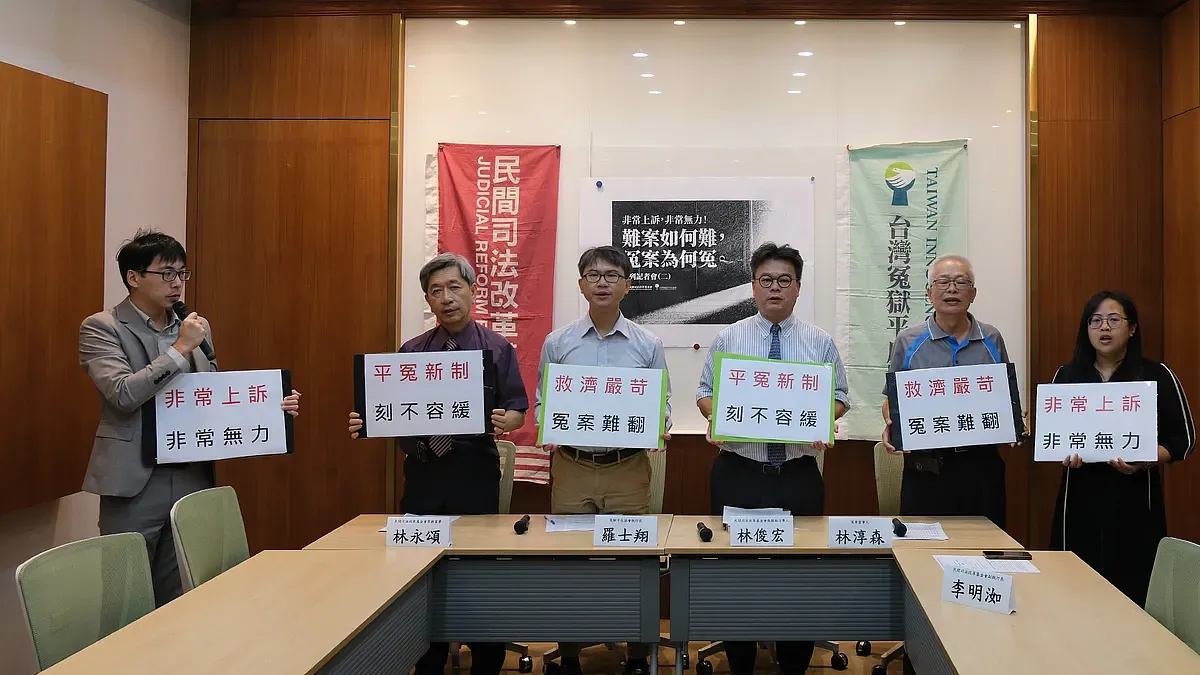
Press Conference | Extraordinary Appeal, Extraordinary Impotence! "How Difficult Are Difficult Cases, Why Are Wrongful Convictions Wrongful" Series of Press Conferences (Part 2)
Last edited: 2026-11-03
Ineffective relief for wrongful convictions has long been a difficult challenge that our judiciary urgently needs to overcome. To explore how to improve our extraordinary relief system, the JRF hereby holds the second press conference of the "How Difficult Are Difficult Cases, Why Are Wrongful Convictions Wrongful" series, proposing the following 3 assertions regarding the institutional flaws of the "extraordinary appeal":
1. The current extraordinary appeal system requires dual institutional reviews, making relief difficult
2. The government should review the practical issue of "criminal retrials" and "extraordinary appeals" passing the buck to each other
3. Implementing the resolutions of the 2017 National Judicial Reform Conference, our country should establish an independently exercising "Wrongful Convictions Relief Committee" and a "Post-Conviction Review Court for Criminal Cases"
1. The current extraordinary appeal system requires dual institutional reviews, making relief difficult
According to Article 441 of the Code of Criminal Procedure, in our country, only the Prosecutor-General may file an "extraordinary appeal" with the Supreme Court. Therefore, in practice, if a defendant wishes to seek relief via an extraordinary appeal, they must first pass through the Supreme Prosecutor's Office before reaching the Supreme Court.
This system, which requires requesting the prosecutorial agency to seek relief on one's behalf, has been criticized by scholars who note: "This traditional mindset seems to be founded on the idea of the patriarchal official, viewing the Prosecutor-General as a benevolent and virtuous ruler and the people as objects at the mercy of the litigation proceedings, possessing no master control or right of participation whatsoever, with all benefits awaiting the grace of the prosecutorial agency with which they once contended."
In addition, even if the prosecutorial agency determines that there are indeed circumstances of a "judgment violating the laws" and files an extraordinary appeal, it does not necessarily mean the case will be vindicated. This is because, institutionally, the final determination of whether the extraordinary appeal has grounds must still be left to the Supreme Court.
Looking at recent data, among cases where individuals apply for an extraordinary appeal, those in which the Prosecutor-General files an extraordinary appeal account for less than 10%. Furthermore, even when the prosecutorial agency determines that the original case indeed involves a "judgment violating the laws" and files an extraordinary appeal, approximately 20% of subsequent cases are dismissed by the Supreme Court as groundless. (Source: Judicial Statistics - Prosecutorial Statistics [Receipts, Disposals, and Judgment Results of Extraordinary Appeal Cases in the Supreme Prosecutor's Office] Table)

Taking the Lo Ming-ts'un case as an example, despite numerous circumstances in the trial such as a lack of direct physical evidence, Lo Ming-ts'un having a clear alibi, and severe flaws in the lie detector report, the court still concluded that Lo Ming-ts'un had accepted a bribe of 500,000 NTD from organized crime. To vindicate the wrongful conviction, Lo Ming-ts'un continually requested the Prosecutor-General to file an extraordinary appeal on his behalf over many years. It was not until September 2018, after Lo Ming-ts'un's 50th request for the Prosecutor-General to file an extraordinary appeal, that the Prosecutor-General finally filed an extraordinary appeal for the case in December of that same year. Nevertheless, in the end, the Supreme Court still dismissed the extraordinary appeal.
Taking the Lai Ting-fu case as another example, while serving as the Director of the Eighth River Management Bureau of the Water Resources Agency in Taitung, Lai Ting-fu was falsely accused of accepting a 100,000 NTD bribe from an aggregate industry operator and was sentenced to 7 years in prison in 2010. The Control Yuan released an investigative report in 2011 to vindicate Lai Ting-fu, and the Prosecutor-General filed extraordinary appeals for Lai Ting-fu twice around 2012 and 2013, but both were dismissed by the Supreme Court.
In the Lin Ch'un-sen case, even though the Prosecutor-General considered that the case had issues violating the rules of evidence, the presumption of innocence, and the rules of experience and logic, and therefore had filed an extraordinary appeal, it was also dismissed by the Supreme Court. In addition, the Control Yuan also deemed the judgment in this case to have major flaws, successively issuing investigative opinions and review opinions twice, pointing out numerous improprieties by the court in investigating and using evidence.
In this regard, we can see from the above cases that even if a case passes the "narrow escape" test of the Supreme Prosecutor's Office, the court may not necessarily buy it.
2. There is a problem of "passing the buck" between "criminal retrials" and "extraordinary appeals" in practice in our country
In our country's civil litigation and administrative litigation systems, relief for final judgments does not distinguish between different procedures based on whether they target "errors of law" or "errors of fact." In contrast, the Code of Criminal Procedure of our country divides extraordinary relief procedures into two tracks: "retrials" and "extraordinary appeals," stipulating that if the original judgment contains an "error of fact," a retrial should be applied for, and if it contains an "error of law," an extraordinary appeal should be filed.
However, it is sometimes not easy to distinguish whether a case dispute actually belongs to a "factual error" or a "legal error." For the parties involved in a case, the most disadvantageous situation is likely that various agencies all determine that the problem of the case does not fall within the scope of their own jurisdiction and push the case back and forth to each other. Scholars even refer to this situation where agencies instruct each other to seek relief from other agencies as "ghost instructions" that lead from dual relief to no relief at all.
This situation was particularly evident in the Lo Ming-ts'un case. When Lo Ming-ts'un made his first 40-plus requests for the Prosecutor-General to file an extraordinary appeal, they were all rejected by official letters on the grounds that the Prosecutor-General believed Lo Ming-ts'un should apply for a retrial with the court rather than an extraordinary appeal. On the other hand, the court repeatedly dismissed applications and appeals for retrials on the grounds that the prosecutor's error in missing the appeal deadline should legally be addressed by requesting the Prosecutor-General to file an extraordinary appeal. In response to this, Control Member Wang Mei-yu of the Control Yuan's Judiciary and Prison Administration Committee even referred to the Lo Ming-ts'un case as a "judicial ping-pong ball between retrials and extraordinary appeals."
In summary, whether the dual-track extraordinary relief pathways in the criminal extraordinary relief system can obtain effective relief in judicial practice sometimes depends on whether there are differences in opinions within the judicial system regarding the identification of the case's problems. These divergences in opinion often affect the possibility for the parties to vindicate themselves against wrongful grievances.
3. Implement the resolutions of the 2017 National Judicial Reform Conference and establish independently exercising "Wrongful Convictions Relief Committees" and "Post-Conviction Review Courts for Criminal Cases"
As reviewed in the previous press conference on "criminal retrials" and this press conference on the "extraordinary appeal" system, we may discover that: apart from existing systemic issues, another factor behind the ineffectiveness of our country's relief for wrongful convictions is that under our country's inherent judicial culture, courts do not easily recognize errors in their trials.
To solve the above problems, this Association asserts that Resolution No. 5-4 of the resolutions of the 2017 National Judicial Reform Conference should be implemented. That resolution states: "A post-conviction relief system that does not wrong anyone is an unabandonable vocational duty of judicial justice. To reduce wrongful convictions and protect human rights, the function of the judiciary in post-conviction relief for the innocent should be strengthened, and the post-conviction relief system for criminal cases should be improved: 4. To increase channels for wrongful conviction relief and give innocent individuals who have been misjudged the opportunity to obtain a reopened trial, it is recommended that the government research and establish an independently exercising 'criminal final case review mechanism' (such as the independent mechanisms of the UK and Norway, namely the Criminal Cases Review Commission system), dedicated to the investigation of final guilty cases and applying for or promoting the opening of retrials for the innocent."
Regarding this legislative amendment direction, the Judicial Yuan's response has consistently been: "Regarding retrial parts, the relevant provisions of the Code of Criminal Procedure have already been amended multiple times, and there should be no need to additionally establish a review institution for final criminal cases." The problem is that the last major amendment to the retrial system was in 2015, while the resolution of the National Judicial Reform Conference was made in 2017. Furthermore, the 2019 amendment to retrials merely completed the litigation procedures that ought to have been in place and cannot be considered a major reform.
This resolution has not been implemented to date, and the Judicial Yuan has taken a passive attitude toward it. To facilitate the realization of this system, this Association has researched four laws—the Control Act, the Organic Act of the Committees of the Control Yuan, the Court Organization Act, and the Code of Criminal Procedure—to formulate a citizen's version of the "Four Laws for Wrongful Conviction Redress." It plans to add a "Wrongful Convictions Relief Committee" under the Control Yuan to serve as an agency dedicated to wrongful conviction investigation and assistance, and to establish a "Post-Conviction Review Court for Criminal Cases" under the Judicial Yuan dedicated to trying cases according to the aforementioned relief procedures, thereby implementing a review mechanism for final criminal cases.
The problem of wrongful convictions has always existed. As a civil society organization, we will respond by publishing the citizens' version of the draft. However, we want to ask: as the primary responsible agency, is the Judicial Yuan willing to do a little more?
Attendees
Lin Yung-sung, Attorney at Law | Standing Director, Judicial Reform Foundation
Lo Shih-hsiang, Attorney at Law | CEO, Taiwan Association for Innocence
Lin Chun-hung, Attorney at Law | Convener of the Rescue Division, Judicial Reform Foundation; Pro Bono Rescue Lawyer for the Lo Ming-ts'un Case
Li Ming-ju, Attorney at Law | Deputy CEO, Judicial Reform Foundation
Mr. Lin Ch'un-sen | Wrongful Conviction Victim
Press Contact
Lü Cheng-yen, Attorney at Law, Director of Legal Policy Department, Judicial Reform Foundation
Telephone: 02-2523-1178#37
Email: elvin@jrf.org.tw
This article is an AI-generated translation of the original Chinese text. In the event of any discrepancy, the Chinese version shall prevail.