
JRF Newsletter
November E-Newsletter | ★ Breaking Constitutional Traps, Protecting the Constitution ☆
Last edited: 2026-07-27
"We must fairly state that the reforms to the constitutional litigation system undertaken during President Hsu Tzung-ly's tenure—while not every resolution had our approval—have indeed advanced the rights of many people in Taiwanese society to a certain degree through constitutional litigation. Facing this progress, we are now confronted with amendments to the constitutional litigation. The outcome of these amendments will obviously cause the constitutional litigation system to become paralyzed, or die, or at least undergo euthanasia."
—Huang Hsu-t'ien / Chairperson, Judicial Reform Foundation
The KMT's push for the draft amendments to the Constitutional Court Procedure Act has triggered waves of opposition across society, with the legal community, academia, and multiple civil society groups successively voicing condemnation. The draft attempts to conflate the "current total number" with the "statutory total number," simplifies existing operational issues of the Grand Justices into an issue of threshold settings, and even misleads the public into believing that the fundamental reason for the slow pace of Constitutional Court rulings is the excessively low adjudication threshold, while ignoring the practical reality of personnel appointments remaining unreviewed for a prolonged period.
"Weng Hsiao-ling labeled the lawyers who stood up on 11/16 as sidekicks of the Democratic Progressive Party, crudely listing everyone out, putting them in boxes, and connecting dots without any basis; yet while they are destroying the Constitution and disrupting the legal order, the legal community has ample evidence, and she herself even admitted that a long-term paralysis of the Constitutional Court is also a good thing."
—Lin Chun-hung / Chairperson, Taiwan Criminal Defense Lawyers Association
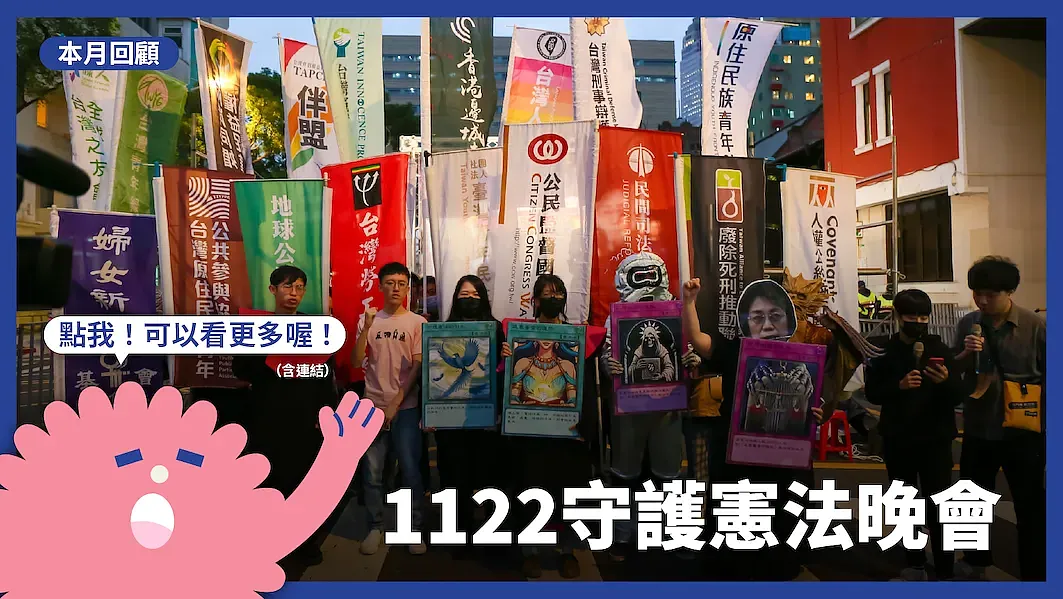
On November 16, the legal community launched the "Protecting the Constitution March" to strongly condemn the opposition party's malicious amendments to the Constitutional Court Procedure Act. However, the Kuomintang (KMT) attempted to smear criticisms of the amendments as "wingman behavior." In fact, the legal community and civil society organizations had long ago presented rigorous legal analyses warning of the disastrous impact these amendments would pose to Taiwan's human rights protections and constitutional order. In response, the JRF and numerous civil society organizations issued a stern warning to the KMT, calling on citizens to take to the streets on November 22 to participate in the "Protecting the Constitution Rally" and demanding that the KMT immediately withdraw the draft amendments to the Constitutional Court Procedure Act proposed by Legislator Weng Hsiao-ling, and refrain from treating the Constitutional Court as an object of political struggle.
"Constitutional litigation procedures concern every person whose rights have been infringed, and whether they have higher avenues to strive for their rights and defend their right to survival in this country. This involves not only Indigenous peoples, but more broadly touches upon the issue of equal survival for more minority groups in Taiwan."
—Savungaz Valincinan / Chairperson, Association of Taiwan Indigenous Peoples' Youth Public Participation
Constitutional litigation has always been an important channel for diverse groups such as laborers, Indigenous peoples, and gender minorities to defend their rights and interests. If the adjudication threshold is raised after the amendments, litigation cases from these groups may be turned away for "failing to meet the threshold," further worsening social inequality. We believe that if the amendments pass, they will severely impact the operation of the Constitutional Court and the people's right to constitutional remedies, potentially causing judicial reform to regress significantly and pushing the Constitutional Court into a crisis of paralysis, thereby destroying the foundation of Taiwan's democracy and rule of law.
"Whenever the values of a free and democratic constitutional order are lost, one becomes a stumbling block to democracy. As long as the great constitutional values are lost, democracy will degenerate into mobocracy, and the Chunghsien Building will turn into a mob building."
—Wu Hao-jen / Professor, Department of Law, Fu Jen Catholic University
➤ Further Reading:
- Statement | Multiple Provisions of the Legislative Expansion of Power Act Unconstitutional; The Legislative Yuan Should Promptly Review the Grand Justices' Personnel Consent Appointments in Accordance with the Intent of Constitutional Judgments
- The Constitutional Court Shall Not Be Abandoned or Destroyed; The KMT Must Not Act Arbitrarily! Civil Groups Call for the "1122 Protecting the Constitution Rally"
- The Judicial Yuan is Leaderless; Who Can Take Responsibility for Stalled Reforms? Calling on the Ruling and Opposition Parties to Promptly Schedule the Review of Grand Justices' Personnel Consent Appointments
- The Constitutional Court Must Not Be Allowed to Stall and Stand Still! The Opposition Party Must Not Paralyze the Constitutional Court and Take the Public's Right to Litigation Hostage
 |
 |
 |
 |
▲ Photography / SKY

Recently, KMT Legislator Weng Hsiao-ling proposed draft amendments to the Constitutional Court Procedure Act, sparking fierce debate from all sides. We want to tell you that while this matter may seem distant from ordinary people, it is actually extremely serious.
➤ Video Highlights:
- What is the connection between the Constitutional Court Procedure Act and this May's Bluebird Movement?
- Other countries (the United States, Canada, Germany, and Japan) all have minimum attendance requirements for Grand Justices; why not support the opposition party's draft amendments?
- Is the cessation of the Constitutional Court's operations more serious than imagined? What does it have to do with the people?
➤ Further Reading:
- Op-Ed | Controversies Surrounding Amendments to the Constitutional Court Procedure Act? Will Grand Justices Never Be Able to Hold Hearings Again?
- Op-Ed | Amendments to the Constitutional Court Procedure Act Should Reference the Legal Systems of Various Countries to Prevent the Constitutional Court from Being Paralyzed
- Lazy Bag | An Opportunity for Systemic Improvement? Or a Crisis of Destroying the Constitution and Disrupting the Rule of Law? What is the Controversy Over Constitutional Litigation Amendments?

Text: Li Hsiang-chun / Department of Humanities and Social Sciences, National Tsing Hua University, JRF Intern
Auntie Lai, a retired high school teacher, had a dispute with a contractor because of waterproofing construction issues at her home. To protect her rights and interests, she filed a small claims lawsuit with the court. She thought that since the amount involved was small, a small claims lawsuit would suffice—it would protect her rights while making the other party understand the importance of business integrity.
However, reality was far more complex than she imagined. When she received the official court document, it stated: "Submit a written document to the court within the time limit to confirm the specific amount of each claim and request, and confirm whether all claims comply with the small claims litigation procedure; furthermore, if this is a partial claim, please submit a document to the court reporting that the remaining balance will not be pursued through a separate lawsuit, otherwise it will violate regulations."
To Auntie Lai, this legal terminology was practically like reading heavenly books. She read it over and over again, yet still did not understand what she was supposed to do. She had no choice but to seek help once again from the court's litigation guidance section, but the answer she received still left her completely baffled. As the lawsuit progressed, Auntie Lai continuously received various notices from the court. She did not understand why a simple lawsuit had become so complicated. She only wanted to get back the money that belonged to her; why did she have to face so many legal obstacles?
What left her most astounded was that, even though she completely followed the suggestions of the litigation guidance section and the court's instructions, the court ultimately dismissed her claims on the grounds that: "The added claims do not comply with the originally filed small claims lawsuit, and therefore a new lawsuit should be filed separately."
Auntie Lai could not understand why legal regulations had to be so complicated, making it utterly impossible for an ordinary citizen to adapt.
Official Documents That Even a High School Chinese Teacher Cannot Understand
"Even I, as a Chinese teacher, cannot understand the contents of the official documents, let alone ordinary citizens, or even elderly or lower-middle-class groups?"
To legal professionals, those professional terms may just be daily habits, but to ordinary citizens, especially the elderly, these literary-style legal terms are no different from reading heavenly scripts.
I once visited the court's litigation guidance section and found that many citizens face the same predicament. They queue up waiting for consultations, yet often feel confused because they do not understand legal terminology. Even with volunteers assisting, due to limited manpower, the consultation time available to each person is restricted.
The existence of law is to protect everyone's rights and interests, but if the language of the law is so obscure, how can the law truly serve the people?
Small Claims Lawsuits Turning Into Big Troubles? Judicial Procedures Make the Public So Helpless!
Auntie Lai originally thought small claims lawsuits were very simple, but she never expected to run back and forth between the court and the litigation guidance section for half a year. The dispute she originally thought could be resolved quickly ended with her being told she had to refile the lawsuit.
Studies show that public satisfaction with the courts in Taiwan is not high, especially among those who have personally participated in litigation. Why is this? Perhaps we can find the answer in Auntie Lai's experience.
When facing legal problems, many citizens often feel helpless. They do not know how to write a statement of claim, nor do they know how to respond to court notices. Even when litigation guidance sections provide assistance, the help is often minimal.
Small claims litigation should have been designed to allow citizens to resolve disputes more quickly and conveniently, but in reality, it makes many people feel even more troubled. This indicates that there is perhaps still ample room for improvement in our judicial procedures.
The JRF's Judicial Reform ER project is currently collecting the judicial experiences of the public. If you have also encountered difficulties in judicial procedures, you are welcome to share your story with us. Your voice will become the driving force for us to promote judicial reform.
Editor's Note: After accepting Auntie Lai's petition, the JRF wrote a letter to the Taipei District Court in September 2024, hoping the Taipei District Court would take note of the public's confusion and inconvenience. In October of the same year, the Taipei District Court replied that it would review related official document templates to make official document wording easier to understand, instruct the litigation guidance section to pay attention to the restrictions on procedural conversions, and—although the judge's discretionary power to inquire with parties ex officio regarding consent to procedural conversion belongs to judicial independence—awareness raising would also be conducted.
This article is an AI-generated translation of the original Chinese text. In the event of any discrepancy, the Chinese version shall prevail.
