
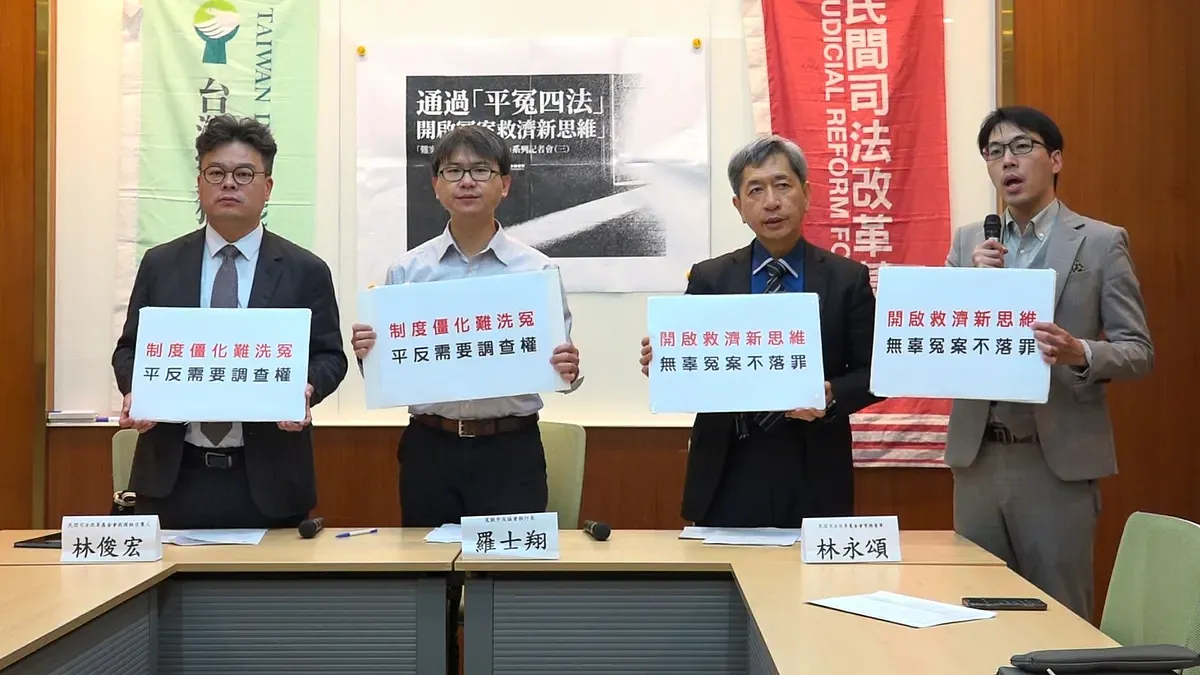
Press Conference|Passing the "Four Acts for Wrongful Convictions" to Open New Perspectives in Wrongful Conviction Relief: "How Hard Are Hard Cases, Why Are Wrongful Convictions Wrong?" Series Press Conference (Part 3)
Last edited: 2026-11-03
Ineffective relief for wrongful convictions has long been a difficult challenge that Taiwan's judiciary urgently needs to overcome. To explore how to improve our country's extraordinary relief system, the JRF held the third press conference in the series "How Hard Are Hard Cases, Why Are Wrongful Convictions Wrong?" As the final installment of this series, we addressed the systemic difficulties of the "Review Board for Cases with Finalized Convictions," presented the following viewpoints and arguments, and published the draft "Four Acts for Wrongful Convictions" drafted by our foundation:
1. Ineffective performance of the "Review Board for Cases with Finalized Convictions"
2. Reforming the wrongful conviction exoneration system and swiftly implementing the resolutions of the National Judicial Reform Conference
3. Emulating foreign systems by establishing a "Wrongful Conviction Relief Commission"
4. The nongovernmental version of the draft "Four Acts for Wrongful Convictions"
1. Ineffective performance of the "Review Board for Cases with Finalized Convictions"
In 2017, the Ministry of Justice formulated the "Directions for the Review Operation of Cases with Finalized Convictions by Prosecutors' Offices" and established the "Review Board for Cases with Finalized Convictions" (hereinafter referred to as the Review Board). It was hoped that this would provide a channel for parties to wrongful convictions to seek exoneration from prosecutors' offices after their petitions for retrial or extraordinary appeal are dismissed. The first article of the review directions explicitly states that its purpose is to "discover the truth and prevent unjust convictions."
However, the Review Board operating under these directions has very limited effectiveness in practical operation. In terms of organizational authority, because the directions lack a legal basis, prosecutors on the Review Board, aside from routine investigations (requesting case files) and reviewing files, do not and can hardly conduct other investigations (carrying out mandatory investigations would lack a legal basis). Furthermore, in practice, members of the Review Board operating under these directions only receive attendance fees without additional administrative support, yet they are burdened with reviewing a massive volume of files and evidence, creating an extra and heavy burden. As a result, members mainly rely on reports and oral explanations, and may not even review the files themselves. Under such an operation, the review of wrongful convictions must heavily rely on the opinions of the handling prosecutor and litigation agents. Moreover, because there are no statutory time limits imposed on the investigation and relief procedures, the initiation of investigations and relief is random, and procedures are often dragged out for too long.
The limitations of the Review Board can be observed from the following two individual cases dismissed by the Board:
- The Hsiao Ming-yüeh case: Under circumstances where all key physical evidence was unrelated to Hsiao Ming-yüeh and there was a severe mistaken identification during the police interrogation stage, the case concluded that Hsiao Ming-yüeh was the "boss" of a drug-trafficking syndicate based solely on the statements of other defendants. Afterwards, three other defendants in this case even recanted, admitting that they had accused Hsiao Ming-yüeh at the time due to sentence reductions or other reasons; yet, the Review Board still refused to grant relief for this case.
- The Kuo Yao-ch'i case: Under circumstances where there was only the testimony of the briber and no physical evidence of bribe-receiving was found, the court determined that Kuo Yao-ch'i had "conditional criminal intent" and "conspiracy to bribe" at the time of receiving US dollars. After the judgment of this case became final, even though the Control Yuan launched an investigation and petitioned the Review Board, and the Review Board also petitioned for a retrial, the court still dismissed it.
As can be seen from the above, given the limited powers and functions of the Review Board itself, its effectiveness in assisting with wrongful convictions is limited, and it is difficult for it to provide further help.
2. Reforming the wrongful conviction exoneration system and swiftly implementing the resolutions of the National Judicial Reform Conference
Following the systemic issues of "criminal retrials" and "extraordinary appeals" discussed in the first two press conferences, and combining this discussion on the "Review Board system," it is evident that our country's current extraordinary criminal relief system as a whole lacks an effective mechanism for exonerating defendants of wrongful convictions.
The JRF believes that to improve our country's wrongful conviction relief system, we should promptly implement the content of Resolution 5-4 of the 2017 National Judicial Reform Conference: "Establish a 'Criminal Finalized Case Review Mechanism' that independently exercises its powers (such as the independent mechanisms in the UK and Norway, namely the Criminal Cases Review Commission system), dedicated to investigating cases with finalized convictions and applying for or promoting the opening of retrials for the innocent."
Currently, the Review Board of the Taiwan High Prosecutors Office does not possess substantive investigative powers over cases, resulting in inconspicuous effectiveness. In addition, some scholars believe that peer pressure within the judicial system is like an unseen elephant in the room, restricting the wrongful conviction rescue mechanism within the prosecutorial system; therefore, wrongful conviction rescue cannot rely solely on the prosecutorial system.
3. Emulating foreign systems by establishing a "Wrongful Conviction Relief Commission"
Before 1997, the only avenue for exoneration after a criminal case became final in the UK was to petition the Home Secretary for administrative intervention. Under the central government's criminal policy department, a "Criminal Cases Unit" (also known as the "C3 Division") was established to review applications and ask the Home Secretary to refer cases with "exoneration value" to the Court of Appeal. The Home Secretary received about 700 to 800 applications per year, but the number of cases referred to the Court of Appeal was very few.
In 1997, the UK established the Criminal Cases Review Commission (CCRC), an independent "non-departmental public body" that, after filtering and investigation, refers cases to the Court of Appeal when there is a reasonable doubt about the solidity of a conviction. Over twenty years, the CCRC has received 22,141 cases, referred 636 cases to the Court of Appeal (accounting for 3%), and the Court of Appeal has accepted 629 cases and granted 421 requests, exonerating hundreds of defendants, with most people released from prison. Compared to the Home Department's "C3 Division," it has indeed effectively fulfilled the effect of exonerating wrongful convictions.
In recent years, Norway and North Carolina in the United States have also established similar criminal finalized case review mechanisms (Norway's NCCRC and the US's NCIIC) as specialized agencies to investigate and bring forth wrongful convictions. North Carolina even uses specially convened panel courts to retry such cases.
4. The nongovernmental version of the draft "Four Acts for Wrongful Convictions"
Drawing inspiration from the aforementioned systems, the JRF has drafted amendments to our country's Control Yuan Organization Act, Organic Act of the Committees of the Control Yuan, Court Organization Act, and Code of Criminal Procedure (collectively referred to as the "Four Acts for Wrongful Convictions"), hoping to serve as a modest spur to induce contributions of valuable ideas and promote the implementation of the system.
First, regarding the establishment of the investigative institution, since the Control Yuan has historically possessed the authority and experience to investigate incidents, and its concern and contributions to human rights issues are obvious to all. For example, the death penalty wrongful convictions that have been exonerated in our country—from Chiang Kuo-ch'ing, the Su Chien-ho case, the Hsü Tzu-ch'iang case, the Cheng Hsing-tse case to the Hsieh Chih-hung case—all first had investigation reports submitted by the Control Yuan before subsequently obtaining judicial relief. Among them, in the Chiang Kuo-ch'ing case, the Control Yuan conducted 176 interviews, 67 consultations, and 10 expert consultations before finally submitting an investigation report, which further facilitated Chiang Kuo-ch'ing's posthumous exoneration. Therefore, the JRF has drafted amendments in the bill to amend Article 2 of the Organic Act of the Committees of the Control Yuan by adding a "Wrongful Conviction Relief Commission," and correspondingly amending the Control Yuan Act to list more diverse investigation methods (such as commissioning appraisals, notifying persons to appear and make statements) to ensure effective investigation into wrongful convictions.
Regarding litigation procedures, because our country's judicial trial culture does not easily change established findings of fact, the JRF's draft proposes amending the Court Organization Act and the Code of Criminal Procedure to establish a "Trial Division for Review of Post-Finalization Criminal Cases" under the Judicial Yuan, dedicated to reviewing cases deemed necessary for relief by the Control Yuan, and conducted through trial procedures involving citizen judges.
Attachment: Full Text of the Draft "Four Acts for Wrongful Convictions"
Time
March 5, 2024 (Wednesday) 10:00
Location
Room 101, Legislative Yuan Research Building (Chung-Hsing Building), No. 3-1, Sec. 1, Chinan Rd., Zhongzheng Dist., Taipei City
Attendees
Attorneys Lin Yung-sung | Executive Director, Judicial Reform Foundation
Attorney Lo Shih-hsiang | CEO, Taiwan Association for Innocence
Attorney Lin Chun-hung | Convener of the Rescue Division, Judicial Reform Foundation
Press Contact
Attorney Lu Cheng-yen, Director of the Legal Policy Department, Judicial Reform Foundation
Phone: 02-2523-1178#37
Email: elvin@jrf.org.tw
This article is an AI-generated translation of the original Chinese text. In the event of any discrepancy, the Chinese version shall prevail.