
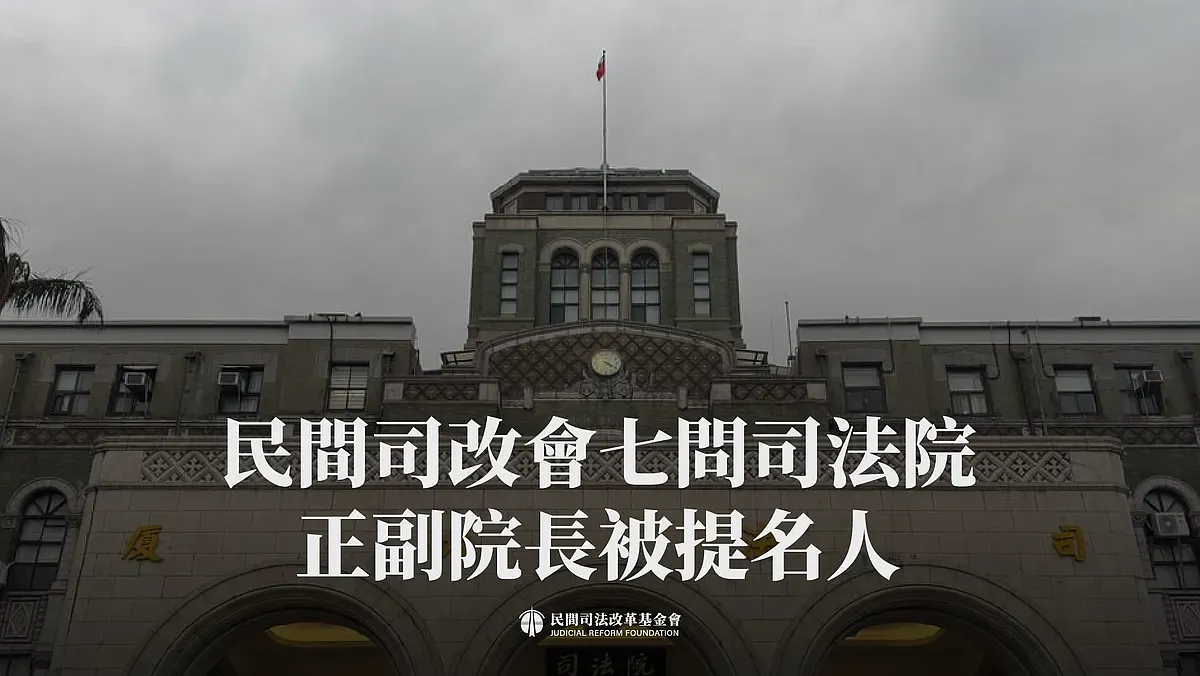
Statement | JRF Poses Seven Questions to the Nominees for President and Vice President of the Judicial Yuan
Last edited: 2026-07-27
Regarding yesterday's announcement by the Grand Justices Nomination Review Committee of the Office of the President regarding the nominees for the President, Vice President, and Grand Justices of the Judicial Yuan—whereby prosecutor Ts'ai Ch'iu-ming was nominated as President of the Judicial Yuan and judge Su Su-o as Vice President—our organization issues the following statement:
I. The Public Urgently Needs Judicial Leaders with a Strong Will to Advance Judicial Reform
From late October of last year until now, the positions of President and Vice President of the Judicial Yuan have remained vacant, with Grand Justice Hsieh Ming-yang temporarily acting as President. Meanwhile, as the Legislative Yuan amended the Constitutional Court Procedure Act, the Constitutional Court remains paralyzed. The absence of formal judicial leadership has brought the advancement and reform of judicial policies to a standstill, and the public's rights will ultimately bear the brunt of the harm.
In addition to once again calling upon the Legislative Yuan to conduct rigorous reviews of nominees' "moral integrity," "constitutional and human rights ideals," and "academic and professional competence" to determine their suitability as Grand Justices, we must also emphasize that the responsibilities of the President of the Judicial Yuan include not only presiding over the Constitutional Court and rendering judgments pursuant to the Constitutional Court Procedure Act, but also overseeing the administration of the court and supervising subordinate judicial organs. The Vice President handles matters entrusted by the President and acts on the President's behalf when the President is unable to perform their duties or when the office is vacant.
To uphold judicial independence and the public's right to a fair trial, the President must shoulder the heavy responsibility of judicial reform and actively promote related judicial policies. Among the current issues that are urgent and in need of reform, there are at least four major areas (for details, please refer to our November 8, 2024 press release): "alleviating the judicial burden," "combating fraud and technological investigation," "judicial personnel appointments and review powers," and "reform of the Citizen Judges Act," which still await continued deliberation, planning, and promotion by the Judicial Yuan. An acting leader can hardly be held accountable for the success or failure of reforms; what the public urgently needs is a formal judicial leader with a strong will to advance judicial reform.
We expect that the nomination and review processes for the consent of Grand Justice appointments should refer to the recommendations put forward by the "Alliance for Civilian Oversight of Judicial Yuan Grand Justice Nominees" and be conducted substantively and prudently. At the same time, all party caucuses should allow legislators a free vote and thoroughly examine the nominees' moral integrity, constitutional and human rights ideals, and academic and professional expertise. They must not repeat past mistakes and allow the public's constitutional rights to be continually hijacked by party politics (for details, please refer to our December 25, 2024 press release).
II. We Respectfully Request the Nominees for President and Vice President of the Judicial Yuan to Express Their Views on Judicial Reform for Public Scrutiny and Evaluation
Grand Justices, hailed as the "guardians of the Constitution," must engage in continuous communication with society to avoid the perils of working behind closed doors and to lead judicial progress. To examine the nominees' constitutional and human rights ideals, academic knowledge, and professionalism, and to urge them to engage in dialogue with the general public, the "Alliance for Civilian Oversight of Judicial Yuan Grand Justice Nominees" will likewise use open questioning methods to inquire nominees about major constitutional issues regarding the exercise of Grand Justices' powers, serving as a reference for the review (for details, please refer to the October 9, 2024 press release).
The attitude towards judicial policy of the nominees for President and Vice President of the Judicial Yuan announced yesterday needs to be fully scrutinized by the outside world. In particular, Judicial Yuan President nominee Ts'ai Ch'iu-ming originates from the prosecutorial system. In Taiwan, the organizational culture of the prosecutorial system and its expression of human rights ideals are evidently not entirely identical to those of the judicial system. His views on judicial reform issues are of paramount concern to all sectors of society.
We respectfully request the nominees for President and Vice President of the Judicial Yuan to promptly express their views on major judicial reform issues (including but not limited to the following):
- Among recent government public satisfaction surveys, the item with the highest dissatisfaction is "judicial reform." In your view, what are the causes of the public's low level of trust in the judiciary, and what specific measures do you propose for improvement?
- It has historically been difficult for different organs and groups in the legal sector to reach a consensus on specific controversial issues. How do you plan to promote dialogue and exchange among various organs and groups (such as citizens, judges, civil society organizations, and the Ministry of Justice)?
- Do you consider the current resources invested by the government in judicial trials to be sufficient? What are your opinions and specific practices regarding the planning or augmentation of the judicial budget?
- When the Judicial Yuan currently proposes reforms in the form of bills, it publishes drafts and legislative explanations, but fails to simultaneously release detailed policy impact assessments, making it difficult for all sectors of society to evaluate their impact. For instance, when the Judicial Yuan passed the draft concerning the "pyramidal litigation system" in 2021, it did not simultaneously detail how many people's rights might be affected by the restriction of the right of appeal, nor how relevant supporting measures would mitigate the impact. In your view, how should the Judicial Yuan communicate judicial policy reforms with the public? Will you simultaneously submit "policy and human rights impact assessments" when proposing major legislative amendment drafts in the future?
- Regarding the current issue of overwork within the judicial system, what do you consider to be the crux of the problem? Under the premise of maintaining the protection of people's rights, what measures do you think should be adopted to reasonably alleviate the judicial burden? What specific solutions do you have for rationalizing case burdens while simultaneously implementing the goals of continuing education and training for judges? Furthermore, our December 23, 2024 press release affirmed the former nominee's proposal to improve judges' overwork through a "Judicial Reform Effectiveness Evaluation and Promotion Committee," which incorporated advocates for "policy and human rights impact assessments," "specialized committees," and "collaboration with frontline courts and grassroots judges." Do you commit to inheriting and implementing such policies?
- What are your views on the implementation of the "Citizen Judges System" thus far? What are your thoughts on continuing to promote reforms to the criminal procedure system (such as the system of non-transfer of dossiers and evidence)?
- What are your views on the "reform of the military trial system"?
This article is an AI-generated translation of the original Chinese text. In the event of any discrepancy, the Chinese version shall prevail.