
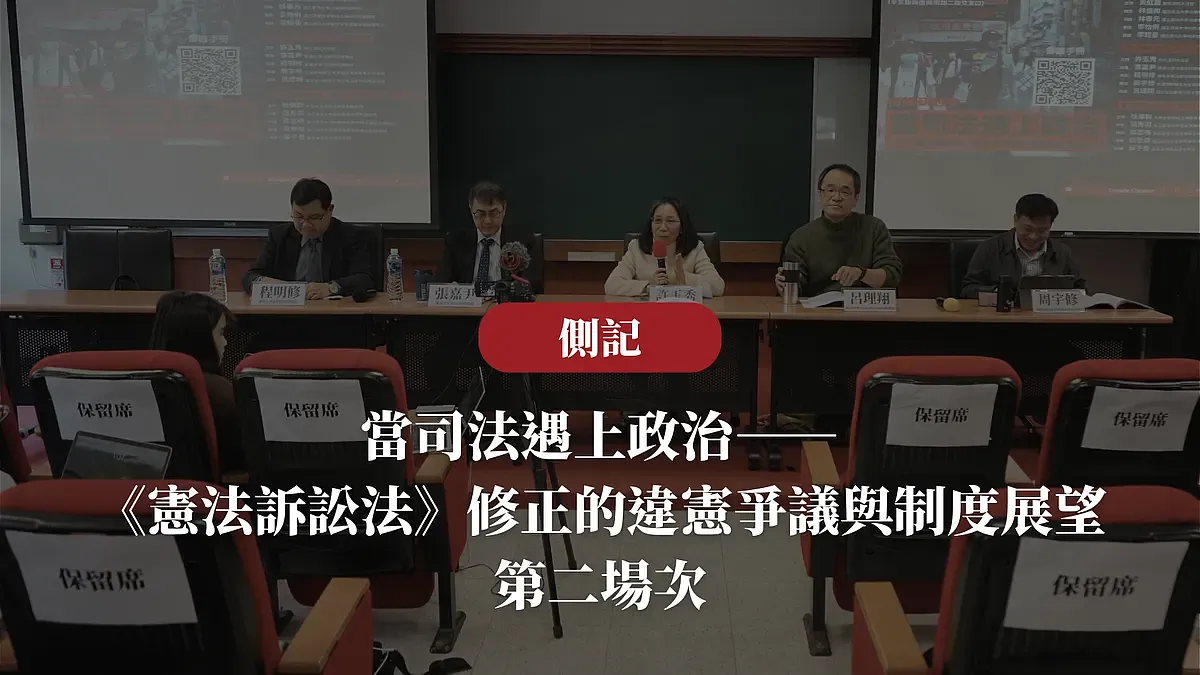
Seminar Sidelights|When the Judiciary Meets Politics—Session 2: Unconstitutionality Controversies Regarding the Amendments to the Constitutional Court Procedure Act
Last edited: 2026-08-22
Session 2: Unconstitutionality Controversies Regarding the Amendments to the Constitutional Court Procedure Act
The theme of the second session of this seminar was "Unconstitutionality Controversies Regarding the Amendments to the Constitutional Court Procedure Act." It was moderated by former Grand Justice Hsu Yu-hsiu, with Distinguished Professor Chang Chia-yin of Soochow University School of Law serving as the speaker on the topic "The Problem of Unconstitutionality in the Newly Amended Constitutional Court Procedure Act—From the Perspective of the Legislature's Freedom of Formation and the Autonomy of Judicial Procedures." The discussants were Distinguished Professor Cheng Ming-hsu of Soochow University School of Law, Attorney Clarence Chou, Chairperson of the Constitutional Reform Committee of the Taiwan Bar Association, and Associate Professor Lu Li-hsiang of the Graduate Institute of Education and Law at National Taipei University of Education.
▌Chang Chia-yin: The Recent Amendments to the Constitutional Court Procedure Act Paralyze the Constitutional Court
First, Professor Chang Chia-yin opened with the statement, "To destroy a country's constitutional democracy, first destroy its Constitutional Court." He pointed out that before discussing the current legislative amendments, one must first consider what problems would arise if the Constitutional Court were unable to function, and whether the public could accept this. Recent events in the legislature have constituted what legal professionals commonly call "surprise judgments," leaving people greatly astonished. The problems encountered in the current amendments have departed from the context of ordinary hermeneutic circles (i.e., the cycle between law and facts), making it difficult to reach direct conclusions using this methodology. Therefore, before discussing the amendments, in addition to the legislative facts themselves, one must also pay attention to the "background" of these facts—namely, the historical development of Taiwan.
The current amendments can be approached from three angles: the necessity of the amendments, the reasonableness of the amendments, and the constitutionality of the amendments. Regarding necessity, the original 2019 version of the Constitutional Court Procedure Act was the result of 26 years of deliberation and study of Taiwan's historical context, whereas the current amendments were hastily proposed just last September, making their necessity difficult to discern. Regarding reasonableness, the focus of the Constitutional Court Procedure Act is to establish a normally functioning Constitutional Court, yet the current amendments require that the number of participants in deliberations be no less than 10, and the number of votes for unconstitutionality be no less than 9. Furthermore, the Legislative Yuan's ongoing failure to pass Grand Justice appointment nominations has made it impossible for the number of Grand Justices to exceed the deliberation threshold, meaning the current amendments can hardly be called reasonable. As for the constitutionality of the amendments, if whether the Constitutional Court can function normally ultimately depends on contingent facts (i.e., the goodwill of the Legislative Yuan), from the perspective of the separation of powers, the current amendments are blatantly unconstitutional. Although the legislature possesses a freedom of formation, the current amendments clearly exceed the constitutional boundaries of the legislature's freedom of formation.
▌Cherng Ming-shiou: Allowing the Exercise of the Constitutional Court's Powers to Stall Clearly Contradicts Its Core Purpose
Professor Cherng Ming-shiou pointed out that the current amendments differ from any legal problems encountered previously, and their constitutionality requires more sophisticated discussion. Looking at the history of amendments to our country's Constitutional Court Procedure Act, one of the primary focal points back then was to relax voting thresholds to facilitate the operation of the system, whereas the current amendments introduce mandatory numerical thresholds that run counter to this intent.
The current amendments result in the Constitutional Court being unable to function due to insufficient personnel, causing the public to endlessly wait for judgments they rightfully deserve and leading to a repeat of past predicaments. Former Grand Justice Weng Yueh-sheng once pointed out in meeting minutes that the Grand Justice system prior to 1993 required a three-quarters majority consent; to avoid stalling certain cases, some Grand Justices were forced to leave the room to lower the voting threshold. Former Grand Justice Su Yung-chin also expressed the same view in a collection of essays. From these senior experiences, it can be seen that in the past, all sectors made every effort to maintain the normal operation of the constitutional system, but the current amendments do not follow this path. Judicial Yuan Interpretation No. 613 is similar to the current amendments; back then, the Legislative Yuan also manipulated the composition of NCC commissioners and voting thresholds to achieve a result where legislators with distinct political inclinations dominated the NCC. There are also historical precedents where the Constitutional Court took matters into its own hands to fill legal loopholes. Whether the existing predicament can be broken through and similar problems prevented in the future via judicial rules or preventive declarations of unconstitutionality is worthy of thought and discussion.
▌Clarence Chou: The Current Amendments Completely Ignore Potentially Severe Consequences
Attorney Clarence Chou pointed out that before the Constitutional Court Procedure Act was passed, the previous Constitutional Interpretation Procedure Act and its enforcement rules only required a majority vote of attending Justices to declare an ordinance unconstitutional. If the current amendments intend to "demonstrate" that public opinion should be respected, yet fail to carefully address the unconstitutionality thresholds for various subjects while instead uniformly imposing extremely high attendance and voting thresholds, this is clearly contradictory. Moreover, the legislative process of the current amendments was extremely hasty. They cannot be declared constitutional simply by removing provisions concerning passing thresholds. Considering the current amendments' disregard for history, internal contradictions in reasoning, and crude and hasty process, they should logically be declared unconstitutional in their entirety.
From a practical perspective, the current amendments create an incentive to avoid discussion, implying that the Constitutional Court should adopt the principle of dismissal without review. By raising the threshold for declaring unconstitutionality and the corresponding costs involved, they drastically weaken the powers of the Constitutional Court. Judicial Yuan Interpretation No. 632 has already clarified that institutional designs which result in the complete paralysis of practical operations cannot be tolerated, especially when the key to practical operation relies upon the preferences of the legislature, which makes it even more unreasonable. Although looking merely at the statutory text of the current amendments might lead to many conclusions that seemingly appear constitutional, judging whether the amendments are constitutional cannot be detached from the factual context and the various calculations of the legislators; rather, a comprehensive discussion must integrate various backgrounds.
▌Lu Li-hsiang: Hoping the Legislature Can Promptly Exercise Its Powers to Return Constitutional Operations to Normal
Associate Professor Lu Li-hsiang pointed out that the purpose of the current amendments is very clear: to drastically raise the threshold for declaring unconstitutionality in order to prevent laws enacted by the legislature from being easily declared unconstitutional. In addition to ignoring many issues that the Constitutional Court Procedure Act ought to address but leaves pending—such as the effect of regular invalidation on administrative agencies—the amendments also contain many crude and contradictory aspects. For example, regarding recusals exceeding 7 Justices, do they include the 7 Justices themselves? Furthermore, if recusals actually leave only 7 Justices, can deliberations still commence, and can unconstitutionality be declared with just a majority of 4? This directly contradicts the high threshold the current amendments seek to achieve.
Judging from the composition of Grand Justices who have previously declared laws unconstitutional, virtually all Grand Justices concurred in declaring unconstitutionality (at least 9), which coincidentally meets the high threshold of the current amendments. Therefore, whether Article 30 of the current amendments directly constitutes unconstitutionality may be open to debate. As the latest wave of Grand Justice nominees has recently been proposed, it is hoped that the legislature can promptly exercise its powers to return constitutional operations to normal.
General Discussion
An audience member asked: Since the current amendments cause severe harm to people's rights, do they violate the constitutional principle of proportionality? Should the substance of the power to interpret the constitution be directly stipulated in the Constitution rather than handled through ordinary legislation? Can the current amendments be described as a situation where the statutory provisions themselves are not unconstitutional, but merely unconstitutional in their application?
Professor Chang Chia-yin stated that traditionally, the principle of proportionality only applies to the review of fundamental rights, but there is no reason why it cannot apply to cases involving the separation of powers, which could further refine the intensity of argumentation. As for how the power of constitutional review should be viewed, it may be impossible to start solely from the literal text. Taiwan's constitutional review has evolved over half a century, and interpreting laws must inevitably reference judicial precedents. Entrenching the power of constitutional review in the text of the Constitution to gain institutional protection is certainly an option worth considering. If the Constitutional Court is paralyzed, the first and foremost right affected is the people's right to constitutional litigation, which in turn indirectly affects other fundamental rights of the people. The current amendments use the legislature's power of consent to shackle the Constitutional Court, severely impacting the institutional guarantee of the Constitutional Court's survival. Germany uses explicit text stating that if the court cannot function normally after members retire, the judges must continue to perform their duties to resolve the issue. The precedent of the Polish court being destroyed by a "super majority" established by the legislature further proves that the current amendments are indeed problematic.
Professor Cherng Ming-shiou stated that applying the principle of proportionality to cases of the separation of powers may require further discussion, but viewed from the context of debates on the constitutionality of the Referendum Act, perhaps the principle of proportionality can be invoked through the perspective of a severe imbalance in checks and balances to strengthen the basis of argumentation. In terms of the current amendments, the legislature places chains on the Grand Justices by raising voting thresholds, thereby unbalancing the relationship of the separation of powers. If this concomitantly affects the people's fundamental rights, the principle of proportionality may also have room to play a role. As for whether the current amendments merely constitute unconstitutional application of the law, if the operation of a system, coupled with unfolding real-world events, leads to unconstitutional results, it logically cannot be concluded that this institutional design is constitutional.
Associate Professor Lu Li-hsiang pointed out that regarding doubts over the application of the principle of proportionality, one must return to the connection between the Constitutional Court Procedure Act and the people's right of litigation. Constitutional litigation is not inherently a necessary means for the people's right of litigation; thus, using the principle of proportionality as one of the grounds for the unconstitutionality of the current amendments may be difficult. As for resolving related issues through constitutional amendments, it is practically difficult to implement and likely too slow to meet urgent needs.
Former Grand Justice Hsu Yu-hsiu pointed out that the core issue of the current amendments is the voting threshold: whether the Constitution permits the legislature to arbitrarily design voting systems is a topic worthy of discussion. Interpretation No. 632 has explicitly stated that a mechanism preventing the interruption of constitutional organs is an important constitutional principle that must be strictly followed. Regarding whether the current amendments are unconstitutional, if the focal point appealed to is the impartiality of judgments and the diversity of composition, the key to judgment should be whether the principles of due process were met. Regarding the current amendments, the legislature has effectively established rules of the game where, if the Grand Justices comply, they are bound to lose. Now that legislative procedures are public and transparent, legislative facts are also easily reviewable subjects for the Grand Justices. Viewed from this perspective, the current amendments indeed raise unconstitutional concerns because the separation of powers has been severely impacted, resulting in a severe inequality of arms. Furthermore, from the perspective of the democratic principle—namely, that the minority submits to the majority while the majority respects the minority—the vast majority of voting thresholds can be resolved by a simple majority; otherwise, it easily devolves into a situation where a minority shackles the majority or a majority bullies the minority. If the operation of a system leads to unconstitutional results, it means reviewers can certainly find flaws in the institutional design and address them.
- Seminar Sidelights|When the Judiciary Meets Politics—Session 1: Constitutional Review Procedures with the Constitutional Court Procedure Act as the Subject of Review
- Seminar Sidelights|When the Judiciary Meets Politics—Session 3: The Tug-of-War Between Parliamentary Democracy and the Constitutional Court
This article is an AI-generated translation of the original Chinese text. In the event of any discrepancy, the Chinese version shall prevail.