
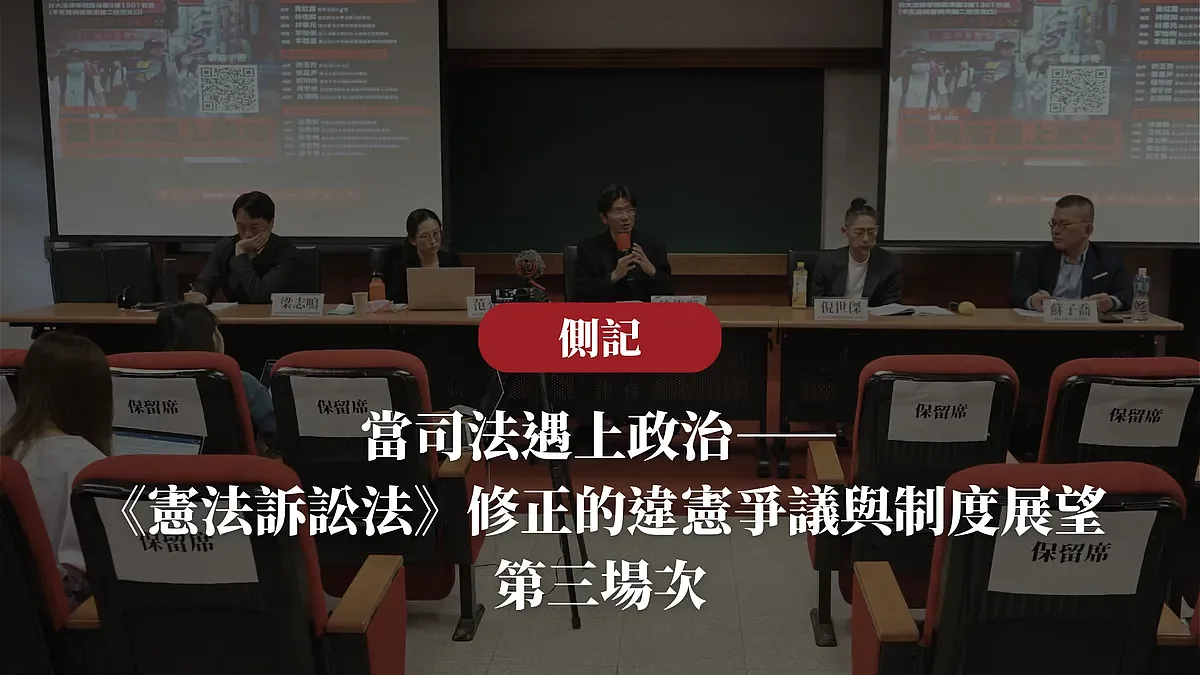
Seminar Sidelights|When the Judiciary Meets Politics—Panel 3: Congressional Democracy and the Tug-of-War with the Constitutional Court
Last edited: 2026-08-22
Panel 3: Congressional Democracy and the Tug-of-War with the Constitutional Court
This is the third panel of the seminar, themed "When the Judiciary Meets Politics—Congressional Democracy and the Tug-of-War with the Constitutional Court." It was moderated by Hsu Wei-chun, Associate Professor at the Department of Financial and Economic Law, College of Law, Chung Yuan Christian University. Presentations were given by Fan Hsiu-yu, Associate Professor at the Graduate Institute of National Development, National Taiwan University, and George Nee, Assistant Professor at the College of International Affairs, National Chengchi University. The discussants were Liang Chih-ming, Professor at the Graduate Institute of Health and Biotechnology Law, Taipei Medical University, and Su Tzu-chiao, Professor at the Department of Political Science, Soochow University. They explored the tug-of-war between the Constitution and Congress represented by the recent amendments to the Constitutional Court Procedure Act, approaching the topic from the perspectives of constitutional law and political science respectively.
▌Fan Hsiu-yu: Those Who Believe Paralyzing the Constitutional Court Means Punishing a Specific Political Party Have Party Factions in Mind, Not the Constitution
Associate Professor Fan Hsiu-yu presented under the title "Congress Says: 'The Constitutional Court's Ruling is Disappointing, I Will Substitute for the Moon to Punish You!'—On the Controversy Surrounding the Recent Amendments to the Constitutional Court Procedure Act." Using a confident yet unjustifiable line from an animated work as a point of comparison, she highlighted how the recent amendments appeared to have a legitimate pretext but were in fact incomprehensible.
The presentation drew comparisons with the United States, which is also a binary democracy, noting that the U.S. Constitution adopts a strict separation of powers and checks and balances. Because congressional legislation requires passage by both chambers, the President possesses a veto power, and overriding a veto requires a two-thirds supermajority vote in both congressional chambers, it ensures that congressional legislation is necessarily the result of "agreement by both the President and Congress" or "agreement by an enhanced congressional majority." The text of the U.S. Constitution does not explicitly provide for judicial constitutional review, but the system of judicial review was established through the 1803 case of *Marbury v. Madison*, which reviewed whether the "judicial review rules enacted by Congress" were unconstitutional; today, it adopts a decentralized system of constitutional review. Justices hold lifetime appointments, and their terms frequently span across political parties. In contrast, Taiwan requires only a relative majority in the Legislative Yuan to pass laws, yet the Constitution explicitly provides for judicial constitutional review and adopts a centralized constitutional review system. This elevates the importance of the Constitutional Court, but because Grand Justices serve fixed terms and half of them may step down simultaneously, it provides political branches with more opportunities for intervention, creating a distinct institutional difference.
Looking at the background facts, the motivation behind the current amendments is very clear: to counter rulings of the Constitutional Court, including launching aggressive rhetoric regarding attitudes and outcomes toward questions posed to Grand Justices during litigation. Furthermore, the legislative reasoning ultimately passed consisted only of a single sentence: "Passed in accordance with the proposal of the Taiwan People's Party caucus." The reasoning from other versions and speculations regarding various historical provisions in previous panels cannot actually package this naked political intent. As a result of the amendments, the law explicitly stipulates that all future legislation passed by the Legislative Yuan will enjoy a high presumption of constitutionality. Under the "fundamental principle that 1+1 can be greater than 1," when there is a definitive fundamental change in the composition or authority of any power component, there should be a consensus of at least two organs to suffice. However, while the recent amendments result in future passed legislation enjoying a statutory high presumption of constitutionality, they require only the consent of a relative majority of the Legislative Yuan. Combined with the background facts involving political retaliation against the Constitutional Court's rulings on the death penalty or parliamentary reform bills, this may turn a mere issue of threshold reasonableness into an unconstitutional direction.
▌Liang Chih-ming: Party Struggles and Vicious Infighting Become the Norm, Making the Flexible Application of Judicial Strategies Even More Important
Professor Liang Chih-ming cut through the historical experience of the long-standing entanglements between American judiciary and politics to discuss the contemporary trend where judicial power increasingly becomes the target of political maneuvering or is even directly attacked. For instance, the Republican Party's technical boycott in 2016 of the Grand Justice nominee nominated by President Barack Obama, who still had a year left in his term, or news events where President Donald Trump attacked judges who overturned his deportation measures and called for impeachments, are all examples of this trend.
Next, Professor Liang Chih-ming discussed the social phenomenon of "political polarization" as the social background for the aforementioned contemporary trend of judicial power under attack. So-called "political polarization" includes "partisan polarization," where political parties increasingly obstruct parliamentary proceedings to a greater degree, and "affective polarization," where voters increasingly harbor negative attitudes toward those with different stances from their own. These phenomena make vicious party obstruction a rational strategy, because preventing opponents from accomplishing anything carries no risk and instead secures support from one's own people. Such a social background continuously erodes judicial neutrality, leading to an increased chance of the judiciary being attacked.
The controversy facing Taiwan over the amendments to the Constitutional Court Procedure Act is, to a certain extent, also the product of a similar social background. When responding to attacks from political branches, the judiciary also needs to understand this social background and consider what strategies can provide the most effective response. In the process of strategic consideration, the judiciary must also consider what the court's primary responsibilities are. If the court wishes to fulfill its function of defending "democracy," does "democracy" equal a congressional majority? If not, how should the content of so-called "democracy" be defined? If the court's primary responsibility is to defend the rule of law, how should it respond to the age-old problem of judicial review—namely, the counter-majoritarian difficulty of judicial review? If the court adopts a more active understanding of its own role, believing that its responsibilities further encompass the maintenance of institutional legitimacy and ensuring the long-term stability of the community, how specifically should such goals be achieved? All of these issues are topics that should continue to be explored moving forward.
▌George Nee: When Dictators Come to Power, They Always Target the Effectiveness and Independence of Judicial Institutions First
Assistant Professor George Nee presented a paper titled "A Moment of Self-Coup for Taiwan's Constitutional Government? Destroying the Judiciary is the First Step for a Dictator to Seize Power," comparing democratic backsliding countries such as Poland, Hungary, and Slovakia, all of which experienced attacks on or attempts to control judicial power during their processes. Under contemporary democratic constitutional theory, the rights of the people limit the power of the state, and judicial organs are the organs that protect rights. Therefore, when political branches expand their power, weakening judicial power becomes a crucial step.
Specifically, the concept of a self-coup in academic doctrine generally refers to a president shutting down the courts and the legislature, suspending the constitution, and ruling by decree until a referendum and new legislative elections are held to approve expanded executive power—that is, when a country's ruler coercively interferes with or shuts down another branch of government in order to maintain, consolidate, or expand power. However, the incident involving the amendments to Taiwan's Constitutional Court Procedure Act was not the ruling party expanding its own power, but rather was initiated by the opposition party in Congress. Nevertheless, the effect of destroying the separation of powers and checks and balances is the same, and one cannot help but suspect whether such a plan is merely the polarization of party checks and balances, or whether larger-scale geopolitical maneuvering has infiltrated it.
Subsequently, the presenter pointed out that the people of Taiwan have long distrusted the judiciary. In particular, the broad generations who went through the democratic transition process trust people who clashed on the streets more than judges as elites who once maintained an authoritarian government. This may have provided an environment for political branches to control the judicial branch; however, an independent judiciary should still be maintained as much as possible after a democratic transition. To this end, this paper compared empirical research from 15 countries and found that the lower the degree of political branch intervention in the selection of judges, the higher the judicial independence. Therefore, the amendment recommendations proposed in this paper include enhancing the transparency and institutional effectiveness of recommended lists, centering on the maintenance of judicial independence, compressing the discretionary space of the executive and legislative branches regarding candidates, and establishing mechanisms to prevent institutional dysfunction, so as to prevent the judiciary from coming under political control.
▌Su Tzu-chiao: Refine Assessment Indicators for Judicial Independence and Establish Sound Separation of Powers
Professor Su Tzu-chiao offered several suggestions to Assistant Professor George Nee's paper to further refine the research findings. First, while the theory of the separation of powers hopes for the idea of various organs mutually influencing and checking one another, how to balance the problem of political interference in the selection of judicial personnel affecting judicial independence during such interaction and checks-and-balances processes is indeed a difficult challenge.
Second, looking at Freedom House reports, Hungary is classified as a "partly free country," Poland's score of 82 is even higher than the United States' 81, Slovakia stands at 89, and Taiwan at 94. Thus, it can be seen that democratic backsliding caused by influencing judicial power manifests differently across countries, and the issues actually faced also differ. Therefore, when drawing lessons, one can more specifically observe under what form of government, which branch interferes with the judiciary through what means, as this represents the situation that most needs prevention.
Finally, while the definition of a "self-coup" points to power expansion by executive rulers, in Taiwan it is the opposition majority party in the Legislative Yuan that is expanding its power. Moreover, the legislature typically has a diverse composition. How this could constitute a dictatorship, and how cross-national indicators of judicial independence are set, should also involve increasing comparison subjects and refining indicators in empirical research methodology. These are all areas where this research can be further refined and its contribution increased on the basis of this seminar.
- Seminar Sidelights|When the Judiciary Meets Politics—Panel 1: Constitutional Review Procedure Targeting the Constitutional Court Procedure Act
- Seminar Sidelights|When the Judiciary Meets Politics—Panel 2: Unconstitutional Controversies of the Amended Provisions of the Constitutional Court Procedure Act
This article is an AI-generated translation of the original Chinese text. In the event of any discrepancy, the Chinese version shall prevail.