
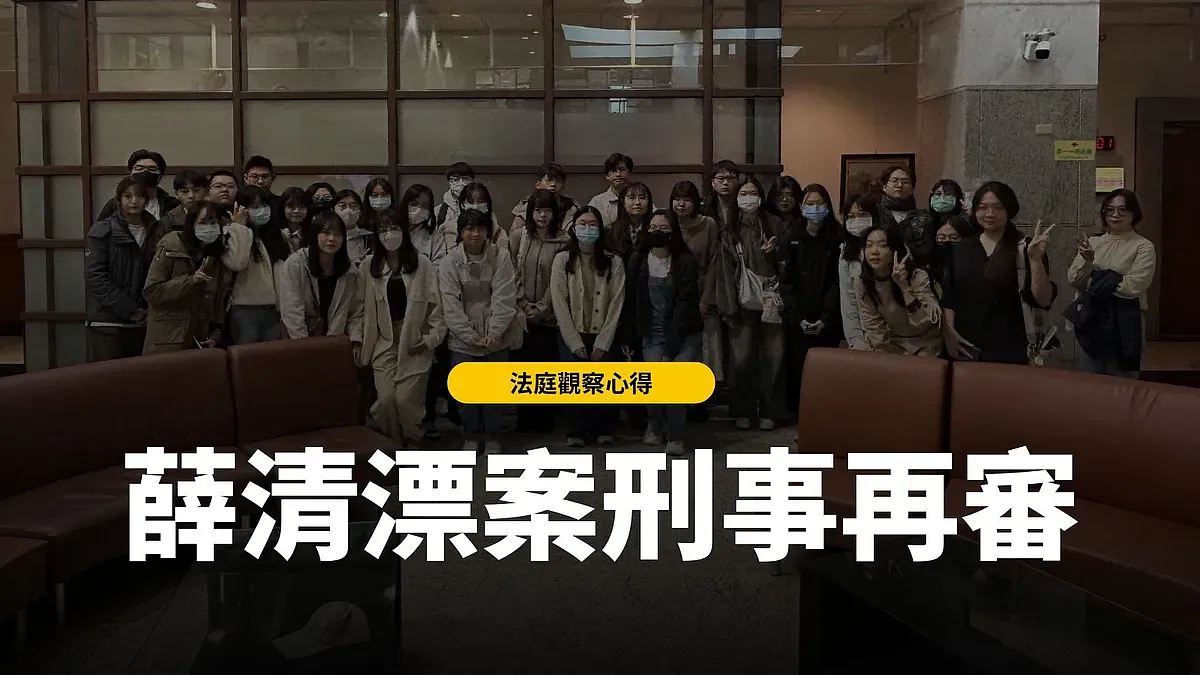
Court Observation Notes | The Criminal Retrial of the Hsueh Ching-piao Case
Last edited: 2026-08-22
113-Tsa-2
- Judge: Ho Chi-jung
- Applicant: Prosecutor, Taiwan Chiayi District Prosecutors Office
- Party (Defendant): Hsueh Ching-piao
Background of the Case
Hsueh Ching-piao was previously sentenced to 16 years of imprisonment for violating the Narcotics Hazard Prevention Act. Pursuant to Articles 5(1)(1), 28, and 37 of the Act of Military Service System, Hsueh lost his status as a reservist. However, while evading apprehension, he received a reservist training summons. Because he failed to report on time, he was subsequently convicted by a final judgment for obstructing military service.
Arguments of the Defense
The defendant denies violating the relevant provisions of the Act of Military Service System, based on the following three grounds:
- The relevant confessions should lack admissibility: The defendant had made a confession, but the relevant audio and video recordings were not successfully retrieved. The records of self-incriminating statements made without legal counsel at the time should lack admissibility as evidence.
- The defendant no longer held reservist status: The Ministry of National Defense had issued a final determination that the defendant lost his reservist status, hence there was no obstruction of military service. Furthermore, this should be considered an internal administrative procedure issue, and the resulting disadvantages should not be imposed on the defendant.
- The defendant lacked the subjective elements and intent to obstruct military service: At the initial stage of the investigation, the defendant was unaware of and stated that he had not received the summons, which proves the absence of subjective intent to obstruct military service.
Evidence Presented and Inquiries by the Judge
-
Regarding whether coercion or duress was used in the prosecutor's questioning
In response to questions about the prosecutor's questioning, the defendant stated that although the prosecutor's tone was relatively fierce and he felt startled, no coercion or duress was involved.
-
Regarding the admissibility of audio and video recordings
Defense counsel argued that in the absence of complete audio and video recordings, the evidence should be inadmissible; even if deemed admissible, it likely cannot be established that the defendant had subjective intent to obstruct military service.
Oral Arguments by the Parties
- The prosecutor acknowledged that the defendant indeed had disqualifying military service status. Although the defendant received the summons on July 2, 2009, he no longer held reservist status at that time and did not commit obstruction of military service; therefore, judgment should be rendered in accordance with the law.
- Defense counsel argued that the defendant no longer held reservist status at the time, did not commit obstruction of military service, and should be acquitted; even in the event of a guilty verdict, leniency should be applied.
- The defendant stated his hope for an acquittal, as he believed he should have received the military service exemption order but never did. He also expressed the desire for a final judgment to be rendered promptly, as it would impact his parole eligibility.
Judge's Inquiry into the Defendant's Education, Work Experience, Family Background, and Child Support
The inquiries into relevant background information were conducted for sentencing considerations. The defendant's statements are as follows:
| Education & Work Experience | Senior high school (vocational) (incomplete) |
| Marital Status | Previously married, currently divorced |
| Minor Children | One daughter studying in Mainland China |
| Past Occupation | Worked as a taxi driver, with a daily income of approximately NTD 1,000 to 2,000 |
| Other | Has been imprisoned for 14 years; his father is also serving a prison sentence, and family members rarely visit |
Observation Insights
This was my first time participating in a court observation activity. Prior to this, my understanding and impression of the activity were limited to it being an opportunity to observe courtroom operations at close range. However, through actual participation, I gained a much deeper understanding: listening to the arguments of all parties helped the judge, prosecutor, and everyone present achieve a more comprehensive comprehension of the case to facilitate the subsequent judgment. Moreover, observing the progression of courtroom procedures gave me a clearer understanding of how a judge directs the entire court proceeding during a hearing.
The session I participated in involved a case of obstructing military service. While last semester's activity focused on preparatory proceedings, this one was a retrial. The core of this case is that the defendant had previously been sentenced to 16 years of imprisonment; under this premise, he should have lost his reservist status and thus not have been involved in obstructing military service. However, due to internal administrative issues, a draft notice was still dispatched to Mr. Hsueh Ching-piao. The primary dispute in this hearing was to verify whether Mr. Hsueh had lost his reservist status—if he had lost it, there was no obstruction of military service; if he had not, he had.
In fact, after completing the court observation, I gained a clearer understanding of the entire case, and I was very pleased to recently receive the judgment acquitting Mr. Hsueh Ching-piao. I believe that law is a tool for uncovering the truth, and using it to deliver the results people rightfully deserve is of utmost importance.
I am very glad to have had the opportunity to participate in this court observation activity. It allowed me a better understanding of the role allocation and trial sequence of various positions in the courtroom—aspects that are difficult to encounter in regular classes but are quite critical in legal practice. This activity brought the knowledge we usually learn from textbooks right before our eyes, allowing us to gain a deeper understanding through first-hand experience. I hope to have more opportunities to participate in the future.
This article is an AI-generated translation of the original Chinese text. In the event of any discrepancy, the Chinese version shall prevail.