
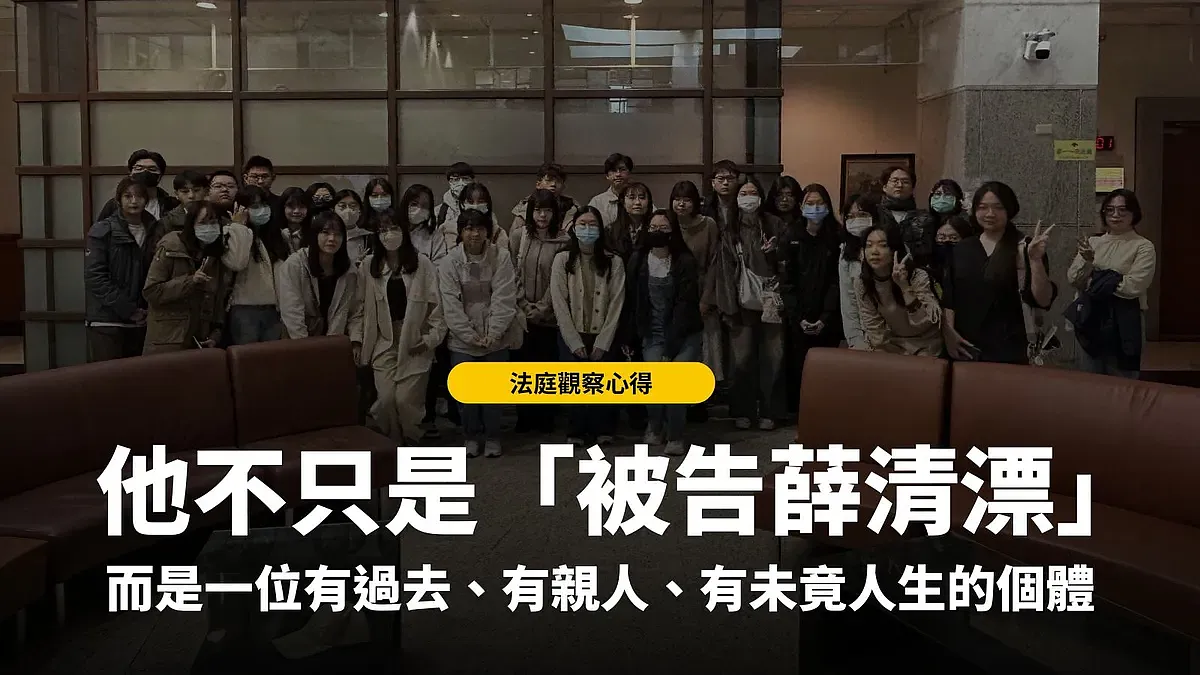
Court Observation Insights: He is not just "Defendant Hsueh Ching-piao," but an individual with a past, family, and an unfulfilled life
Last edited: 2026-08-22
Year 2024-Sheng-Chien-Tsai-Tzu No. 2 Criminal Ruling
- Party (Defendant): Hsueh Ching-piao
- Judge: Ho Chi-jung (Same judge as the preparation proceedings court)
Defense Counsel's Arguments
The defendant in this case, Hsueh Ching-piao, was convicted and sentenced for violations of Article 10, Paragraph 3, Paragraph 1, Subparagraph 3, and Article 6, Paragraph 1 of the Punishment Act for Violation to Military Service System. The following are the oral arguments presented by defense counsel:
-
Inadmissibility of Confession:
The defendant made a confession during the investigation proceedings; however, the audio and video recordings of those investigation proceedings were not retrieved, making the true circumstances of the defendant's interrogation unclear. Furthermore, the defendant made self-incriminating statements during the investigation without appointing defense counsel. Therefore, it is argued that the confession lacks evidentiary capability.
-
The Defendant No Longer Holds the Status of a Reservist:
According to the official letter from the Ministry of National Defense and the medical certificate from the Reserve Command, since the defendant no longer holds the status of a reservist, there is no issue of violating the Punishment Act for Violation to Military Service System.
Moreover, the prosecutor's intent is mistaken; the Ministry of National Defense stated that the defendant did not hold reservist status at the time of the judgment, otherwise it would not have accused the defendant of obstructing military service "retroactively." The aforementioned issue should be an internal administrative procedure problem, and the disadvantages arising from such administrative procedures should not be imposed upon the defendant. -
Lack of Subjective Elements:
The defendant did not receive the education-call notice when sentenced and was unaware of being summoned. Therefore, the defendant subjectively lacked the intent, purpose, and will to obstruct military service.
Judge's Presentation of Evidence and Inquiry into Confession Circumstances
According to the Chia-yi Reserve Command, the Min-hsiung Precinct's fugitive inquiry statement, the list of un-reported personnel, and judgments from previous courts, defendant Hsueh Ching-piao was indeed education-called at the time but failed to report. Neither the defendant nor the prosecutor raised any objections to this part of the evidence. Furthermore, the initial preparation proceedings court was tried by the same judge, who had already expressed opinions and was aware of the prior evidence at that time. Therefore, there was no need to elaborate excessively on the dispute and presentation of evidence.
Regarding the defense counsel's initial concern that the confession lacked evidentiary capability, the judge inquired whether the defendant's confession during the investigation stage was obtained through improper interrogation methods such as violence, threats, or inducement. The statements made by the defendant and defense counsel are as follows:
- The defendant stated that when interrogated by the prosecutor's investigator, the other party's attitude was relatively harsh, causing the defendant to be startled and nervous; however, the other party did not use violence, threats, or inducements to force the defendant to make self-incriminating statements or statements contrary to their own will.
- Defense counsel argued that because the audio and video recordings of the investigation proceedings could no longer be retrieved, the veracity of the contents recorded in the confession protocol could not be verified, nor could it be confirmed whether the confession was made voluntarily; thus, it is argued that the confession lacks evidentiary capability. Even if it possesses evidentiary capability, it cannot prove that the defendant had the subjective intent and purpose to obstruct military service.
Judge's Inquiry into the Defendant's Background
To determine the defendant's sentencing, an investigation into the defendant's family background, education, and experience was necessary. If the defendant had minor children or relatives at home requiring support, imposing an excessively harsh punishment would be inappropriate. The defendant stated that he had completed some vocational high school education (did not graduate), had been previously married but is now divorced, has a minor daughter studying in mainland China, and worked as a taxi driver prior to imprisonment with a daily income ranging roughly between NT$1,000 and NT$2,000. He has currently served 14 years in prison. His mother is 65 years old and retired, his father is also serving a prison sentence, and he has siblings, though family members rarely visit.
Oral Argument Proceedings
Prosecutor's Statement:
"It was discovered in this case that the defendant holds a service-disqualification status. Following the Prosecutor-General's extraordinary appeal, it can be known from the Chia-yi Reserve Command's civilian document loss certificate that the defendant was aware of his service-disqualification status, and has not held reservist status since July 2, 2009." Because previous judgments held that the defendant had the fact of obstructing military service and was thus guilty, the Prosecutor-General considered the previous judgments to be unreasonable to the defendant, believing that the original judgment was problematic and might involve a miscarriage of justice. This case should result in an acquittal or a mitigated sentence. Therefore, an extraordinary appeal was filed in hopes that the facts could be retried. The extraordinary appeal also represents the stance of the prosecution agency regarding this case, which the prosecutor hereby presents.
Defense Counsel's Statement:
Since the defendant no longer holds the status of a reservist, he does not constitute the offense of obstructing military service. Therefore, we earnestly request this Honorable Court to render a judgment of acquittal. Defendant Hsueh Ching-piao expressed his hope that the court would grant an acquittal, noting, "I have never seen anyone subjected to an education-call because of a drug offense; other co-offenders of drug crimes all received service-disqualification orders, but only I did not receive one. If I must be found guilty, I earnestly request a lenient sentence, and I hope the court can render a judgment as soon as possible so as not to affect my parole application." The desire for a speedy judgment stems from the fact that the defendant is a Class 1 inmate (inmate classifications range from Class 4 as the lowest to Class 1 as the highest). Because of his good behavior, the defendant is eligible to apply for parole; however, lengthy court hearings and trial procedures will affect the points the defendant accumulates during treatment, potentially hindering his future ability to apply for parole.
Court Observation Insights
Compared to the initial preparation proceedings court, today's hearing was shorter and discussed fewer disputed points. Because the offense of obstructing Punishment Act for Violation to Military Service System charged against defendant Hsueh Ching-piao carries a lighter sentence, a single-judge bench was adopted. Furthermore, since the defense argued for acquittal, summary proceedings or simplified judgment procedures could not be used. In addition, this case has been dragged out for a long time; further prolonging the trial might prejudice the defendant, and the court also hopes to conclude the case. Therefore, this should be the final hearing for the Hsueh Ching-piao case. Because both the initial preparation proceedings court and the current hearing were tried by the same judge, and the judge inquired about the defendant's confession in both instances, I believe that the interpretation of the confession may be the key to this case. This court observation has given me a deeper understanding of the operation and procedures of court trials, making it an excellent learning experience. At the same time, my state of mind and understanding of the law have shifted because of it.
Throughout the auditing process, I harbored a contradictory and complex sentiment. On one hand, I understood that this was a concrete legal case involving legal norms, procedural justice, and evidentiary disputes; on the other hand, I was acutely aware that sitting at the defendant's stand was a real human being whose life and choices were now being scrutinized and judged by the law. This sense of presence—stepping out of paper statutes and into the real world—made me feel during every attorney statement and judge inquiry that the law is no longer an abstract system, but a scene where human nature and institutional operations intersect.
When I heard defense counsel argue regarding "whether the confession possesses evidentiary capability," my heart was actually tense. That tension was not an adversarial emotion, but a concern and care for "due process." Counsel's insistence on confirming whether the confession was made of free will was not merely a technical effort to secure a favorable ruling for the client, but a defense of the basic safeguards a person should enjoy when facing state power. When the defendant stated that although he was startled and nervous, he was not subjected to coercion or inducement, I felt even more of the ambiguity and complexity of this "middle ground": sometimes, a gap exists between a person's feelings and the requirements set by the system, yet these gaps may determine the direction of a case.
What left the deepest impression on me was when the defendant spoke about his family background. At that moment, the entire courtroom fell silent as he calmly recounted his experiences—dropping out of vocational high school, getting divorced, having a minor daughter, having a father who is also serving time in prison, and an elderly mother living on a pension. There were no agitated emotions in these words, but it was precisely this calmness that made them all the more heavy. I suddenly realized that while this was merely a court observation for us, for him, it was a judgment that would affect his future.
He is not just "Defendant Hsueh Ching-piao," but an individual with a past, family, and an unfulfilled life. When he mentioned hoping for a speedy judgment to avoid affecting his parole application, I felt a rational and realistic consideration amidst the struggle, and came to realize that even within the legal sanction system, a person still strives to fight for the possibility of changing their destiny.
This court observation not only taught me about the trial and operational procedures of criminal litigation, but also deepened my understanding of the empathy and professional sensitivity that legal professionals should possess. Law is not merely a benchmark for measuring right and wrong, but an extremely delicate interaction between people, and between institutions and individuals. I hope there will be more opportunities to participate in observations in the future, allowing me to get closer to the warmth and weight behind the law while studying it.
This article is an AI-generated translation of the original Chinese text. In the event of any discrepancy, the Chinese version shall prevail.