
JRF Newsletter
April E-Paper | Thirty Years Ago, How Did Judicial Reformers Receive the News? Our Working History Revealed!
Last edited: 2026-08-22
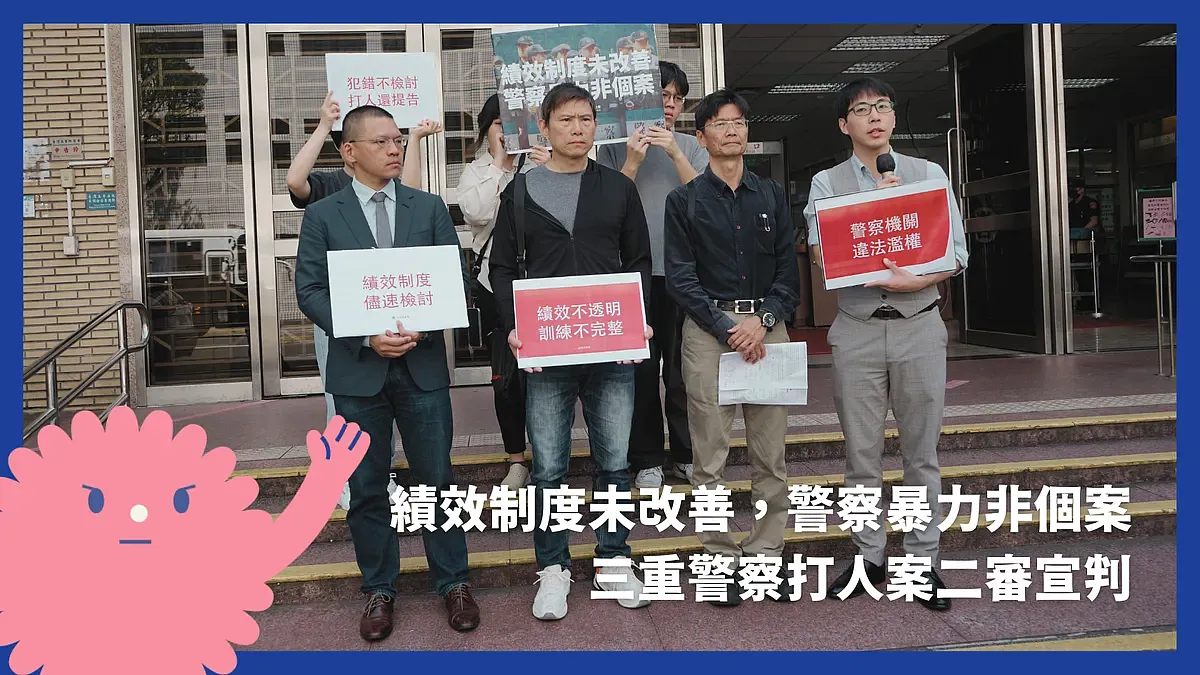
▌Statement | "Performance Evaluation System Unimproved, Police Violence Not an Isolated Incident": Second-Instance Verdict in the Sanchung Police Assault Case
In September 2022, two police officers from the Sanchung Precinct of the New Taipei City Police Department mistakenly identified Mr. Huang Lien-shun as a wanted person. Not only did they forcibly subdue him without identifying themselves, but they also continued to hurl insults, spray pepper spray, and assault him after he had lost the ability to resist, causing severe injury. Even after realizing their mistake, the police still detained Huang with handcuffs and filed charges against him for obstruction of justice and injury. In 2024, the district court ruled that the charge of abuse of power causing injury against the officer surnamed Weng was established, while Huang Lien-shun was acquitted; today, the High Court upheld this outcome in the second instance.
This case exposes systemic issues of police abuse of power and violent law enforcement. Illegal policing is closely linked to unreasonable performance pressures; if the National Police Agency fails to review this from systemic and educational perspectives, public fear of police cannot be eliminated. Supporting groups call for the establishment of a "Police Performance Management Committee" to prevent performance pressure from becoming a driving force for illegal abuse of power.
Furthermore, after mistakenly arresting innocent citizens, the police often use "filing charges of assault and obstructing official duties" as a threat to cover up their own mistakes. The Huang Lien-shun case is not an isolated incident. The Judicial Reform Foundation urges prosecutors to handle similar cases with caution to prevent innocent citizens from being victimized again, while emphasizing that police agencies must strengthen education and training, confront the harms caused by wrongful arrests, and prevent such errors from recurring.
🔎 Review of the First-Instance Verdict Statement:
✦ Statement | "Police Violence Unrepentant, Performance System Must Be Reviewed Promptly": First-Instance Verdict in the Sanchung Police Assault Case

▌Sidelights | "Speaking Out for Disobedience: Defense during Investigation and Civil Disobedience in Social Movements" Symposium
By Chen Ting-ru / Judicial Reform Foundation Intern, Department of Law, Soochow University
Living in a free and democratic country, protests and social movements have always been ways for the public to express demands and fight for rights, typically speaking out on policies, social issues, or injustices. However, when protests and social movements involve acts of civil disobedience—especially when participants wish to use civil disobedience as a strategy—it often entangles participants in legal disputes. In such cases, what role can lawyers play? What makes assisting clients different? And if you are a participant, what should you watch out for?
This article will be led by Attorney Chen Hung-chi to help us understand the practical matters to watch out for in police station accompaniment cases during social movements, and by discussant Professor Wei Pei-hsuan to help us understand how to speak out for "civil disobedience."

Advocacy groups engage in dialogue with the public hoping that their appeals will be heard, while simultaneously needing to respond to public anxieties to truly connect. To align social movements with the pulse of public opinion, the methods and mediums used in each era vary slightly. Over the past thirty years, the methods of the Judicial Reform Foundation have also been constantly evolving.
▌First-Generation Clippings: Physical Newspapers
At the end of 2024, due to urban renewal, the Judicial Reform Foundation officially moved out of the Sungchiang Office that had accompanied us for twenty-six years (photos from the farewell party). During the moving process, we found many interesting historical items. Among them was a stack of thick "press clippings." In the exhibition area titled "Pens," which records the history of judicial reform, we have also sorted out some of them to give everyone a tangible feel of how early judicial reform issues were presented in the media.
At that time, reading physical newspapers was still mainstream, and the Judicial Reform Foundation subscribed to print newspapers such as the China Times, Liberty Times, and Taiwan Daily. When volunteers came to the office, they would help check recent newspaper reports concerning judicial reform, compile them into volumes, and provide them to the committee members for reference during the monthly executive committee meetings. This was not only to observe current events but also to observe whether our own actions were being reported by the media and how they were being covered.
Su Chien-ho packed up moving items while sharing that after being released from prison, he came to the Judicial Reform Foundation to volunteer, and his very first assigned task was making press clippings, which he would come in to do every Thursday morning.
Because press clippings merely served as a tool to help everyone keep abreast of public opinion during the dynamic process of social movements, they were not regarded as crucial archival materials and were not particularly well-preserved. When we found this box of historical items, we knew they were incomplete. What survived were roughly some press clippings from around the year 2000, and upon closer inspection, their contents evoke a sense of melancholy.
 ▲ November 27, 2001, China Times | Association for Legal Reform: Spare Those under the Gun At a time when we were still in the urgent stage of rescuing Hsu Tzu-chiang, in a Taiwan with the death penalty, rescuing wrongful death penalty cases always required pleading with the Ministry of Justice to "spare those under the gun." |
 ▲ January 11, 2001, China Times Express | Judicial Corruption Case Again Implicates Two High Court Judges Naturally, one can also see that the first-generation judicial reform goal of "anti-corruption" had its origins. |
 ▲ December 10, 2003, Liberty Times | Government to Budget Funds to Assist Public Litigation, Judicial Reform Alliance Advocates Establishing Legal Aid Foundation The Legal Aid Act was also on the verge of implementation at that time. |
 ▲ May 22, 2001, China Times Express | Sexual Assault Complaint and Investigation Mechanisms Urgently Need Establishment Many social issues had not yet been regulated by legislation. When they were first reflected through the media, the Judicial Reform Foundation was sometimes asked for its stance. Therefore, it can also be seen that in addition to traditional Judicial Reform Foundation issues, the press clippings also covered certain issues that "the Judicial Reform Foundation had not yet started caring about." This selection logic continued into the second generation of press clippings. |

In addition to receiving them from newspapers, the Judicial Reform Foundation also published the top ten judicial reform news stories. From the earlier days when cartoonist Chien Hsi-chieh presented many wonderful contents through comics, some of these collected items are also exhibited in the exhibition hall.
The Judicial Reform Magazine also featured an analysis of the top ten judicial news stories of the year 2000:
(1) Judiciary is inept, the President slaps it in the face
(2) Walking toward the dawn as the light reappears
(3) Finally, a president "discovers" that human rights are truly important for Taiwan's standing in the international community!
(4) While sweeping away organized crime is good, don't forget procedural justice! Lest black gold hasn't been eliminated yet, and prosecutors' quality issues pile up like a mountain!
(5) The rat dropping in the pot of porridge finally surfaces!
(6) The new regime takes office, dead cases experience a resurrection, "Who killed Colonel Yin?"
(7) Taiwan's version of Law & Order finally hits the stage
(8) Walk the night path often enough, and you're bound to run into a ghost!
(9) If you can't lock them up, you just can't! Call me the ultimate survivor!
(10) Flags of reform flutter everywhere (A regrettable omission) The judiciary's deepest pain—refusing to face the truth and hastily executing death sentences
Right up until 2018, one could still see this approach being used to help the public understand the key points of judicial reform:

▌Second-Generation Clippings: Electronic News
The habits of news readers were constantly changing, and the Judicial Reform Foundation began sending out electronic press clippings in March 2015. The recipients at this time included not only internal members but also supporters who subscribed to the Judicial Reform Foundation's e-paper. Print newspapers were completely canceled around the end of 2019 to save budget.
At that time, the daily mailing of e-papers was intended to allow partners concerned with judicial reform to keep up with current events in the legal sector. The "newest" colleagues were responsible for this task. Thanks go to the Secretariat staff who participated in the production of press clippings over the years, which, looking from the backend, included: Ting Yu-cheng, Jasmine Chan, Yu Chia-fang, Chen Yi-chen, Huang Shu-chuan, Chen Chi-yu, Chang Yu-ting, Ting Hsiao-wen, Chen Yang, Chang Chih, Su Pei-hsuan, Chen Chia-ping, Tsai Shang-yu, Wu Yi-hsun, Chou Yu-ling, Lee Ming-ju, Wang Chen Yun, Kao Fu-hsuan, Tsai Meng-chu, Ma Chien-ya, Lin Chih-fang, Wang Chun-shih, Chang Hua-che, Huang Chun-wei, Wang Yi-ting, and Hsieh Chia-chen.
The categories of press clippings were divided into official news from agencies such as the Judicial Yuan, the Ministry of Justice, and the Control Yuan, press releases from the Taiwan Judges Association or Taiwan Prosecutors Association, and reports from other media outlets. Reviewing a few past issues at random, they roughly looked like this:
 |
 |
We also once accidentally clipped some judicial event content from content farms and received complaints from readers. (It was only after being complained to that we realized someone was actually reading carefully!)

However, sending e-papers daily was quite a heavy burden. Considering overall efficiency, at the end of 2021, following lengthy discussions at the Secretariat meeting, it was decided to suspend publication.
▌The New Generation of Judicial Reform: How to Receive and Convey Information?
The Judicial Reform Foundation has previously communicated with the Taiwan Science Media Center (SMC) on issues such as forensic science and artificial intelligence writing judgments. Although still in its infancy in Taiwan, we saw how civil organizations dedicated to science communication perceive that behind "esoteric knowledge that is difficult for the public to understand" lies a lack of translation training and friendly communication platforms within the closed linguistic system of professional workers, causing information to get stuck right at the "media" barrier—journalists find it difficult to find suitable experts, and experts lack mutual trust to interact with the media to generate language that translates to the public.
Judicial reform issues, much like scientific knowledge, often involve profound concepts and complex contexts. If meaningful translation and explanatory materials are not provided when many judicial reform issues appear before the public, it is difficult to reduce fake news, misleading information, and anxieties in the digital age, nor can it foster a more resilient democratic discussion environment.
However, how to provide these meaningful contents involves constant changes in carriers. We once listened to this episode of The Reporter discussing why they started doing audio-visual news on podcast, which mentioned that at this very moment, media outlets are facing the challenge of "shifting from digital first to social first." Media organizations are all asking: "Are social media platforms channels for news content, or are they gradually becoming another product?" Social media is no longer used just to attract readers to news websites to read news; on the contrary, more and more readers are absorbing news content while scrolling through social media.
The way news is received is changing. Even though advocacy groups are not media workers, they share the same anxiety of having to effectively transmit and receive information. Currently, regarding information reception, colleagues respectively subscribe to press releases from various agencies and media outlets (in this "Aside from Rescuing Wrongful Cases, What is the Judicial Reform Foundation Doing? — Unboxing Legal Advocacy Work" e-paper, websites commonly used for legal advocacy work can be seen), and some also use Google Alerts as an aid.
The e-paper for conveying information externally was previously transformed into the feature-report-styled "Szu-Szu" Quarterly, and currently takes the form of the information-sharing Monthly Magazine. Both embody the hope of moving beyond merely "forwarding and clipping media reports" to further allow subscribers to see raw content materials originating from the JRF itself. Everyone is welcome to subscribe!
 |
 |
If you have any better suggestions, please feel free to give us feedback!
This article is an AI-generated translation of the original Chinese text. In the event of any discrepancy, the Chinese version shall prevail.