
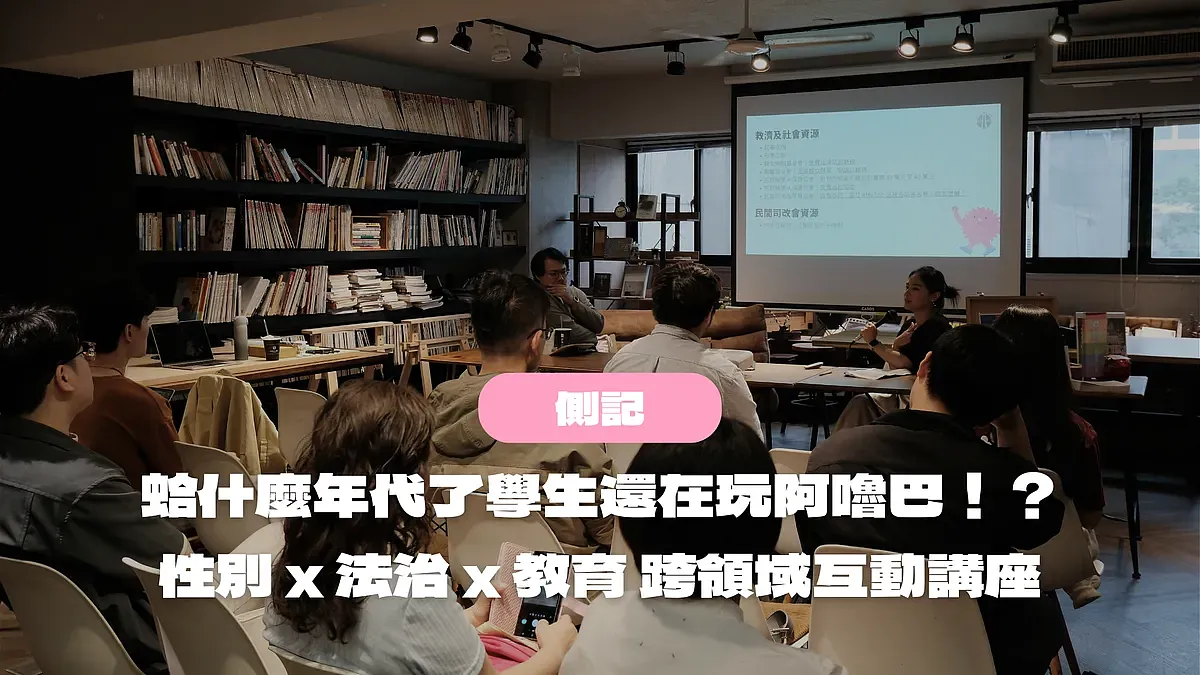
Sidelights | What Era Is This, Students Are Still Playing 'Aluba'(Happy Corner)?! Gender x Rule of Law x Education Interdisciplinary Interactive Lecture
Last edited: 2026-08-22
Amid rising gender consciousness, many people feel perplexed—while we seem better able to recognize the forms of gender-based violence than in the past, we still cannot eradicate these problems. As social ethos and the legal environment gradually loosen past oppressions surrounding power and gender, why do gender inequality and sexual harassment still emerge endlessly? Carrying these doubts, this lecture invited two speakers from different professional fields to start a dialogue.
Observations from the Educational Frontline: Deconstructing Stereotypes in the Classroom
Chou Yuan-chi, a civics teacher at Taipei Municipal Nangang High School, has firsthand experience in promoting gender equity education at school, actively discusses the latest social issues with students, and has participated in numerous gender education training sessions. During the lecture, he shared the practical dilemmas and progressive opportunities faced on the educational frontline. He pointed out, "Students are actually full of curiosity about gender issues and are willing to discuss them, but we must give them sufficient language and a safe space." In class, through case discussions and diverse media materials, he guides students to understand the relationship between gender stereotypes and asymmetrical power dynamics.
When facing complaints, Teacher Chou also mentioned that initiating reporting upon receiving a complaint is crucial. If frontline teachers hold the attitude that "some minor matters can be settled privately," it easily fosters distrust among students toward the campus grievance mechanism and may even create room for opportunistic individuals who intend to harm others.
Well-Intended Systems, Dilemmas on the Educational Frontline
However, gender equity-related work is a heavy burden for teachers: "Especially since teachers themselves shoulder teaching and counseling tasks, balancing lesson preparation with handling heavy gender equity complaint cases makes the workload truly tight."
Chou Yuan-chi also added that under Article 22 of the Gender Equity Education Act, the rule of "report upon knowing" has become a legal obligation, leading frontline educators to often lean toward "reporting everything" out of fear of making a wrong judgment. While this tendency aims to avoid omissions, it also places an extreme burden on administrative capacity. Especially when dealing with gray-area situations such as "poking backs, spreading private life information, or making others uncomfortable with one's gaze," both teachers and students bear indescribable pressure.
Under a heavy caseload, private complaints among teachers may emerge—feeling that "the gender equity procedures are being abused." But to him, even though teachers' grievances and hardships must be seen and addressed, students becoming more sensitive to discomfort and filing complaints is an inevitable change arising under contemporary gender equity education, and precisely the direction that systemic and conceptual reforms hope to alter.
The Teacher's Role Under Multiple Pressures: Drawing Boundaries Between Professionalism and Emotion
Beyond systemic pressures, interactions between teachers and students also face highly sensitive scrutiny and questioning. The lecture mentioned the "five boundaries for teachers"—emotional, relational, power, communication, and physical boundaries—which are core areas teachers currently need to constantly perceive and navigate.
Chou Yuan-chi pointed out, "Teachers often fall into a dilemma: on the one hand, they wish to care for students, while on the other hand, they fear being misunderstood as excessively interfering or crossing boundaries." In practice, it is not uncommon for teachers to be reported for gender equity violations by students or parents while trying to handle students' romantic issues, leading many teachers to choose "not to touch or manage," which ultimately leaves students without someone to turn to at critical moments.
"Teachers are not counseling professionals, yet they understand students best; while guidance counselors have professional training, they may not be able to look after every single student." Such contradictions have become a recurrent systemic dilemma in the educational frontline.
New Forms of Digital Gender-Based Violence: More Concealed and Younger Victims
In the digital environment, the forms of gender-based violence have also become more concealed and complex. Chou Yuan-chi pointed out that the age of victims of digital gender-based violence is constantly dropping. In elementary schools, victims are commonly lured by strangers online; in junior high schools, cases are hard to trace because victims cannot identify the sources; while in high schools, they more often involve acquaintances or emotional entanglements. These incidents are difficult to detect and hard to handle.
He emphasized that schools should strengthen digital literacy and cybersecurity education, and establish a complete response mechanism and psychological support system to truly help students protect themselves and seek assistance.
Types of Gender Equity Cases, Locations, and Remedies
In the second part of the lecture, speaker Teng Yu-hsuan shared gender equity-related cases she has previously handled. Common types of gender victimization include sexual assault, sexual obscenity, sexual harassment, stalking and harassment, and child/youth sexual exploitation. The locations where these types of victimization occur are mostly in families, schools, and workplaces.
Regarding available remedies and social resources for gender victimization, filing a criminal complaint is the most common, and civil claims for damages can proceed concurrently with criminal complaints. For other legal resources, Awakening Foundation provides free legal consultations, while Garden of Hope Foundation primarily counsels abused women and abused children. Furthermore, the Association for Victims Support offers financial subsidies for related sexual assault cases. Additionally, the Judicial Reform Foundation (hereinafter JRF), after the 2023 MeToo movement eruption, produced a manual guiding victims on how to respond in such situations.
Beyond Ex-Post Monitoring, JRF Hopes to Invest More Resources into Front-End Rule-of-Law Education
Unlike legal aid organizations, legal advocacy groups like JRF often play the role of ex-post accountability and systemic monitoring. Taking the indecent assault case at a Go classroom in New Taipei City as an example: the parents in this case had two children, whom they sent to extracurricular Go classes at their own expense after school. One child reported back home that the Go teacher had touched his private parts and recorded the touch simultaneously. It was subsequently discovered that this had happened many times. The parents took the child to the police station to report the crime, during which we found numerous omissions. First, after the parents initially went to the police station to report, the first police precinct shirked responsibility, claiming lack of jurisdiction. From the initial report until the child finished injury examination, it took a total of 14 hours, during which the child had to repeatedly recount the case as many as 15 times. During the injury examination, hospital personnel informed them they could apply for a subsidy, but insisted on obtaining a household registration transcript, completely failing to consider the exhaustion experienced by the parents and the child throughout the entire day.
Subsequently, the parents reported to the school about what happened at the privately-run Go classroom, hoping the school could provide counseling for the child, but the school guidance counselor was unwilling to handle it. Even before we appealed this case to the Control Yuan, the New Taipei City Education Department took absolutely no action or investigation regarding the case, and the school neither notified nor provided any assistance channels to the parents. Furthermore, while the case was at the prosecutors office—where lawyers and social workers usually accompany a child during interrogation—the prosecutor in this case refused to allow the parents and lawyers to accompany, and even assigned a different accompanying social worker than before, subjecting the child to interrogation without any mental preparation. Moreover, during the provisional attachment (provisional seizure) procedure, when the New Taipei District Court Civil Execution Branch issued an official letter, it masked the child's name but failed to mask the parents' names and addresses. When brought to the attention of the Execution Branch, they shockingly remarked, "The other party won't come looking for you, what are you afraid of?" These grave deficiencies were only rectified after a lawyer filed a formal written objection with the court.
Furthermore, when the parents applied for compensation from the Association for Victims Support, not only was the address for the relevant documents mailed incorrectly, but the disbursement of compensation was also unreasonably delayed. Because the client encountered these situations in this case, they sought JRF's assistance, hoping to use public power to push for reforms addressing the numerous loopholes in the current system. Consequently, JRF has filed a complaint regarding the current situation with the Control Yuan.
From the aforementioned case, we can see that JRF reviews the current system based on individual cases. We accompany parents to meetings, integrate opinions from civil society organizations, draft statements, and hold press conferences. Regarding gender issues, following the 2023 MeToo movement, we formed a working group. For adults, we initially tracked the "three gender equity laws," promoted amendments on digital gender violence, advanced offense against sexual privacy and synthetic sexual videos, and tracked the implementation of the Stalking and Harassment Prevention Act across local agencies. For children and youth, aside from following up on the Assisted Reproduction Act, we promoted child work permits and campus gender equity lectures.
However, these are indeed very much "ex-post." Teng Yu-hsuan shared that JRF also hopes to move further upstream toward prevention, and therefore plans to develop gender equity-related mock trial scripts in the second half of the year, hoping to foster students' gender awareness through case simulation. Building upon accumulated reform experiences, some of these discussions will be incorporated into scripts and brought into campuses.
Case Discussion

At the end of the lecture, using an actual case provided by Teacher Chou, the audience was encouraged to personally empathize with the dilemmas of various roles within the educational frontline's gender equity environment. We divided the audience into three groups: if you were the teacher involved, if you were another teacher, and if you were a gender equity committee member, how would you judge and act respectively?
Through discussions, one finds that under the framework of gender equity mechanisms, the navigation of boundaries between teachers and students has clearly undergone a paradigm shift. Out of "self-protection," those acting as teachers pay attention not to handle students' emotional distress outside of academics alone. To a certain extent, this prevents the possibility of teachers improperly harming students under past asymmetrical teacher-student power dynamics, but at the same time, much like doctors adopting "defensive medicine," it fosters a mindset of "defensive counseling" toward students. Audience members acting as other teachers mostly stood from the perspective of connecting more resources to help; while audience members acting as gender equity committee members were very dutifully eager to understand whether the case involved factors of "sex and gender."
Facing These Practical Dilemmas on the Ground, What Can We Do?
JRF believes that it is extremely important for civil society organizations to continuously develop diverse resources to assist teachers while steadily investing manpower to understand the difficulties they encounter, ensuring that so-called gender rule-of-law education is not unilaterally outputted within a "vacuum" or a "legal professional's imagination." This was also the conclusion that today's lecture attempted to collect through interaction.
At the close of the lecture, the host also invited everyone to support the development of JRF's rule-of-law education teaching materials and courses, and to continue paying attention to this issue!
This article is an AI-generated translation of the original Chinese text. In the event of any discrepancy, the Chinese version shall prevail.