
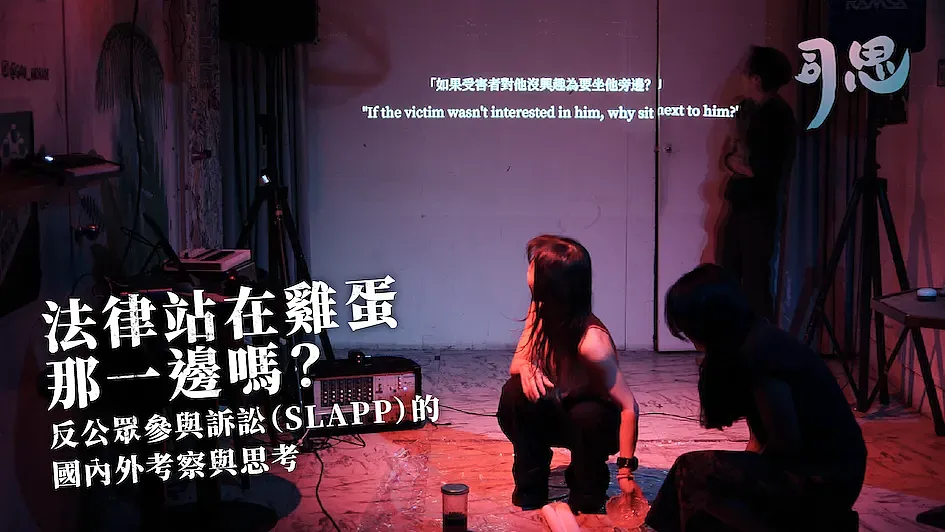
Does the Law Stand on the Side of the Egg? Domestic and International Observations and Reflections on Strategic Lawsuits Against Public Participation (SLAPPs)
Last edited: 2026-08-22
What is a SLAPP?
"SLAPP" stands for Strategic Lawsuit Against Public Participation. According to definitions in the literature by American scholars George Pring and Penelope Canan, it refers to situations where individuals (often large corporations or political figures) face criticism from the general public over issues concerning the public interest, and the criticized party files a lawsuit aiming to make the critics endure the unbearable burdens of litigation costs—such as labor, time, and expenses—thereby forcing them to abandon their criticism.
Are There SLAPP Cases in Taiwan
In Taiwan, earliest discussions regarding SLAPPs typically revolved around classic categories such as environmental cases and labor cases.
Case 1: Formosa Plastics Corp. v. Professor Tsuang Ben-jei
Taiwan Taipei District Court Year 2012 Chung-Su-Tzu No. 291 Civil Judgment marks a civil lawsuit filed in April 2012 by Formosa Plastics Group subsidiaries, Formosa Chemicals & Fibre Corp. and Mailiao Power Corp. (hereinafter Formosa subsidiaries, etc.), pursuant to Articles 184 and 195 of the Civil Code against Tsuang Ben-jei, a professor in the Department of Environmental Engineering at National Chung Hsing University. They argued that the erroneous research conclusions published by him caused public panic and damaged Formosa's reputation, seeking 40 million NTD in damages and the publication of an apology on the front page of four major daily newspapers. Additionally, Formosa filed a criminal defamation complaint.
Regarding the civil claims, the primary grounds asserted by the Formosa subsidiaries were statements made or disseminated by Professor Tsuang Ben-jei starting in January 2010 on various occasions related to the Kuo-Kuang Petrochemical development project, which allegedly defamed both companies. A report by the Environmental Information Center summarized the claims made by the Formosa subsidiaries and Professor Tsuang as follows:
| Occasions and Content of Professor Tsuang's Statements | Formosa Mailiao Sixth Naphtha Cracker's Perspective |
| (1) Expert meeting held by the Environmental Protection Administration on Nov. 3, 2011, titled "Environmental Monitoring and Evidence Collection Methods for Sixth Naphtha Cracker Industrial Safety Incidents": "...Sixth Naphtha Cracker's own stack data remains blank to this day; it has 66 chimneys (Editor's note: should be 387 chimneys), which are related to concerning carcinogenic and hazardous substances... cancer has increased in many places following the establishment of the Sixth Naphtha Cracker..." |
Relevant monitoring reports have been submitted to the Yunlin County Environmental Protection Bureau, and primary emitted pollutants are accounted for. Furthermore, according to Bureau of National Health Insurance data, cancer rates nationwide have risen year by year, not just in Yunlin County. Moreover, cancer incidence is linked to genetics, environment, and lifestyle habits. Using the establishment of the Sixth Naphtha Cracker as a dividing point is a deliberate misguidance and malicious commentary. |
| (2) Liberty Times report on Nov. 10, 2011, regarding Professor Tsuang's statements: "According to internal EPA data, emissions of volatile organic compounds, lead, mercury, cadmium, arsenic, and dioxins from the Sixth Naphtha Cracker Phase IV account for the following proportions of emissions in the central region: arsenic 55%, cadmium 40%, mercury 29%, and lead and dioxins both 20%." |
Upon downloading this report, its content does not contain the emission proportions claimed by Professor Tsuang. |
| (3) The following three clips on YouTube: (1) Feb. 22, 2011, at the Changhua Medical Alliance New Year Tea Gathering: "...the petrochemical industry causes an increase in cancer patient numbers, as can be seen from the Sixth Naphtha Cracker experience..." (2) Jan. 27, 2011, at the 4th Review Meeting of the Kuo-Kuang Petrochemical Project Team: "...retrospectively, pollution from the Sixth Naphtha Cracker historically caused an additional 1,686 deaths per year..." (3) Apr. 22, 2011, outside the 5th EIA Review Meeting: "...cancer deaths caused annually by the Sixth Naphtha Cracker exceed 1,000..." |
Formosa cited an EPA press release dated Apr. 17, 2011, as evidence, pointing out that Professor Tsuang is not a professor specializing in epidemiology and health risk assessment research, and that he interpreted basic terminology in epidemiology and health risk assessment using his own self-created methods... using academic packaging to sensationalize and vie for media coverage. |
After undergoing six preparatory hearings and one oral argument session, the Taiwan Taipei District Court rendered its civil judgment on September 4, 2013 (Taiwan Taipei District Court Year 2012 Chung-Su-Tzu No. 291 Civil Judgment), ruling in favor of the defendant and dismissing the claims of the Formosa subsidiaries. The court's grounds for judgment were:
- The statements listed by the Formosa subsidiaries as allegedly infringing upon their reputation by Professor Tsuang possessed the dual characteristics of both factual assertions and expressions of opinion.
- Professor Tsuang's statements constituted appropriate commentary on matters subject to public discussion.
- Accordingly, the court held that: "The statements made by the defendant as listed in the attached table all possess the characteristics of both factual assertions and expressions of opinion. Furthermore, they were made in good faith based on his aforementioned academic research, expressing opinions on matters subject to public discussion concerning the lives, health, and public safety of all citizens. Since the plaintiffs' Formosa Sixth Naphtha Cracker voluntarily entered this public sphere concerning public safety, it naturally bears a higher degree of concession. Moreover, balancing the truth or falsity of the intermixed factual assertions and the alleviation of the burden of proof, the defendant's statements regarding these matters subject to public discussion constitute appropriate commentary. It is difficult to deem that he unlawfully infringed upon the plaintiffs' rights and thereby caused damage to the plaintiffs' reputation."
Case 2: EVA Airways Corp. v. Taoyuan Flight Attendants Union
Second, in June 2019, the Taoyuan Flight Attendants Union (hereinafter TFAU) submitted eight demands to EVA Airways Corp. (hereinafter EVA Air) for labor-management negotiations. However, negotiations collapsed as consensus could not be reached on certain conditions. TFAU subsequently announced a strike on June 20, 2019. On July 6, TFAU and EVA Air signed a labor-management agreement after three rounds of negotiations, with the entire strike lasting over 20 days until July 10.
Nevertheless, on the second day of the strike—June 21, 2019—EVA Air filed a damage compensation lawsuit against TFAU, naming the union's chairperson and all executive directors and supervisors as defendants. The grounds asserted were that EVA Air considered the strike illegal, resulting in the cancellation of 62 flight services on June 20 and 21, 2019, and incurring an additional 34 million NTD in compensation and expenses.
On March 25, 2022, the Taiwan Taipei District Court rendered its civil judgment (Year 2019 Chung-Laou-Su-Keng-I-Tzu No. 1) dismissing EVA Air's claims. The court's grounds for judgment were essentially:
- Where a labor union and its members undertake a strike or other dispute actions to obstruct the normal operation of an enterprise and counter it in accordance with the Act for Settlement of Labor-Management Disputes in order to achieve their assertions, provided such actions do not violate the principle of good faith or the prohibition of abuse of rights, the employer may not claim compensation from them based on damages arising from dispute actions taken by the union and its members pursuant to said Act.
- EVA Air's assertions that the subject matter and procedure of the strike in question were illegal, that the purpose of the strike was illegal, and that the means of the strike were illegal were all unconvincing and could not be adopted.
- Therefore, the court held: "It is difficult to deem that the defendant union engaged in illegal conduct as shown in Attached Table 1 during the strike in question, nor can it be deemed to have violated the principle of good faith or the prohibition of abuse of rights. Pursuant to Paragraph 2, Article 55 of the Act for Settlement of Labor-Management Disputes, the plaintiff may not request compensation from the defendant union and its members based on damages arising from dispute actions taken by them pursuant to said Act. Consequently, the plaintiff's claims—asserting that the defendant union violated laws protecting others and intentionally inflicted damage upon the plaintiff through methods contrary to good morals, thereby causing damage, and requesting the defendant union to bear damage compensation liability pursuant to the latter part of Paragraph 1 and the former part of Paragraph 2 of Article 184 of the Civil Code, and further requesting the remaining defendants (being cadres or employees of the defendant union who performed duties during the strike in question and caused damage to the plaintiff) to bear joint and several damage compensation liability together with the defendant union pursuant to Article 185 of the Civil Code, or respectively pursuant to Article 21 of the Labor Union Act and Articles 28 and 188, Paragraph 1 of the Civil Code—are all without merit."
The second-instance court in this case held that the strike did not involve violence, coercion, or obstruction of EVA Air employees in exercising their rights, nor did it obstruct employees from entering or leaving the company. Setting up strike picket lines was not primarily aimed at harming EVA Air, nor did it sacrifice EVA Air's interests to profit the union, thus upholding the first-instance judgment. EVA Air appealed. Ultimately, in April of this year, the Supreme Court held in its Year 2024 Tai-Shang-Tzu No. 1906 Judgment that the second-instance judgment contained no errors and dismissed the appeal, finalizing the entire case (see the special report by The Reporter).
How is Taiwan's Gender Movement Connected to SLAPPs
In Taiwan, discussions regarding SLAPPs have recently resurfaced in the wake of the #MeToo movement in mid-2023.
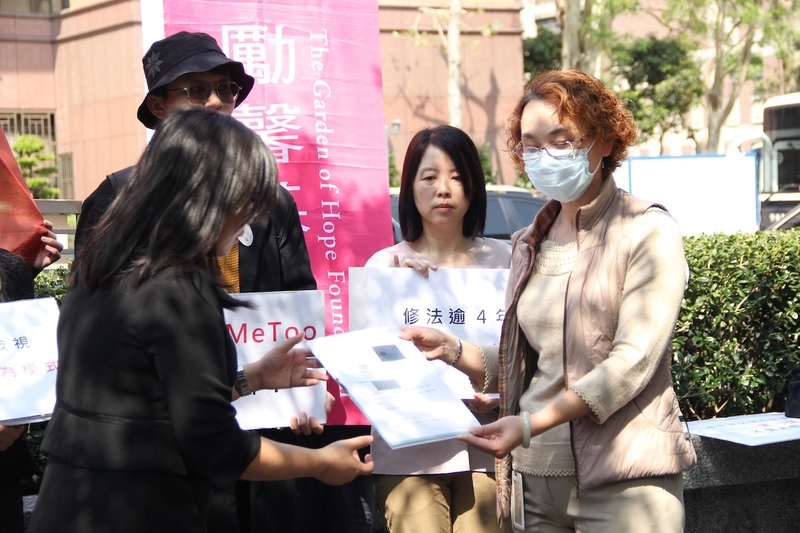 Photo / #MeToo Movement Derivative Prosecutor Evaluation Case, filing and case solicitation press conference. (Photography / Miffy Jiang)
The Gendered Trend of Strategic Lawsuits Against Public Participation (Gendered SLAPPs)
In October 2017, The New York Times and The New Yorker reported on the sexual harassment and assault misconduct of Hollywood producer Harvey Weinstein. Victims included female production assistants, temps, and actresses from his film company. Propagated through Twitter posts, many people responded and used the #MeToo hashtag, empowering numerous women to stand up and accuse powerful male perpetrators. These included well-known actresses Ashley Judd and Gwyneth Paltrow accusing Weinstein in Hollywood, as well as Fox News anchor Gretchen Carlson accusing Fox News media mogul Roger Ailes. These events triggered a "national reckoning" in the United States. The public began paying large-scale attention to sexual assault and sexual harassment incidents, and other survivors bravely used social media platforms to accuse perpetrators and share their trauma experiences. Consequently, this series of speaking-out actions was termed by the media and academia as the #MeToo gender movement.
Meanwhile, East Asia also responded to the #MeToo movement—such as South Korea's #MeToo/#WithYou movement and China's #MeToo movement. Taiwan's #MeToo movement also kicked off in May 2023 following a political worker speaking out. Its impact spread from the political sphere to media, arts, film and television, the judiciary, sports, campuses, and other fields, even catalyzing legal reforms in sexual harassment legislation. For instance, in July of the same year, during a congressional recess, the Legislative Yuan held intensive discussions and rapid legislative amendments over a two-week provisional session, completing the revision bills for the Gender Equity Education Act, Gender Equality in Employment Act, and the Sexual Harassment Prevention Act respectively. The direction of the amendments focused primarily on "improving the complaint procedure" and "severe penalties," and explicitly defined the pattern of "power-dynamic sexual harassment" involving power relationships, thereby expanding the concept and connotation of sexual harassment.
Additionally, the amendments expanded the scope of application of the three gender equity laws. For example, Article 12 of the Gender Equality in Employment Act incorporated scenarios of sexual harassment experienced "outside working hours"; Article 3 of the Gender Equity Education Act no longer limited schools to units under the jurisdiction of the Ministry of Education, additionally including military schools and police academies, etc. In short, apart from victims utilizing social media platforms for trials in the court of public opinion, the outcomes brought by Taiwan's #MeToo movement also drove a new wave of legal reforms regarding sexual harassment.
However, the #MeToo movement has not been entirely smooth sailing; the speaking-out actions of victims accusing perpetrators also faced the judicial risks of legal prosecution. In other words, as a gender movement, the #MeToo movement similarly confronts the dilemma of SLAPPs. In fact, SLAPPs have even developed a gendered trend (gendered SLAPPs): powerful male perpetrators launch retaliatory legal actions against female victims through litigation. The purpose of these lawsuits is not to assert their legal rights, but rather through a series of complex and protracted litigation processes to exhaust victims physically and mentally and force them to bear corresponding litigation costs, achieving an effect of judicial harassment. To put it bluntly, the court—originally intended as a channel for upholding fairness and justice—seems to have been perverted into a purgatory where victims suffer anew.
How Can Local Legal Means Be Used Against Public Participation?
One of the characteristics of SLAPPs against the #MeToo movement is "retaliatory defamation suits." For instance, perpetrators sue victims through the crime of defamation under Article 310 of the Criminal Code or tort claims regarding reputation under Article 184 of the Civil Code, claiming that the victim's #MeToo movement is baseless, or contesting that the sexual harassment and assault offenses never occurred, dismissing them as clumsy dramas of parties falling out after consensual encounters. In other words, retaliatory defamation lawsuits attempt to divert the public opinion momentum of the #MeToo movement, transforming the narrative structure of gender violence into a political reckoning of slander and smearing, thereby shifting the public's focus from structural issues of gender power relations to scrutinizing the authenticity of individual cases.
Therefore, retaliatory defamation suits produce a backlash against the #MeToo movement: sexual violence and sexual harassment in the #MeToo movement represent the past gender trauma experiences of victims. Due to statutes of limitations and evidence issues, the majority of cases cannot utilize existing laws to bring perpetrators to judicial justice; thus, victims gather and speak out through the power of social media platforms, gaining public support via social opinion. Paradoxically, however, retaliatory defamation suits force victims to stand in court. Victims must prove that the sexual harassment and sexual violence they suffered were real. Regrettably, even if victims prove them to be real, it merely serves to passively establish that the crime of defamation or torts infringing upon reputation is not established, while perpetrators still escape judicial sanctions for sexual harassment or sexual violence. Consequently, speakers in the #MeToo movement are forced to face the legal risks of retaliatory defamation suits, repeatedly reviewing whether their trauma experiences have sufficient evidence to cope with potential defamation lawsuits. In severe cases, victims may even choose to remain silent after evaluation, thereby producing a chilling effect on the entire movement. The damage affects not only whether individual freedom of speech is restricted, but also strangles the movement energy of collective action.
**To assist the public, Judicial Reform Foundation has accordingly launched a version of the "Self-Help Manual | Exposed #MeToo and Counter-Sued for Defamation: What Should I Do?"**
In Taiwan, civil society organizations (the Judicial Reform Foundation, the Garden of Hope Foundation, the Taiwan Women's Link) have begun to realize the backlash effect of "retaliatory defamation suits" and are grasping the subsequent development of the #MeToo movement through "Judicial Supervision and Challenges in the Post-#MeToo Era."
Furthermore, civil society organizations gradually understand the potential legal responses of courts when facing retaliatory defamation suits through legal aid in various individual cases (victims, family members, whistleblowers, etc.), thereby reflecting upon legal assertions that can be raised at the litigation level and even legal regulations that can be adopted at the legislative level, in order to support Taiwan's #MeToo movement from being suppressed and interfered with by retaliatory defamation lawsuits.
For example, Judicial Reform Foundation previously assisted in this case: "Whistleblower Counter-Sued for Exposing the Risu Sexually Explicit Private Image Community Leak Case," successfully securing an acquittal for the whistleblower.
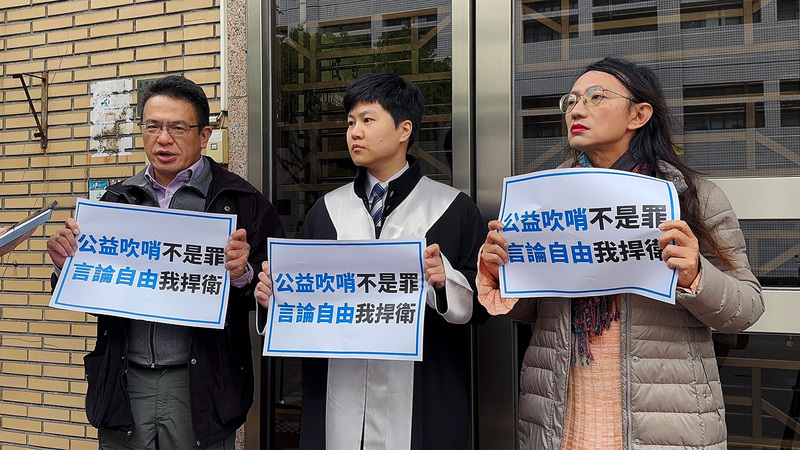 Photo / The RISU defamation lawsuit case was overturned on appeal and changed to an acquittal. (Photography / Hsieh Chia-chen)
More typical cases involve civil damage compensation lawsuits filed against defendants after the #MeToo movement. Among them, the judgments of the following two recent cases have particularly attracted widespread attention:
1. Taiwan Taipei District Court Year 2023 Su-Tzu No. 2934 Civil Judgment
(1) Case Background:
- Plaintiff Chiu Chen-yuan served as a legislator and at the time was the Deputy Mayor of Hsinchu City, possessing a high degree of social recognition. Defendant Female A served at the time as an assistant in the office of legislator Lai Hsiang-ling, who belonged to the same political party as the plaintiff. On September 14, 2020, both parties had a brief interaction due to attending an event, during which the defendant accompanied the plaintiff in a vehicle and participated in related activities.
- On June 17 and 19, 2023, the defendant published two posts on her personal Facebook page, alleging that during an inspection event in 2020, the plaintiff had "continually looked up and down at her body" and "placed his hand on the left hand on her thigh," among other behaviors.
- The plaintiff considered the defendant's posts to be untruthful statements that severely infringed upon his reputation, and thus filed this lawsuit requesting damages and the publication of a statement notice
(2) Issues in Dispute:
- Were the statements in question untruthful?
- Did the statements published by the defendant unlawfully infringe upon the plaintiff's right to reputation?
- If the plaintiff's right to reputation was infringed, what is the amount of mental damages the plaintiff may claim? May a proper disposition for the restoration of reputation be requested?
(3) Burden of Proof in This Case:
- The court held that the plaintiff should bear the burden of proof regarding the constitutive requirements of a tort.
- Regarding the truth of the statements in question, the plaintiff throughout only vaguely asserted that "he definitely did not engage in the behaviors pointed out by the defendant" (pp. 289–290 of the court record). However, the evidence submitted (such as media reports, screenshots of Google search keyword pages, the plaintiff's personal Wikipedia entry, online graphics and texts, etc.) was all utilized to prove that his right to reputation had been damaged, and did not make assertions or provide proof as to "why the statements in question were untruthful." In other words, the court held that to constitute an infringement of the right to reputation, the plaintiff must prove that the defendant's assertions were untruthful statements. Since the plaintiff in this case failed to prove that the content of the statements published by the defendant was untruthful, it is difficult to deem that the defendant committed unlawful acts infringing upon the plaintiff's rights.
- Even though the defendant could not prove that the statements in question were "completely consistent with the facts," the court still did not consider the statements to have deliberately fabricated facts to infringe upon the plaintiff's reputation, for the following reasons:
(1) Sexual harassment incidents themselves possess the "characteristics of suddenness and concealment," presenting limitations in proof.
(2) The circumstances of this case occurred in moments of brief interaction; without someone deliberately paying close attention, it is difficult to have other human witnesses or objective evidence.
- The circumstances described in the defendant's posts involved the plaintiff's behavior and moral image, which are connected to public interest and do not belong purely to the realm of private morality. Statements made by the defendant based on her "subjective experience and logical deduction" fall within the scope of speech supervision over public figures, which the court held possesses a certain "reasonable basis" and does not constitute malicious attacks.
- Regarding subjective comments made by the defendant such as "sexual offender," the court held that this constitutes an "expression of opinion" rather than purely factual assertions, and represents a value judgment made based on the defendant's own experience, falling within the scope of fair comment. As a public figure, the plaintiff's reputation should bear a higher degree of tolerance toward freedom of speech.
(4) Conclusion: Although the statements in question may have affected the plaintiff's reputation, they were not proven to be fabricated or maliciously slandered, and fell within the scope of fair comment, differing from a tort; hence, no liability for damages is borne.
2. Taiwan Taoyuan District Court Year 2024 Li-Hsiao-Tzu No. 215 Small Claims Civil Judgment
(1) Case Background:
- Plaintiff Chen Yu-hao alleged that Defendant Chen XX published four posts on her personal Facebook page on June 2, 2023, accusing the plaintiff of having subjected the defendant to sexual harassment and inappropriate behavior, involving statements such as "waist-embracing, buttock-touching, hair-playing, and stealthily kissing the cheek," and stating that the plaintiff "madly pressed the doorbell, knocked on the door, and kicked the door" and "had an overbearing air."
- The plaintiff considered these posts to be untruthful and infringing upon his right to reputation, and thus requested 100,000 NTD in non-property damages pursuant to Articles 184 and 195 of the Civil Code.
(2) Issues in Dispute:
- Were the contents of the defendant's posts true? Did they exceed the boundaries of what is subject to public comment and constitute an infringement upon the plaintiff's reputation?
- If a tort is constituted, should the defendant bear damage compensation liability?
(3) Grounds for Judgment:
- Pursuant to the opinion in Supreme Court Year 2020 Tai-Shang-Tzu No. 427 Judgment, speech can be categorized into "factual assertions" and "expressions of opinion":
(1) "Factual assertions" involve the issue of truth or falsity and are provable. If an actor makes statements of factual assertion after reasonable verification, and based on the information obtained through verification has reasonable grounds to believe them to be true, even if it is subsequently proven that what was said does not match the facts, they cannot be held liable to pay damage compensation for a tort. The same applies if the objective evidence presented by the actor is sufficient to show that at the time of publishing the speech, there were reasonable grounds to believe it to be true.
(2) "Expressions of opinion" refer to an actor expressing their own views or stances, belonging to the realm of subjective value judgments, which do not involve the question of truth or falsity. If an actor makes appropriate comments in good faith regarding matters subject to public discussion without using excessively vitriolic language, it can be deemed that the act lacks illegality, does not constitute an infringement upon another's right to reputation, and does not entail damage compensation liability for a tort.
- Therefore, if (1) the defendant's speech constitutes factual assertions, which are provable, the defendant has a duty of reasonable verification; (2) if the defendant's speech constitutes expressions of opinion, provided excessively vitriolic language is not used, it does not infringe upon another's right to reputation.
- The court examined the four posts individually, and its determinations were as follows:
(1) Post 1 ("The plaintiff engaged in sexual harassment behaviors such as waist-embracing, buttock-touching, hair-playing, and face-touching against the defendant"):
Testimony by a witness (a former colleague) confirmed that the plaintiff engaged in behaviors such as "buttock-touching, hair-playing, and face-touching" toward the defendant at a gathering. Thus, it can be ascertained that the post was not false and lacked illegality; the defendant bears no damage compensation liability for a tort.
(2) Post 2 ("The plaintiff disregarded the defendant's refusal and madly pressed the doorbell, knocked on the door, and kicked the door, which was sufficient to make others conclude that the plaintiff's emotional and mental state was unstable and that he engaged in harassment and property destruction behaviors"):
Witness testimony did not match this portion of the post, and the defendant provided no other evidence to prove this scenario. It is difficult to deem that the plaintiff engaged in such behavior, and the illegality of the defendant publishing Post 2 cannot be precluded. Therefore, the defendant must bear damage compensation liability for a tort in this regard.
(3) Post 3 ("Having an overbearing air," "should accept that he will be in a superior posture," etc.):
The court held this belonged to the defendant's own expression of opinion, which involves no question of truth or falsity, and contained no vitriolic or intolerable language. It is difficult to deem that there was any infringement upon the plaintiff's right to reputation.
(4) Post 4 (Describing the plaintiff supporting the fainted defendant): The scenario was reasonable and belonged to subjective feelings.
A. Statements in Post 4 regarding "My body was touched, Chen hugged me face-to-face," "My entire waist area was embraced by male Chen" constituted factual assertions. Since the plaintiff did not deny hugging or supporting the defendant, Post 4 was not false; hence, the plaintiff's claim in this regard is without merit.
B. Statements in Post 4 where the defendant further stated "I really wanted to scream out loud, but I had no strength at all to resist," "I truly felt that my entire body was filthy," etc., represented the defendant's subjective thoughts or opinions. Since the court had already determined that the plaintiff engaged in sexual harassment behaviors toward the defendant, the defendant's evaluation of the plaintiff's behavior can hardly be said to have exceeded appropriate limits, and it is difficult to deem that the plaintiff's right to reputation was infringed.
(4) Conclusion: Only Post 2 constituted a tort, and the compensation amount was discretionarily reduced to 10,000 NTD.
Current civil court opinions appear clear: regarding factual assertions, if a party can prove them to be true, or that the primary facts match, they need not be held to account for their statements matching reality down to the exact detail; or even if the content of the speech cannot be proven true, based on the submitted evidence materials, there are reasonable grounds to believe it true. Furthermore, regarding expressions of opinion, they represent an actor expressing their own views or stances, belonging to the realm of subjective value judgments, which do not involve truth or falsity. If made in good faith as appropriate comments on matters subject to public discussion, they lack illegality.
However, the deep waters lie in determining what constitutes factual assertions versus expressions of opinion, and regarding factual assertions, to what extent do courts require parties to prove and fulfill verification duties?
Through a review of past relevant judgments, it can be discovered that past defeat judgments—including the defeated portion in the second judgment of the preceding table (Taiwan Taoyuan District Court Year 2024 Li-Hsiao-Tzu No. 215 Small Claims Civil Judgment)—frequently demonstrated that "where the burden of proof lies, the defeat lies," as requiring victims who claim to have been sexually harassed to prove facts is frequently very difficult.
Nevertheless, in the first judgment of the preceding table (Taipei District Court Year 2023 Su-Tzu No. 2934 Civil Judgment), regarding the burden of proof, the court required the plaintiff to prove that the defendant's assertions were untruthful statements, and categorized "sexual offender" under the realm of expressions of opinion, preventing the victim's value judgments and fair comments—made based on personal experience—from falling into the territory requiring damage compensation. This judgment, rendered as recently as March 26 of this year (2025), is a rare shot in the arm for victims since the #MeToo movement in Taiwan.
Drawing Inspiration from Others: What Are the Possibilities in Legal Systems?
Reviewing foreign experiences, we can observe more comprehensive discussions.
The #MeToo movement that unfolded abroad in 2017 also took the lead in reflecting on the negative impacts brought by "retaliatory defamation suits," and even contemplated how legal systems could protect #MeToo activists' speaking-out actions from being suppressed and free them from judicial harassment brought by retaliatory defamation lawsuits. Examples include legislative strategies in the United States such as "invalidating non-disclosure agreements" or Canada's Protection of Public Participation Act to regulate SLAPPs. Through anti-SLAPP legislative means, perpetrators are blocked from maliciously using court litigation to intimidate and suppress survivors' speaking out about sexual harassment and sexual assault.
United States
In the 1980s, social movements and public participation activities flourished in the United States, but a phenomenon of strategic abuse of judicial procedures emerged alongside them. American scholars George W. Pring and Penelope Canan first proposed the concept of SLAPPs in their research.
Common scenarios at the time included environmental activists criticizing large development projects or community residents protesting public policies, yet being sued by corporations for defamation or commercial disparagement. Even if such lawsuits ultimately failed, they had already achieved a chilling effect of weakening critical voices and deterring others from participating in public affairs. The research of Pring and Canan attracted widespread attention, leading to the 1996 publication of their book, *SLAPPs: Getting Sued for Speaking Out*, which systematically analyzed the threat posed by SLAPP lawsuits to public participation in a democratic society.
As the SLAPP phenomenon gained attention, U.S. states successively enacted so-called Anti-SLAPP bills. The earliest was California's enactment of Section 425.16 of the California Code of Civil Procedure in 1992, establishing procedures for the rapid dismissal of abusive lawsuits, shifting the burden of proof, and empowering the prevailing party to request attorney's fees.
Canada
In the late 2000s, as increasingly more instances of abusive litigation suppression arose in social movements, environmental protection advocacy, and journalism, Canada gradually recognized the severity of the SLAPP problem. Ontario became the first region in Canada to legislate on the SLAPP issue, officially passing the Protection of Public Participation Act in 2015 (reference: Protection of Public Participation Act, 2015, Ontario).
European Union
Systematic discussions of the SLAPP problem within the European Union primarily stemmed from heightened vigilance over threats to press freedom. In 2017, Maltese investigative journalist Daphne Caruana Galizia was assassinated, shocking the international community. Prior to her murder, she had faced as many as 43 lawsuits, most of which were believed to have been filed to suppress her reporting exposing corruption. This event became a turning point for widespread recognition within the EU of the severity of the SLAPP problem (reference: Commission welcomes political agreement on countering abusive lawsuits against public participation (SLAPP)). Thereafter, statistics compiled across Europe showed that in 2023 alone, 166 SLAPP cases emerged in Europe. Victims were predominantly journalists, editors, media organizations, NGOs, and human rights workers. Approximately one-third of these cases were related to exposing corruption, and over 15% involved environmental issues (reference: New SLAPPs report shows urgent need for effective anti-SLAPP legislation).
In April 2022, the European Union proposed the Proposal for a Directive on protecting persons who engage in public participation from manifestly unfounded or abusive court proceedings ("Strategic lawsuits against public participation"), aiming to establish a set of legal safeguards against cross-border SLAPP cases, particularly protecting journalists and civil society participants.
All of the above provide continuous food for thought for Taiwan when facing various SLAPPs, and all sectors are invited to continue paying attention.
This article is an AI-generated translation of the original Chinese text. In the event of any discrepancy, the Chinese version shall prevail.