
After the Verdict | The Unending Road to Exonerating a Wrongful Conviction: An Interview with Lo Ming-tsun's Eldest Brother
Last edited: 2026-08-24
Upon first meeting Mr. Lo (Eldest Brother), JRF legal officer Kuan-chen began by explaining the current progress of the rescue efforts for Lo Ming-tsun's case. Unable to suppress his emotions, Mr. Lo poured out the injustices and resulting sufferings experienced throughout Lo Ming-tsun's 28-year ordeal with a wrongful conviction. The rhythm of our interview naturally unfolded along with Mr. Lo's emotions and narrative.
Twenty-eight years accounts for one-third of many people's lifetimes—enough time for an ordinary person to be born, complete their education, enter the workforce, and start a new family. Speaking about his state of mind regarding the rescue of Lo Ming-tsun, Mr. Lo said, "This sentence of life imprisonment, it's a prison in the heart, a prison of the heart." A prison in the heart, a burden on the mind; Mr. Lo's bitterness was intertwined with running about for judicial injustice and dealing with the internal disorder within his family. While Lo Ming-tsun was serving time inside, his family members were also serving time outside.
The Inescapable Abyss of Judicial Disappointment

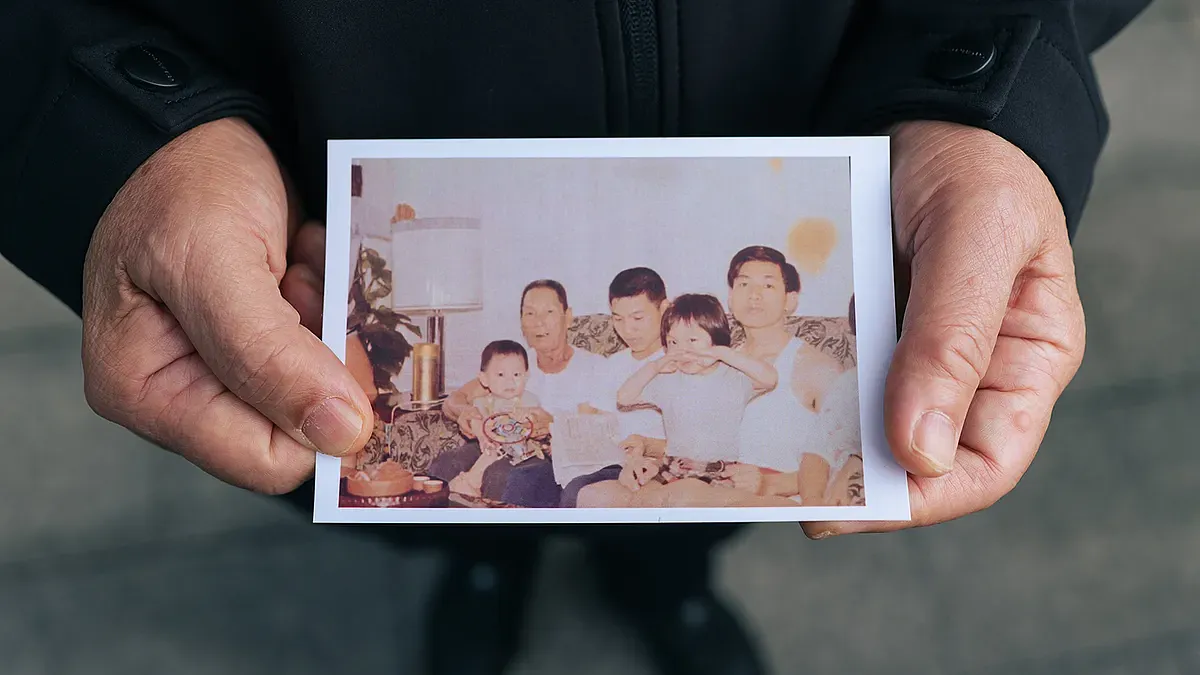
▲ The back of Mr. Lo, who would also refer to himself as Grandpa Lo during the interview. (Photography / Li Chao-yen)
In 1997, Lo Ming-tsun, who rose to prominence for investigating the Chen Chin-hsing case, made headlines after being accused of taking bribes in violation of his official duties. Mr. Lo, who ran an import-export trading business, was in Hong Kong at the time and received a newspaper clipping faxed by his wife. However, Lo Ming-tsun told reporters that he had an alibi and was not afraid, and Mr. Lo believed the judiciary would uphold justice for Lo Ming-tsun.
Carrying hope, Mr. Lo returned to Taiwan and immediately sought out Lo Ming-tsun. He drove Lo Ming-tsun from the Xinzhuang Precinct—where Lo was stationed at the time—along the route to the "Sanluliu Tea Art House" parking lot on Wenhua 2nd Road in Guishan, Taoyuan, where the bribery and collusion were alleged to have been negotiated. They timed and noted the intersections they had to pass through to prove that it was physically impossible for Lo Ming-tsun, who was chairing a meeting at the Xinzhuang Precinct at the time, to have traveled to Guishan in such a short period.
At the same time, Lo Ming-tsun also possessed ample alibi evidence, such as drawing his firearm and meeting minutes from that day, yet the courts failed to accept them. Recalling the times he accompanied Lo Ming-tsun through interrogations, lie detector tests, court trials, and indictments, Mr. Lo felt increasingly disappointed with Taiwan's judiciary:
The era I grew up in, although we only encountered the 228 Incident the year before last, I didn't believe there could be so many wrongful accusations, but today I believe it. If you prosecutors have fairness and justice, you should go investigate immediately, right? Didn't the High Court rule us not guilty, right? It's written in the judgment, anyone can look it up online, right? It's strange how their conscience isn't troubled... How could the Investigation Bureau's interrogation record be written so viciously... They should have continued investigating, but instead of doing that, they indicted him, and this time the Control Yuan's report states that the interrogation records are severely untruthful, and another Control Yuan report points out human rights violations. Up until now, only the JRF cares...
During the interview, Mr. Lo continually recounted the various injustices Lo Ming-tsun suffered within the judicial system, his anger and heartache self-evident (The Lo Ming-tsun Case: A Wrongful Conviction Treated Like a Football):
- There is no physical evidence in this case; conviction relied primarily on testimonies obtained through improper interrogations.
- Regarding the time the court determined Lo Ming-tsun met with the briber, he has an alibi.
- The lie detector report used by the court as corroborating evidence for conviction is flawed (The Lo Ming-tsun Case: Lie Detector Reports Can Lie).
- He should have been finally acquitted, but due to the prosecutor's prolonged delay in signing for the judgment to evade the statutory appeal period, he was wrongfully convicted again.
Faced with the judiciary's repeated apathy, Mr. Lo said, "How is one supposed to swallow this suffering?"
From the Pride of the Village to Family Traum
Lo Ming-tsun comes from a chicken/duck farming family in Chaochou, Pingtung, and is the third of seven siblings. Due to family poverty, after graduating from senior high school, he chose to study at the Police Officers' Academy (now: Central Police University). Mr. Lo proudly shared that Lo Ming-tsun studied very hard and performed exceptionally well. After taking up a career as a police officer, he became a criminal division squad leader in his 30s and was once commended by the Minister of the Interior, who awarded him a police medal.

▲ Lo Ming-tsun once received a certificate of merit awarded by the Commissioner of the National Police Agency. (Provided by / Mr. Lo)
However, the former pride in Mr. Lo's words has been ruthlessly shattered by the judiciary: "Such a promising young man, his entire future dashed, dragging down his entire family and all his relatives." Both Lo Ming-tsun's family of origin and the family he built himself as an adult have long since collapsed like ruined walls.
Mr. Lo recalled that when their father learned of Lo Ming-tsun's trouble, he collapsed and was paralyzed for a time, and thereafter dared not mention it again for fear of gossip from neighbors. Mr. Lo said bitterly, "I carry shame within my family because when my father passed away, Lo Ming-tsun couldn't come to mourn. While our father was alive, he certainly must have wondered how Ah-tsun could have been involved in corruption, sentenced to 13 years, 24 years, and facing two more cases." "When Father passed away, relatives all came and asked why Ming-tsun wasn't seen. Because we hadn't told outsiders, and people in the countryside read newspapers less, they didn't know how miserable Ming-tsun's situation was." The inquiries from relatives and friends that were difficult to answer became wounds the family could not bring themselves to speak of.
Until his dying breath, their father still worried about Lo Ming-tsun. Mr. Lo said, "When Father was passing away, he took my hand and said Ah-tsun hasn't come back yet, Ah-tsun hasn't come back yet..." The Lo family had seven siblings; now, he is nearing 80 years of age, and many of his relatives and siblings have also passed away, yet Mr. Lo still has not lived to see the day Lo Ming-tsun returns home.
It is not just Mr. Lo who is still waiting for Lo Ming-tsun, but also Lo Ming-tsun's two daughters (Interview with Lo Ming-tsun's Daughter: A 14-Year-Old Girl Who Lied for 20 Years). After the judgment became final in 2009, an unreconciled Lo Ming-tsun fled alone to Vietnam. What left a deep impression on Mr. Lo was the time Lo Ming-tsun's wife came to his office and borrowed a phone to call Lo Ming-tsun. Mr. Lo listened from the side as the couple told each other to take good care of their health, and the unbearable heartache welled up from within.
Mr. Lo had always cared for his younger brother Lo Ming-tsun since childhood. Facing the predicament of Lo Ming-tsun's family, Mr. Lo voluntarily extended a helping hand, providing living expenses and tuition for the children, hoping Lo Ming-tsun's family could steady their footing amidst the turbulence. At that time, Mr. Lo also wrote a letter to Lo Ming-tsun's daughters: "I told your sisters, as the eldest, you must take responsibility for taking care of your mother and younger sisters, and do your own duties well, so that your father can have peace of mind abroad. One day, your father will surely return safely."
Through 28 long years of longing, the Lo family has still not given up on fighting for Lo Ming-tsun's innocence: "Grandpa Lo carries this psychological pain, and my only wish is that before I die, before I pass away, I must see justice done for Lo Ming-tsun."
On the Road: The JRF Stands Guard, Hoping the Judiciary Will Be Rectified

▲ During the interview that day, Mr. Lo (left) also repeatedly expressed his gratitude to legal officer Kuan-chen (right) and the JRF. (Photography / Li Chao-yen)
At the close of the interview, Mr. Lo expressed his gratitude for the JRF's continued assistance on the long road of standing guard for Lo Ming-tsun's innocence. The JRF legal team submitted an application to the Taiwan High Prosecutors Office's Review Committee for Conviction Cases in May 2024, but it has yielded no results to date. Legal officer Kuan-chen mentioned that the legal team will file for a retrial for Lo Ming-tsun again in March and will continue to visit him, urging Mr. Lo to take good care of his health. Mr. Lo deeply returned his gratitude: "Our Kuan-chen looks upon my Ming-tsun like family, and I certainly look upon Kuan-chen like my daughter." "Having this daughter is truly wonderful."
On the long road of exonerating wrongful convictions, the JRF stands by and accompanies defendants and their families, hoping for improvements in the judicial environment and the correction of erroneous judgments, so that standing guard becomes a force against injustice, wishing Lo Ming-tsun an early return in 2026.
This article is an AI-generated translation of the original Chinese text. In the event of any discrepancy, the Chinese version shall prevail.