
Lin Yu-wen Case
Case Overview
Lin Yü-wen was the director of a kindergarten affiliated with a charitable foundation. The kindergarten had a long-standing practice of accepting special needs children.
In 2012, Lin Yü-wen dismissed Teacher A and Teacher B from the kindergarten after receiving continuous complaints from parents regarding their poor attitude and care negligence.
Dissatisfied, the two teachers filed a grievance with the Labor Department. Following mediation by the district court, they were reinstated, but Lin Yü-wen later discovered suspected improper disciplinary actions by both teachers against special education students at the facility.
After consulting with a lawyer, Lin Yü-wen decided to file a criminal complaint against Teacher A and Teacher B for interference with personal liberty; Lin Yü-wen also sent a written account of Teacher A's prior negligence to the kindergarten parents. Following investigation by the prosecutor, the charges of interference with personal liberty against Teacher A and Teacher B were not indicted. Teacher A filed counter-charges against Lin Yü-wen for false accusation and aggravated defamation. Lin Yü-wen was ultimately sentenced to six months' imprisonment for false accusation and three months' imprisonment for aggravated defamation, which became final.
Disputes in This Case | Regarding the Charge of False Accusation:
Article 169, Paragraph 1 of the Criminal Code: "A person who, with intent to cause another person to be subject to a criminal or disciplinary disposition, lodges a false complaint with a competent public official shall be sentenced to imprisonment for not more than seven years."
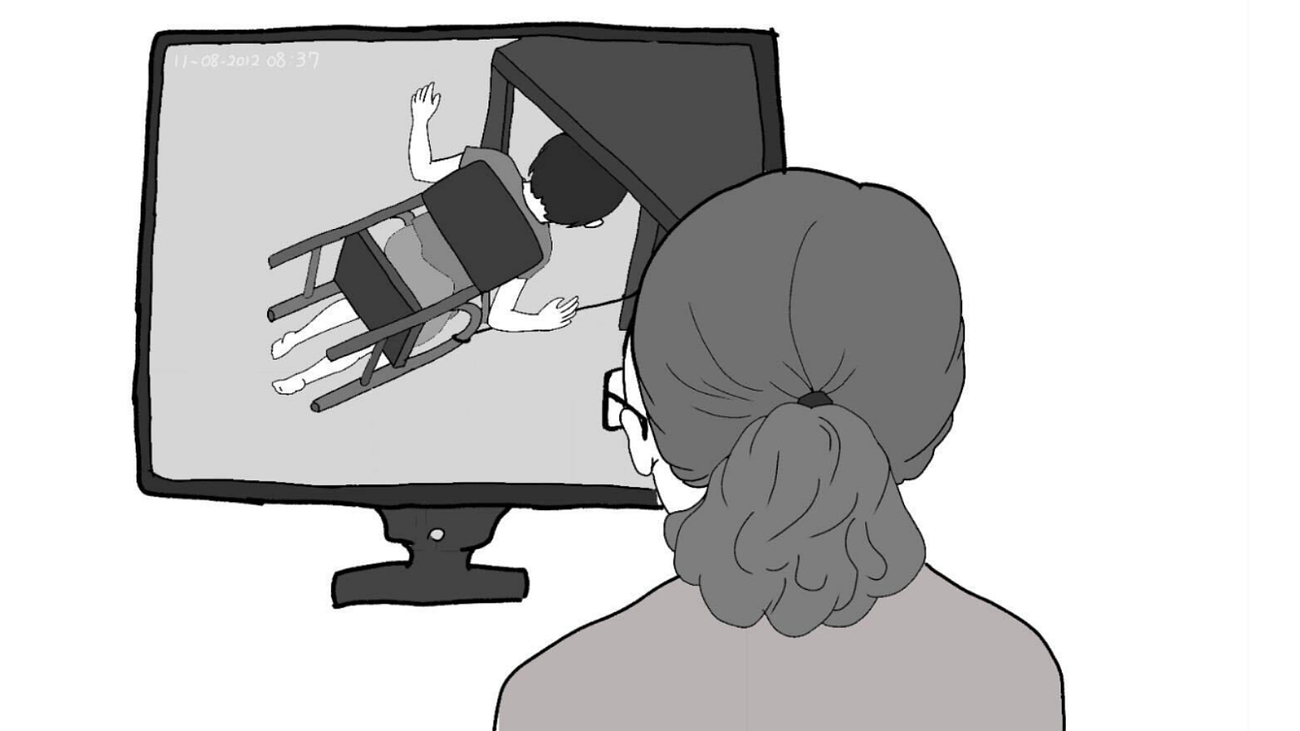
Lin Yü-wen observed via surveillance footage that the teachers had tied a special needs student to a chair, slapped the student's face and forehead, and other acts, believing these constituted improper discipline. After consulting a lawyer, Lin Yü-wen filed a complaint with the prosecutor for interference with personal liberty.
Did Lin Yü-wen genuinely commit false accusation?
Dispute 1: What Happened?
Court: The kindergarten caretakers' act of restraining the special needs student in a rattan chair constituted a protective measure, and no slapping of the face was observed on the surveillance footage. The footage suspected of showing forehead-slapping, when played at normal speed, appeared to be a gentle patting motion.
Lin Yü-wen: The surveillance footage confirms that the nursery workers deprived the child of personal liberty and committed improper acts such as slapping the face and forehead. Furthermore, tying students to chairs and dragging them cannot be considered protective measures.
Dispute 2: Did Lin Yü-wen Verify the Facts?
Court: Surveillance footage alone cannot establish that the teachers committed improper acts; other evidence should have been sought. Moreover, Lin Yü-wen should not have concluded that the behavior was improper after viewing the surveillance at double speed, thereby failing in the duty of verification.
Lin Yü-wen: After carefully reviewing the surveillance footage, improper teacher behavior was clearly visible. Crucially, Lin Yü-wen consulted an attorney and filed the complaint for interference with legal liberty with the attorney's assistance.
Dispute 3: Did the Teachers Interfere with Personal Liberty (Improper Discipline)?
If a special education student falls under the definition of "students with emotional and behavioral problems" pursuant to Article 9, Subparagraph 4 of the Enforcement Rules of the Special Education Act and exhibits behavior that harms others, tying them to a rattan chair does indeed constitute a protective measure. However, teachers are legally required to establish a "behavioral function intervention plan" within the Individualized Education Program (IEP). Restricting a student's behavior without establishing such an intervention plan violates the Special Education Act.
The special needs student in this case was diagnosed as developmentally delayed by the Changhua Christian Hospital, and therefore an Individualized Education Program (IEP) was legally required—an educational plan formulated for students with physical and mental disabilities who have special education or related service needs, to ensure that every student with disabilities can receive adaptive education. Teachers must follow the contents of the IEP when administering discipline. The actions of the two nursery workers were improper, such as dragging a student seated in a rattan chair and repeatedly failing to immediately help up a special education student seen struggling after falling to the ground.
Disputes in This Case | Regarding the Charge of Defamation:
Issues Raised by the Term "Naptime"
Because Lin Yü-wen had previously issued a public announcement to parents and other teachers that damaged the reputation of the kindergarten teachers, the teachers filed a criminal complaint for written defamation against Lin Yü-wen. The court sentenced Lin Yü-wen to three months' imprisonment. The excerpted content of this announcement regarding this teacher reads as follows: "Due to repeated complaints from parents regarding poor attitude and, during naptime on March 5, 2012, a failure in vigilance allowing a newly enrolled child to wander out onto the main road outside the kindergarten, Caretaker XXX was still asleep and completely unaware."
Pursuant to Article 310, Paragraph 3 of the Criminal Code: "A person who commits defamation by pointing out or spreading facts that can be proven to be true shall be exempt from punishment." In this announcement, the definition of the term "defamatory fact" is highly controversial because, after investigation, the teacher did indeed allow a student to wander out onto the road, but not due to negligence from sleeping, but rather because she went to check on the condition of other students. If the core of the alleged defamatory statement was allowing the student to wander onto the road, Lin Yü-wen should have been acquitted.
However, the court held that the wording "was still asleep and completely unaware" deliberately emphasized that the teacher was in a nap state at the time, causing parents to doubt the teacher's professionalism and dedication, thereby damaging her reputation.
This Association's Constitutional Interpretation Petition Regarding the Crime of Defamation
Objective:
The "aggravated defamation" applied in the judgment of this case and "Grand Justices' Interpretation No. 509" violate the principle of legal clarity, and are suspected of conflicting with Article 8 of the Constitution (personal liberty), Article 11 (freedom of speech), Article 23 (principle of proportionality and principle of legal clarity), and Article 7 (principle of equality and prohibition of arbitrariness), thus raising constitutional doubts.
1. Violation of the Principle of Legal Clarity:
Article 310, Paragraph 1 of the Criminal Code stipulates: "A person who, with intent to spread to the public, points out or circulates facts that are sufficient to damage another person's reputation commits the offense of defamation, and shall be sentenced to imprisonment for not more than one year, detention, or a fine of not more than five hundred yuan." Paragraph 3 provides: "A person who commits defamation by pointing out or spreading facts that can be proven to be true shall be exempt from punishment." The constitutional doubts of the provisions in question are discussed separately below:
(A) Regarding "Spreading to the Public":
First, the defamation provision under Article 310 of the Criminal Code sets "spreading to the public" as an element of intent, with the standard for determination being whether there is a "risk of damaging another's reputation." However, it lacks an objectified standard for damaging another's reputation, unlike the offense of insult which requires the objective circumstance of "publicly" to be established. Instead, the determination of defamation falls back on the subjective judgment of the adjudicator as to whether a "risk sufficient to damage reputation" exists, leading to the following dual subjective determinations:
- The determination of the intent to spread to the public has almost become a formal subjective judgment.
- Whether it is sufficient to damage another's reputation is judged solely on the factual statements themselves to determine whether they pose a risk of damaging reputation.
This type of determination lacks an objectified standard, resulting in standards that fluctuate between lenient and strict.
Secondly, the crime of defamation lacks clear regulations regarding the medium and method of speech transmission. For example, if information is communicated orally or in writing to a single individual at different times, does this constitute the subjective state of mind of "spreading to the public"? Or must information be communicated to a multitude of people at the exact same time to possess the subjective state of mind of "spreading to the public"?
(B) Pointing out or circulating facts sufficient to damage another's reputation:
Does this element mean that the core matter of the speech concerns another's reputation, or that the speech as a whole concerns another's reputation? Or can it be viewed in a severable manner? To state the issue briefly: whether a sentence damages another's reputation is to be judged by the main idea conveyed by the sentence? Or by whether the content of the entire sentence causes damage to the party's reputation? Or by extracting a certain fragment from the sentence to establish damage to reputation?

(C) Pointing out or spreading facts that can be proven to be true:
Does the ability to prove the truth refer to the core matters of the speech being proven true, or the speech as a whole being proven true? Or can the speech be severed so that a certain portion can be proven true?
Summary:
The first point lapses into the adjudicator's subjective determination, while the second and third points lack a unified standard in practice, leaving citizens unable to clearly understand under what circumstances they will be penalized for defamation, thus raising doubts of violating the principle of legal clarity.
In addition, there is the question of the degree of proof required. Although Interpretation No. 509 proposed "reasonable grounds for firm belief in its truthfulness" as a substantive constituent element of defamation, judicial practice lacks a stable review standard, generally dividing into the following two standards:
- All stated facts must conform to reality in order to meet the requirement of having reasonable grounds for firm belief in their truthfulness.
- Visible evidence roughly conforms to the facts, which can then be recognized as having reasonable grounds for firm belief in its truthfulness.
Adjudicators frequently choose standards and methods of verification in individual cases based on their subjective preferences, making it impossible for the public to foresee the scope of application of this article, thereby violating the principle of legal clarity.
2. Violation of the Right to Equality and the Principle of Proportionality
Regarding the Principle of Equality:
The right to equality guarantees substantive equality in people's legal status, requiring that things essentially the same be treated the same, and prohibiting arbitrary and unjustified differential treatment. It requires that "likes be treated alike; unlikes be treated unlike," and prohibits arbitrary and unjustified differential treatment.
- Different communication media have different impacts, yet they are subjected to the same aggravated defamation charges. For example, newspapers and student contact books have vastly different audience scopes, yet the legislation does not provide differential treatment on that basis.
- Interpretation No. 509 was an interpretation rendered regarding the freedom of speech of news media, yet the text makes no distinction between media speech and non-media speech. In practical application, this gives rise to the phenomenon where different matters receive identical treatment.
Regarding the Principle of Proportionality:
- Article 310 of the Criminal Code concerning defamation fails to consider whether, under different circumstances, there are less restrictive means that can achieve the same objective (such as civil damages or measures to restore reputation).
To be continued...
Following the dismissal of the appeal by the Supreme Court in Judgment 105-Tai-Shang-3442, the case was finalized. Lin Yü-wen had long since completed serving the sentence, but although the case has concluded, the emotional trauma inflicted upon Lin Yü-wen by this miscarriage of justice can never be erased.
It is hoped that more people will pay attention to the Lin Yü-wen case, and that this case will spark broader discussion regarding the constitutionality of the elements within the chapter on offenses of public insult (particularly the defamation involved in this case).
Ending?
On June 9, 2023, the Constitutional Court rendered Judgment 112-Const.-P.J.-8. The Justices issued a supplementary interpretation of Interpretation No. 509 regarding speech concerning public interest, and dismissed the petitions of several petitioners.
Although Lin Yü-wen was also one of the petitioners whose petition was dismissed, it can be seen from Judgment 112-Const.-P.J.-8 that:
『In situations where the evidentiary material acquired by a speaker through reasonable verification procedures is not actually true, yet serves as the basis for the defamatory speech made by the speaker, as long as the speaker's citation of such untruthful evidentiary material is not based on actual malice or gross recklessness, the speaker may still be eligible for the application of the first segment of Paragraph 3 of the provision in question due to having objectively fulfilled reasonable verification procedures.』
『If a speaker is involved in citing untruthful evidentiary material, the prosecutor or private prosecutor must prove that it was caused by actual malice or gross recklessness before the application of the first segment of Paragraph 3 of the provision in question may be excluded.』
The spirit of freedom of speech is an essential cornerstone of a democratic legal system. In this constitutional judgment, the Justices reaffirmed the balancing between freedom of speech and individual reputation, and we look forward to a society in Taiwan characterized by more rational and amicable speech.