

Public Transparency / Accountability Standards
Dear Donors,
We value every donor. Your support is the driving force that keeps judicial reform moving forward. To strengthen our organizational accountability standards, we have joined the Taiwan NPO Self-Regulation Alliance, holding ourselves to high standards of "financial transparency, fundraising integrity, service efficiency, and good governance." We promise to faithfully fulfill the following covenant and treat every donor with sincerity.
NPO Self-Regulation Covenant
The purpose of this Self-Regulation Covenant is to enhance public awareness and trust in non-profit organizations, help donors understand the operations of non-profit organizations, and encourage non-profit organizations to commit to and practice public credibility and accountability, thereby enhancing their public interest image and social mission.
Article 1 Non-Profit Principle of the Organization
1.1 This organization is willing to adhere to the principle of not distributing surpluses to personnel related to the organization's operations.
Article 2 Organizational Governance and Supervision
2.1 This organization is willing to establish decision-making mechanisms and management systems appropriate for its development.
2.2 The Board of Directors (and Supervisors) of this organization commits to supervising organizational management and financial budgets, fulfilling its governance and oversight functions.
Article 3 Fundraising Integrity
3.1 This organization commits that the relevant information provided in fundraising activities is truthful, reliable, and non-misleading, and is consistent with the organization's mission.
3.2 This organization commits to keeping fundraising costs within a reasonable range.
3.3 This organization commits to conducting public audits (cheng-hsin) on donation data for funds raised, while strictly maintaining the confidentiality of donors' personal information.
3.4 This organization is willing to disclose the amount of donations raised and the flow of their usage.
3.5 This organization is willing to disclose the outcomes of the use of donations.
Article 4 Service Performance
4.1 This organization commits to achieving its work objectives and demonstrating service performance.
4.2 This organization is willing to set specific service targets and propose appropriate evaluation methods to demonstrate service effectiveness.
Article 5 Financial Transparency
5.1 This organization is willing to publish its annual revenues and expenditures every year, provide accurate and timely financial reports, and accept supervision and consultation.
5.2 This organization is willing to regularly make public the flow of the organization's funds.
Article 6 Information Disclosure
6.1 This organization is willing to proactively announce business-related information in a manner easily accessible to the general public.
6.2 This organization is willing to respond actively and accurately to inquiries from the general public regarding organizational operations (such as fundraising practices, fund flows, and service performance) to respect the public's right to know.
Article 7 Conflict of Interest Avoidance
7.1 This organization commits that personnel related to its operations will proactively avoid any transfer of benefits between the organization and individuals.
Donation Acceptance Policy
- To ensure the independence of our oversight of judicial reform, the Foundation does not accept government donations in any form. The Foundation may, under the premise of not compromising the independence of judicial reform oversight, co-organize events with government agencies, administrative corporations, or government-endowed foundations, sharing some or all of the expenses or resources.
- To ensure fairness and impartiality in conducting individual case actions and relief, and to uphold professional ethics, for any party who files a grievance regarding a judicial case with the Foundation, or whose administrative procedures or judicial relief are assisted by the Foundation, the Foundation will not accept donations from them until the conclusion of the procedures for the assisted case.
- If a judicial case grievance filed with the Foundation is rejected by the Foundation, donations from the petitioner will continue to be rejected after the rejection of the case. When a regular, recurring donor files a judicial case grievance with the Foundation, their donations shall be suspended immediately.
Public Auditing and Privacy Protection
- The Foundation will regularly publish information required for public auditing (cheng-hsin) under the Foundations Act, the Charitable Fundraising Act, and the NPO Self-Regulation Covenant on our website.
- Information made public by the Foundation can also be queried on the website of the "Taiwan NPO Self-Regulation Alliance" and the Ministry of Health and Welfare's "Charitable Fundraising Management System."
- Names and titles published for public auditing by the Foundation will be appropriately masked in accordance with the Personal Data Protection Act.
- Donors who do not wish to be included in public audits may fill out a "Statement of Objection to Public Auditing," and the Foundation will use "Friends of Judicial Reform" in place of their real name or title to protect personal privacy.
Charitable Fundraising Permit Numbers
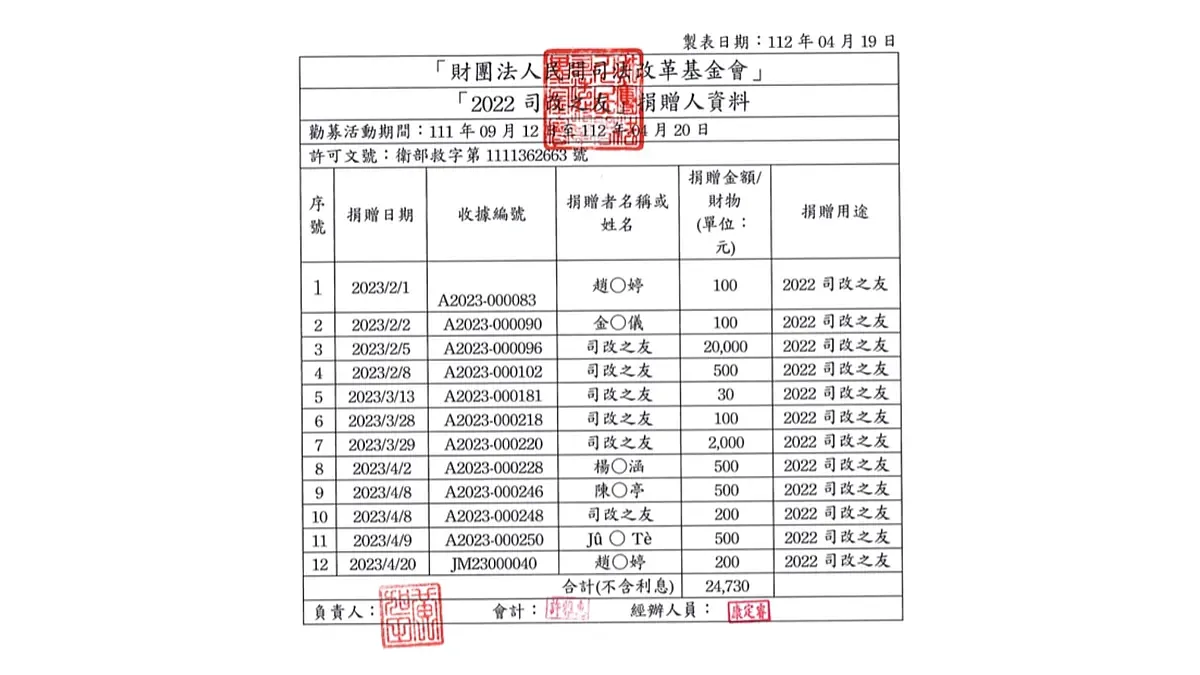
"2022 Friends of Judicial Reform" Wei-Bu-Jiu-Zi No. 1111362663, implementation period from September 12, 2022 to April 20, 2023
"2023 Friends of Judicial Reform" Wei-Bu-Jiu-Zi No. 1121361721, implementation period from May 9, 2023 to April 20, 2024
"2024 Friends of Judicial Reform" Wei-Bu-Jiu-Zi No. 1131360791, implementation period from April 21, 2024 to April 20, 2025
"2025 Friends of Judicial Reform" Wei-Bu-Jiu-Zi No. 1141360935, implementation period from April 21, 2025 to April 20, 2026
"2026 Friends of Judicial Reform" Wei-Bu-Jiu-Zi No. 1151361186, implementation period from April 21, 2026 to April 20, 2027
What laws and regulations govern public disclosure of donations?
Article 25 of the Foundations Act
1. A foundation shall, within one month after the start of each fiscal year, submit its work plan and budget for the current year, and within five months after the end of each year, submit its work report and financial statements for the preceding year, to its board of directors for approval and then file them with the competent authority for record. Where the work plan and budget involve countries or regions at high risk of money laundering or terrorist financing, a risk assessment report shall also be attached.
2. Where a foundation has supervisors, the aforementioned work report and financial statements shall, after approval by the board of directors, also be sent to all supervisors for individual review, and be filed with the competent authority for record together with the supervisory report for the preceding year prepared by the supervisors.
3. A foundation shall proactively disclose the following information:
(1) The materials filed with the competent authority for record under the preceding two paragraphs, to be disclosed within one month after such filing. However, materials of government-endowed foundations shall not be disclosed where their disclosure would jeopardize national security, diplomatic or military secrets, overall economic interests, or other major public interests, and the competent authority has given its consent.
(2) The rosters of subsidies and donations received and of grants and donations paid out for the preceding year, disclosing only the names or titles of the providers and recipients and the amounts involved. However, such information shall not be disclosed where the provider or recipient has objected in writing in advance, or where disclosure would hinder or seriously affect the foundation's operations, and the competent authority has given its consent.
(3) Other information designated by the competent authority to be disclosed within a specified period as necessary for public oversight.
4. For foundations whose financial statements must be audited and certified by a certified public accountant under Paragraph 2 of the preceding article, the competent authority may set up a website and require them to upload all or part of the information subject to proactive disclosure to that website.
Article 26 of the Foundations Act
Unless otherwise provided by law or otherwise designated by the competent authority, the proactive disclosure of a foundation's information shall be made in one of the following ways:
(1) Publication in newspapers or other publications.
(2) Transmission via telecommunications networks or other means for online public inquiry.
(3) Making the information available for public reading, transcription, photocopying, audio recording, video recording, photographing, reproduction, or duplication.
Paragraph 3, Article 6 of the Charitable Fundraising Act
Where a fundraising organization, for public-interest purposes, raises money or goods from its members or staff, accepts their voluntary donations, or accepts voluntary donations from the public, it shall do so in accordance with Paragraph 1; public schools shall, within two months after the end of the fiscal year, and other fundraising organizations shall, within five months after the end of the fiscal year, report the implementation status and the final income-and-expenditure accounts to the authority that approved their establishment or registration or that supervises them, for record.
Article 18 of the Charitable Fundraising Act
A fundraising organization shall, within thirty days from the day after the end of a fundraising activity, publicly announce and disclose the donors' donation data, the proceeds of the fundraising activity, and the income-and-expenditure report, and file them with the competent authority for record.
Any expenditure of NT$10,000 or more from the proceeds of the aforementioned fundraising activity shall be made by check or by remittance through a post office or financial institution; cash shall not be used.
Article 20 of the Charitable Fundraising Act
A fundraising organization shall, within thirty days after the plan for using the property obtained from a fundraising activity has been fully executed, submit the usage status to its board of directors for approval, then publicly announce and disclose it, and file it, together with the results report, expenditure details, and relevant supporting documents, with the competent authority for record. Where there are justifiable reasons, an extension of no more than thirty days may be requested.
The fundraising organization shall publish the aforementioned filed materials on the competent authority's website, and the competent authority shall conduct annual reviews on a regular basis.
Article 8 of the Personal Data Protection Act
When a government agency or a non-government agency collects personal data from a data subject pursuant to Article 15 or Article 19, it shall expressly inform the data subject of the following matters:
(1) The name of the government agency or the non-government agency.
(2) The purpose of the collection.
(3) The categories of the personal data.
(4) The time period, region, recipients, and methods of the use of the personal data.
(5) The rights that the data subject may exercise under Article 3 and the methods for exercising them.
(6) The impact on the data subject's rights and interests if they choose not to provide personal data when free to do so.
Notification may be waived under any of the following circumstances:
(1) Notification may be waived pursuant to law.
(2) The collection of personal data is necessary for a government agency to perform its statutory duties or for a non-government agency to fulfill its statutory obligations.
(3) Notification would impair the performance of statutory duties by a government agency.
(4) Notification would harm public interests.
(5) The data subject already knows the content of the notification.
(6) The collection of personal data is not for profit and clearly causes no adverse effect on the data subject.
Article 9 of the Personal Data Protection Act
Where a government agency or a non-government agency collects personal data not provided by the data subject pursuant to Article 15 or Article 19, it shall inform the data subject of the source of the personal data and the matters listed in Subparagraphs 1 to 5 of Paragraph 1 of the preceding article before processing or using the data.
Notification may be waived under any of the following circumstances:
(1) Any of the circumstances listed in Paragraph 2 of the preceding article applies.
(2) The personal data has been disclosed by the data subject themselves or has otherwise been lawfully disclosed.
(3) Notification cannot be given to the data subject or their legal representative.
(4) The collection is necessary for statistics or academic research in the public interest, provided that the data, after processing by the provider or through the manner of its disclosure by the collector, can no longer identify any specific data subject.
(5) The personal data is collected by mass media for news reporting in the public interest.
The notification under Paragraph 1 may be made at the time of the first use of the data vis-à-vis the data subject.
What happens if a donor does not wish their donation or in-kind gift information to be made public?
Donor names are published only with the donor's consent. If there is an error, a correction is needed, or you prefer not to have your full name published, please contact our Resource Development Department. If you do not wish your donation, grant, or subsidy to be disclosed, please download the Statement of Non-Consent to Public Disclosure, complete it, and return it by post, by fax, or as a scanned copy via email.

2024
Public Financial Disclosure | JRF Donation and Grant Disclosure List for April–June 2024

2024
Public Financial Disclosure | January–March 2024 JRF Financial Disclosure Registry

2024
Public Financial Disclosure | 2023 Friends of Judicial Reform Public Fundraising Campaign
Public Financial Disclosure | 2023 Friends of Judicial Reform Public Fundraising Campaign
2024
Public Accountability | JRF Donation and Financial Disclosure List: July–September 2023
List of donations, subsidies, grants, and contributions received and disbursed by JRF from July to September 2023 in…

2023
Public Financial Disclosure | April–June 2023 JRF Donor and Financial Disclosure Registry
Financial disclosure registry of the Judicial Reform Foundation for April to June 2023, published in accordance with…
2023
Public Financial Disclosure | JRF List of Donors and Supporters for January–March 2023
List of donations, subsidies, and grants received or provided by the Judicial Reform Foundation from January to March…

2023
Public Financial Disclosure | 2022 JRF Financial Disclosure List
2023
Public Financial Disclosure | 2022 Judicial Reform Friends Public Fundraising Project
Public Financial Disclosure | 2022 Judicial Reform Friends Public Fundraising Project