
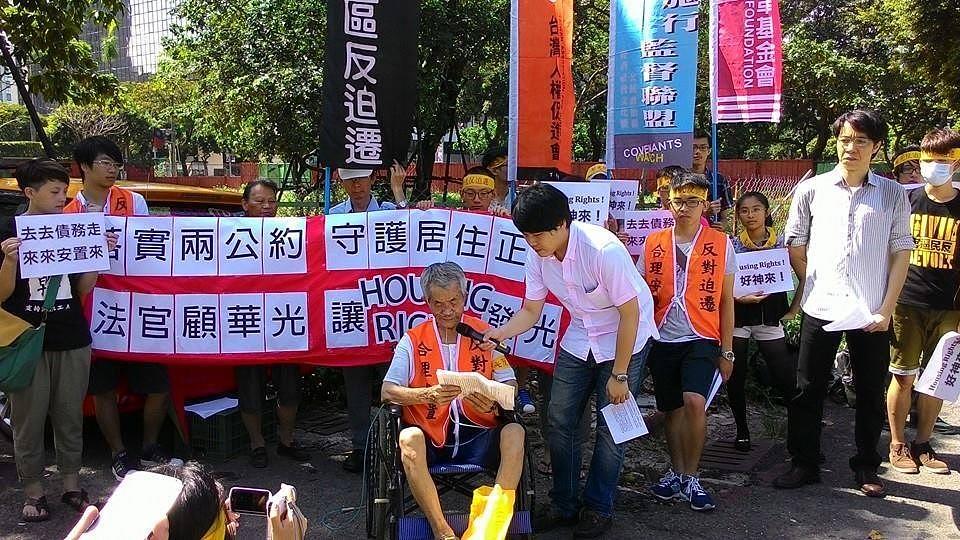
Huaguang Anti-Demolition Case
Table of Contents
I. Introduction to Huakuang Community
Huakuang Community is located in Taipei City, surrounded by Hangzhou S. Rd., Chinshan S. Rd., Jinhua St., and Lane 25 of Hangzhou S. Rd. Covering nearly 10 hectares, it was formerly the dormitory area for the Taipei Prison and judicial personnel. Residents living there can be roughly divided into three types: legal dependents, illegal dependents, and illegal building occupants (informal settlers). The Huakuang Student Investigative Team entered the community in late 2013 to protest alongside the informal settlers.
"Illegal building occupants" is an imprecise term used by the government for residents lacking land titles. Referring to the International Covenant on Economic, Social and Cultural Rights (hereinafter ICESCR), these residents are informal settlers and cannot be compared to rooftop additions or ordinary "illegal buildings." Huakuang Community was an early peripheral area of Taipei City's urban development. Before the Taipei Prison relocated, aside from judicial personnel, residents there were largely vulnerable populations formed by rural-to-urban migrants.
According to the Investigative Team's surveys, residents living in informal buildings included not only 1950s and 1960s rural-to-urban migrants, but also many lower-ranking civil servants from the early prison system and second- or third-generation judicial personnel. Residents often said: If one truly had money, who would be willing to stay in a house with such poor living conditions? Therefore, residents were not, as the government claimed, sudden land-grabbing plunderers, but rather vulnerable populations who had long provided the labor necessary for urban development.
The land of Huakuang Community belongs respectively to the District Court, High Court, and Taipei Detention Center, and was reclaimed in batches by the Ministry of Justice around 2002. The government first targeted residents living in dormitories, distinguishing between so-called legal and illegal occupants; however, past lax dormitory management resulted in more than half of the residents falling into "illegal dependents," leaving them unable to receive any compensation. On the other hand, residents living in informal buildings already held inferior rights under the law, making them naturally extremely vulnerable when facing a powerful state apparatus.
II. Records of the Huakuang Protest Movement
"Looking at the nearly one year of protests in Huakuang Community, more than 50 people faced state criminal prosecution successively. Except for one case handled under the Assembly and Procession Act, all others were for obstruction of justice."
——Taiwan Association for Human Rights / Judicial Reform Foundation 2014 Movement ObservationMarch 27 First Wave of Forced Demolition──District Court Uses Excavators to Demolish Houses with People Still Inside
The first wave of forced eviction began on March 27, 2014. The two households selected by the government at the time had already found places to live outside on their own, prompting the government to publicly claim they owned property and needed no resettlement. However, the facts were far from this—had the government not repeatedly broken its promises, residents would not have had to leave the land where they grew up. Purchasing a house at a low price from relatives simply out of fear of having nowhere to live after their home was demolished could also become a factor for forced eviction, showing that the government stopped at nothing to reclaim the land.
On the day of the March 27 forced eviction, in addition to deploying supporters outside the houses, multiple people inside and on the roofs tied themselves to the houses. However, during the execution process, the District Court disregarded safety and proceeded to demolish houses with people still inside using excavators, turning from a bystander into a protagonist by repeatedly insulting supporters present and threatening to refer them for obstruction of justice. True to their word, they subsequently referred 5 residents and 26 supporters.
April 24 Second Wave of Forced Demolition──Police Block Roads 13 Hours Early, 14 Supporters Arrested
Prior to the second wave of forced eviction, the Investigative Team went to the residence of then-Premier Jiang Yi-huah to hold up banners downstairs, and a team member was also referred under the Assembly and Procession Act.
Before the April 24 forced eviction, a peaceful concert was held the night before. Police suddenly blocked the streets in advance, separating residents from supporters, and deceived Jinhua Street business owners by breaking their promise to allow them to do business. That evening, because a resident refused to take a detour home and police failed to respond in any way, residents and students grew infuriated and demanded the removal of road barricades. In a series of conflicts, multiple supporters were arrested and transferred to the Da-an Precinct that very night.
By the early morning of the next day, as demolition equipment entered, another wave of clashes occurred, and police made arrests in the chaos. On the day of the April 24 forced eviction, 14 supporters were transferred, and prosecutors subsequently added a ringleader, making a total of 15 people prosecuted for obstruction of justice.
May 23 Executive Yuan Press Conference──Demanding the Central Government Face the Huakuang Issue
To break the deadlock of the Huakuang movement and demand that the central government confront the issue, Huakuang Community held a press conference at the Executive Yuan. After failing to achieve a dialogue with officials following the meeting, crowds and police engaged in pushing and shoving. Afterwards, one supporter was indicted, and the first instance sentenced them to 3 months for obstruction of justice.
August 27 "Shell-Broken Snails, Penance Among Ruins"──Last Community-Centric Event
The final community-centered event for Huakuang Community was the August 27 "Shell-Broken Snails, Penance Among Ruins." At that time, dozens of people in the penance group carried rubble and furniture from the community, walking all the way from Huakuang Community to Ketagalan Boulevard; simultaneously, the main contingent also departed from Huakuang Community, passing through the Executive Yuan, and finally converged with the penance group at Ketagalan Boulevard.
After the march ended, the crowd temporarily redirected to the Ministry of Justice, demanding that the Ministry step forward to resolve the issue and implement the Two Covenants. At that time, the crowd gathered at the entrance of the Ministry of Justice, chanting "Huakuang Community is here on official business"; the Ministry's reaction was to demand forceful law enforcement, deploying the Special Police Force to aggressively clear the supporting crowd, and afterwards, two team members were referred under charges of obstruction of justice.
III. Litigation Outcome Statistics
The table below shows the statistics of disposition results for defendants subjected to criminal prosecution following various protest events in the Huakuang anti-demolition case.
| Protest Event Date | Non-Prosecution | Conditional Non-Prosecution upon Confession | Indictment | Acquittal / Conviction | Total |
|---|---|---|---|---|---|
| 2014-03-27 Forced Eviction | 31 | 0 | 0 | 0/0 | 31 |
| 2014-04-24 Forced Eviction | 5 | 5 | 5 | 0/5 | 15 |
| 2014-05-23 Executive Yuan Press Conference | 0 | 0 | 1 | 0/1 | 1 |
| 2014-08-27 Penance Action | 2 | 0 | 0 | 0/0 | 2 |
| Total | 38 | 5 | 6 | 0/6 | 49 |
IV. JRF Press Releases
Huakuang Private Law Dispute, Police Abuse Police Powers Act ~ Have We Returned to a "Police State"?
Co-issued by: Parliamentary Office of Legislator T'ien Ch'iu-chin, Covenants Watch, Judicial Reform Foundation
Attendees: Legislator T'ien Ch'iu-chin of the Legislative Yuan, Kao Jung-chih, Attorney and Vice Convener of Covenants Watch, Lu Shih-wei, Pro Bono Defense Attorney
Regarding the renewed demolition of Huakuang Community on April 24, where police cordoned off streets 13 hours in advance and arrested 14 supporters, this press release raises three major accusations: (1) The Ministry of Justice violates the law while knowing it, taking the lead in breaking the law, disguising the forced eviction case as a "private dispute" and relegating it to private law; (2) Police blindly obey and abuse Articles 6 and 27 of the Police Powers Act as the basis for establishing "exclusion zones"; (3) Violation of General Comments No. 4 and No. 7 of the ICESCR, severely infringing upon substantive and procedural guarantees of people's "right to housing."
V. Further Reading and External Resources
Below are related in-depth reports and materials on Huakuang Community, forced eviction issues, and the right to housing. Clicking will open them in a new tab.