
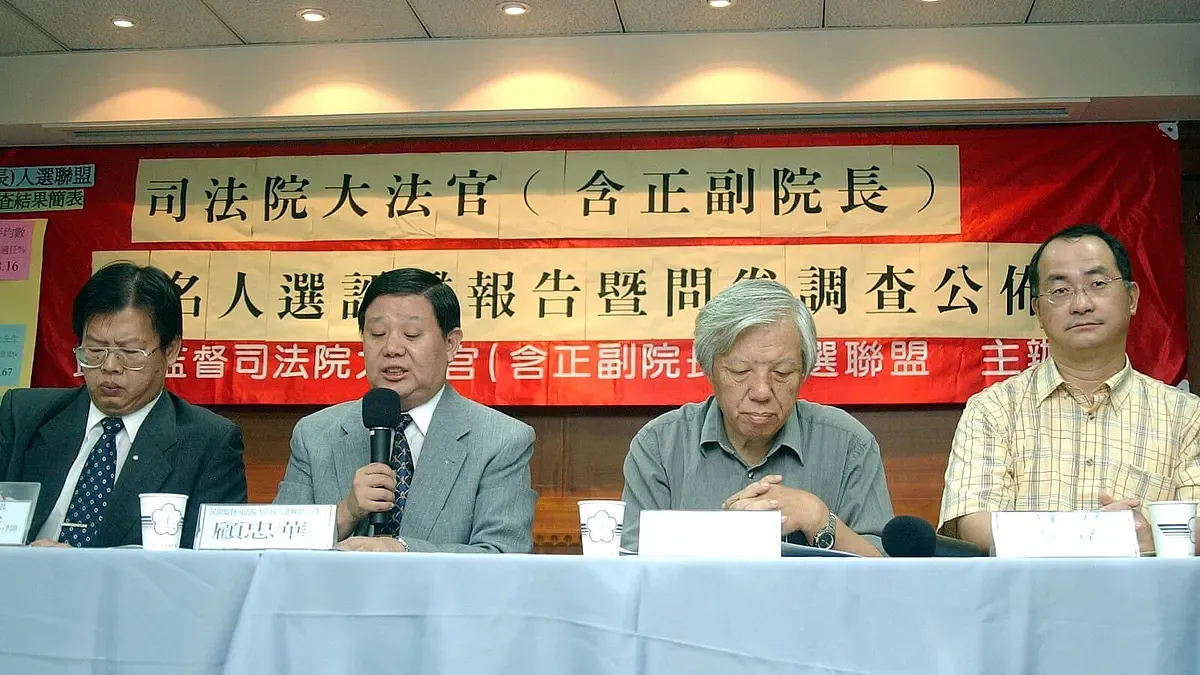
Evaluation Report on Mr. Ch'en Chung-mo's Unfitness for the Position of Grand Justice and Vice President of the Judicial Yuan
Last edited: 2026-07-27
I. Introduction
The judicial power has always been the cornerstone of the national constitutional system and social fairness and justice. In the past, the Grand Justices of the Judicial Yuan played an important role in Taiwan's democratization and constitutional development, and made great contributions to interpreting the Constitution to protect human rights. Moreover, the term of the current Grand Justices will expire on October 2 of this year (2003), and the next batch of Grand Justices (including the President and Vice President of the Judicial Yuan) will be the first "guardians of the Constitution" nominated and appointed in accordance with the new system stipulated in Article 5 of the Additional Articles of the Constitution. Based on the above recognition, six organizations—the Cheng-She, Taiwan Association for Law, Taiwan Association for Human Rights (TAHR), bar Association R.O.C. (Taiwan), Taipei Bar Association, and Judicial Reform Foundation (JRF)—initiated the formation of the Alliance for Civilian Monitoring of Nominees for Grand Justices (Including the President and Vice President) of the Judicial Yuan in mid-December last year (2002). Through the spontaneous and independent observation and monitoring power of civil society, they hoped to urge the President and the Legislative Yuan to fulfill their duties of nomination, appointment, review, and consent, while arousing public awareness of the functions of the Grand Justices, thereby popularizing constitutional concepts and human rights awareness.
On January 19, 2003, the "Alliance for Civilian Monitoring of Nominees for Grand Justices (Including the President and Vice President) of the Judicial Yuan" (hereinafter referred to as the Alliance), initiated by the aforementioned six civic organizations, officially announced its establishment. True to its founding purpose, the Alliance focuses on three main tasks: 1. monitoring the President's nomination process; 2. issuing evaluation reports on unfit nominees; and 3. monitoring the Legislative Yuan's review and exercise of the consent power. Since its establishment, the Alliance has been actively operating. Its main activities include: holding multiple press conferences with other civic organizations to understand the expectations of various sectors of society regarding the Grand Justice nominees; having an audience with the President to present the Alliance's core demands; organizing academic seminars on the Grand Justices and the constitutional system; and attending public hearings on Grand Justice qualifications upon the invitation of the Judiciary Committee of the Legislative Yuan.
In April 2003, the Alliance conducted its first questionnaire survey (hereinafter referred to as the first-wave questionnaire) targeting scholars, experts, and lawyers regarding their satisfaction with the performance of party caucuses in exercising their consent power in the Legislative Yuan last year, as well as the governance satisfaction of the President and Vice President of the Judicial Yuan. This survey was completed in late May of the same year [see Attachment 1] and served as reference material for the Alliance's future operations. In late April 2003, the Alliance also began organizing the "Evaluation Committee for Nominees for Grand Justices (Including the President and Vice President) of the Judicial Yuan" (hereinafter referred to as the Evaluation Committee), which is responsible for evaluating unfit nominees for Grand Justices (including the President and Vice President of the Judicial Yuan). It was initially decided that the Evaluation Committee would consist of fifteen members, comprising two representatives delegated by each initiating organization, along with three independent and impartial figures invited to serve as evaluation members. In early May of the same year, because the Taipei Bar Association and the Taiwan Association for Law—both initiating organizations—recommended external candidates for Grand Justices, the Alliance resolved in a meeting, in order to ensure the credibility of the Evaluation Committee, that the Taipei Bar Association and the Taiwan Association for Law would not participate in the future operations of the Evaluation Committee. Instead, the other initiating organizations (Cheng-She, TAHR, bar Association R.O.C. (Taiwan), and JRF) would each dispatch three representatives to form the Evaluation Committee together with the three independent and impartial members. Furthermore, the Alliance formulated the "Organization and Evaluation Regulations of the Evaluation Committee for Nominees for Grand Justices (Including the President and Vice President) of the Judicial Yuan" [see Attachment 2] as the basis for the Committee's future operations.
II. Evaluation Process and Resolution Results of the Evaluation Committee
The Evaluation Committee held a total of six meetings from its first meeting on May 22, 2003, to its final meeting on August 11 of the same year. Each meeting investigated, studied, evaluated, and discussed the background and data of every Grand Justice nominee one by one. In late May 2003, the Evaluation Committee formulated the "Recusal Regulations for Members of the Evaluation Committee for Nominees for Grand Justices (Including the President and Vice President) of the Judicial Yuan" [see Attachment 3]. In addition, it resolved to conduct another questionnaire survey (hereinafter referred to as the second-wave questionnaire)—again targeting legal-political scholars, lawyers, and other experts—to assess the suitability of the fifteen Grand Justice nominees (including the President and Vice President of the Judicial Yuan) nominated by the President. The results of this questionnaire survey were completed in mid-June of the same year [see Attachment 4]. In mid-June 2003, after intensive discussions and the gathering of evidence, the Evaluation Committee preliminarily narrowed down the potential unfit candidates to three Grand Justice nominees. On July 30, 2003, following a careful evaluation of the moral integrity, scholarship, professional performance, and constitutional understanding of these three potential unfit Grand Justice nominees, and based on a secret ballot cast by the thirteen members present, Mr. Ch'en Chung-mo was evaluated by the Evaluation Committee as unfit for the positions of Grand Justice and Vice President of the Judicial Yuan, receiving votes exceeding two-thirds of all fifteen committee members. As for the other two Grand Justice nominees, the number of unfit votes they received did not reach two-thirds of all fifteen committee members, and thus they did not meet the Evaluation Committee's criteria for an unfit Grand Justice. On August 11, 2003, the Evaluation Committee submitted the evaluation process and the contents of the evaluation report concerning Mr. Ch'en Chung-mo's unfitness as a Grand Justice and Vice President of the Judicial Yuan to the Alliance meeting for approval. The Alliance resolved to publicly release the evaluation results on August 17 of the same year, detailing the reasons and evidence as follows.
III. Reasons for Evaluating Mr. Ch'en Chung-mo as Unfit for Grand Justice and Vice President of the Judicial Yuan
1. Mr. Ch'en Chung-mo had severe flaws in approving the execution of the death penalty during his tenure as Minister of Justice
The Alliance believes that during his past tenure as Minister of Justice, Mr. Ch'en Chung-mo handled the procedures for approving death penalty executions with severe contradictions and flaws. Furthermore, his understanding and awareness of the concept of human rights protection were insufficient, making him unsuited for the position of Grand Justice safeguarding human rights. Regarding this point, an investigation report issued by the Control Yuan on December 1, 1999, explicitly pointed out that "the Ministry of Justice indeed had 'flaws' in the approval procedures for the execution of death row inmates Chou Hsun-shan, Chuang Ch'ing-chih, Jonathan Maala Burgos, Liu Yen-lung, and T'ang Ming-hsiung" [see Attachment 5]. Among them, the three individual cases of Chou Hsun-shan, Chuang Ch'ing-chih, and the Philippine national Burgos occurred precisely during Mr. Ch'en Chung-mo's tenure as Minister of Justice, demonstrating that Mr. Ch'en's handling of death penalty approval procedures during his time as Minister of Justice was indeed questionable.
Specifically, taking the Chou Hsun-shan case as an example, the Control Yuan's investigation results showed: "Before the Supreme Prosecutors Office submitted the relevant case files to the Ministry of Justice on October 14, 1998, it had never confirmed whether Chou Hsun-shan and his defense counsel had received the judgment document." Moreover, "the prosecutor handling the case at the Ministry of Justice submitted it step-by-step up the administrative hierarchy to the Minister on the same day, and the execution of the death penalty was approved by the Minister within a single day, namely, October 15." "On October 19, Chou Hsun-shan filed an application for an extraordinary appeal with the Supreme Prosecutors Office and petitioned the Ministry of Justice to stay the execution of the death penalty. The Supreme Prosecutors Office deemed that there were no grounds for an extraordinary appeal, and thus dismissed Chou's application for an extraordinary appeal on the following morning (October 20), executing Chou that same night (estimated to be after 9:00 PM)." Meanwhile, "Chou Hsun-shan's defense counsel only received service of the final judgment on the day after his execution (October 21)" [same as Attachment 5]. In addition, the circumstances surrounding the execution of Chuang Ch'ing-chih and Philippine national Burgos were largely similar to the Chou Hsun-shan case. Notably, Mr. Ch'en Chung-mo, the then-Minister of Justice, took only three days or even a single day to approve the death penalty executions of Chuang Ch'ing-chih and Burgos. Furthermore, "the Ministry of Justice's excessively rapid execution of the death penalty" left the family members and defense counsel of the death row inmates "with virtually no possibility of filing an extraordinary appeal or retrial" [same as Attachment 5].
As is well known, the execution of the death penalty involves the deprivation of the right to life and constitutes a punishment that is irreversible once carried out. It ought to be handled with extreme caution. In modern rule-of-law countries, it is rarely heard of that within a day after all judicial remedies are exhausted, a Minister of Justice hastily approves a death penalty execution, let alone the shocking incident where a death penalty is executed before defense counsel has even received the final judicial judgment documents. However, Mr. Ch'en Chung-mo, the then-Minister of Justice, exhibited the aforementioned questionable aspects in the execution procedures for death row inmates Chou Hsun-shan, Chuang Ch'ing-chih, and Philippine national Burgos. In response, the Control Yuan's investigation report explicitly pointed out: "The Supreme Prosecutors Office submitted the relevant case files to the Ministry of Justice on the very day the defendant Chou Hsun-shan received the judgment document, leaving the defendant's defense counsel with virtually no possibility of filing an extraordinary appeal or retrial. The execution of the death penalty was drafted by the handler on October 14, passed through various levels of supervisors at the Ministry of Justice, and was approved by the Minister (i.e., Mr. Ch'en Chung-mo) the very next day. Within the span of a single day, how could one expect and believe that the Minister of Justice and all levels of supervisors had truly read the judgment and related case files in detail (Note: The Chou case went through five remands and retrials, accumulating as many as 14 volumes of case records and evidence) and verified whether there were grounds for a retrial or extraordinary appeal?" [same as Attachment 5] Furthermore, as stated in the aforementioned Control Yuan investigation report: "The legislative intent requiring executions of the death penalty to be ordered and approved by the Ministry of Justice is to respect the right to life, ensuring that this capital punishment—which cannot be reversed or remedied once executed—is carried out through the most rigorous and prudent mechanism" [same as Attachment 5]. However, during Mr. Ch'en Chung-mo's tenure as Minister of Justice, the crude nature of the death penalty execution procedures not only caused the "review procedure to become a mere formality, and its rapid review could hardly shake off the suspicion of being eager to execute, presenting a major flaw in the protection of human rights" [same as Attachment 5]. How can such disregard for the protection of the right to life qualify someone to undertake the great responsibility of Grand Justices in upholding human rights?!
2. Mr. Ch'en Chung-mo's understanding of the concept of human rights protection is insufficient
Building upon the above, subsequent interviews conducted by the Evaluation Committee with individuals related to the Chou Hsun-shan case revealed that on October 21, 1998, after receiving the Supreme Court's final judgment, Chou Hsun-shan's defense counsel—in order to rescue Chou, whose "life hung in the balance" (Note: at that time, they were still unaware that Chou had already been shot and executed)—proactively invited three organizations: the Taipei Bar Association, the JRF, and the TAHR. Through the arrangement of a legislator, they scheduled a meeting with the then-Minister of Justice, Mr. Ch'en Chung-mo, at the Legislative Yuan on October 23, requesting Minister Ch'en to stay the execution of Chou Hsun-shan's death penalty. Regarding the course of the conversation that day, representatives from the three organizations present pointed out that Mr. Ch'en Chung-mo stated he had read the contents of the Chou Hsun-shan case and believed there were indeed problems with the case, and that it did not necessarily warrant the death penalty, with life imprisonment being the utmost. Moreover, since he took office as Minister of Justice, eighty to ninety percent of the death penalty cases he approved had room for re-investigation and reconsideration. However, just as the attendees thought Minister Ch'en shared their philosophy and were engaged in a pleasant conversation, a staff member suddenly stepped forward to whisper in the Minister's ear. Afterwards, Mr. Ch'en Chung-mo immediately changed his tune, stating that he had previously signed the death penalty execution order for Chou Hsun-shan, and that Chou's death sentence had already been carried out. The representatives of the three organizations and Chou's defense counsel were deeply shocked upon learning that Chou Hsun-shan had already been shot and executed! As the meeting drew to a close, Mr. Ch'en Chung-mo even mentioned twice: he hoped the representatives of the three organizations would not speak of this matter, otherwise it would be disadvantageous to them.
Regarding the above situation, because there was no documentary evidence or audiovisual recordings to corroborate it, the Evaluation Committee, out of an abundance of caution, invited individuals who were present that day to appear in batches at different meeting times to freely state their recollections. Based on the collected evidence, the Evaluation Committee is convinced that the facts of that day should be as described in the preceding paragraph. Accordingly, the Alliance believes that Mr. Ch'en Chung-mo's statements were self-contradictory, his attitude was arrogant and unreasonable, and he was suspected of playing fast and loose with human lives.
Furthermore, although Mr. Ch'en Chung-mo was the Minister of Justice at the time, when subsequently facing questioning from the media and the aforementioned three civic organizations, he unexpectedly claimed that he was merely speaking purely in the capacity of a "criminal law scholar," attempting to blur the solemn role that the Minister of Justice ought to play as a gatekeeper of the death penalty. Even more egregiously, the Ministry of Justice led by Mr. Ch'en Chung-mo at the time even claimed that the service of a judgment and the finality of a case both fell under the jurisdiction of the Supreme Court, and that even if a defendant was executed before their defense counsel received the final judgment, the Ministry of Justice's procedures were still unassailable [see Attachment 6]. Synthesizing the above evidence, the Alliance believes that the responses given by Mr. Ch'en Chung-mo or the Ministry of Justice at the time adequately demonstrate that he downplayed the premature execution of the death penalty beforehand and offered excuses and shifted blame afterward. Therefore, the Alliance has ample reason to doubt what attitude Mr. Ch'en Chung-mo will hold toward related human rights issues once he assumes office as a Grand Justice.
It is reported that the master's thesis in law completed by Mr. Ch'en Chung-mo back then focused on the abolition of the death penalty as his research topic. However, when holding the ultimate authority over death penalty executions, Minister Ch'en was so lacking in caution, which leaves the Alliance deeply worried about whether his commitment to academic theory and human rights principles is firm. Furthermore, as the Minister of Justice—a guardian of justice—whether he failed to carefully review case files and evaluate the case before hastily signing off on a death penalty, or signed the execution order regardless after discovering controversies upon reviewing the files, or continued to display an ignorant and detached attitude after approving and completing the execution, Mr. Ch'en Chung-mo's casual and perfunctory mindset regarding the life and death of death row inmates during his tenure as Minister of Justice is simply unacceptable.
Moreover, as can be seen from the records of the aforementioned Control Yuan investigation report: in October 1998, knowing full well that his approval of the execution procedure for Chou Hsun-shan's death penalty had caused an uproar among civic human rights organizations, Mr. Ch'en Chung-mo actually "persevered" and—adopting the exact same extremely rapid handling model—approved the death penalty execution cases of Philippine national Burgos and Chuang Ch'ing-chih in November and December of the same year, respectively [same as Attachment 5], which leaves a deep impression. A close examination of the execution process of these death penalty cases adequately demonstrates Mr. Ch'en Chung-mo's weak human rights awareness and convictions. The Alliance believes that harboring such a severely distorted human rights record makes him truly unsuited to assume the post of Grand Justice responsible for defending the fundamental rights of the people.
3. Questionnaire analysis results from scholars and experts indicate that Mr. Ch'en Chung-mo is unfit for Grand Justice and Vice President of the Judicial Yuan
In addition to evaluating the professional backgrounds of Grand Justice nominees based on their representative and important publications, judgments, academic credentials, and work experience, the Alliance also surveyed the opinions of legal-political scholars, lawyers, and other experts via telephone interviews or mailed questionnaires in order to gather opinions from the legal professional community regarding the nominees for the President and Vice President of the Judicial Yuan and Grand Justices, thereby minimizing any subjective biases that might arise solely from the Evaluation Committee's independent assessment. According to the results of the Alliance's first-wave questionnaire survey, among the 219 scholars and experts successfully interviewed, 62.56% of respondents expressed satisfaction with Mr. Ch'en Chung-mo's performance as Vice President of the Judicial Yuan up to that point, while 19.18% expressed dissatisfaction [same as Attachment 1]. Secondly, according to the results of the Alliance's second-wave questionnaire survey, among the 110 legal-political scholars, lawyers, and other experts who responded, 69.45% of respondents considered Mr. Ch'en Chung-mo suitable to be a Grand Justice, while 19.44% considered him unsuitable. Not only was the percentage of respondents considering him suitable nearly 9 percentage points lower than the average of the fifteen Grand Justice nominees (78.22%), but the percentage considering him unsuitable was also 11 percentage points higher than the average of the fifteen Grand Justice nominees (8.16%), making him the nominee with the highest percentage of perceived unfitness among all fifteen Grand Justice nominees. Meanwhile, the statistical results of this questionnaire also showed that although 62.61% of respondents considered Mr. Ch'en Chung-mo suitable to be Vice President of the Judicial Yuan, more than a quarter (25.23%) of the responding scholars and experts considered him unsuitable to serve as Vice President of the Judicial Yuan [see Attachment 4]. In other words, the Alliance's questionnaire survey results show that Mr. Ch'en Chung-mo's past performance in the judicial sector was evidently evaluated less than ideally by the professional community, which is quite familiar with the duties of a Grand Justice.
Judging from Mr. Ch'en Chung-mo's past judicial experience as a Grand Justice, Minister of Justice, and Vice President of the Judicial Yuan, his nomination once again—not only having the highest percentage of perceived unfitness as a Grand Justice among all nominees, but also an even higher percentage of perceived unfitness as Vice President of the Judicial Yuan—is well worth the attention and deep reflection of our nation's citizens. After considering this opinion poll of the professional community, the Alliance believes that whether it is appropriate to entrust such an important social public asset of the Judicial Yuan and the heavy responsibility of constitutional interpretation and defense to Mr. Ch'en Chung-mo is a matter that demands careful deliberation.
Furthermore, the second-wave questionnaire issued by the Alliance included an open-ended comments section, allowing respondents to choose whether to fill in comments based on their observations of each nominee. After carefully examining and analyzing the feedback written by respondents regarding each nominee, the Evaluation Committee found that there were an excessive number of comments concerning Mr. Ch'en Chung-mo. Moreover, most of these comments expressed disapproval of Mr. Ch'en Chung-mo's long-term political career and past performance as Vice President of the Judicial Yuan, alongside negative evaluations of his philosophy of judicial reform and his understanding of constitutional human rights. After repeatedly discussing this phenomenon and the content of the comments, the Evaluation Committee decided—under the premise of complying with the professional ethics requirements of questionnaire surveys—to publish these comments to uphold public credibility. For ease of reading, they have been slightly categorized and summarized to serve as a reference for citizens in judging whether Mr. Ch'en Chung-mo is fit for office. Simultaneously, to faithfully present the original appearance, the open-ended comments appearing in the questionnaires are listed separately below (Note: marks such as (003) and (007) indicated after the comments represent the 003rd or 007th questionnaire retrieved by the Alliance):
(1) Constitutional Understanding
- Frequently has excessive political or power considerations, lacking the loyalty, independence, impartiality, and objectivity toward the Constitution that a Grand Justice ought to possess. (003)
- Political ideology is too strong. (004)
- Political stance is too distinct, undermining the image and credibility of the Grand Justices. (012)
- During his tenure as Minister of Justice, he failed to strictly vet the execution of the death penalty, which is inconsistent with contemporary trends. 2. During his tenure as Vice President of the Judicial Yuan, he had prolonged disagreements with the President of the Judicial Yuan that were difficult to coordinate, affecting the operation of the Judicial Yuan and the effectiveness of judicial reform. (098)
- Political stance is overly distinct, lacking a neutral and objective posture. In the past when the Kuomintang was in power, he cultivated good relations with the Kuomintang, whereas now he champions local colors, displaying a strong fence-sitting character. How can he serve as a guardian of the Constitution and a defender of justice? (109)
(2) Professional Performance
- Lacks judicial reform philosophy and deeds, has controversial personal character, and says one thing while doing another. (007)
- Often speaks insincerely and fails to steadfastly adhere to principles. He constantly talks about "abolishing the death penalty," yet during his tenure as Minister, he still approved the execution of death row inmates despite believing the evidence was insufficient. (046)
- Having previously served as Vice President, he failed to assist the President in promoting judicial reform. To avoid him continuing to serve as Vice President based on seniority after becoming a Grand Justice, it is recommended to avoid nominating him as a Grand Justice. (074)
- Party and government relations are too complicated, and he is too bureaucratic. (084)
- Mr. Ch'en's political personality is far too heavy; perhaps he is suited to serve as an administrative official, but serving as a Grand Justice and Vice President of the Judicial Yuan—who must maintain neutrality—is very, very, very, very inappropriate. During his tenure as Vice President of the Judicial Yuan, Mr. Ch'en opposed the President at every turn, which, apart from highlighting his ambition to seize the position of President, fails to reveal any sense of mission he holds toward the judiciary. (096)
(3) Scholarly Ability
- Mr. Ch'en has been an official for too long, and his academic knowledge is likely largely rusty. (017)
- His academic scholarship appears to have stagnated for many years. (042)
- Sloppy in teaching, insincere. (043)
- His scholarship and deportment make him unsuited to be a respected Grand Justice. (110)
4. Mr. Ch'en Chung-mo's autobiography is grandiose and boastful, inconsistent with the dignity required of a Grand Justice
The Alliance believes that, aside from external evaluations and opinions, the statements and assessments made by nominees for the President and Vice President of the Judicial Yuan and Grand Justices regarding their own upbringing, intellectual development process, and professional achievements adequately reveal each nominee's reflections and insights into their past life experiences and professional training. To a considerable extent, this also reflects their views on social justice and constitutional human rights, serving as one of the indicators for assessing their future attitudes toward constitutional interpretation. For this reason, the Evaluation Committee specifically analyzed the autobiography written by the individual nominees. Overall, upon reviewing the autobiographies written by the fifteen Grand Justice nominees, the Alliance found that the autobiographies of the overwhelming majority of nominees were reasonably plain and realistic, with only Mr. Ch'en Chung-mo's autobiography containing multiple grandiose and boastful descriptions. Several passages are selected and presented below [see Attachment 7] for public appraisal:
- ...pored over books at his desk during his freshman year, aspiring to read all the world's masterpieces, historical books, and legal-political classics...
- During his studies in the United States, it coincided with the Diaoyutai Islands dispute. Pondering the purpose of studying the sages and texts, he harbored a grand ambition to take the world upon his own shoulders, deeply realizing that only by serving his homeland could he live up to his birth and fulfill the nation's heavy trust. In the spring of 1971, he resolutely turned down high-paying foreign job offers and embarked on the homeward journey.
- ...in his conduct and dealings with others, he has always taken "fostering the righteous energy of heaven and earth, modeling after the paragons of past and present" as his lifelong vocation. Mindful of this day and night, studying by lamplight in the freezing cold, clearing out the turbid to exalt the pure, bearing hardships without complaint, he is dedicated to his work and harmonious with his peers. As for those studying law, he has adhered even more firmly to the spirit of nurturing people and trees, offering earnest exhortations, guidance, and encouragement with painstaking effort.
- While serving in the Provincial Government, he traveled across all 309 townships and districts of the province, actively offering proposals to regulate rivers and reservoirs, adjust agricultural, industrial, and commercial policies, develop new mindsets and practices for provincial education, and plan the formation of northern, central, and southern metropolitan areas, receiving numerous awards.
- ...having the subject of "Administrative Law" added to the Special Examination for Judicial Officers and the Higher Examination for Attorneys directly stimulated the rapid and vigorous development of public law studies, resulting in distinguished governance achievements and major contributions.
- ...ushering our nation's administrative legal system into a new international era, inspiring all colleagues across the Ministry of Justice to go all out with high morale, and maintaining seamless cooperation with various ministries and councils.
IV. Conclusion
As mentioned above, the candidates for the President and Vice President of the Judicial Yuan and Grand Justices are of utmost importance, as they concern the developmental trajectory of our nation's democracy, rule of law, constitutionalism, and human rights. At the dawn of this new century, an independent and neutral judicial power will serve all the more as the driving force steering our national constitutional system toward excellence. In the past, civil society in our country paid little attention to the nomination and consent processes and outcomes for the aforementioned positions. Consequently, unlike other advanced democratic constitutional nations, we failed to gradually popularize education on democracy, rule of law, constitutionalism, and human rights throughout society through the process of concern and discussion regarding Grand Justice candidates, thereby failing to forge a consensus on constitutionalism and human rights—which is deeply regrettable. In view of this, this spontaneous formation of a civic monitoring alliance by civic organizations marks the first attempt to observe and monitor the nomination and consent processes for the President and Vice President of the Judicial Yuan and Grand Justices, as well as to evaluate the nominees for Grand Justices (including the President and Vice President of the Judicial Yuan). This should be recorded as a notable milestone in the history of our constitutional development. Admittedly, under the realistic constraints of limited information and resources, completing this evaluation work was no easy task. However, all members of the Alliance and the Evaluation Committee carried out discussions, voting, and the drafting of the evaluation report adhering as much as possible to an objective and neutral attitude under the premise of loyalty to professional scholarship and ethical requirements. Although the process and results may fall short of complete perfection, summarizing the discussions, dialectics, and the analysis of the evaluation report by the Alliance and the Evaluation Committee over the past few months, the Alliance concludes that upon evaluating the four major categories of moral integrity, scholarship and ability, professional performance, and constitutional understanding, Mr. Ch'en Chung-mo exhibits aspects worthy of severe censure regarding his philosophy and implementation of human rights protection. Furthermore, within the evaluations of the professional community comprising legal-political scholars and lawyers, Mr. Ch'en Chung-mo's performance also exhibits a distinctly low rating. Finally, coupled with the fact that his autobiography contains no shortage of boastful elements inconsistent with the dignity expected of a Grand Justice, based on the numerous reasons above, the Alliance believes that Mr. Ch'en Chung-mo is unfit for the positions of Grand Justice and Vice President of the Judicial Yuan, and hereby submits this report for the reference of our fellow citizens.
Attachments
- Survey Report on Scholars' and Experts' Satisfaction with the Performance of the Current President and Vice President of the Judicial Yuan (First-Wave Questionnaire)
- Organization and Evaluation Regulations of the Evaluation Committee
- Recusal Regulations for Members of the Evaluation Committee
- Survey Results on the Suitability of Fifteen Grand Justices (Including the President and Vice President of the Judicial Yuan) by Scholars and Experts (Second-Wave Questionnaire)
- Excerpted Edition of the Control Yuan Investigation Report Dated December 1, 1999
- Excerpted Edition of Press Clippings and Ministry of Justice Press Releases
- Autobiography of Mr. Ch'en Chung-mo
This article is an AI-generated translation of the original Chinese text. In the event of any discrepancy, the Chinese version shall prevail.
