
Meeting Notes from the Fourth Session of the Fifth Division of the National Official Conference on Judicial Reform
Last edited: 2026-08-25
- Meeting Summary
This meeting invited Dean Chen Wei-chien of the College of Public Health at National Taiwan University, Director Wu Chien-chang of the Department of Psychiatry at National Taiwan University Hospital, and Prosecutor Wang Chieh-to of the Taiwan High Prosecutors Office to report on drug addiction treatment, alcohol addiction, and the treatment of mental illness.
Committee members Lin Chih-chieh and Lin Wen-wei were on leave for this meeting.
The meeting progressed relatively slowly, with substantial discussions taking place only on items 5-2-1 and 5-2-2. Regarding the treatment of drunk driving and crimes committed by individuals with mental illness, the committee merely invited relevant scholars to provide opinions and asked the Ministry of Justice to submit an assessment and analysis report, with detailed contents left for discussion at the next meeting.
Prior to the meeting, the Second Working Group held a meeting on April 9. Most of the suggestions for modifying the current system proposed during that working meeting were not adopted. Several members believed that the current legal system is already complete, and efforts should instead focus on the enforcement aspect.
Regarding the issue of drug decriminalization, before it was discussed and confirmed in the meeting, media reports drew public attention. The chairperson emphasized during the meeting that this suggestion was merely an initial personal opinion raised by a member, and most other members believed the core problem lies in improving treatment programs. Therefore, drug decriminalization did not become a formal proposal for discussion and was not discussed at this meeting.
The next meeting is scheduled for May 4, where Agenda Item 5-3, "Effective Crime Fighting," and the unfinished discussions from today will be addressed.
Agenda Item 5-4, "Crime Prevention and Management," will be discussed on May 11; Agenda Item 5-5, "Review of Child- and Gender-Friendly Judicial Systems," will be discussed on May 18.
Sub-topics and Discussion Opinions
5-2 Review of Criminal Policies on Substance Abuse and Crimes Involving Mental Illness
Review of Drug Enforcement and Severe Punishment Policies for Drug Offenses, Including the Review of "One Crime, One Penalty" for Drug Use Offenses
Committee member Lu Ying-chieh argued that drug use has a repetitive nature. Following the abolition of continuous offenses, drug use was subjected to "one crime, one penalty." Member Lu believes this will continuously prolong prison sentences and carries the risk of excessive punishment, and thus proposed that when drug use is treated with protective measures as the legal consequence, multiple acts of use should be evaluated comprehensively at once to avoid "one crime, one penalty."
On the other hand, committee member Yu Li-chen stated that this would make drug users think they can use drugs without restriction before a judgment becomes final. Committee member Li Ming-hung, a judge at the Juvenile and Family Court, mentioned that due to the repetitive nature of drug use, even when "one crime, one penalty" applies, judges in practice do not calculate sentences arithmetically during sentencing. Therefore, after discussion, the meeting concluded that there is no need to amend the provision of "one crime, one penalty" for drug offenses.
The Ministry of Justice's opinion is that current drug policies focus heavily on drug enforcement; however, drug addiction is a highly complex issue where social welfare and public health administrations are comparatively crucial. Therefore, the Ministry hopes to weaken the enforcement aspect in the direction of reform and strengthen the roles of social welfare, public health, and education. Nevertheless, in the current resolution regarding the Ministry's proposal to lower the possession threshold of Category 3 and Category 4 drugs from "20 grams," the rationale was primarily to use the possession amount to distinguish personal use from trafficking, with the latter posing a higher social risk that warrants a distinction in sentencing. The Ministry considered the current "20 grams" rule to be somewhat lenient and thus planned to lower the gram threshold for possessing Category 3 and Category 4 drugs to expand the scope of punishment. This approach of strengthening the intensity and scope of drug enforcement seems contradictory to its aforementioned opinion that drug enforcement policies should be weakened. Committee member Hsu Shih-feng noted that inferring potential trafficking based on the possession amount to impose heavier penalties violates the presumption of innocence. Furthermore, what the quantity standard should actually be and how it should be established remain more core issues.
Committee member Lu Ying-chieh proposed in her written materials to review the offenses and penalties under the Narcotics Hazard Prevention Act, specifically deleting the offense of possession with intent to sell and other offenses with ambiguous applicability, and suggested removing the minimum sentences for drug supply offenses (transfer, manufacturing, transportation, trafficking, or inducing others to use drugs) while setting identical sentencing ranges, with additional aggravating provisions for particularly serious offenses, such as adults supplying drugs to minors, organized drug trafficking, and so on. Regarding these opinions, committee member Chen Hung-ta held a reserved attitude, believing that the public is indifferent to this issue and there is no need to raise it for discussion at the National Conference on Judicial Reform, and that deleting the offense of possession with intent to sell would weaken the drug enforcement safety net. Regarding the suggestion to set identical sentencing ranges, Chen Hung-ta mentioned during the meeting that the Criminal Code has a price list and judges may have different values, which would result in an excessively broad sentencing discretion for judges. Committee member Hsu Shih-feng expressed agreement with Chen Hung-ta's view on Lu's proposal, while committee member Huang Hsu-tien thought there was still room for discussion. However, due to time constraints, Lu Ying-chieh did not respond to Chen's concerns, and the present members did not discuss this opinion further in depth.
Improvement of Diverse Treatment Models for Addiction Treatment of Drug Users, Integrating Judicial, Medical, and Social Work Resources, and Returning Compulsory Rehabilitation Centers to the Medical System of the Ministry of Health and Welfare
The Department of Mental Health of the Ministry of Health and Welfare currently allocates official budget funds to subsidize addiction treatment costs and is developing therapeutic communities to introduce medical treatment into correctional institutions. However, the dilemmas encountered are that funding subsidies are limited, and whether the effectiveness of treatment conducted inside correctional institutions can be sustained outside of them is a major challenge faced by the Ministry. Drug addiction involves deep-seated social issues. Whether a favorable atmosphere can be fostered to help cases reintegrate into society after treatment is an aspect that requires special attention to help them escape drug addiction.
Judge Li Ming-i from the Criminal Division of the Judicial Yuan introduced drug courts, which are designed to improve current treatment methods for drug addicts that rely on incarceration. Since the effectiveness of incarceration is limited, the goal is to allow individuals to maintain their original normal lives while receiving physical or psychological treatment under a certain degree of compulsion through "court monitoring." Drug courts play a role in combining the "criminal justice system" with the "substance abuse treatment system." After discussion, no consensus was reached on whether to establish drug courts, and no resolution was made.
The Judicial Yuan believes that Taiwan's suspension of prosecution addiction treatment system actually has the same function as drug courts. The problem lies in the lack of a permanent dedicated agency to integrate information and medical human resources across ministries, leaving the necessity of establishing separate drug courts in doubt. Committee member Liu Shu-chiung also believed that efforts should be focused on building community-based treatment network resources so that probation officers can play their role in helping drug users break their addiction and reintegrate into society.
On the other hand, committee member Chen Hung-ta believed that drug prevention policies should adopt the concept of "network management" for team-based anti-drug efforts, emphasizing mutual support, and suggested establishing a coordinating Anti-Drug Office directly under the Executive Yuan. Drug courts could be integrated with current mechanisms to better achieve problem-solving objectives.
Committee member Lu Ying-chieh suggested that protective measures should replace current incarceration-based observation and rehabilitation for drug users and holders of Category 3 and Category 4 drugs. Adopting protective measures does not mean decriminalization; rather, it means breaking away from punishment-oriented criminal penalties under considerable compulsion, shifting the purpose toward treatment and problem-solving. However, this argument was rejected by members from the practical sector, as they considered it no different from the current system.
Regarding the proposal by the Second Working Group to amend provisions concerning diverse treatments in the Narcotics Hazard Prevention Act and deploy dedicated probation officers, members concluded after discussion that there are no problems with the current legal system and no amendments are needed; they only hope the government can invest more funds and resources.
In the discussion on legalizing diverse treatment institutions in the private sector, committee member Liu Shu-chiung, based on quality management and encouraging private participation, argued for legalization and budgetary subsidies. Meanwhile, Li Ming-hung and Hsu Chu-feng pointed out that the problem lies in insufficient subsidy budgets, and that subjecting these institutions to government regulation would reduce their flexibility and defeat the expected outcomes. Therefore, subsidies should be provided first to encourage participation, followed by the establishment of supervisory and counseling mechanisms. Regarding whether the competent authority should be the Ministry of Health and Welfare, committee member Tsai Hsiu-chuan believed that the consistent stance of diversity should be maintained, and restricting it to the Ministry of Health and Welfare might be overly narrow; thus, the responsible institution was not specified.
Diverse Treatment for Drunk Driving
Dean Chen Wei-chien of the College of Public Health at National Taiwan University pointed out that a current problem facing alcohol addiction treatment is insufficient incentives. Because current regulations do not subsidize related addiction treatment costs, addicts must pay for treatment out of pocket. Existing legal provisions regulating alcohol sales should be enforced, and consideration should be given to enacting a Statute for Alcohol-Related Harm Prevention to provide a channel for relief and supportive treatment when inappropriate drinking causes social problems.
The Ministry of Health and Welfare similarly believes that current budgets and human resources for alcohol addiction treatment are quite insufficient. Future reforms should aim to expand alcohol addiction treatment personnel and medical institutions, systematically establish case data as a basis for empirical research, and compile relevant educational materials on alcohol addiction prevention to enhance public understanding of alcohol addiction.
Prevention and Treatment Models for Individuals with Mental Illness Who Commit Crimes
Director Wu Chien-chang of the Department of Psychiatry at National Taiwan University Hospital outlined three preventive stages in the treatment model for mentally ill offenders: active prevention, early detection and early treatment, and treatment after problems arise. Once a problem arises, individual behavior is usually used as the observation and analysis intervention point; however, behind this behavior lie structural issues embedded within the family, workplace, school, and even society as a whole, requiring a multi-layered analysis of the existence of the problem.
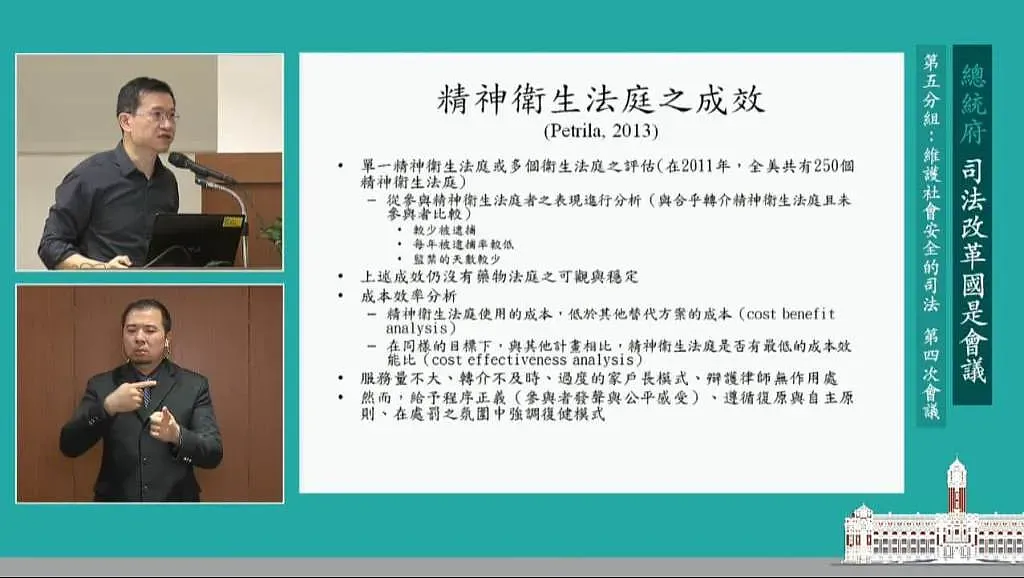
In addition, Director Wu briefly introduced the Mental Health Court. The Mental Health Court is a treatment-oriented, problem-solving court, particularly aiming to achieve the goal of "rapid screening, referral, and triage." It emphasizes the active participation of mentally ill offenders in future medical measures such as community care under the Mental Health Court, allowing judges to lead the overall treatment direction and take responsibility for the entire treatment process.
Meeting Resolutions
Confirmation of Resolution Contents on the Agenda "Effective Crime Fighting" from April 6
Regarding the second item in the private sector under the first point of the previous meeting's resolutions, "Review of Anti-Corruption Legal Systems"—stating that "to strengthen the governance and supervision of foundations, the Foundation Act should be enacted as soon as possible and related laws and regulations should be revised"—this resolution was approved for deletion by 9 votes in favor and 7 votes against among the attending members, and this item is hereby deleted.
The remaining resolutions were unanimously confirmed and approved by the attending members.
Meeting Records for Today's Discussion Topic: "Review of Criminal Policies on Substance Abuse and Crimes Involving Mental Illness"
Preliminary resolution on "Review of Drug Enforcement and Severe Punishment Policies for Drug Offenses, Including the Review of 'One Crime, One Penalty' for Drug Use Offenses":
Amend the Narcotics Hazard Prevention Act to expand the system of confiscation, thoroughly depriving perpetrators of the proceeds of serious crimes such as manufacturing, trafficking, and transporting drugs.
Revise the Narcotics Hazard Prevention Act to change the standard for possessing Category 1 and Category 2 drugs from "pure net weight" to "net weight." Also, study the lowering of the possession threshold for possessing "20 grams" of Category 3 and Category 4 drugs.
Preliminary resolution on "Improvement of Diverse Treatment Models for Addiction Treatment of Drug Users, Integrating Judicial, Medical, and Social Work Resources, and Returning Compulsory Rehabilitation Centers to the Medical System of the Ministry of Health and Welfare":
Propose the establishment of a drug prevention fund and set up a dedicated mechanism directly under the Executive Yuan to supervise and horizontally integrate and coordinate drug prevention resources across ministries.
For drug users, in addition to criminal penalties, it is recommended that the government invest more resources to implement diverse treatment programs, helping drug users break their addiction and reintegrate into society.
Request competent authorities (Ministry of Health and Welfare, Ministry of Justice, etc.) to encourage the private sector to establish diverse treatment institutions for addicts and allocate ample budgetary subsidies to these institutions to encourage private participation, while establishing subsidy and counseling mechanisms.
Diverse Treatment for Drunk Driving
Ask the Ministry of Justice to prepare a report on penalty standards for drunk driving in various countries.
Examine countries that penalize individuals other than the driver (such as passengers or establishments) and their regulations.
Examine regulations on alcohol sales.
Examine regulatory status regarding foreign alcohol-related harm prevention statutes.
Brief Commentary
- Responding to Substance Abuse: From Criminal Punishment to Decriminalization, What Are the Possible Strategies?
- Changing 'One Crime, One Penalty' = Unlimited Drug Use? Unlimited Drug Trafficking?
- Drug Possession Grams: Are Both Higher and Lower Standards Wrong?
- Drug Supply Offenses: Are Heavier Penalties More Effective? (With a Discussion on Legalization)
- The Hardships of Drug Enforcement: What Has Actually Changed? (On Reasonable Policy Performance Evaluation Indicators)
This article is an AI-generated translation of the original Chinese text. In the event of any discrepancy, the Chinese version shall prevail.