
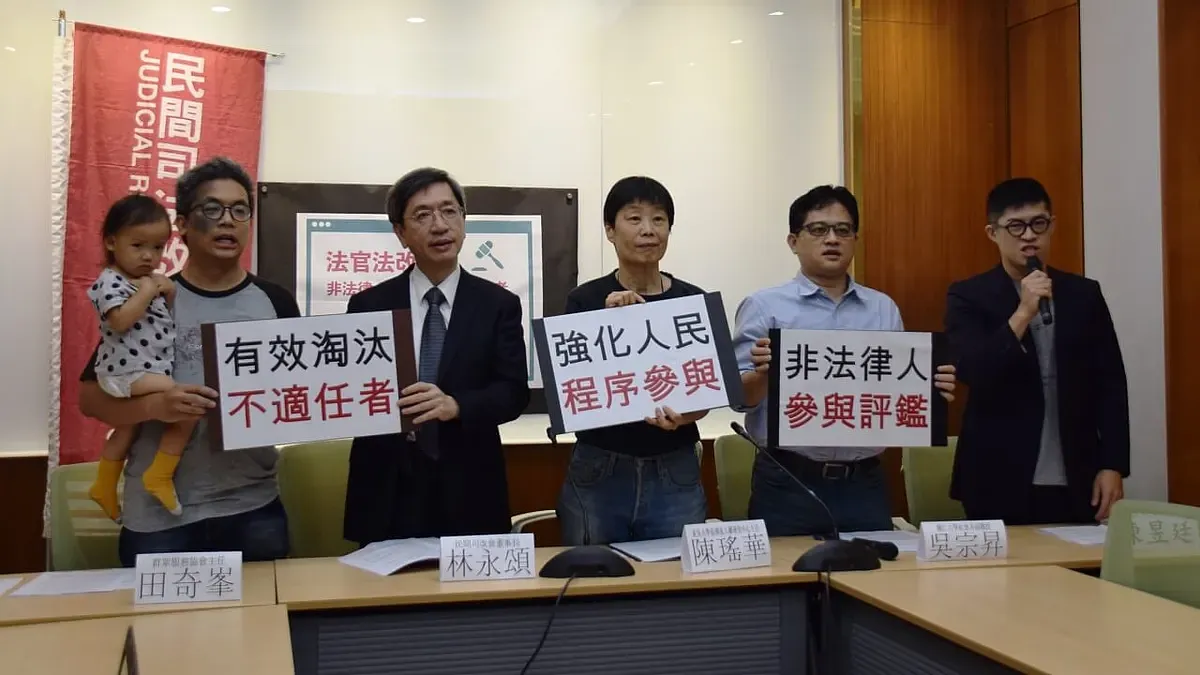
Judicial Reform Foundation Press Conference: Judges Act Reform Requires Non-Lawyer Participation to Oust Unfit Judges
Last edited: 2026-07-27
Yesterday (June 17), the Legislative Yuan convened an extraordinary session to deliberate on urgent and important bills. Among them are reform proposals under the Judges Act aimed at effectively removing unfit judges and prosecutors. This demonstrates that lawmakers have heard the public's calls for judicial reform. However, the most pressing issue at hand is how to pass truly effective reform measures. To address this, the Judicial Reform Foundation (JRF), alongside civil society organizations and scholars, held a press conference today (June 18) to offer recommendations for the reform of the Judges Act from the perspective of "non-lawyers."
Unfit Judges and Prosecutors Through the Eyes of "Non-Lawyers"
Calls for reform of the Judges Act have been growing louder. One of the reasons is that several judicial integrity scandals over the past two years have reawakened painful memories for individuals who have interacted with the judicial system, prompting them to stand up and demand the reform of the Judges Act and the removal of unfit judges and prosecutors.
Take, for instance, Resolution No. 2 (107) of the Judges Evaluation Commission (JEC). The judge under review in that case not only scheduled all monthly cases to be heard on the very same day, leaving the parties involved in each case only three to five minutes to make their statements, but also made sarcastic remarks toward the parties during the trial. For example, when urging a settlement, the judge told a party, "Your sincerity makes my heart very cold," "This is no different from North Korea," "You are a troublemaker," or "You need to watch your attitude; there is no standard for consolation money—how a judge decides depends on it, and if your attitude is bad, the judgment will be harsher." These remarks compromised the parties' rights as well as judicial credibility in both procedural and substantive terms. Nevertheless, the JEC still resolved that the professional misconduct was not serious and that the evaluation was not established.
Additionally, in Judgment No. 2 (107) of the Judicial Yuan's Disciplinary Court, a defendant surnamed Ch'en was implicated in a convenience store game point card theft. Although Ch'en presented a receipt during the investigation showing that he was shopping at another convenience store 250 meters away at the time of the incident, the police failed to attach the receipt to the case file submitted to the prosecutors and mistakenly recorded the time when taking photos of the surveillance footage. This created the false impression that Ch'en had no alibi. Yet, the prosecutor accepted the materials submitted by the police at face value, without scrutinizing the surveillance footage or thoroughly investigating the receipt establishing Ch'en's alibi, and proceeded to indict him. Consequently, Ch'en felt utterly hopeless and resolved to commit suicide to prove his innocence. Despite clear misconduct and the Disciplinary Commission imposing a one-year suspension on the handling police officer, the Disciplinary Court still held that the prosecutor committed no professional misconduct and was exempt from disciplinary action.
"Non-Lawyers" Should Be Included in the Removal Mechanism
As seen in the aforementioned cases, within the removal mechanisms for judges and prosecutors—whether it is the JEC initiating disciplinary action or the Disciplinary Court making the final decision—their interpretation of the same events often diverges sharply from the feelings of ordinary citizens caught in the judicial vortex. Shaped by the same educational background and cultural context, they often struggle to empathize with the grievances experienced within the judicial system by people who do not understand the law. It must be emphasized that many "minor misconducts" that legal professionals take for granted often impact an individual's entire life. Therefore, the participants advocate that both the JEC and the Disciplinary Court must include non-lawyer participation. The JEC, as the initiating body, should have a majority of non-lawyer members to break away from legal solipsism.
Furthermore, the public's right to participate in the evaluation procedure should be strengthened. Under the current system, evaluation applicants cannot review the case files nor obtain the written defense of the evaluated person. While the official draft stipulates that applicants may apply to be served the written defense, the committee may still refuse. Moreover, only the evaluated person may review the case files, leaving a clear imbalance of arms between the two sides. Unless equal rights are granted to both parties during the evaluation procedure, oversight and removal cannot be realized, and the objective of ousting unfit personnel will remain unfulfilled.
The first step toward effectively removing unfit judges and prosecutors is to incorporate the voices of non-lawyers, ensuring that professional misconduct taken for granted by legal professionals no longer becomes a routine infringement upon people's rights. In addition, citizens must be placed on an equal footing within evaluation procedures. Strengthening external participation and allowing the public to transparently oversee and understand the judiciary is the most crucial step toward restoring public trust in the justice system.
Attachments
| Official Draft | JRF Draft | |
| Composition Ratio of Evaluation Commissioners |
Article 33, Paragraph 1 The Judges Evaluation Commission shall be composed of three judges, one prosecutor, three attorneys, and six scholars and socially impartial figures; evaluation commissioners shall serve a two-year term and may be reappointed once. |
Article 33, Paragraph 1 The Judges Evaluation Commission shall be composed of one judge, one prosecutor, two attorneys, one legal scholar, and six non-legal scholars and representatives of social groups who have long participated in judicial reform, human rights, public interest, or disadvantaged issues. |
| Procedural Participation of Parties |
Article 41-1 The Judges Evaluation Commission may conduct necessary investigations upon the application of the evaluated judge and the applicant or ex officio, and may notify interested parties to appear and provide explanations; materials obtained from investigations shall not be provided to other agencies, organizations, individuals, or made available for review or transcription, unless otherwise provided by laws and regulations. Where the evaluated judge and applicant apply to appear and state their opinions, such requests shall not be refused unless manifestly unnecessary; any inappropriate speech or conduct during their appearance may be restrained. The Judges Evaluation Commission may restrict or refuse an applicant's request to be served the written opinion submitted by the evaluated judge; if delivery is approved, a reasonable period to express opinions shall be granted. The evaluated judge may apply to review, transcribe, photocopy, or photograph the materials obtained through investigations under paragraph 1. However, the Judges Evaluation Commission may restrict or refuse requests under any of the following circumstances: 1. Draft manuscripts prepared prior to the resolution of an individual case evaluation matter. 2. Preparatory or deliberative documents for the resolution of an individual case evaluation matter. 3. Necessity for protecting the legitimate rights and interests of third parties. 4. Other necessity for confidentiality pursuant to law or based on the public interest. Materials obtained through application under the preceding paragraph shall be kept confidential. Except as otherwise provided in this Act, the provisions of the Administrative Procedure Act shall apply mutatis mutandis to evaluation procedures regarding the investigation of facts and evidence, dates, periods, and service of documents. |
Article 41-1 The Judges Evaluation Commission may conduct necessary investigations, or notify interested parties to appear and provide explanations; materials obtained from investigations shall not be provided to other agencies, organizations, individuals, or made available for review or transcription, unless otherwise provided by laws and regulations. Applicants, agencies, or organizations requesting an evaluation may request the Judges Evaluation Commission to investigate facts and evidence. Where the Judges Evaluation Commission has legitimate reasons to believe that an investigation is unnecessary, it shall set forth its reasons and explanations. When investigating evidence or inquiring of the person under evaluation or interested parties, the Judges Evaluation Commission may notify the evaluation applicant, agency, or organization to be present and grant them an opportunity to express opinions. Evaluation applicants, agencies, or organizations may request to review, transcribe, photocopy, or photograph relevant materials or case files. The Judges Evaluation Commission shall not refuse requests under the preceding paragraph, except for those that should be kept confidential according to law. The Judges Evaluation Commission shall forward the written opinions submitted by the evaluated judge to the evaluation applicant, agency, or organization, and grant a reasonable period for them to express opinions. |
Attendees
Chi Hui-jung / Executive Director, Garden of Hope Foundation
T'ien Ch'i-feng / Director, Association for the Rights of Workers Association
Wu Tsung-sheng / Associate Professor, Department of Sociology, Soochow University
Ch'en Yao-hua / Director, Chang Fo-quan Center for Human Rights, Soochow University
Lin Yung-sung / Chairperson, Judicial Reform Foundation
Ch'en Yu-ting / Staff Attorney, Judicial Reform Foundation
Media Contact
Judicial Reform Foundation / Director Hsiao I-min (02)2523-1178
This article is an AI-generated translation of the original Chinese text. In the event of any discrepancy, the Chinese version shall prevail.