
JRF Newsletter
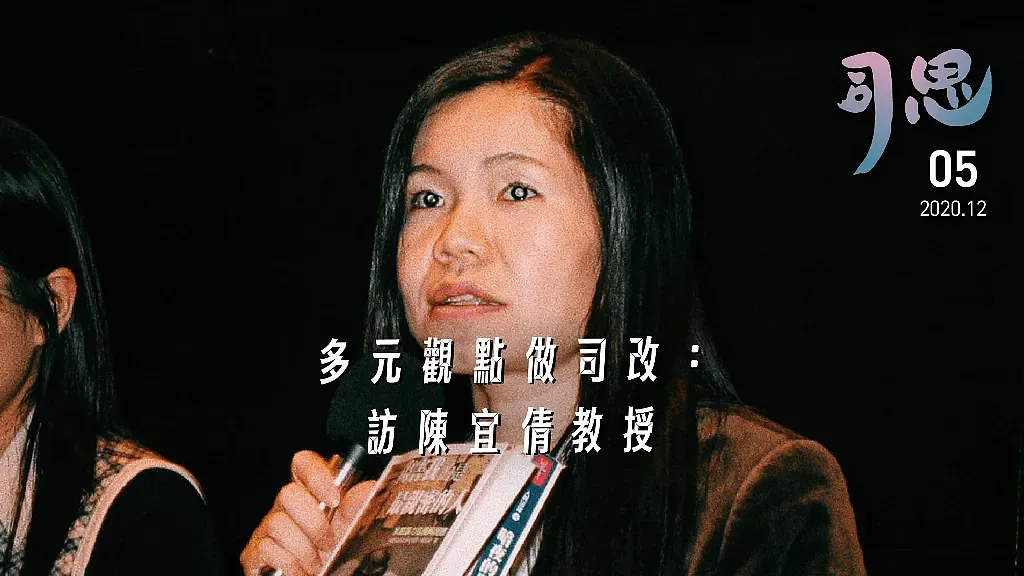
Judicial Reform Through Diverse Perspectives: An Interview with Professor Chen I-Chien
Last edited: 2026-08-29
Professor Chen I-Chien served as a standing executive committee member of the Judicial Reform Foundation from 2004 to 2010. She is now a professor at the Graduate Institute of Gender Studies at Shih Hsin University and a JRF supervisor. A former practicing attorney and former chairperson of the Awakening Foundation, her academic work focuses on feminist legal theory, men and masculinities, and LGBT law. She has observed gender dynamics both inside JRF and across the justice system and has continued to advocate and build capacity around gender issues.
Bringing Diverse Concerns into Judicial Reform
 Photo / November 27, 2004: Professor Chen I-Chien participates in the eighth Judicial Humanities Lecture.
Chen's interest in law took shape in high school during Taiwan's transition out of martial law, when the Tangwai movement was flourishing. Law seemed to offer a measure of fairness and justice and a way to help chart a path for Taiwanese society, so she chose to study law. At university, constitutional-law classes taught by Professors Lin Tzu-I and Hsu Tsung-Li sparked a deep interest in comparative law. She was especially struck by the way dissenting opinions in U.S. cases could become majority positions years later, changing precedents on issues such as same-sex marriage and women's right to practice law. That interest eventually took her to Cornell University for further study. Already concerned with prisoners' rights, environmental law, and gender equality, she returned to Taiwan after completing her doctorate and, while looking for a teaching position, joined the then much less widely known JRF as a standing executive committee member because of her commitment to criminal-justice reform.
Judicial Reform in an Era of Gender Blindness
Chen still serves as a JRF supervisor, although she now has less day-to-day contact with Secretariat staff. When JRF later invited her to conduct training on sexual harassment, participants from different generations finally had an opportunity to compare how the organization's internal culture had changed-and what had remained the same.
 Photo / August 18, 2020: Professor Chen I-Chien conducts JRF staff training on gender and sexual harassment under the title "Varied Subjects, a Tongzhi State?"
Asked about gendered workplace dynamics, Chen said the patterns she observed at JRF resembled those in legal practice more broadly: women attorneys were more likely to be employees, while men were more likely to be partners. During her years of active participation, JRF's attorney members were also predominantly male. Administrative and secretarial work tended to fall to women, and women's contributions in meetings were often taken less seriously, making equal participation more difficult. Chen added candidly that holding both a doctorate and an attorney qualification may have helped her command more respect than other women received.
Because her father had been her primary caregiver growing up, and because her own scholarship focused on feminist legal theory, Chen was comfortable raising gender issues directly even in male-dominated settings. She recalled one press conference where staff proposed using "the empress's chastity" as a metaphor for the integrity of the judiciary; the slogan was dropped after she challenged it. In another discussion about the composition of a committee, she proposed that neither gender should make up less than one-third of the membership. Some participants asked what gender had to do with the issue, while others offered stereotyped arguments for and against the proposal-including the claim that "women are less likely to be corrupt." She also remembered gendered responses in older courtroom practice: when a male litigant began to cry, judges would rush to close the courtroom doors, while women's tears produced no comparable reaction. To her, the contrast showed how differently society treats emotional expression by men and women.
Chen said she understood that, given the social environment and educational experiences of the time, many people's gender awareness remained rooted in traditional assumptions. "They were still slowly learning to see women as equal partners at work." The stereotypes did not necessarily cause her severe personal harm, she said, but she tried to respond directly whenever they arose, using each issue and each activity as another opportunity for discussion.
Toward Judicial Reform with Greater Sensitivity to Difference
What kinds of reform did Chen try to advance through JRF? The organization's website still contains many of her earlier articles, including her 2006 piece "Court Interpreters: Decorative Vases? - Unequal Justice Under Linguistic Hegemony" criticizing linguistic domination in the courtroom, and her 2014 article "Doesn't Everyone Know What Happens in the Military?" criticizing the judiciary's role in maintaining male dominance in the military. Chen also recalled an unrealized plan with colleagues to publish a book on sexual-harassment and sexual-assault cases. Writers and potential interviewees had already been identified, but the project ultimately fell through for various reasons-something she still regrets.
Chen also places great importance on access to justice. Gender, race, and class discrimination exist within the legal system, she argued, and the judiciary must correct those biases if it wants to earn public trust and make people willing to use the courts. In her essay "Measuring by People's Needs - Toward Judicial Reform Sensitive to Race, Gender, Class, and Other Social Differences," she described how the U.S. court system began examining racial and gender bias in legal practice in 1988 and used that self-scrutiny to pursue fairer adjudication. If Taiwan's courts cannot conduct that kind of institutional reflection themselves, she believes JRF should make it a central reform issue. "Gender-related legal reform can only be effective when organizations themselves incorporate a gender perspective into their own professional work and reflect on it. We cannot simply leave gender to other NGOs; the work has to proceed in parallel."
Looking at JRF today, Chen sees substantial improvement. The gender imbalance on the standing executive committee remains large, but she believes more communication between younger participants and more experienced members-especially an effort to understand the roles and constraints on both sides-can bring more diverse voices into the organization and create room for institutional change and new priorities.
Gender and the Younger Generation
After hearing Chen describe her experience of judicial reform, we wondered why, after practicing law, she ultimately chose to teach in a graduate institute devoted to gender studies.
Wrongful convictions still demand vigorous rescue work, Chen said, but she increasingly wanted to move the point of intervention further upstream-to "education" and "prevention." "Looking at death-penalty cases in Taiwan today, many involve breakdowns in gender relationships. But there are many interacting factors that lead someone to that point. What we should do is work on preventing those factors, not simply excluding people." Different stages of any social problem require different roles, she said, and what matters most is identifying the role one is both able and willing to play. "Education works slowly, but I will keep doing it."
In the classroom, Chen once invited a sexuality counselor to speak in her course "Sex, Love, and Law." During anonymous questions, she found that students living in an era of constant internet access still had many of the same questions and uncertainties about intimacy and sexuality as earlier generations. "The internet is more convenient now, but precisely because it is hard to know what information is true, students are actually less certain about what they find online. They come to class wanting to know the teacher's 'standard answer.'" Today's students may show greater interest in relationships, gender equality, and sexuality education, she observed, yet that interest often remains at the level of formal equality-for example, knowing that a woman can be president or that a Gender Equity Education Act exists-while the orientation and substance of foundational teaching materials have changed much less. Education therefore still does not fully meet young people's need to understand gender and sexuality.
Chen has also observed that some students today seem to have a narrower understanding of, or reduced confidence in, intimate relationships. Long-term reliance on online communication can leave people with less experience of direct interpersonal interaction and greater discomfort with face-to-face emotional exchange. "I lived through a time when mobile phones were not widespread, so I have a point of comparison. Younger people do not, and they may unintentionally display weaker interpersonal skills without any bad intent." Young men are another group she now studies closely. Social expectations can compress their thoughts and behavior into a very narrow space, she said, while families and schools often fail to provide the emotional education or cultural support they need. "When I see some of them struggling in relationships, I actually feel a great deal of sympathy."
Gender themes have also become increasingly visible in television and film popular with younger audiences. Chen, who has written reviews including "I Want to Be Gong Yoo's Lover", said: "Many of these things have been happening all along; people simply had not opened their eyes to gender. Film and television now use media audiences are willing to engage with to bring those issues into view." Characters and plots may depart somewhat from social reality for dramatic reasons, she said, but if popular entertainment prompts reflection, it has already succeeded in communicating the issue.
Looking ahead, Chen expects gender relations and emotional communication to keep changing. "But how will they change? That's very hard to predict. In the end, I suppose we still have to practice."
What Kind of Taiwan Do We Want to Become?
 Photo / November 23, 2020: JRF's Central Office hosts "Gender and Law Series: Actively Advocating Feminism to Men," featuring Professor Chen I-Chien and Attorney Li Hsuan-I. Beginning with everyday gender-role stereotypes in Taiwan, the speakers invited participants to reflect on "Who is a man?", "What does gender mean?", "Gender equality," and "Gender self-determination."
In Taiwan, when disagreements arise over race or gender, people sometimes invoke national unity or the need to "get through difficult times together" to suppress the conflict. Chen rejects that move: "Precisely because our national identity is still being built, we should be asking even more seriously what kind of Taiwan we want to become." In other words, the way Taiwan handles conflicts involving race and gender is itself part of building national identity.
Earlier generations still debated relatively basic questions of gender equality. Today's generation faces more complex questions: once a woman can become president, are government policies themselves gender-sensitive? How should people of different genders collaborate within families, workplaces, and society? Deeply rooted stereotypes, binary treatment, microaggressions, and other forms of inequality will not disappear without continued education, organizational advocacy, and social practice.
Taiwan today contains both continuity and difference across generations in understandings of sexuality, gender, and relationships, while an increasingly wide range of issues can be openly discussed. What does gender mean in the workplace or in education? What role should the judiciary and legal professionals play? How should those institutions evolve? Chen raises many questions, but they return to the same invitation to younger generations: "What kind of Taiwan do we want?" As we feel our way through those questions and learn together, her refrain-"In the end, I suppose we still have to practice"-feels both challenging and reassuring.
This article is an AI-generated translation of the original Chinese text. In the event of any discrepancy, the Chinese version shall prevail.
