
JRF Newsletter
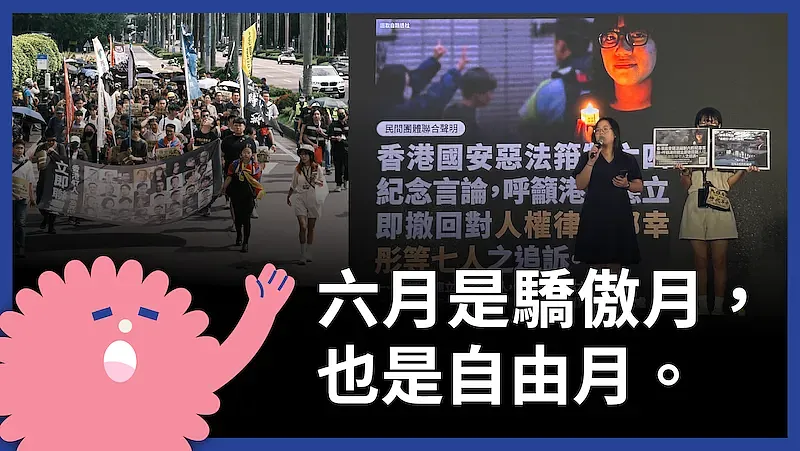
June E-Newsletter | June is Pride Month, and it is also Freedom Month.
Last edited: 2026-11-04
The 35th Anniversary of the "June 4th Incident" and the Hong Kong Rally
In March 2024, the Hong Kong authorities passed Article 23 of the Basic Law of the Hong Kong Special Administrative Region. On May 28, the Hong Kong police invoked the Safeguarding National Security Ordinance (an ordinance enacted pursuant to Article 23 of the Basic Law) for the first time to arrest a total of eight people, including human rights lawyer Chow Hang-tung (鄒幸彤), her mother, her maternal uncle, and five pro-democracy activists. The Hong Kong police accused barrister Chow Hang-tung of using other individuals on social media platforms to "publish information with seditious intention" regarding "a certain sensitive date approaching," with the intent to provoke hatred among citizens toward the government and the judiciary.
"A certain sensitive date approaching" is precisely the "June 4th" that the Hong Kong police dare not speak aloud. This year marks the 35th anniversary of the June 4th Incident. Numerous advocates and organizations, carrying the will of those persecuted politically, continue to hold commemorative events in Taiwan, expressing the spirit of pursuing democracy without fear through film screenings, democracy markets, short-talk sessions, and candlelight vigils.
Today, Hong Kong is under serious threat from Chinese authoritarianism. The June 9 massive rally once organized in response to the anti-extradition bill, as well as the annual July 1 marches of the past, have ceased to exist since 2020 due to suppression. On June 9 this year, the Hong Kong rally was held in Taipei for the fifth consecutive year. We hope that on this land where freedom is still cherished, Taiwan and Hong Kong will walk side by side, and the winds of Hong Kong will continue to blow.
As those of us in Taiwan, we must continue to support Hong Kong's freedom and democracy, giving each other moral and practical support and encouragement. If history cannot be preserved, if participants cannot speak out, memories will vanish in the torrent of time. This is a long-term struggle; we must speak the words that Hong Kong cannot say and allow the truth to be passed down.
Finally, I want to say that many people may claim Hong Kong is dead, but I feel that true death is doing nothing and gradually being forgotten by everyone. Yet, our Hong Kong friends are still struggling in the cracks, holding on in their own way. Therefore, I hope Taiwanese people can continue to support them, witness their experiences, remain vigilant against authoritarianism, and not easily surrender our rights—just like the Bluebird Movement, expressing our thoughts through action. - MIDO

Documentary Screening | "Chow Hang-tung: Imprisoned" Legal Aid Collaborative Session
To help Taiwan's legal community understand the democratic threats faced by Hong Kong, the British group The 29 Principles, the Taipei Branch of the Legal Aid Foundation, and JRF jointly organized this documentary screening.
This session specially invited Ch'en Yi-t'ing, President of the Legal Aid Foundation Taipei Branch, to deliver opening remarks. The post-screening forum will be moderated by JRF Deputy Executive Director, Attorney Li Ming-ju, and will feature Attorney Lo Ping-cheng as a panelist.

Joint Statement | Hong Kong National Security Evil Law Restricts June 4th Commemorative Speech: Urging the Hong Kong Government to Immediately Withdraw the Prosecution against Human Rights Lawyer Chow Hang-tung and Six Others
In response to the Hong Kong National Security Department citing the Safeguarding National Security Ordinance enacted pursuant to Article 23 of the Basic Law on May 28 and 29, 2024, to arrest human rights lawyer Chow Hang-tung, her mother, and five pro-democracy activists (totaling 7 people) on suspicion of offenses with seditious intent, our foundation has issued a statement and put forward 3 demands.

MIDO's Full Speech | Hong Kong Freedom June 2024 Taipei Rally — Defending Democracy, Taiwan and Hong Kong Hand in Hand
We all know that the most severe battlefield is after the movement ends: how to sustain subsequent actions so that the truth is not forgotten by time and by the public. At this moment, Hong Kong is facing the Chinese and Hong Kong governments using "law" as a sharp tool to suppress freedom of speech. As JRF, which has long focused on justice and human rights, we should step forward even more to condemn the actions of the Hong Kong government.

Is Doing Time in Taiwan a Breeze?! Inmates Must Also Work and "Get Paid"! How Much Can You Earn by Folding Lotus Origami and Paper Boxes?
In 2015, Taiwan's first prison warden hostage incident occurred. The inmates' statement mentioned: "Since you are going to lock me up until I die, shouldn't you give us the ability to be self-reliant? Working for a month yields only two hundred NT dollars, which is not even enough to buy a set of underwear, and we still have to rely on our families for financial assistance. We have lost all human dignity and are still dragging down our families—then the only paths left are 'suicide' and 'fighting it out'."
Now, nine years later, behind the thick, towering concrete walls, do the labor outputs of inmates in prisons and detention centers receive fair treatment that respects human dignity?
This episode of the JRF podcast briefly introduces what prison labor remuneration is and whether the amount is sufficient for inmates to cover their daily living expenses.
Video Highlights:
📍What is prison labor remuneration?
📍Can labor remuneration cover expenses in prison?
📍How should inmates' remedies for rights violations be pursued?
📍Myths about doing time in prison
In 2023, the administrative litigation judgment of the Taiwan Hualien District Court explicitly pointed out that the system related to labor remuneration was unconstitutional and illegal, yet the Ministry of Education (Correction note: Ministry of Justice) and the Agency of Corrections refuse to admit their mistakes or change.
On July 9, 2024, the Constitutional Court will hold oral arguments on the issue of excessively low inmate labor remuneration. Prior to this, JRF, along with the Judicial Reform Committee and Human Rights Committee of the Taiwan Bar Association, and the Human Rights Committee of the Taipei Bar Association, held a seminar on inmate labor remuneration, hoping to serve as a modest stimulus to encourage exchanges between academia and frontline workers to facilitate discussions and promote subsequent reforms.
Current statutory provisions dictate that, barring illness, security custody, or special legal provisions, inmates must participate in prison labor to fulfill the objective of reintegration into society. However, the appalling living conditions and meager labor remuneration in correctional institutions fall far short of this reintegration objective.
Inmates will one day return to society. If the path to reintegration remains rugged and difficult, how can we expect them to truly "rehabilitate"? Caring for the rights of inmates is also caring for the society in which we live. We hope everyone will join us in paying attention to prison issues and the upcoming Constitutional Court arguments on labor remuneration in July!
Further Reading:
▍Constitutional Court Amicus Curiae Brief | Excessively Low Labor Remuneration Case
▍Mandatory Labor: Security Dispositions Indistinguishable from Prison Execution

Post-Dummy Account Era Practical Response Seminar | Sidelights
JRF has been concerned with wrongful convictions involving dummy accounts and systematic human rights violations since 2013, spanning over a decade.
With the enactment of Article 15-2 of the Money Laundering Control Act regarding the offense of simply transferring accounts, and the Executive Yuan's latest rollout of the Fraud Crime Hazard Prevention Act, the Communication Security and Surveillance Act, the Money Laundering Control Act, and the Science and Technology Surveillance Act—which are currently being scheduled for review in the Legislative Yuan—we time and again gaze at the two sides of the balance scale: combating crime and protecting human rights, struggling amidst the predicament of being a "fraud state."
Criminal Judgment No. 1075 (Tai-Shang-Tzu, 2022) of the Supreme Court stated: "The court should comprehensively consider various subjective and objective factors as well as the individual circumstances of the actor to determine whether the actor's act of handing over an account constitutes the offense of aiding and abetting money laundering or fraud." Criminal Judgment No. 2664 (Tai-Shang-Tzu, 2022) of the Supreme Court stated: "One cannot use the intellectual standards and experiences of us as ordinary objective persons to hastily deduce that such persons must possess the same level of vigilance and must have foreseen the facts constituting the crime."
There is an urgent need to combat fraud; where should the controversy surrounding the broad determination of subjective elements involved in dummy account fraud go from here?
Thus, as the amended Money Laundering Control Act is about to reach its one-year anniversary of implementation, JRF, alongside the Legal Aid Foundation, the Taichung Bar Association, and the Tainan Bar Association, co-organized the [Post-Dummy Account Era Practical Response Seminar] in Taichung, Tainan, and Taipei respectively. The seminar invited practicing lawyers, judges, prosecutors, and professors from academia to discuss together how legal practice should respond to the dilemmas of this post-dummy account era. It is also hoped that relevant authorities, while contemplating the fight against crime, will not lightly neglect the protection of human rights.
This article is an AI-generated translation of the original Chinese text. In the event of any discrepancy, the Chinese version shall prevail.