
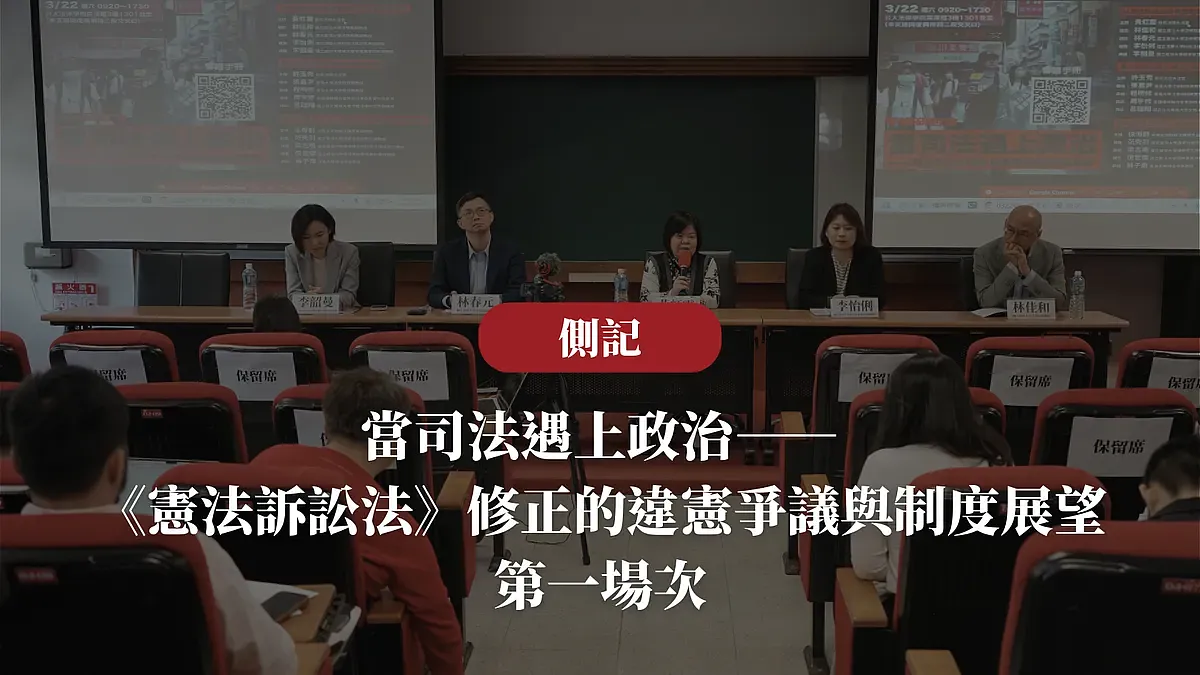
Seminar Sidelights|When the Judiciary Encounters Politics – Session 1: The Unconstitutionality Review Procedure with the Constitutional Court Procedure Act as the Object of Review
Last edited: 2026-08-21
Introduction
Attorney Huang Hsu-tien stated in his opening remarks that constitutional litigation is a critical pillar of the rule of law, and the JRF, as a civil society organization, has long monitored related issues. Last December and this March, the JRF issued statements and observed considerable resonance among the public. Therefore, it is hoped that this seminar will foster deeper discussions. The event is structured into three parts: the morning session focuses on "whether the Constitutional Court Procedure Act can serve as the target of unconstitutionality review," while the afternoon sessions respectively discuss "statutes themselves as constitutional issues" and "the interaction between law and politics."
Professor Lin Chun-yuan pointed out in his opening remarks that since the Sunflower Student Movement, Taiwanese society has continuously faced various challenges, prompting civil society to constantly reflect on the relationship between the constitution and politics. He expressed hope that this seminar would bring about deeper exchanges and inspiration.
Session 1: The Unconstitutionality Review Procedure with the Constitutional Court Procedure Act as the Object of Review
The theme of the first session of this seminar was "Unconstitutionality Disputes Regarding Amended Provisions of the Constitutional Court Procedure Act." It was moderated by former Grand Justice Huang Hung-hsia, with Associate Professor Lin Chia-ho of the College of Law at National Chengchi University and Associate Professor Lee Yi-li of the Institute of Technology Law at National Tsing Hua University acting as presenters. Associate Professor Lin Chun-yuan of the College of Law at National Taiwan University and Assistant Professor Lee Shao-man of the Academy of Computing and Information Services at National Cheng Kung University served as discussants.
▌Lin Chia-ho: The Constitutional Court is the Master of Its Own Procedures
In his presentation titled "Who is the Master of Constitutional Litigation Procedures? Observations from German Theory and Practice," Professor Lin Chia-ho raised three fundamental questions: First, can the Constitutional Court Procedure Act, as procedural rules enacted and amended by the legislature, become the target of unconstitutionality review? Second, if it can become the target of review, would this render the Constitutional Court akin to an institution that sets its own procedural rules and arbitrarily declares inappropriate legislative provisions unconstitutional? Third, if it cannot, and the legislature intentionally renders it unable to do so (regardless of whether from naked political intent), would the Constitutional Court not lose its unconstitutionality review function?
The professor argued that the Constitutional Court Procedure Act can certainly serve as the target of unconstitutionality review, and the crux lies in "how to determine" unconstitutionality. Taking the Federal Constitutional Court of Germany as an example, the Federal Constitutional Court itself is the master of its procedures, possessing a considerable degree of procedural autonomy. Even unconstitutional constitutional amendments can become the target of review; a fortiori, this applies all the more to the statutory level.
It must be emphasized here that under the separation of powers, the principles of functional appropriateness and institutional appropriateness dictate that the legislative branch has no right to unilaterally delineate the boundaries of the Constitutional Court. The establishment of the Constitutional Court is precisely aimed at controlling the social formation function exerted by laws enacted by a legislative majority through the judicial review of legal norms. Moreover, the democratic legitimacy of the judiciary derives from public respect, broad acceptance, the ability to influence political calculations, and the raising of political costs for non-compliance; any judgment inevitably faces critical voices.
If it cannot be reviewed, whenever the legislature intends to evade it, the Constitutional Court could lose its supervisory function. This contradicts the consensus of democratic theories—such as popular sovereignty theory, representative constitution theory, modern republican theory, and liberalism theory—regarding "justiciable constitutional supremacy." No democratic theory would support the argument that "no Constitutional Court is a good Constitutional Court." The Constitutional Court indirectly masters the constitutionality of substantive content by determining procedural controls; its procedural autonomy is indispensable.
In summary, while the number of attendees and voting members, as well as the thresholds and requirements for provisional measures, are open to discussion, the Constitutional Court as the master of its own procedures possesses procedural autonomy that serves as an important cornerstone under a modern democratic system of the rule of law. This principle must not be compromised.
▌Professor Lin Chun-yuan: The Procedural Dilemma of Constitutional Court Procedure Act Review – Multi-Contextual Thinking
In "The Procedural Dilemma of Constitutional Court Procedure Act Review – Multi-Contextual Thinking," Professor Lin Chun-yuan pointed out that if procedural regulations undermine the organizational function of the Constitutional Court and reduce it to a vassal, such regulations should be deemed unconstitutional. In fact, in the U.S. case Marbury v. Madison, the Supreme Court reviewed judicial procedural norms enacted by the legislature. Taiwan's past Judicial Yuan Interpretations Nos. 371 and 530 have already affirmed that the judiciary possesses rule-making power; Interpretation No. 602 revealed the duty of loyalty of constitutional organs, and Interpretation No. 601 explicitly highlighted the role of the Constitutional Court in safeguarding the constitutional order.
If the Constitutional Court Procedure Act or congressional practices weaken the function of the Constitutional Court and turn it into a vassal, it should become a target of unconstitutionality review. The separation of powers theory maintains healthy operations on a democratic basis; without the separation of powers, there is no sustained democracy. However, in reality, the separation of powers is often replaced by the separation of political parties, and democracy even faces populist challenges and infiltration by foreign forces. Global constitutional democracy is in regression, with many regimes using democratic and lawful means to gradually weaken constitutional systems, manipulating personnel consent or modifying rules to package the Constitutional Court, and ultimately destroying constitutional democracy. The Constitutional Court is the last line of defense.
Taiwan's Constitutional Court has been relatively responsive in the past, tending to carefully maintain its legitimacy while evaluating three aspects: constitutional and legal foundations, the attitudes of political branches, and civil society support. Therefore, when facing the problem of an insufficient number of Grand Justices, the support of civil society is an important force to prevent the regression of constitutional democracy and reverse the dilemma.
▌Huang Hung-hsia: The Country Must Save Itself, and the People Must Make Their Voices Heard
Former Grand Justice Huang Hung-hsia expressed strong agreement with the opinions of Professor Lin Chia-ho and Professor Lin Chun-yuan, emphasizing that "the country must save itself, and the people must make their voices heard." Having served as a Grand Justice, she realized that a failure to respond might be interpreted as acquiescence to the legislature's practices. For instance, regarding Constitutional Court Judgment No. 9 of 2024, she believed that the matter should genuinely be approached from the perspective of unconstitutionality due to legislative due process violations; procedural issues must be handled with priority and limited strictly to procedural matters.
In addition, Justice Huang pointed out that although the draft Constitutional Court Procedure Act was handled by the Judicial Yuan in terms of judicial administration, the attitude of judicial administration was overly conservative, tending to make regulations overly detailed. In reality, sufficient flexibility and space should be reserved for the Constitutional Court. Finally, Justice Huang also stated that she agrees Taiwan's Constitutional Court has historically leaned toward a "responsive" nature, and there is no need to overly worry that it will infringe upon human rights.
▌Lee Yi-li: The Review Objects and Provisional Remedy Procedures of the South Korean Constitutional Court
In "The Review Objects and Provisional Remedy Procedures of the South Korean Constitutional Court: A Comparison between Taiwan and South Korea," Professor Lee Yi-li pointed out that South Korea's democratic and constitutional development is frequently compared with Taiwan's due to the similarities in their democratic transition processes. South Korea substantially amended its constitution in 1988 and established the Constitutional Court, becoming an important representative of judicial activism, with numerous prominent human rights protection and political controversy judgments (such as presidential impeachment cases). South Korea has also faced the problem of vacant Grand Justice positions; because the terms of three Grand Justices expired and a parliamentary deadlock prevented the filling of the vacancies, the normal operation of the court was affected. South Korean constitutional review practice adopts a simple majority rule, requiring at least seven Grand Justices to participate in adjudication and four votes in favor to render a judgment.
Regarding review objects, there are some differences between the constitutional courts of Taiwan and South Korea: Taiwan's Constitutional Court possesses the authority to uniformly interpret laws and ordinances (abstract review), whereas South Korea does not; both countries have norm constitutional review and adjudication constitutional review cases (concrete review), but South Korea additionally allows individuals to directly petition the Constitutional Court when courts reject unconstitutionality review applications. Both sides share identical designs in jurisdiction disputes, impeachment review (which has a broader scope in South Korea, including high-ranking officials and prosecutors), and political party dissolution review, except that Taiwan includes local autonomy protection review while South Korea does not.
Regarding provisional remedy procedures, debates exist in South Korea over whether their application should be expanded. Opponents argue they should be limited to political party dissolution and jurisdiction dispute adjudication, but the majority opinion supports their application to other constitutional litigation procedures. South Korea had a case where Ms. Lee Jung-sook filed an application for a provisional remedy, which six Grand Justices unanimously decided to grant, temporarily suspending the application of Article 23, Paragraph 1 of the Constitutional Court Act. The reasons included foreseeable fundamental rights violations, urgent necessity, a balance of equities, and the limited impact of provisional remedies on adjudication procedures. Academia has also discussed whether this case constitutes a special circumstance or can serve as a routine reference for the future.
▌Lee Shao-man: Grand Justices Should Possess the Authority to Self-Adjust and Decide
Professor Lee Shao-man pointed out that the harms brought by judicial vacancies warrant deep reflection. It is necessary to weigh their substantial impact on the functions of the Constitutional Court and evaluate whether constitutional litigation should be used to respond. Over the three years since the implementation of the Constitutional Court Procedure Act, more than 50 judgments have been rendered; although the number is not large, they all involve fundamental rights and important constitutional issues. However, due to judicial vacancies over the past three months, not a single decision has been made, demonstrating that the function has completely ceased. Regarding dismissal rulings, the past three years accumulated about 210 cases, but only 3 cases occurred in the past three months, showing that the Grand Justices have been extremely cautious and dare not easily let cases leave the court. Because provisional measure rulings involve the merits, the legislature has set a higher threshold; only 4 rulings have been made in the past 3 years, while the past 3-plus months have likewise seen a complete standstill.
In terms of the systematic interpretation of the Constitutional Court Procedure Act, whether the Constitutional Court may issue provisional measures is worth pondering. According to current regulations, a judgment requires the participation of at least two-thirds of incumbent Grand Justices in deliberation, a majority vote in favor, and no fewer than 10 participating members in deliberation, while a declaration of unconstitutionality requires at least 9 votes in favor. This threshold similarly applies to provisional measure rulings, impeachment declarations, and political party dissolution decisions. In practice, review panel rulings have exceeded 6,000 cases in the past 3 years, whereas the past three months saw only about 200 dismissal rulings. Professor Lee emphasized in conclusion that Grand Justices should possess the authority to self-adjust and decide, and be courageous in challenging current rigid thresholds in order to respond to practical needs.
General Discussion
During the general discussion, former Grand Justice Huang Hung-hsia shared that during a past visit to the South Korean Constitutional Court, she sensed a lack of harmony between the South Korean Constitutional Court and the Supreme Court. Justice Huang also pointed out that most dismissed cases are decided unanimously by three judges on a review panel; if there are differing opinions, the cases are referred to the Constitutional Court for adjudication, making dismissals rendered by the Constitutional Court relatively rare. She believed that Taiwan is not without cases like that of Ms. Lee Jung-sook, and it is not impossible for citizens to apply for provisional measures. However, if a provisional measure were actually rendered, there is a risk it might be interpreted as indirectly acknowledging that the unconstitutional provisions remain valid.
Regarding a question from the floor concerning the selection of the President of the Judicial Yuan being a prosecutor, Justice Huang stated that the qualification of the "defense bar" was only incorporated following the 2015 legal amendments, and discussions had been held on the advantages of including the defense bar. From the perspective of judges, prosecutors, and scholars, prosecutors are more specialized in criminal procedures, but attorneys possess broader perspectives and greater exposure to grassroots society, allowing attorneys to play an important auxiliary role among Grand Justices. Professor Lee Yi-li added that the composition of South Korea's Constitutional Court explicitly includes four categories: judges, prosecutors, defense attorneys, and scholars, among which the proportions of judges and prosecutors are higher while academic backgrounds are fewer. Professor Lin Chia-ho pointed out that Germany stipulates that Grand Justices must possess judicial qualifications (although Germany's legal training adopts the concept of the "fully qualified lawyer," making transitions between different roles more diverse), with the majority ultimately serving as judges or scholars. Professor Lin Chun-yuan believed that the composition of Grand Justices is itself a manifestation of the democratization process, reflecting the public's expectations of Grand Justices. Professor Lee Shao-man emphasized that the diverse identities and ideologies within the composition of Grand Justices are not only a representation of imagination but may also reflect certain myths held by the public regarding the role of the Constitutional Court.
Addressing a question from the floor regarding the Second Review Panel's dismissal of rulings on the grounds that "the case in dispute does not apply to the new Constitutional Court Procedure Act," Huang Hung-hsia stated that resolving the unconstitutionality issue of the new Constitutional Court Procedure Act should not be handled through provisional measures. If the new Constitutional Court Procedure Act is deemed unconstitutional, unconstitutionality can be directly declared during the procedural review stage of concrete case adjudication, refusing to apply the new Constitutional Court Procedure Act before proceeding to the substantive stage. Therefore, the new Constitutional Court Procedure Act should pose no problem for the current operations of the Constitutional Court. Professor Lin Chia-ho suggested that safeguarding the objective legal order and protecting individual fundamental rights are two fundamental functions of the Constitutional Court; viewed from the perspective of safeguarding the objective legal order, the Constitutional Court should be able to set its own cases for adjudication. Professor Lee Yi-li stated that the most fundamental approach should begin with procedural review; if that is impossible, provisional measures are the only remaining recourse, but the result shifts the procedural costs onto the people.
Professor Lin Chun-yuan reminded attendees that in addition to its legal role, the Constitutional Court also fulfills political functions; therefore, the real problem encompasses not only "what the law cannot do" but also "what politics cannot do." Regarding a question from the floor on how to mobilize civil society, Professor Lin pointed out that the difficulty lies in the public's limited understanding of the constitution. Taiwanese society is fond of using languages such as "freedom and democracy"; if "democracy" can be further redefined as "constitutional democracy," the concept that "a parliamentary majority does not equal democratic legitimacy" can be conveyed to the public. Professor Lee Shao-man suggested utilizing platforms such as political talk shows to expose ordinary citizens to diverse and in-depth legal discussions, using quantitative changes to drive qualitative changes. Finally, former Grand Justice Huang Hung-hsia concluded that while some people may still not understand the overall situation, the steadfast stance of the majority remains the most crucial key.
- Seminar Sidelights|When the Judiciary Encounters Politics – Session 2: [Unconstitutionality Disputes Regarding Amended Provisions of the Constitutional Court Procedure Act]
- Seminar Sidelights|When the Judiciary Encounters Politics – Session 3: [The Tug-of-War Between Parliamentary Democracy and the Constitutional Court]
This article is an AI-generated translation of the original Chinese text. In the event of any discrepancy, the Chinese version shall prevail.