
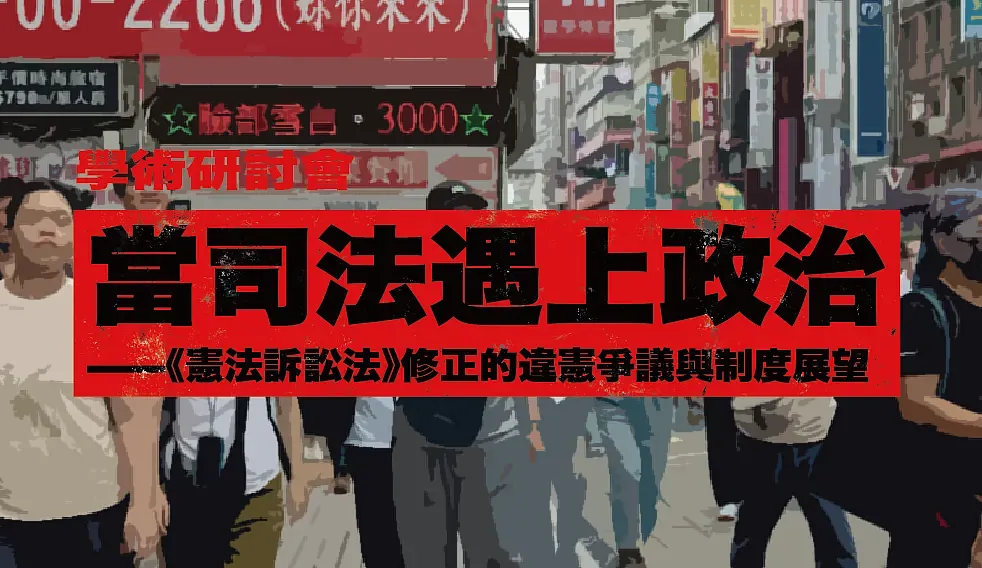
Seminar Proceedings | When the Judiciary Meets Politics: Unconstitutionality Disputes and Institutional Prospects Arising from the Amendments to the Constitutional Court Procedure Act
Last edited: 2026-08-22
The amended provisions of the Constitutional Court Procedure Act officially entered into force on January 25, 2025. Because there are currently only 8 sitting Grand Justices, under the revised provisions, the Constitutional Court is presently prohibited from conducting substantive deliberations on cases or rendering judgments.
The legislative process of this amendment—from proposal and voting to its promulgation and enforcement—has sparked intense concern within the legal academia and society at large. The matter has already entered judicial proceedings; aside from the Democratic Progressive Party caucus in the Legislative Yuan filing a constitutional litigation petition against the amendments, quite a few individuals have also submitted petitions for provisional measures regarding this issue.
To clarify the constitutional and legal controversies surrounding this amendment and explore the development of constitutional principles such as the separation of powers within our nation's constitutional interpretation, the Judicial Reform Foundation—together with organizations concerned with the development of our constitutional democracy, including the Center for Public Law at the College of Law of National Taiwan University, the Constitutional Litigation Practice Committee of the Taiwan Bar Association, the Constitutional Reform Committee of the Taiwan Bar Association, and the Judicial Reform Committee of the Taiwan Bar Association—jointly held an academic seminar.
Session I The Unconstitutionality Review Procedure Targeting the Constitutional Court Procedure Act | Moderator: Huang Hung-hsia, Former Grand Justice

Presenter Lin Chia-ho / Associate Professor, College of Law, National Chengchi University
The Constitutional Court Procedure Act can certainly serve as the target of unconstitutionality review; the crux lies in "how to determine" unconstitutionality. Taking the Federal Constitutional Court of Germany as an example, the Federal Constitutional Court itself is the master of its own proceedings, possessing a considerable degree of procedural autonomy to the extent that even unconstitutional constitutional amendments can become review targets. A fortiori, this applies all the more to the statutory level.

Discussant Lin Chun-yuan / Associate Professor, College of Law, National Taiwan University
If the Constitutional Court Procedure Act or parliamentary practice undermines the functions of the Constitutional Court and reduces it to a vassal, it should be eligible to become a target of unconstitutionality review. The doctrine of the separation of powers maintains healthy operations on a democratic foundation; without the separation of powers, there is no sustained democracy. However, in reality, the separation of powers is frequently replaced by partisan division, and democracy even faces populist challenges and the infiltration of foreign forces.

Moderator Huang Hung-hsia / Former Grand Justice, Judicial Yuan
I strongly agree with the views of Professors Lin Chia-ho and Lin Chun-yuan, emphasizing that "the country must save itself, and the people must make their voices heard." Having served as a Grand Justice, I deeply realize that failing to respond might be interpreted as tacit approval of the legislature's actions. For instance, regarding Constitutional Judgment No. 9 of 2024, I believe we truly should cut in from the perspective of legislative due process unconstitutionality; procedural issues must be dealt with first, and only procedural issues should be addressed.

Presenter Lee Yi-li / Associate Professor, Institute of Law of Science and Technology, National Tsing Hua University
South Korea's democratic and constitutional development is frequently compared with Taiwan's due to the similarities in their democratic transition processes. South Korea substantially amended its constitution in 1988 to establish a constitutional court, which has become a prominent representative of judicial activism, issuing several famous judgments on human rights protection and political controversies (such as presidential impeachment cases). South Korea has also faced the problem of Grand Justice vacancies; because the terms of three Grand Justices expired and legislative deadlock prevented the filling of the seats, the normal operation of the court was affected. South Korea's constitutional interpretation practice adopts a simple majority rule, requiring at least 7 Grand Justices to participate in adjudication and 4 concurring votes to render a judgment.

Discussant Li Shao-man / Assistant Professor, Academy of Fintech and Big Data, National Cheng Kung University
The infringement caused by judicial vacancies is worthy of deep reflection. We must weigh its substantive impact on the functions of the Constitutional Court and assess whether constitutional litigation should be used to respond. Over the three years since the implementation of the Constitutional Court Procedure Act, more than 50 judgments have been rendered; although the quantity is not large, they all involve fundamental rights and major constitutional issues. However, over the past three months, due to the vacancies of justices, no decisions could be made at all, demonstrating that its functions have been completely paralyzed.
Session II Unconstitutionality Disputes over the Amended Provisions of the Constitutional Court Procedure Act | Moderator: Hsu Yu-hsiu, Former Grand Justice

Presenter Chang Chia-yin / Distinguished Professor, School of Law, Soochow University
Various recent occurrences in the legislature have constituted what lawyers colloquially call "surprise adjudications," leaving people quite astonished. The problems encountered in this round of amendments have transcended the context of the ordinary hermeneutic circle (i.e., the circle between law and facts), leading to difficulties in drawing direct conclusions when adopting this methodology. Therefore, before discussing this amendment, apart from the legislative facts themselves, attention must also be paid to the "background" of these facts, namely the historical developmental context of Taiwan.

Discussant Cherng Ming-shiou / Distinguished Professor, School of Law, Soochow University
This amendment is unlike any legal issue previously encountered, and its constitutionality relies on more delicate discussion. From the perspective of the legislative history of our Constitutional Court Procedure Act, one of the primary focuses back then was to relax voting thresholds to facilitate the operation of the system; however, the current amendment introduces mandatory numerical thresholds, running completely counter to this intent.

Discussant Clarence Chou / Chairperson of the Constitutional Reform Committee, Taiwan Bar Association, and Attorney-at-Law
Before the passage of the Constitutional Court Procedure Act, the original Constitutional Interpretation Procedure Act and its enforcement rules only required a majority of attending members to agree on declaring an ordinance unconstitutional. If the intent of this amendment was to "manifest" that public opinion should be respected, but it failed to delicately handle the unconstitutionality thresholds for various targets and instead uniformly set extremely high attendance and voting thresholds, it is manifestly contradictory. Moreover, the process of this amendment was extremely hasty; it cannot be declared constitutional simply by removing the provisions on the number of votes needed. Considering the historical neglect, internal logical contradictions, and crude and hasty process of this amendment, it ought to be declared entirely unconstitutional.

Discussant Lu Li-hsiang / Associate Professor, Graduate Institute of Education and Law, National Taipei University of Education
The purpose of this amendment is very obvious, which is to drastically raise the threshold for declaring unconstitutionality in order to prevent laws enacted by the legislature from being easily declared unconstitutional. Aside from ignoring many issues in the Constitutional Court Procedure Act that ought to be addressed but remain pending—such as the effect of regular expirations on administrative agencies—the amendment also contains many crude and contradictory aspects. For instance: when more than 7 justices recuse themselves, does this include 7? And if recusals indeed leave only 7 justices, deliberations can still open, and with a simple majority—namely 4 justices—unconstitutionality can be declared, which also contradicts the high threshold this amendment aims to achieve.
Session III The Tug-of-War Between Parliamentary Democracy and the Constitutional Court | Moderator: Professor Hsu Wei-chun

Presenter Fan Hsiu-yu / Associate Professor, Graduate Institute of National Development, National Taiwan University
Observed from the background facts, the motivation behind this amendment is extremely clear: to counter judgments of the Constitutional Court, including launching aggressive remarks against the attitude and results of questioning Grand Justices during litigation. Furthermore, the legislative reasoning ultimately passed consists only of the single sentence: "Passed in accordance with the proposal of the Taiwan People's Party caucus." Speculations made in earlier sessions via other version rationales and various historical provisions cannot actually mask this naked political intent.

Discussant Liang Chih-ming / Professor, Graduate Institute of Health and Biotechnology Law, Taipei Medical University
So-called "political polarization" includes "party polarization," where political parties increasingly obstruct each other's parliamentary business, and "affective polarization," where voters increasingly harbor negative attitudes toward those with different stances. These phenomena make malicious partisan boycotts a rational strategy, because preventing opponents from accomplishing anything carries no risk and instead gains support from one's own camp. Such a social background also causes the neutrality of the judiciary to be continuously eroded, resulting in an increased opportunity for the judiciary to be attacked.

Presenter George Nee / Assistant Professor, College of International Affairs, National Chengchi University
The concept of "self-coup" in academic doctrine generally refers to a president shutting down courts and the legislature, suspending the constitution, and ruling by decree until a plebiscite and new legislative elections are held to approve broader executive powers—namely, a country's ruler coercively interfering with or shutting down another branch of government in order to retain, consolidate, or expand power. However, the incident involving the amendment of Taiwan's Constitutional Court Procedure Act was not an executive self-aggrandizement, but rather initiated by the opposition party in the legislature. Nonetheless, the effect of destroying the separation of powers and checks and balances is the same, and one cannot help but wonder whether such a plan is merely the polarization of partisan checks and balances, or whether larger-scale geopolitical maneuvering has permeated into it.

Discussant Su Tzu-chiao / Professor, Department of Political Science, Soochow University
The definition of a "self-coup" points to the aggrandizement of power by the executive leadership, whereas in Taiwan it is the opposition legislative majority that is expanding its power. Moreover, the legislature typically possesses a diverse composition; how this could possibly constitute dictatorship, alongside the setting of indicators for transnational judicial independence, would benefit from increasing comparative objects and refining indicators in empirical research methodology—all of which are areas where this research can be further refined and contribute more on the basis of this seminar.
This article is an AI-generated translation of the original Chinese text. In the event of any discrepancy, the Chinese version shall prevail.