
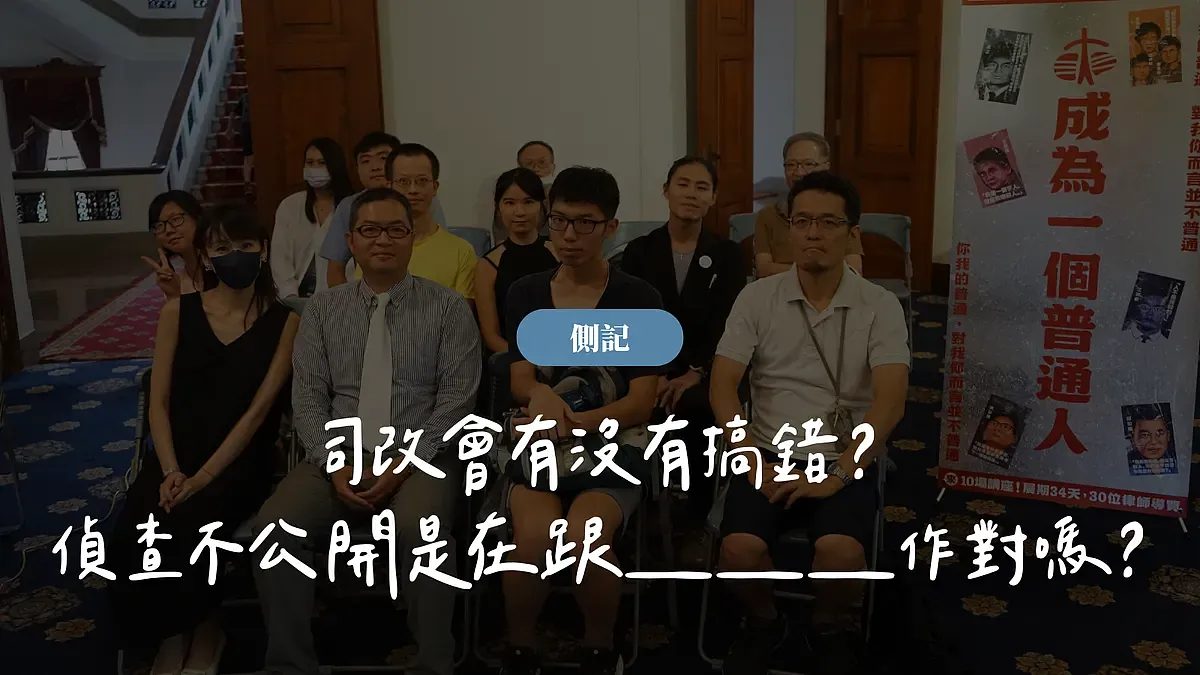
Sidelights | Has the JRF Lost Its Mind? Is Non-Publicity of Investigation Going Against___?
Last edited: 2026-08-23
Moderator|Chang An-ting (Member of the Standing Executive Committee, JRF; Attorney, Tung-Yin Law Firm)
Speaker|Shih Hung-Cheng (Member of the Standing Executive Committee, JRF; Attorney, San Ho Law Firm)
A core concept within the "Mirror" section of the "Becoming an Ordinary Person" exhibition is that "what is ordinary to us at this moment may not be ordinary to others."
Ten years ago, the "709 Crackdown," an internationally shocking mass arrest of human rights lawyers and citizens, began in the early hours of July 9, 2015, when Chinese public security and state security officers launched a sudden round of arrests against Wang Yu, a lawyer at Beijing Fengrui Law Firm, her husband Bao Longjun, and their son Bao Zhuoxuan (Bao Mengmeng). A total of 316 human rights lawyers, law firm staff, human rights defenders, and their family members across mainland China were summoned, forcibly interrogated, restricted from leaving the country, placed under residential surveillance, criminally detained, or subjected to enforced disappearance and arrest. Among them, 36 remained in detention or under enforced disappearance.
This year marks the tenth anniversary of the "709 Crackdown on Chinese Human Rights Lawyers." We have learned that over the past decade, the practicing environment for Chinese human rights lawyers has not improved; instead, it has deteriorated further—involving restrictions on personal freedom, disbarment, exit bans, and even harassment of family members.
During this exhibition, the JRF collected videos co-recorded by seven overseas lawyers and eight Taiwanese lawyers, which will premiere at the exhibition. The Foundation has also invited the Human Rights Committee of the Taiwan Bar Association and the Human Rights Committee of the Taipei Bar Association to discuss the plight of Chinese human rights lawyers and how and why Taiwanese lawyers can care about the issue.
The lecture series held during the exhibition "Becoming an Ordinary Person" highlights and deeply explores pivotal themes from the 30-year development of Taiwan's judicial reform. Among them, the issue of non-publicity of investigation has been one of the topics of greatest public concern in recent years.
This lecture was moderated by attorney Chang An-ting and presented by attorney Shih Hung-Cheng. The title of the lecture, "Has the JRF Lost Its Mind? Is Non-Publicity of Investigation Going Against___?", actually aimed to explore what the non-publicity of investigation is, why it is necessary, where its boundaries lie, and the real harms and risks it brings when abused.
Examining the Impact of Non-Publicity of Investigation on Case Parties Through Several Cases
To quickly engage the audience in the scenario, attorney Shih opened the session by playing several video clips—
The first was the well-known "Mom's Mouth" case; the second video was the "Bungled Espionage Case." Another video discussed the abuse of non-publicity of investigation: a couple who merely had a traffic dispute with the police became public targets due to extensive media coverage; although acquitted in the first and second instances and even having their administrative penalty revoked, their reputation had long been ruined. Other examples include police handling a drug case by leaking arrest footage, which surged to over a million views—investigative details were leaked before the suspect was even indicted, potentially alerting upstream figures and interfering with the search—not to mention the disregard for defendants' privacy and personality rights when they are treated as marketing material. (For details, see: Principle of Non-Publicity of Investigation)
In recent years, the high-profile "Kai-Kai Case" pushed the issue into an even sharper dilemma—a social worker was handcuffed and led out of the police station to a police car as if walking a "red carpet." Regarding this case, the JRF issued two consecutive statements pointing out that the police and prosecutors condoned media filming of the handcuffed social worker, which violated the principle of non-publicity of investigation. This not only failed to protect the lives of children, but also trampled upon the personal and occupational dignity of professionals. (For details, see: Joint Statement | Violating the Principle of Non-Publicity of Investigation Fails to Protect Child Welfare; What is the Justification for Handcuffing and Parading the CCFAM Social Worker?, Statement | Handcuffed Alongside the Social Worker is Our Human Rights: Implement the Rule of Law! Eradicate the Systemic Incentives for Police Violations!)
Perhaps the most controversial recent case is the corruption case involving Ko Wen-je (hereinafter referred to as the Ko Case). Attorney Shih carefully explained that during the investigation stage of the Ko Case, certain media outlets continuously published transcripts, USB contents, and other dossier materials. The JRF initially remained silent not because it was indifferent, but because it could not verify whether the reports were true. It was only after obtaining the indictment and conducting a cross-comparison that the Foundation confirmed the media held internal materials from investigative authorities, prompting the release of the statement 〈Nine Questions Regarding the Non-Publicity of Investigation〉. (For details, see: Statement | Nine Questions on the Open Investigation: Please Have Responsible Authorities Promptly Release an Investigation Report to Account to Society! The Judicial Reform Foundation's Statement Regarding Violations of the Non-Publicity of Investigation During the Investigation Process of the Ko Wen-je Case). Subsequently, the Taiwan High Prosecutors Office promised an investigation, and the Prosecutor-General emphasized that prosecutors follow regulations, but tracking down the source of leaks in practice remains extremely difficult, and no clear investigation results or disciplinary actions have been seen to date. This case also highlights the "cognitive polarization" in political cases: supporters with different stances selectively absorb media information based on preexisting biases, further reinforcing mutual antagonism. Some have argued for using "court livestreaming" to offset the media bias caused by investigative leaks, but attorney Shih reminded the audience that without rigorous design, livestreaming could instead cause procedural contamination.
From a legal perspective, however, this is a very straightforward issue. Attorney Shih explained the constitutional purpose of the non-publicity of investigation through the lens of Judicial Yuan Interpretation No. 737: on one hand, it helps the state effectively exercise its punitive power, and on the other hand, it protects the fundamental rights of suspects, defendants, and related parties. The purpose of the non-publicity of investigation can be broken down into several dimensions: avoiding "trial by media," preventing pre-trial biases from seeping in, avoiding implicating the innocent, preventing leaked case details from interfering with investigations, and preventing cases from being politicized. In reality, however, the reward and punishment systems for grassroots police officers are often tied to media exposure—exposure equals performance, equals commendation, and equals incentives for promotion or transfer. The "Love and Blood" series of videos launched by police departments across Taiwan in the past were typical examples, spreading outward from the Kaohsiung City Police Department until continuous protests by the JRF forced their gradual removal.
Attorney Shih pointed out that polls show the public most detests this kind of trial by media / open investigation, yet paradoxically, it is often the content that generates the highest web traffic.
How Can the System Be Improved?
Attorney Shih reviewed Resolution No. 14 of the National Drasstic Reform Conference on Judicial Reform: First, the non-publicity of investigation must be implemented by establishing administrative, criminal, and disciplinary responsibilities, investigated and strictly held accountable by competent authorities, and published regularly; second, law enforcement promotions should exclude factors such as media exposure and the charges brought, while thoroughly upholding the presumption of innocence; third, the Judicial Yuan, in conjunction with the Executive Yuan, should review the implementation effectiveness of the "Regulations Governing Non-Disclosure of Investigations." Although these directions are being followed "formally," their practical implementation remains quite limited.
On the other hand, attorney Shih introduced items 1 through 7 of Paragraph 1, Article 8 of the "Regulations Governing Non-Disclosure of Investigations," which list circumstances where exceptions allowing "disclosure" apply, such as safeguarding public interest, reassuring the public, or protecting the legitimate rights and interests of specific individuals. Theoretically, this only applies when there is preliminary suspicion of a crime requiring public assistance in identification, or when a suspect is at large and assistance is needed for capture.
For example, the First Commercial Bank ATM robbery case and the Pai Hsiao-yen case are typical examples requiring the power of the masses. In practice, however, when investigative agencies leak case details, they most frequently cite Article 8, Paragraph 1, Subparagraph 1 ("having a significant impact on national security, social order, major disasters, or cases of high public interest"), arbitrarily designating the cases they handle as high-profile and leaking information. But "high public interest" is not a universal pass; relevant regulations also emphasize that such cases must possess generality, impact, continuity, or social phenomenon characteristics, and must have a necessary connection to the individual case.
However, the everyday reality in practice is that Subparagraph 7 of Paragraph 1 of Article 8 is assembled into an "invincible offensive of open investigation," combined with the discretionary power granted by the directions for prosecutors to make "case-by-case disclosures," making the legislative purpose of non-publicity of investigation even harder to achieve. Furthermore, attorney Shih pointed out another frustrating contrast: police and prosecutors who violate the non-publicity of investigation are almost never caught and rarely disciplined, whereas lawyers involved in "leaking secrets" are repeatedly prosecuted, creating an absurd disparity.
Regarding the media side, attorney Chang reminded the audience that Article 22 of the Radio and Television Act, the Television News Self-Regulation Code, and the News Self-Regulation Implementation Guidelines of the ROC Association of Radio and Television Enterprises all explicitly state that "the principle of non-publicity of investigation should be respected." However, newspapers and most self-media lack equivalent self-regulation and external norms. Because the Code of Criminal Procedure does not list "media" as direct subjects regulated by the non-publicity of investigation, the NCC in recent years has only been able to advocate for self-regulation and guidelines; within this vacuum, enhancing citizens' media literacy becomes crucial.
How Should the Boundary Between "Publicity" and "Non-Publicity" of Investigation Be Defined?
Here, attorney Chang An-ting added several examples to help everyone grasp the boundaries of what "should be made public" and what "should not be made public."
Attorney Chang emphasized that the disclosure of relevant investigative contents in the First Commercial Bank and Pai Hsiao-yen cases was justified because disclosure directly facilitated identification or arrest. However, in recent cases such as the Ko Case or the Sanxia traffic accident, media outlets obtained and published interrogation transcripts, dossier photos, or video footage—materials that fall squarely within the scope of "absolutely prohibited from disclosure" under regulations—yet they were nakedly released.
Attorney Chang cited another example involving overseas scam hostages: a certain TV station broadcasted footage of "going to Dubai to work and being electrocuted and tortured," but the hostage was actually in Cambodia and had not yet escaped. After the footage was made public, the hostage was subjected to even more severe torture. When the JRF assisted in the rescue and subsequent judicial claims for compensation in cross-border marriage cases, judges asked in return: How can it be proved that the perpetrators "watched that video" before intensifying the torture? Even when communication records with friends and psychological counseling records were submitted, the court's judicial conviction still leaned toward the inability to prove causal connection. This case laid bare the difficulty of proving the damages caused by the publicity of investigations. Conversely, there are also instances where information "should have been made public but was not," such as the initial handling of sexual harassment at a kindergarten, where some media outlets remained completely silent to protect children, resulting in suspected victimized children remaining at risk. Competent authorities later clarified that based on the public interest and the prevention of ongoing harm, such cases can be disclosed under regulatory exceptions. Therefore, the "non-publicity of investigation" is by no means an ivory-tower concept; the key lies in meeting the requirements and balancing proportionality.
Q&A Session
During the final Q&A, someone asked: To implement the non-publicity of investigation, which law is most in need of amendment?
Attorney Chang responded that the primary subjects of regulation are inherently those within proceedings (prosecutors, prosecutors' investigators, police, accusers, defendants, defense counsel, related parties, etc.), and whether exceptions permit disclosure is decided by the police and prosecutors themselves—under this reality where "discretion and regulated subjects overlap," what the JRF can mostly do is urge compliance, while what truly matters remains the self-regulation and external oversight of the police-prosecutorial system. Attorney Shih added that having the police and prosecutors "investigate themselves" is inherently difficult; practically, the Control Yuan has previously issued corrective measures on individual cases (such as a Kaohsiung case and the Lu Ping-hung case), showing that intervention by a third-party institution is a viable path. Comparatively, Germany has a practice of incorporating "severe violations of the non-publicity of investigation" into sentencing considerations, which is worth evaluating for introduction in Taiwan.
Another person asked: Since radio and television have self-regulation while newspapers and publications do not, could the JRF in the future, when issuing official letters to police and prosecutors, directly inquire which exception under Article 8 of the enforcement directions the media's source falls under? And do general administrative agencies also fall under the regulated subjects of the non-publicity of investigation?
Attorney Chang replied that although the enforcement directions do not directly regulate the media and administrative agencies, if the media infringes upon the rights of parties through reporting, remedies or prosecution can still be pursued through civil (reputation, personality rights) or criminal pathways; the JRF will also continue to internalize principles into industry self-regulation through dialogues with media guilds and competent authorities.
Another person bluntly stated that if journalists do not report, they face pressure from superiors, making it seem too idealistic to demand media self-regulation?
Attorney Chang stated that she herself is a journalism graduate, and schools teach the necessity of non-publicity of investigation, but the realities of the media industry are indeed cruel. Practitioners can still report on criminal cases, but they must keep boundaries in mind. Attorney Shih added that the abolition of the Publication Act back then positioned the media as the fourth estate; using state power to excessively fetter them might instead create a chilling effect, which may not be a good thing.
As for someone suggesting whether to adopt a broader "judicial reservation" to protect investigative information, attorney Shih's view was that judicial reservation in Taiwan is mostly used for formal investigative measures such as compulsory dispositions, and judges usually make judgments on individual cases. For a court to shoulder the decision-making responsibility on "public interest determinations" that have no direct connection to individual cases would likely conflict with the nature of judicial power.
This article is an AI-generated translation of the original Chinese text. In the event of any discrepancy, the Chinese version shall prevail.