Protection of Crime Victims' Rights
If you are a victim of a felony in need of assistance, please contact the Association for Victims Support (National Service Hotline: 0800-005-850).
The protective services under the Crime Victim Rights Protection Act are limited to severe circumstances such as the death, severe injury, or sexual assault of the victim (see Article 13 for details).
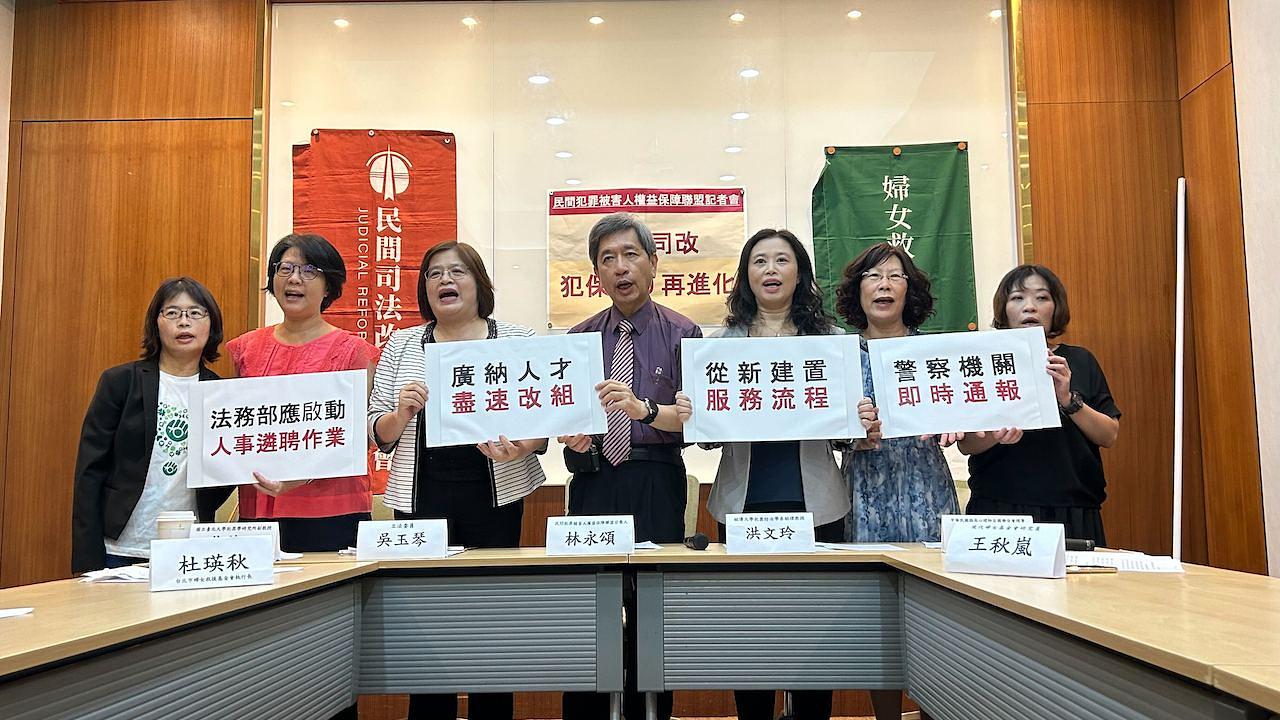
Established in 2020, the "Crime Victim Rights Protection Alliance" comprises the Child Rights Promotion Association of R.O.C., the National Federation of Clinical Psychologists Taiwan, the Taiwan Coalition Against Violence, the Judicial Reform Foundation, the Awakening Foundation, the Garden of Hope Foundation, the Modern Women's Foundation, as well as multiple scholars and attorneys. The Alliance pointed out that under the former Crime Victim Protection Act, the Association for Victims Support suffered from insufficient budgets and human resources, as well as unreasonable salary and compensation for personnel. This led to stagnant service quality that failed to meet societal expectations for victim protection. Furthermore, the slow processing speed of compensation failed to provide timely compensation to victims. In response, the Alliance took the lead in drafting a private-sector version and actively promoted legislative reform.
Following the Executive Yuan's submission of a draft bill—bringing together the official authorities, political parties from both the ruling and opposition camps, and civil society groups within the Alliance—the amended Crime Victim Rights Protection Act was passed on January 7, 2023. The Legislative Yuan also passed an attached resolution requiring the submission of a performance report within one year and an annual review of the implementation results of the new law.
This legislative reform is the most substantial overhaul since the enactment of the law in 1998, and the newly amended provisions concerning protective services and compensation have now been implemented. Regarding the disbursement of compensation, the past average determined amounts of crime victim compensation between 2016 and 2021 typically ranged between NT$400,000 and NT$560,000 for survivor cases; NT$700,000 to NT$1,250,000 for severe injury cases; and NT$200,000 to NT$240,000 for sexual assault cases. As for the new disbursement method, it has been changed to a "lump-sum fixed amount": NT$1.8 million per case for survivor compensation; tiered fixed amounts ranging from NT$800,000 to NT$1.6 million for severe injury compensation; and disbursement standards ranging from NT$100,000 to NT$400,000 for sexual assault compensation, categorized according to the statutory provisions under which the indictment was brought.
Civil society organizations such as the Judicial Reform Foundation will continue to monitor the personnel elections and service implementation of the Association for Victims Support. If you are a crime victim or a family member and have encountered shortcomings in various mechanisms of the current system that need review and improvement, you are welcome to contact our foundation.
Key Amendments to the Crime Victim Rights Protection Act
- The definition of "severe injury" has been expanded from Article 10 of the Criminal Code to include major illnesses and injuries under the National Health Insurance, broadening the scope of victims eligible to claim compensation.
- Crime victims' family members are now included as subjects of protective services. Adopting a family-centered approach, the scope of protection, services, and financial assistance provided to victims has been expanded, including legal litigation assistance, emergency relief, family living support, medical care, and counseling and guidance services.
- Crime victim compensation has been transformed from a nature of "subrogated recovery" to a "state lump-sum fixed payment." The state will no longer seek reimbursement of compensation from victims based on the perpetrator's civil liability. If the defendant is acquitted in the future, the victim is not required to return the compensation either.
- A provision has been added for crime victim protection orders. When the court deems that in cases of intentional offenses resulting in death, severe injury, violation of sexual autonomy, or offenses related to sexual imagery, the defendant meets the criteria for detention but detention is not strictly necessary, it may issue a protection order requiring the defendant to comply with specific matters.
Unfinished Legislative Agenda of Civil Society in This Reform
The primary demand raised by civil society groups during this legislative reform was that the government allocate sufficient organizational and personnel budgets to handle matters concerning crime victim rights protection and protective services. Unfortunately, the amendments regarding compensation review and funding sources were not adopted by the government in this legislative reform.
- To further increase the efficiency of compensation reviews and reasonably divide operational responsibilities, compensation reviews should be transferred from local prosecutors offices to local Associations for Victims Support.
- Prison labor earnings within correctional institutions should not serve as a source of funding for compensation.
First Anniversary Monitoring Action of the Reform: The Victim Support Alliance's "Civil Society Evaluation Report"
Following the passage of the new law, this Alliance has continuously monitored the work implementation and fulfillment of attached resolutions by the Association for Victims Support and relevant ministries under the new framework. Referring to the "Results Report on the One-Year Implementation of the New Crime Victim Rights Protection Act" submitted by the Ministry of Justice, and evaluating the implementation effectiveness of the new law over its first year in effect, the Alliance has proposed a Civil Society Evaluation Report, putting forward 10 major demands and 20 specific recommendations to the Ministry of Justice, the National Police Agency, and the Association for Victims Support across organizational, service, and systemic dimensions:
- Demand 1: Implement the attached resolutions of the Legislative Yuan to respond to public expectations.
- Demand 2: Work result reports should clearly and directly present whether performance indicators have been achieved; the establishment and modification of performance metrics must be supported by professional evaluations and sufficient explanations.
- Demand 3: Establish professional service quality evaluations to facilitate the review and continuous enhancement of service quality.
- Demand 4: Comprehensively review organizational design, simplify bureaucratic and hierarchical operations, and foster a new atmosphere in organizational culture.
- Demand 5: Cooperate across ministries and agencies to understand actual victimization circumstances, achieving a true "no cases fall through the cracks" approach.
- Demand 6: Implement 24-hour timely reporting to catch crime victims at the very first instance.
- Demand 7: In accordance with the legislative intent of the new law, take stock of and review the implementation status of volunteer training programs.
- Demand 8: Strengthen communication and cooperation mechanisms with other organizations to minimize the inconvenience victims face when seeking assistance.
- Demand 9: Enhance the visibility of the Association for Victims Support and implement benefit evaluations for promotional funding.
- Demand 10: Advance news processing from "information provision" to "perspectives advocacy" so that society can see the victims.
Meanwhile, particularly regarding the reform of the statute of limitations for the prosecution of "childhood sexual assault survivors," the Crime Victim Rights Protection Alliance has held multiple press conferences in recent years, arguing that relevant legislative reforms have matured. The Legislative Yuan, after incorporating opinions from all walks of life, should advance related legislation as soon as possible to further protect victims' rights. At the same time, we call upon the Ministry of Justice, as the competent authority for regulations, to conduct broader studies and take stock of supporting systems.