
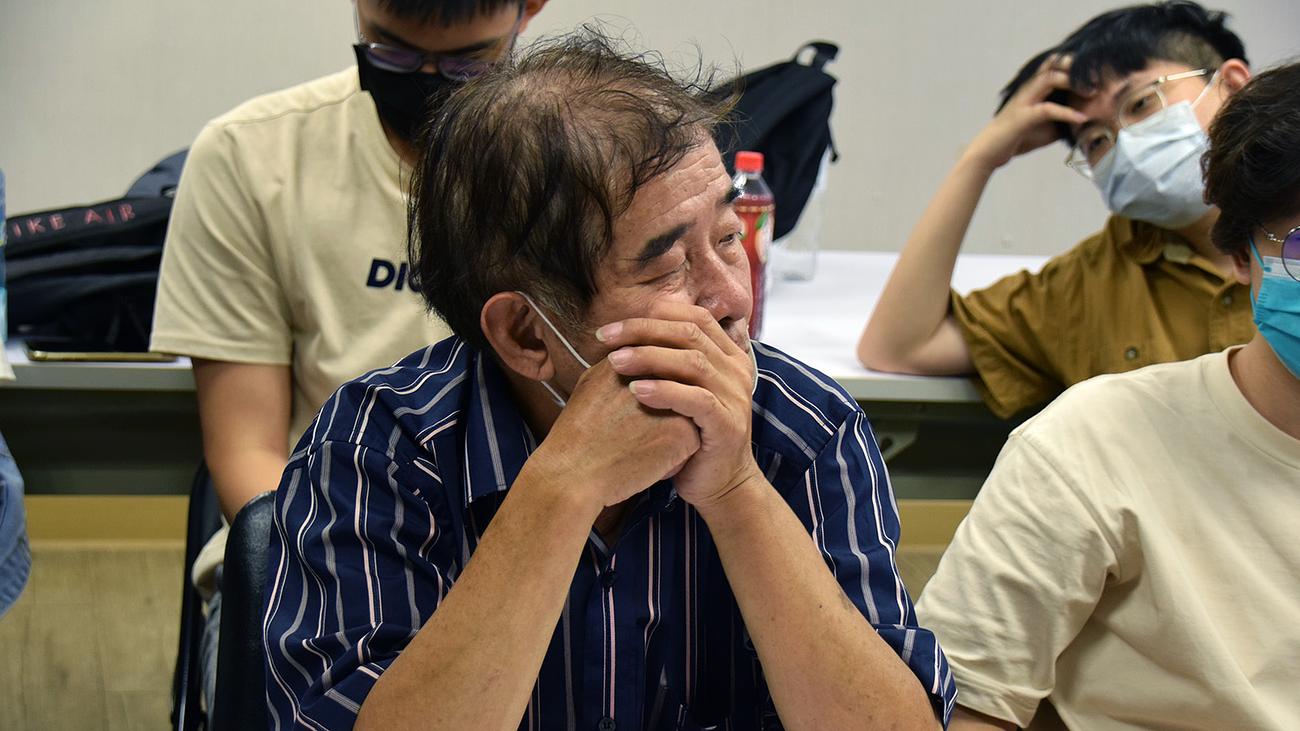
Kuo Chung-hsiung Case
In 1986, the Chin-Jui-Chen Jewelry Store robbery occurred in Hsinchu, entangling two co-defendants, Su Ping-k'un and Kuo Chung-hsiung, in a wrongful conviction.
I. The Road to Exoneration for Big Brother Su Ping-k'un of the Chin-Jui-Chen Jewelry Store Robbery
Perhaps many people encountered the name Kuo Chung-hsiung for the first time within this context—
From the Taiwan Association for Innocence website, one can read the case introduction of the "Su Ping-k'un Case": "In June 1986, Kuo Chung-hsiung was apprehended while failing in a jewelry store burglary. At the police station, he stated that the Chin-Jui-Chen Jewelry Store robbery that occurred in March of that year was jointly committed by himself and Su Ping-k'un. He claimed that Su Ping-k'un and he together broke the iron window of the Chin-Jui-Chen Jewelry Store and entered, and Kuo Chung-hsiung went to the jewelry store's kitchen to take a kitchen knife in case the owner discovered them. ...... The court of first instance acquitted the two men, but upon the prosecutor's appeal, the court of second instance held that Kuo Chung-hsiung and Su Ping-k'un were guilty of attempted robbery resulting in homicide, and the Supreme Court dismissed the appeal."
After the conviction became final, the convicted person Su Ping-k'un firmly asserted his innocence, maintaining he was not involved in the attempted robbery with intent to commit murder. The case was reopened for investigation by prosecutors, who concluded that Su Ping-k'un and Kuo Chung-hsiung were indeed not involved. The prosecution system filed for four retrials and four extraordinary appeals for Su Ping-k'un, none of which provided relief. With judicial remedies exhausted, President Chen Shui-bian granted a pardon to Su Ping-k'un on December 10, 2000, pursuant to the latter part of Article 3 of the Amnesty Act, declaring the sentence null and void.
In 2017, Su Ping-k'un applied for a retrial regarding the conviction of attempted robbery with intent to commit murder. The Taiwan High Court ruled to commence a retrial via its 106-Year-Sheng-Tsai-tzu No. 225 Criminal Ruling, and subsequently rendered the 107-Year-Tsai-tzu No. 3 Criminal Judgment, holding that Su Ping-k'un was not involved in the attempted robbery with intent to commit murder, dismissing the prosecutor's appeal, and upholding the acquittal of the first instance. As the prosecutor did not appeal, the case became final (Case Number: Taiwan High Court 107-Year-Tsai-tzu No. 3 Criminal Judgment).
Note: For details regarding the "Su Ping-k'un Case," please refer to "A Hijacked Life: Su Ping-k'un's Thirty-Year Long Road from Wrongful Conviction to Acquittal" authored by Ch'en Chao-ju.
II. Kuo Chung-hsiung, the "Other Defendant" in the Chin-Jui-Chen Jewelry Store Robbery: The 2020 Retrial and Exoneration in the "Attempted Robbery and Homicide Case"
Following Su Ping-k'un's exoneration, the judiciary implicitly acknowledged that the evidentiary structure established years prior through torture, coerced confessions, and fabricated physical evidence was untenable. In alignment with the factual scope of Su Ping-k'un's retrial case, and following a review by the Taiwan High Prosecutors Office's Review Committee for Final Convictions, prosecutors proactively filed for a retrial on Kuo Chung-hsiung's behalf in 2019, while the Judicial Reform Foundation assisted in organizing a defense team to also file for a retrial.
After the Taiwan High Court ruled to commence a retrial via its 108-Year-Sheng-Tsai-tzu No. 331 Criminal Ruling, and rendered the 108-Year-Tsai-tzu No. 3 Criminal Judgment dismissing the prosecutor's appeal and upholding the acquittal of the first instance, 34 years after Su Ping-k'un and Kuo Chung-hsiung were embroiled in the Chin-Jui-Chen Jewelry Store wrongful conviction, both defendants finally awaited judicial relief and were exonerated and acquitted. (Case Number: Taiwan High Court 108-Year-Tsai-tzu No. 3 Criminal Judgment)


III. The Road to Relief for Three Additional "Theft Cases" Stemming from Torture
However, searching for Kuo Chung-hsiung's name in the judgment retrieval system yields not only the aforementioned case numbers but also many different rulings, and even an Grand Chamber ruling. What is going on?
(I) The Qualifying Round: Can a Retrial Be Filed for Three of the Four Cases Constituting a "Continuous Offense"?
It turns out that when subjected to torture back then, Kuo Chung-hsiung stated that the police told him, "You've already confessed to the major charge [referring to the part overlapping with Su Ping-k'un, i.e., the attempted robbery and murder at Chin-Jui-Chen Jewelry Store], you might as well confess to the minor ones too!" Therefore, following the exoneration under 108-Year-Tsai-tzu No. 3, three of the other four theft cases—which were also confessed to due to torture back then—are still striving to seek a retrial and exoneration.
Supreme Court 109-Year-T'ai-K'ang-Ta-tzu No. 1221 Criminal Grand Chamber Ruling established the Supreme Court's legal opinion regarding whether a retrial can be petitioned for a portion of the criminal facts deemed a single offense under the continuous offense theory (three of the four thefts) in this procedural aspect of the case:
"With the growing emphasis on the awareness of fundamental human rights, our country's retrial system has gradually been unbundled, and interpreting the literal meaning of statutory provisions indeed necessitates keeping pace with the times. For multiple offenses involving multiple punitive powers, since all criminal facts are independent of each other, if a retrial is petitioned solely for some of the criminal facts on the grounds of discovering new facts or new evidence warranting an acquittal, it should be deemed to meet the requirement of 'warranting an acquittal' under Article 420, Paragraph 1, Subparagraph 6 of the Code of Criminal Procedure, thereby permitting a retrial application. Consequently, for offenses deemed a single offense by legal fiction, they are substantively multiple offenses, treated as a single offense or punished by the heaviest punishment merely due to statutory provisions. If a petition for a retrial based on the inability to prove part of the criminal facts were treated differently from substantive multiple offenses comprising multiple acts, it would hardly be considered fair."


(II) The Road to Retrial for the "Three Theft Cases" Faces Obstacles
Although the Grand Chamber ruling confirmed that a retrial "can be petitioned" for this part, the grounds for retrial have been very straightforward from the beginning. As shown in the presentation slides of the retrial investigation hearing on this page, the evidentiary structure of this case is very simple, consisting solely of a confession as direct evidence, along with a witness's testimony and a gold jewelry registry. The defense team argued that the fact of torture recognized in the judgment for attempted robbery and homicide is closely intertwined with the impact caused by the torture in this case, and the content of the circumstantial evidence significantly diverges from the seized stolen goods:


However, after filing for retrial and having it dismissed three times, the defense team filed interlocutory appeals to the Supreme Court, which thrice set aside the rulings and remanded them to the High Court, until the Supreme Court dismissed them definitively in March 2025.
Among them, the court's logic was that even if it is confirmed that torture occurred regarding the "attempted robbery and homicide part (i.e., the part already exonerated)," it is difficult to confirm whether the effect of the torture extended to the part where "Kuo Chung-hsiung confessed to these three theft facts."
Were Kuo Chung-hsiung's confessions truly voluntary? As shown in the presentation slides of the retrial investigation hearing on this page, the defense team has consistently argued that these transcripts were all confessions made during three frequent police interrogations conducted in the exact same environment of torture and extreme high pressure:


The relief process is summarized in the table below (compiled by Attorney Ch'en Chia-yi):
| Ruling Date | Case Number | Content |
| 2020.6.30 |
Reasons for dismissing the retrial petition for the theft cases: 1. The fact that Kuo Chung-hsiung's successive police interrogation and prosecutorial transcripts were subjected to torture naturally has the effect of shaking the validity of the original judgment. 2. Kuo Chung-hsiung's confessions were determined by Taiwan High Court 107-Year-Tsai-tzu No. 3 Criminal Judgment to lack voluntariness. Kuo Chung-hsiung's confession inherently possesses the characteristics of testimony, serving as testimony to self-incriminate (a false confession), which satisfies the provisions of Article 420, Paragraph 1, Subparagraph 2 of the Code of Criminal Procedure. |
|
| 2021.4.22 |
Original ruling set aside, remanded to the High Court. Reasons for the Supreme Court setting aside High Court 108 Sheng-Tsai 476: 1. The original ruling failed to explain the reasons why excluding Kuo Chung-hsiung's confession—which was determined to lack voluntariness by the High Court's 107-Year-Tsai-tzu No. 3 judgment—still has no impact on the original judgment, constituting a failure to state reasons. 2. Wrong file retrieved: The lower court instructed for the retrieval of the case files and evidence of the lower court's 75-Year-Shang-Chung-I-Su-tzu No. 355 (see page 119 of the lower court's file); however, the original ruling recorded how the appellant's successive 4 counts of theft were individually discussed and rebutted in the reasoning of the original final judgment, and detailed the basis relied upon and the reasons for forming convictions within the judgment reasoning, having been verified by reviewing the electronic files (evidence) of successive instances of this Court's 108-Year-T'ai-Shang-tzu No. 2265 in accordance with its ex officio authority (see page 4 of the original ruling). What connection this Court's file retrieved by it has with the original final judgment was never explained, also suffering from the flaws of contradictory reasons and failure to state reasons. |
|
| 2021.11.30 |
Taiwan High Court 110-Year-Sheng-Tsai-Keng-I-tzu No. 5 Ruling |
Retrial petition for theft cases dismissed. Reasons for petition: 1. Compiling Kuo Chung-hsiung's successive transcripts to illustrate the lack of voluntariness in his confessions (comparing the petitioner's confessions during police interrogation regarding the offenses in Table ㈠, Items 1 to 3, with the police interrogation contents of Tsai Jui-chen, Wang Shun, and Ch'en Hsien-jung, as well as the transcript recorders and recording times, it can be seen that the police used the police interrogation contents of Tsai Jui-chen and others to coerce the petitioner into confessing to ungrounded theft offenses; the petitioner's confessions lacked voluntariness.) The court held that the confessions matched the criminal facts and were insufficient to shake the facts established by the original final judgment regarding the theft part (Table 1, Items 1 to 3). 2. A false confession still satisfies Article 420, Paragraph 1, Subparagraph 2 of the Code of Criminal Procedure. The court held that a witness refers to a judge, prosecutor, or third party other than the defendant. A defendant confessing to criminal facts in the capacity of a defendant is a defendant's confession rather than testimony; even if it is subsequently discovered that the confession is false and untruthful, it does not meet the requirement of Article 420, Paragraph 1, Subparagraph 2 that the testimony relied upon by the original judgment has been proved to be false. |
| 2022.3.2 |
Original ruling set aside, remanded to the High Court. Reasons for the Supreme Court setting aside High Court 110 Sheng-Tsai-Keng-I 5: 1. A defendant's confession is likewise a statement by a "person," and is a statutory method of proof referred to in Article 156, Paragraph 1 of the same Law. Where a confession is voluntary and matches the facts, it may be used as evidence; its evidentiary nature is no different from a witness's statement, and both may serve as the basis for establishing criminal facts, not straying beyond the possible literal meaning of "testimony." If the "defendant's confession" relied upon by the original judgment has been proved to be false, by logical interpretation, it should still be deemed to fall within the scope of "testimony" referred to in Article 420, Paragraph 1, Subparagraph 2. 2. The chronological sequence of recording the transcripts and the authenticity of the confessions await clarification: "How was the police able to notify the aforesaid 3 victims to take police interrogation transcripts within a short time after the appellant was apprehended by the police? Did each of these victims originally intend to pursue the crimes? What was the chronological relationship between the appellant's confession regarding this part and the victims' statements of victimization? Did the time when the police learned of the criminal facts match the time when the transcripts were made?" These aspects truly concern the judgment of the authenticity of the appellant's confession regarding this part, and require further deliberation and clarification. |
|
| 2023.2.3 |
Taiwan High Court 111-Year-Sheng-Tsai-Keng-Er-tzu No. 3 Ruling |
Retrial petition for theft cases dismissed. Reasons for petition: 1. Confessions lacked voluntariness. In a temporally closely connected context, Kuo Chung-hsiung confessed to the theft offenses described in Table ㈠ of the original final judgment (i.e., the offenses shown in Table 1, Items 1 to 3, hereinafter the criminal facts of this case), clearly suffering the improper impact of the aforementioned torture. Moreover, Kuo Chung-hsiung's successive statements regarding the details of the theft facts varied (comparing the police interrogation contents of victims Tsai Jui-chen, Ch'en Hsien-jung, and Wang Su-han's father Wang Shun, it can be seen that the police used the contents of statements by Tsai Jui-chen and others to demand that the petitioner confess to the offenses of this case). Regarding the criminal facts of this case and the offenses determined to have non-voluntary confessions in cases 107-Year-Tsai-tzu No. 3 and 108-Year-Tsai-tzu No. 3, because the times Kuo Chung-hsiung underwent police interrogation and the interrogating police officers were different, and the contents interrogated and investigated were also separable, there was no circumstance of confessions lacking voluntariness regarding the theft part. 2. The expression "testimony relied upon by the original judgment has been proved to be false" in Article 420, Paragraph 1, Subparagraph 2 of the Code of Criminal Procedure does not limit such testimony to being charged with the crime of perjury; as long as the testimony is determined by a judgment to be false, it is applicable. The statements made by the petitioner during police interrogation adopted by the original final judgment, as well as the testimony given under oath by witness and handling police officer Chang Jui-hsiung during prosecution investigation stating there was no torture, waterboarding, or forced coercion, have been determined by this Court's judgments 107-Year-Tsai-tzu No. 3 and 108-Year-Tsai-tzu No. 3 to be false, satisfying the provisions of Article 420, Paragraph 1, Subparagraph 2 of the Code of Criminal Procedure. The court held that Kuo Chung-hsiung's confession during police interrogation regarding the criminal facts of this case was not false. There is no positive evidence proving that witness Chang Jui-hsiung's sworn testimony during prosecution investigation was false, failing to meet the threshold of "testimony relied upon has been proved to be false" under Article 420, Paragraph 1, Subparagraph 2 of the Code of Criminal Procedure. 3. The court sua sponte summoned Tsai Jui-chen and Cheng Chin-liang, the police officer who recorded Ch'en Hsien-jung's police interrogation, but failed to notify the defense team to express their opinions. |
| 2023.8.31 |
Original ruling set aside, remanded to the High Court. Reasons for setting aside 111 Sheng-Tsai-Keng-Er 3: Failure to notify the defense team to express opinions violated due process: "Where the competent court receiving a retrial petition investigates evidence without notifying the prosecutor, the convicted person, and their agent in advance of the designated investigation date to enable them to be present during the investigation, and fails to give the aforesaid persons the opportunity to learn of the evidentiary data obtained from the investigation so as to make legal opinions, nor states legitimate reasons in the ruling for failing to fulfill the aforementioned relevant procedures, yet cites the evidentiary data obtained from its own investigation to summarily dismiss the retrial petition, the procedure of investigating evidence for the retrial petition conducted by it can hardly be said to be lawful." |
|
| 2024.10.14 |
Taiwan High Court 112-Year-Sheng-Tsai-Keng-San-tzu No. 5 Ruling |
Retrial petition for theft cases dismissed. Reasons for petition: 1. In a temporally closely connected context, Kuo Chung-hsiung suffered improper impact from torture during the police interrogation for the attempted robbery and murder offense; Kuo Chung-hsiung's successive statements regarding the details of the criminal facts of this case varied widely, and his confessions lacked voluntariness and authenticity. The court held that the confession regarding the theft offense possessed voluntariness. 2. The expression "testimony relied upon by the original judgment has been proved to be false" in Article 420, Paragraph 1, Subparagraph 2 of the Code of Criminal Procedure does not limit such testimony to being charged with the crime of perjury; as long as the testimony is determined by a judgment to be false, it is applicable. The statements made by the petitioner during police interrogation adopted by the original final judgment, as well as the testimony given under oath by witness and handling police officer Chang Jui-hsiung during prosecution investigation stating there was no torture, waterboarding, or forced coercion, have been determined by this Court's judgments 107-Year-Tsai-tzu No. 3 and 108-Year-Tsai-tzu No. 3 to be false, satisfying the provisions of Article 420, Paragraph 1, Subparagraph 2 of the Code of Criminal Procedure. The court held that the judgments of 107 and 108-Year-Tsai-tzu No. 3 regarding the selection or alternative evaluation of Chang Jui-hsiung's testimony are not binding on the theft facts of this case, and do not align with the provisions of Article 420, Paragraph 1, Subparagraph 2 of the Code of Criminal Procedure. |
| 2025.2.13 |
Interlocutory appeal dismissed. Reasons for dismissal: Wang Shun originally had no intention of reporting his limited property loss. This clearly shows that if the appellant had not voluntarily confessed, and if it did not match the facts, how could the police have anticipated his criminal facts to coerce and induce the appellant into a full and frank confession? Thus, the original ruling held that even if the retrial judgment in another case submitted by the appellant determined that the appellant's confession regarding the offense in Table 2, Item 2 lacked voluntariness, it is still insufficient to shake the 3 counts of aggravated theft facts of this case determined by the original final judgment, failing to meet the provisions of Article 420, Paragraph 1, Subparagraph 2 and Subparagraph 6 of the Code of Criminal Procedure, which is entirely proper. Moreover, since the appellant's retrial petition was without merit, there is certainly no question of ordering the prosecutor to bear the burden of proof that the confession originated from free will. |
Among them, after the High Court's remand retrial ruling dismissed the petition (Case Number: Taiwan High Court Criminal Ruling 110-Year-Sheng-Tsai-Keng-I-tzu No. 5), the defense team appealed to the Supreme Court. In the Supreme Court's reasoning for vacating and remanding (Case Number: Supreme Court Criminal Ruling 111-Year-T'ai-K'ang-tzu No. 23), it recognized that the scope of "testimony" referred to in Article 420, Paragraph 1, Subparagraph 2 also includes a defendant's confession, and pointed out several parts where the authenticity of the confession was in doubt, briefly kindling hope for the defense team.
Important legal opinions of Supreme Court 111-Year-T'ai-K'ang-tzu No. 23 Criminal Ruling:
- A "defendant's confession" that has been proved to be false should still be deemed to fall within the scope of "testimony" referred to in Article 420, Paragraph 1, Subparagraph 2.
- While testimony (including confessions) determined by a finalized "judgment" to be false does not solely refer to testimony that has already been adjudicated under the crime of perjury, it must still be a criminal judgment supported by substantial positive evidence to prove its falsity in order to match.
However, fighting all the way to February 2025, setting aside procedural grounds where the court failed to let the defense team express their opinions, on the substantive legal issues, the court ultimately still held that the confession regarding the theft part "is difficult to recognize as having any improper interrogation or continuation thereof." To this day, Kuo Chung-hsiung has reached the age of 75 without ever having the opportunity to open a retrial.
(III) Extraordinary Appeal and Constitutional Litigation
Following the Supreme Court's dismissal, the defense team considered the court's interpretation of "testimony" under Article 420, Paragraph 1, Subparagraph 2 of the Code of Criminal Procedure—namely, "testimony, appraisal, or interpretation relied upon by the original judgment has been proved to be false"—to be overly stringent, as well as its ruling on the burden of proof regarding torture evidence. Logically, Article 156 of the Code of Criminal Procedure (evidentiary capability of confessions) is a general provision; the Supreme Court's ultimate dismissal reasoning that the prosecutor bears no burden of proof would result in a violation of due process and infringe upon Kuo Chung-hsiung's litigation defense rights as a victim of torture. Based on the above, the defense team filed an extraordinary appeal and constitutional litigation on August 25, 2025.
However, one week after filing the extraordinary appeal (September 2), an official non-acceptance document was swiftly received from the Supreme Prosecutors Office, and a non-acceptance ruling for the constitutional litigation case was also received on March 3, 2026 (115-Year-Shen-Tsai-tzu No. 502).
| Date | Relief Sought | Content |
| 2025.8.25 |
Filed an extraordinary appeal and constitutional litigation |
1. The interpretation of "testimony" under Article 420, Paragraph 1, Subparagraph 2 of the Code of Criminal Procedure ("testimony, appraisal, or interpretation relied upon by the original judgment has been proved to be false") is overly stringent. 2. Regarding the burden of proof for torture evidence, Article 156 of the Code of Criminal Procedure (evidentiary capability of confessions) is a general provision; the Supreme Court's ultimate dismissal reasoning that the prosecutor bears no burden of proof causes a violation of due process and infringes upon Kuo Chung-hsiung's litigation defense rights as a victim of torture. |
| 2025.9.2 |
Extraordinary appeal not accepted |
A retrial dismissal ruling does not have the same legal effect as a final judgment of sentencing. Pursuant to Supreme Court Precedents 21-T'ai-Fei-152 and 44-T'ai-Fei-41, an extraordinary appeal may not be filed. |
| 2026.3.3 |
Constitutional litigation not accepted |
Failed to specifically articulate the reasons how the final and conclusive judgment is unconstitutional. |
IV. Kuo Chung-hsiung Is Not the Only One Who Failed to Be Exonerated
The Hsinchu District Prosecutors Office sought extraordinary relief for Su Ping-k'un, holding that Ch'en Jung-hui, the owner of the Chin-Jui-Chen Jewelry Store, knowingly claimed fraud compensation despite knowing that the seized gold jewelry was not the loss incurred by his store, and prosecuted Ch'en Jung-hui for the crime of fraud. Ch'en Jung-hui was found guilty of fraud by the Taiwan High Court 84-Year-Shang-I-tzu No. 881 Judgment, sentenced to one month's imprisonment with a two-year suspension of sentence; because it was unappealable, the conviction became final (Full text of the judgment). The prosecutor then petitioned for a retrial in the interest of Su Ping-k'un based on this fraud conviction, leading to an absurd result—the actual victim of the Chin-Jui-Chen Jewelry Store robbery in this case instead became a defendant in a fraud case and was convicted.
Both the Taiwan High Court 107-Year-Tsai-tzu No. 3 Judgment and the Taiwan High Court 108-Year-Tsai-tzu No. 3 Judgment record that when the handling police officers notified Ch'en Jung-hui on June 19, 1986, to come and collect one gold bracelet and one gold necklace retrieved from the Paohsing Jewelry Store, they merely presented a pre-filled receipt for the custody of stolen goods and evidence for him to sign and press his fingerprint, without handing over these gold jewelry items to him on the spot. Moreover, when Ch'en Jung-hui and Ch'en Hsu-mei-lung successively expressed on the spot that "these two pieces of gold jewelry are not the stolen gold jewelry of the Chin-Jui-Chen Jewelry Store and they were unwilling to take them back," the handling police officers "still violated the subjective wishes of Ch'en Jung-hui and Ch'en Hsu-mei-lung," forcibly returning the two pieces of gold jewelry to the Chin-Jui-Chen Jewelry Store, and the two persons subsequently returned the property.
From this, it is evident that Ch'en Jung-hui fundamentally lacked the intent to fraudulently claim stolen goods. However, there is currently no opportunity to pursue extraordinary relief or request a pardon regarding this part.