

Unfit Judges & Prosecutors
What should I do if I encounter a judge or prosecutor with serious case-handling problems?
After July 17, 2020, citizens may directly file a complaint (i.e., "request a [case-specific] evaluation") against a judge or prosecutor with the evaluation committee. Below, the JRF shares its complete past experience in requesting evaluations from the ground up, and provides relevant legal briefs and case references for your use. If you encounter a judge or prosecutor with problematic case-handling practices, you can request an evaluation yourself or retain an attorney to do so.
The biggest change under the new law is that while it removed the eligibility of civil society organizations to request evaluations, it opened the door for citizens to file requests directly. The legislative purpose of the new law is to allow citizens to approach the evaluation committee channel more directly and easily, without having to go through the screening of intermediate civil society organizations; but conversely, it also leaves the evaluation committees without the buffer, organization, and assistance of civil society organizations, requiring them to directly face requests from citizens on the front lines.
On July 17, 2021, the revised Judges Act marked its first full year of implementation. According to public data released by the Judges Evaluation Commission (JEC) and the Prosecutors Evaluation Commission (PEC), most cases currently result in a decision not to refer for evaluation. The JRF is particularly concerned with whether the JEC and PEC actively investigate evidence during the review process, such as:
- Whether case files and evidence were retrieved?
- For attitude-related cases: whether court recording audio discs were retrieved?
- Whether the complainant or relevant witnesses were invited to appear and state their opinions?
If your case resulted in a decision not to refer for evaluation or a request being dismissed, and you can identify issues related to the investigation of evidence, you are welcome to report it to the JRF!
1. When can an evaluation be requested?
If you believe that a judge or prosecutor has engaged in any "unlawful conduct or dereliction of duty" while handling your case, you may directly request an evaluation from the Judges Evaluation Commission or the Prosecutors Evaluation Commission on your own or by retaining an attorney within three years after the conclusion of the case. Conversely, if the statute of limitations has expired, an evaluation can no longer be requested.
What does "conclusion of the case" mean?
Simply put, it means your case has come to an end. For example, after a court of first instance judgment, the appeal period expires, and the case is definitively concluded. Or, if both parties have already reached a settlement, the case is also considered concluded.
How is the "statute of limitations" calculated?
-
If the grounds for evaluation do not involve a case handled by the judge or prosecutor, the starting point for the statute of limitations is when the factual occurrence of such improper conduct ends!
-
If you are requesting an evaluation regarding the delayed case situation under Article 30, Paragraph 2 of the Judges Act (cases that have been pending in the court of first instance for more than 6 years without a judgment being rendered, with sufficient facts to establish intentional or gross negligence), the statute of limitations is calculated as 3 years starting from the date the judgment is finalized or from the expiration of the 6-year pending period.
2. Can an evaluation be requested for erroneous legal interpretations?
The purpose of an evaluation is to identify judges or prosecutors who exhibit "unlawful conduct or dereliction of duty" in handling cases; it does not, by law, address issues of "legal interpretation." If an evaluation is requested solely on the grounds of "legal interpretation," the evaluation committee will resolve to issue a "decision not to refer for evaluation" pursuant to Article 37, Paragraph 4 of the Judges Act.
Therefore, if you believe that the judge's or prosecutor's "legal interpretation" is erroneous and your case is still ongoing, it is recommended to seek relief through remedies such as appeal (or initiate a retrial or extraordinary appeal for finalized cases).
However, if the scope of "legal interpretation" is interpreted all-encompassing, it might make the severe misconduct of judges or prosecutors immune to oversight. Therefore, the JEC has previously raised the following exceptions:
Exception: "Arbitrary Abuse of Power"
The results of a hospital DNA paternity test indicated that the probability of a "half-sibling relationship" between the parties was less than 1%, yet the court judgment made an opposite determination without explaining the reasons for rejecting the test result (JEC 2013 Ping-Tzu No. 1). Although the JEC found that "the complete omission of this appraisal report in the judgment, while not a major error, was nevertheless improper," and deemed the request unsubstantiated, it still decided to refer the matter to the Chief Judge for administrative supervision.
Exception: "Manifestly Unlawful"
During a preparatory proceeding in a district court, the evaluated judge ruled in court to detain the defendant without inquiring about the defendant's opinions (violating Article 101, Paragraph 3 of the Code of Criminal Procedure) (JEC 2015 Ping-Tzu No. 2). In this regard, the JEC took the view that disciplinary action may still be taken if the conduct reaches the degree of "arbitrariness entirely lacking in basis or manifest unlawfulness." However, the facts of this case did not quite reach that threshold, and thus no evaluation was instituted regarding this part.
Although the aforementioned exceptions are very strict in their determination, if you encounter similar situations that severely affect your rights and interests, you may still consider requesting an evaluation.
3. What constitutes "unlawful conduct or dereliction of duty"?
As explained previously, evaluations target the "unlawful conduct or dereliction of duty" of judges and prosecutors. Drawing from the JRF's nine years of past experience, grievances that are relatively easier to succeed in—resulting in disciplinary action against judges and prosecutors—generally fall into two categories: "procedural violations" and "poor demeanor" (after all, other illegal or improper behaviors are difficult to discern merely from court hearings and interactions with the judge or prosecutor).
-
Violation of Case-Handling Procedural Regulations
A judge or prosecutor violates mandatory procedural rules that must be observed during litigation and leave no room for discretionary power, thereby resulting in damage to your rights and interests.
[Case 1] A judge ordered the appellant's litigation agent and the appellee to leave the courtroom, and subsequently compelled an 86-year-old appellant holding a physical and mental disability certificate to withdraw their lawsuit using improper methods, severely violating case-handling procedural regulations. Regarding this case, the JRF previously published the audio recording after the courtroom doors were closed (JEC 2014 Ping-Tzu No. 11).
[Case 2] The Code of Criminal Procedure stipulates that concerning statements made by a defendant—including denials and excuses—further investigation and interrogation regarding why they are inconsistent with previous statements, witness testimony, physical evidence, or case files shall not be conducted during preparatory proceedings, so as not to undermine the principles of direct trial and oral trial. A judge conducted substantive investigations during the preparatory proceedings of the subject case and engaged in extracting confessions through detention, which was determined to violate the presumption of innocence enshrined in Article 154, Paragraph 1 of the Code of Criminal Procedure, improperly infringing upon the defendant's constitutionally protected right to a fair trial (JEC 2018 Ping-Tzu No. 5).
[Case 3] Pursuant to Point 166 of the Directions for Courts Handling Criminal Litigation, when a judge inquires whether a defendant intends to withdraw an appeal, they must not use inducement. However, a judge provided incorrect information to a defendant, telling him that his case could be commuted to community service, thereby inducing the defendant to withdraw his appeal. After withdrawing the appeal, the defendant discovered that his case could not be commuted to community service at all (JEC 2012 Ping-Tzu No. 1).
-
Poor Demeanor
Under current evaluation practice, unless the demeanor is truly atrocious, poor demeanor still needs to be coupled with a violation of case-handling procedural regulations that harms your rights and interests to make a successful complaint more likely. Nonetheless, attitude-related cases do include the following instances:
[Case 1] A judge stated in the courtroom, "Counsel for the plaintiff, you must have studied until something is wrong with your brain," and "For goodness sake, you've studied until you've gone stupid! Your brain is broken, and I truly admire you lawyers—I don't know how you ever studied back then" (JEC 2019 Ping-Tzu No. 2, JEC 2019 Ping-Tzu No. 7).
[Case 2] A judge said to a party, "The court does not welcome unclean hands coming in to litigate a lawsuit." and "Are your hands clean? Right? You're not clean, and he's not clean either, do you understand that?" (JEC 2018 Ping-Tzu No. 2).
How can citizens request an evaluation on their own?
Submission Recipient: Evaluation Committee
-
Judges Evaluation Commission
- Phone: 02-2383-0619
- Address: 6th Fl., No. 26, Sec. 2, Guiyang St., Wanhua Dist., Taipei City
- Submission methods: Mail or in-person submission are both acceptable
-
Prosecutors Evaluation Commission
- Phone: 02-2311-8312
- Address: 5th Fl., No. 130, Sec. 1, Chongqing S. Rd., Zhongzheng Dist., Taipei City
- Submission methods: Mail, in-person, or submission at the receipt desk on the left side of the 1st floor of the Ministry of Justice are all acceptable
1. How to write an evaluation request form?
Please first download the blank legal brief templates:
- Judge Evaluation Request Form (Including matters applying for evidence investigation) |Criminal |Civil |Administrative |
- Prosecutor Evaluation Request Form (Including matters applying for evidence investigation) |Criminal |
- If you need to retrieve court recording audio discs |Criminal |Civil |Administrative |
In addition to the brief templates we prepared, you can also refer to the official versions provided:
These blank brief templates need to be adapted and used in conjunction with the materials described below. We have also open-sourced parts of the request forms we filed in the past after redacting personal information and certain facts for your reference. A clear request form consists of three parts:
-
Facts of the Case-Specific Evaluation Request
- What is your role in what kind of case?
For example: Are you a defendant in a criminal fraud case? Or a plaintiff in a civil damages lawsuit? - What did the prosecutor or judge do during the investigation or trial proceedings?
For example: What harsh remarks were said, or what actions were taken?
※ How to obtain case file review data? Case file data is the foundation for applying for an evaluation. Please refer to the article 〈How to Obtain Case File Review Data?〉 - What is your role in what kind of case?
-
Reasons Why the Evaluated Judge Should Be Subject to Evaluation
※ Reminder: This section requires legal argumentation, not merely describing what you experienced. This part is relatively complex, so past cases will be shared later.- In the "evaluation facts" written in point 1, what case-handling procedures do you believe were violated? Where were the "Judges/Prosecutors Code of Ethics" breached?
- Do the contents of the violation meet the grounds for evaluation under the Judges Act?
-
Matters Requesting Evidence Investigation
※ Reminder: The evidence investigation here refers to the investigation targeting the unsuitability of the judge/prosecutor, "not" other evidence investigations intended to overturn the outcome of your case (such as dashboard cameras disputing facts in the original case, call detail records of the opposing party, etc.)!- What else needs to be investigated?
For example: Which case number's file, transcript, or courtroom recording should be retrieved? What kind of official records within the court or prosecutors office should be retrieved?
- What else needs to be investigated?
2. How to write "Reasons Why the Evaluated Judge Should Be Subject to Evaluation"?
-
Part 1: First, state what case-handling procedures you believe the judge or prosecutor violated, or where the "Judges/Prosecutors Code of Ethics" was breached.
Facts Legal Provisions Cited in the Request Form Reference Files of Request Briefs with Personal Info and Partial Facts Redacted Improperly persuading the withdrawal of a lawsuit - Article 288 of the Code of Civil Procedure: "If the court cannot form a mental conviction based on the evidence applied for by the parties and deems it necessary for the discovery of truth, it may investigate evidence ex officio. When conducting an investigation pursuant to the preceding provision, the parties shall be given an opportunity to state their opinions."
- Article 3 of the Judges Code of Ethics: "When exercising their official duties, judges shall maintain fairness, objectivity, and neutrality, and shall not engage in conduct that impairs public trust in the judiciary."
- Article 12, Paragraph 3 of the Judges Code of Ethics: "Judges may encourage and facilitate parties to conduct mediation, settlement, or resolve disputes through other appropriate means, but shall not do so by improper methods."
108 Fa-Ping No. 6 Evaluation Request Form (Simplified Version) Substantive investigation during preparatory proceedings, extracting confessions through detention - Article 3 of the Judges Code of Ethics (as above)
- Article 12, Paragraphs 1 and 2 of the Judges Code of Ethics: "Judges shall make adequate preparations prior to opening court; during court sessions, they shall listen with objectivity, impartiality, neutrality, patience, and politeness, and uphold the litigation rights or rights of defense of parties and interested parties. Judges shall maintain court solemnity and order, and shall not hurl insults at, unreasonably reprimand, or otherwise impair the dignity of persons present in court."
- Article 98 of the Code of Criminal Procedure: "Interrogation of a defendant shall be conducted with an earnest attitude, and shall not utilize violence, threats, inducement, fraud, fatigue interrogation, or other improper methods."
- Article 154 of the Code of Criminal Procedure: "A defendant shall be presumed innocent until proved guilty by a final judgment."
- Article 273 of the Code of Criminal Procedure (Scope of Preparatory Proceedings)
107 Fa-Ping No. 5 Evaluation Request Form (Simplified Version) Interruption of court recording - Article 90, Paragraph 2 of the Court Organization Act: "When court is in session, audio recording shall be conducted unless otherwise provided by law. Video recording may be conducted when necessary."
- Article 2, Paragraph 1 of the Regulations Governing Court Audio and Video Recording and the Utilization and Preservation Thereof: "To uphold the openness and transparency of court proceedings and judicial accountability, when the court holds hearings within the court premises in civil, criminal, and administrative litigation cases (matters) as well as family and juvenile protection cases, audio recording shall be conducted. The same shall apply to other cases (matters) when audio recording is necessary."
- Point 6 of the Implementation Guidelines for Digital Court Recording: "When digital court recording equipment cannot be used due to any reason, the courtroom clerk shall use other digital recording equipment to conduct the recording. After the court session, it shall be handed over to the information office to be transcribed to the host machine for centralized custody, and the original recording content shall be deleted."
107 Fa-Ping No. 2 Evaluation Request Form (Simplified Version) Sarcastic and cynical remarks - Article 4 of the Judges Code of Ethics: "When exercising official duties, judges shall not exhibit bias, discrimination, disparate treatment, or other improper conduct on the grounds of gender, race, region, religion, nationality, age, physical condition, sexual orientation, marital status, socio-economic status, political affiliation, cultural background, or other factors."
- Article 3 of the Judges Code of Ethics (as above)
- Article 12, Paragraphs 1, 2, and 3 of the Judges Code of Ethics (as above)
Excessively short court hearing duration, not allowing parties to make statements - Article 199 of the Code of Civil Procedure: "The presiding judge shall take care to order the parties to make appropriate and complete arguments regarding the facts and law of the litigation relationship. The presiding judge shall question or instruct the parties to make statements of fact and law, apply for evidence, or make other necessary applications and statements; if the applications or statements are unclear or incomplete, the presiding judge shall order them to clarify or supplement."
- Point 52 of the Directions for Handling Civil Litigation Events: "The presiding judge shall constantly take care to exercise the power of clarification, questioning or instructing the parties to make statements of fact and law, apply for evidence, or make other applications or statements necessary for determining the litigation relationship. If their applications or statements are unclear or incomplete, the presiding judge shall order them to clarify or supplement, and shall take care to order the parties to make appropriate and complete arguments regarding the facts and law of the litigation relationship. All litigation materials to be considered in the judgment must be given full opportunity for the parties to argue. When arguing on a certain matter, the parties shall be ordered to make continuous statements, and unnecessary questioning shall not be conducted, provided that disjointed and repetitive statements may be prohibited or restricted. The questioning or instruction of the presiding judge shall not be delivered with harsh tone and demeanor, frivolous attitude, or utilizing suggestive or directive phrasing."
- Point 181 of the Directions for Handling Civil Litigation Events: "Summary litigation events shall, as a rule, be concluded with arguments on a single date, provided that the investigation of evidence and determination of facts must still be handled prudently. Cases that have not reached the stage where a judgment can be rendered shall not be abruptly concluded."
Impatience, telling parties they are wasting their time - Articles 3 and 12, Paragraphs 1, 2, and 3 of the Judges Code of Ethics (as above)
104 Fa-Ping No. 12 Evaluation Request Form (Simplified Version) Improperly persuading a guilty plea - Article 96 of the Code of Criminal Procedure: "Interrogation of a defendant shall afford an opportunity to explain away criminal suspicions; if explanations are offered, the defendant shall be ordered to make continuous statements from beginning to end; if statements of favorable facts are made, the defendant shall be ordered to indicate methods of proof."
- Article 98 of the Code of Criminal Procedure: "Interrogation of a defendant shall be conducted with an earnest attitude, and shall not utilize violence, threats, inducement, fraud, fatigue interrogation, or other improper methods."
- Point 27 of the Directions for Courts Handling Criminal Litigation Cases: "While the interrogation of a defendant focuses on discerning the existence of criminal facts, facts concerning the elements of the offense, aggravating elements, sentencing standards, or grounds for mitigation should all be deeply attended to during interrogation and researched clearly. If a defendant raises favorable facts, their methods of proof and avenues of investigation must be pursued step-by-step, and they must not be treated with indifference. Where a defendant or accomplice confesses to a crime, other necessary evidence must still be investigated to thoroughly deduce whether it accords with the facts, and the confession of a defendant or accomplice shall not be used as the sole evidence for a guilty judgment. The investigation of a defendant's confession that may serve as evidence shall, unless specially provided otherwise, be conducted after the investigation of other evidence related to the criminal facts is completed."
Ordering court bailiffs to handcuff the defendant - Articles 89 and 91 of the Court Organization Act
- Guidelines for Court Bailiffs of Taiwan High Court and Courts at All Levels Subordinate Thereto in Using Restraints
104 Chien-Ping No. 5 Evaluation Request Form (Simplified Version) Due to the principle of non-publicity of investigations, if many cases are concluded with a decision not to prosecute or a disposition not to initiate prosecution, the JRF, being a civil organization, is unable to investigate evidence and the data obtainable is limited. Therefore, in the past, parties were sometimes asked to sign a declaration to testify to what they personally saw and heard, coupled with an application for evidence investigation, in order to draft the request form. For example, in the following case:
Facts Legal Provisions Cited in the Request Form Reference Files of Request Briefs with Personal Info and Partial Facts Redacted Improperly intervening in another prosecutor's investigation - Article 5 of the Prosecutors Code of Ethics: "Prosecutors shall uphold integrity, exercise caution in speech and conduct, strive to maintain the honor and dignity of their office, and shall not utilize their office or title to seek improper property or benefits for themselves or third parties."
- Article 11 of the Prosecutors Code of Ethics: "Prosecutors shall neither make nor accept any requests or lobbying that may impair the fairness, detachment, independence, and integrity of their duties."
- Article 6 of the Civil Service Employment Act: "Public servants shall not abuse their power to seek benefits for themselves or others, and shall not utilize opportunities arising from their duties to inflict harm upon others."
107 Chien-Ping No. 4 Evaluation Request Form (Simplified Version) Under the current system, when citizens make direct requests, they only need to clearly state in the request form what data they are asking the Prosecutors Evaluation Commission to investigate and the reasons for the investigation.
Related Links
-
Part 2: Does the aforementioned violation meet the grounds for evaluation under the Judges Act?
Grounds for Judge Evaluation Grounds Basis Case Example There are sufficient facts to establish that due to intent or gross negligence, there are manifest and major errors in adjudicating cases, resulting in severe infringement upon people's rights and interests. Article 30, Paragraph 2, Subparagraph 1 Judge D failed to carefully review the land registry transcript and directly ruled in accordance with the plaintiff's request that the defendant transfer the land to the plaintiff, only to discover later that the land did not belong to the defendant at all. Violation of official obligations, dereliction of duty, or unbecoming conduct and speech of a serious nature. Article 21, Paragraph 1, Subparagraph 2; Article 30, Paragraph 2, Subparagraph 2 Judge E failed to increase the defendant's sentence in accordance with recidivism regulations, disregarded evidence of the defendant's criminal record, abused discretionary judicial conviction, and pronounced a suspended sentence for the defendant. Serious violation of case-handling procedural regulations or official duties, of a serious nature. Article 30, Paragraph 2, Subparagraph 5 Judge F handled drug and juvenile cases, and instead of producing ruling documents as required, directly substituted them with pronouncement transcripts, severely violating case-handling procedures. Violation of the Judges Code of Ethics, of a serious nature. Article 30, Paragraph 2, Subparagraph 7 Judge G insulted defense counsel more than 20 times during court hearings using terms such as "stupid," "crazy," and "garbage." Grounds for Prosecutor Evaluation Grounds Basis Case Example After the judgment has become final, or in cases pending in the court of first instance for more than 6 years without a judgment being rendered, or cases where a disposition of non-prosecution or conditional non-prosecution has become final, there are sufficient facts to establish that due to intent or gross negligence, there are manifest and major errors, resulting in severe infringement upon people's rights and interests. Article 89, Paragraph 4, Subparagraph 1 Prosecutor H used summary sentencing as a condition to coerce and induce an innocent defendant into pleading guilty. Dereliction of duty, exceeding authority, or unbecoming conduct, of a serious nature. Article 89, Paragraph 4, Subparagraph 2; Article 95, Subparagraph 2 Prosecutor I seized 18 to 20 smuggled firearms, but falsely reported 50. Reporting fewer to claim more, seeking credit and rewards. Serious violation of case-handling procedural regulations or official duties such as non-publicity of investigations, of a serious nature. Article 89, Paragraph 4, Subparagraph 5 Prosecutor J brought media personnel to the scene to photograph during a search and seizure; and accepted interviews multiple times to publicly discuss the case. Violation of the Prosecutors Code of Ethics, of a serious nature. Article 89, Paragraph 4, Subparagraph 7 Prosecutor L [Note: K in original text context] used the pretext of discussing a case to privately invite a female party to meet, demanding sexual acts or committing indecent assault to satisfy desires. Common Grounds for Judge and Prosecutor Evaluation Grounds Basis Case Example A judge or prosecutor fails to resign from their position or retire/be severed in accordance with the law prior to one year before the expiration of the term of office for the respective public office they intend to participate in, or prior to registration for a re-election, by-election, or legislative election held after the dissolution of the Legislative Yuan by the President, yet registers as a candidate for public office election. Article 15, Paragraphs 2 and 3; Article 30, Paragraph 2, Subparagraph 2; Article 89, Paragraph 4, Subparagraph 3 The prosecutor's father, Councilor L, unexpectedly passed away 4 months before the election, and the prosecutor inherited his father's aspirations to enter the election. A judge or prosecutor joins a political party, political organization, or their activities during their tenure, or fails to withdraw from a political party or political organization joined prior to taking office, of a serious nature. Article 15, Paragraph 1; Article 30, Paragraph 2, Subparagraph 2; Article 89, Paragraph 4, Subparagraph 4 A judge organized a judicial sector support group for a presidential candidate and served as its chairperson. A judge or prosecutor concurrently holds any of the following posts or businesses, of a serious nature: Representatives to people's bodies at central or local levels; Posts that public servants are prohibited from holding concurrently under civil service regulations; Members of regulations or appeal review committees of agencies other than judicial authorities, or members of the Civil Service Protection and Training Commission; Directors, supervisors, or other responsible persons of private schools at all levels; Other posts or businesses sufficient to affect a judge's independent adjudication or incompatible with their professional ethics and official dignity. Article 16; Article 30, Paragraph 2, Subparagraph 2; Article 89, Paragraph 4, Subparagraph 4 A prosecutor taught concurrently at cram schools specializing in attorney and judicial officer examinations to earn money. A judge or prosecutor engages in conduct that impairs the dignity of their office or trust in their duties, fails to strictly keep official secrets, of a serious nature. Article 18; Article 30, Paragraph 2, Subparagraph 2; Article 89, Paragraph 4, Subparagraph 4 A prosecutor, entrusted by a friend, used investigating a case as an excuse to retrieve the phone call log records of the friend's ex-wife to help the friend find out whether she had formed a new relationship. Without justifiable reason, delaying the progress of a case, resulting in impact on the rights and interests of the parties, of a serious nature. Article 30, Paragraph 2, Subparagraph 6; Article 89, Paragraph 4, Subparagraph 6 A prosecutor, without justifiable reason, handled 14 cases without holding court sessions for half a year, and 6 cases for a year. Related Links
3. How should one argue "Matters Requesting Evidence Investigation"?
Example:
- It is requested that Your Commission, ex officio pursuant to Article 41-1, Paragraph 1 of the Judges Act, retrieve the courtroom audio recordings of this case to corroborate the aforementioned circumstances of poor demeanor of the evaluated judge listed by the requester, and it is further requested that Your Commission allow the requester to view, transcribe, copy, or photograph the data obtained from the aforementioned investigation pursuant to Article 41-1, Paragraph 4 of the Judges Act.
- If the evaluated prosecutor submits an opinion statement, it is requested that Your Commission deliver the evaluated prosecutor's opinion statement to the requester pursuant to Article 41-1, Paragraph 3 of the Judges Act.
- It is requested that Your Commission notify the requester to appear before the committee to state opinions pursuant to Article 41-1, Paragraph 2 of the Judges Act.
Courtroom audio recordings are very important evidence, but are they very difficult to retrieve?- For a compilation of practical views, please refer to the article 〈Application for Delivery of Courtroom Audio Recording Discs - Compilation of Rulings〉
- Before requesting an evaluation, you can try to obtain them in advance. If they cannot be retrieved, when drafting the evaluation request form, you can also attempt to request the JEC or PEC to retrieve them after finishing writing the evaluation facts and reasons.
-
Judges Evaluation Commission
Under the new law, although the JRF is no longer the principal subject for requesting evaluations, it will continue to care about cases involving unsuitable judges and prosecutors, and assist the public through other means.
When encountering problems with unsuitable judges and prosecutors, you may refer to the above introduction to file an evaluation yourself or seek help from an attorney on your own. If you have related questions or wish to report issues concerning the evaluation committee, you may still contact the JRF Complaint Center.
Complaint Center Hotline
If you have any other questions, you are welcome to schedule an in-person interview at the JRF Legal Clinic.

2013
The Good Fight Is Not Yet Over
Upon leaving the Prosecutor Evaluation Commission, my shoulders felt immensely light, yet my heart was exceedingly…
2013
The Control Yuan Can No Longer Muddy the Waters
The Prosecutors Evaluation Commission resolved to refer the unlawful and abusive Huang Shih-ming and Special…
2013
"The Huang Shih-mings" Will Eventually Pass
The Prosecutor Evaluation Commission issued a resolution to remove Huang Shih-ming from office. Seeing that his…
2013
Statement by the JRF Regarding the Decision of the Proskynesis Evaluation Committee on the Huang Shih-ming Leak Case
Regarding today's (12/14) decision by the Prosecutors Evaluation Committee regarding Prosecutor-General Huang Shih-ming…
2013
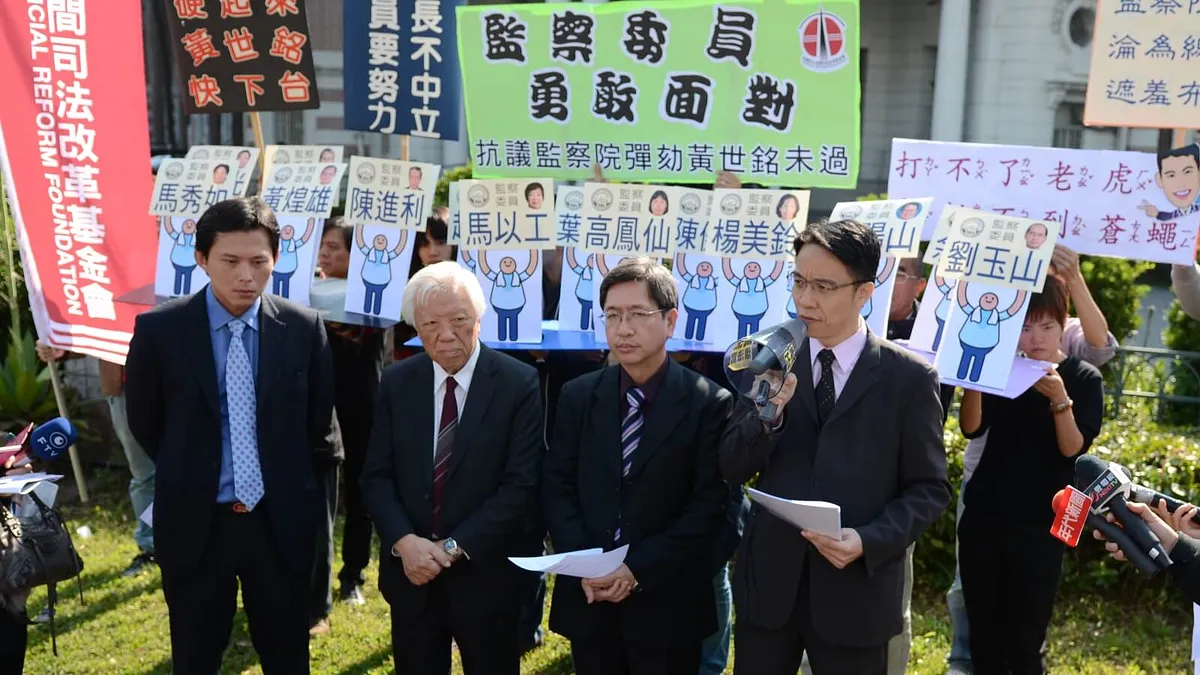
Control Yuan Members, Face It Bravely! ~ Press Conference Protesting the Control Yuan's Failure to Impeach Huang Shih-ming
On September 16, our Foundation formally submitted a written petition to the Control Yuan, detailing specific grounds…
2013
JRF Expresses Deep Regret over Control Yuan's Failure to Impeach Prosecutor-General Huang Shih-ming
Regarding the failure to impeach Prosecutor-General Huang Shih-ming, our organization issues this statement.
2013
A "Self-Representation" Trial Destined to Be a Joke
After being indicted, Huang Shih-ming stubbornly insisted on continuing to work as if nothing had happened, accusing…
2013
Infringement of Parties' Right to Procedural Participation Tarnishes Evaluation: JRF Statement on the Prosecutors Evaluation Commission's Deliberation of the Huang Shih-ming and Other Cases
Regarding the Special Investigation Division's allegations that Taiwan High Prosecutors Office Chief Prosecutor Ch'en…
2013
Disappointing Prosecutor Evaluations
On the evening of June 13, 2011, I attended a meeting at the Judicial Reform Foundation with friends long dedicated to…
2013
Huang Shih-ming Must Relinquish the Prosecutor-General's Command Authority
Minister of Justice Lo Ying-shee invoked the Judges Act, which applies mutatis mutandis to prosecutors, refusing to…
2013
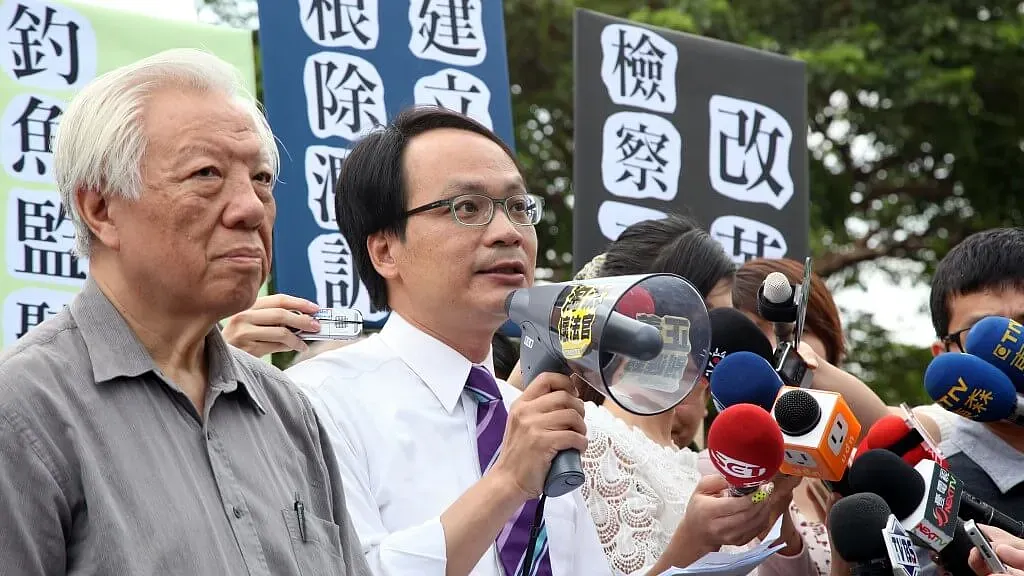
High Standards and Low Thresholds in the Leak Case
For alleged violations of Article 132 of the Criminal Code and Article 27 of the Communication Security and…
2013
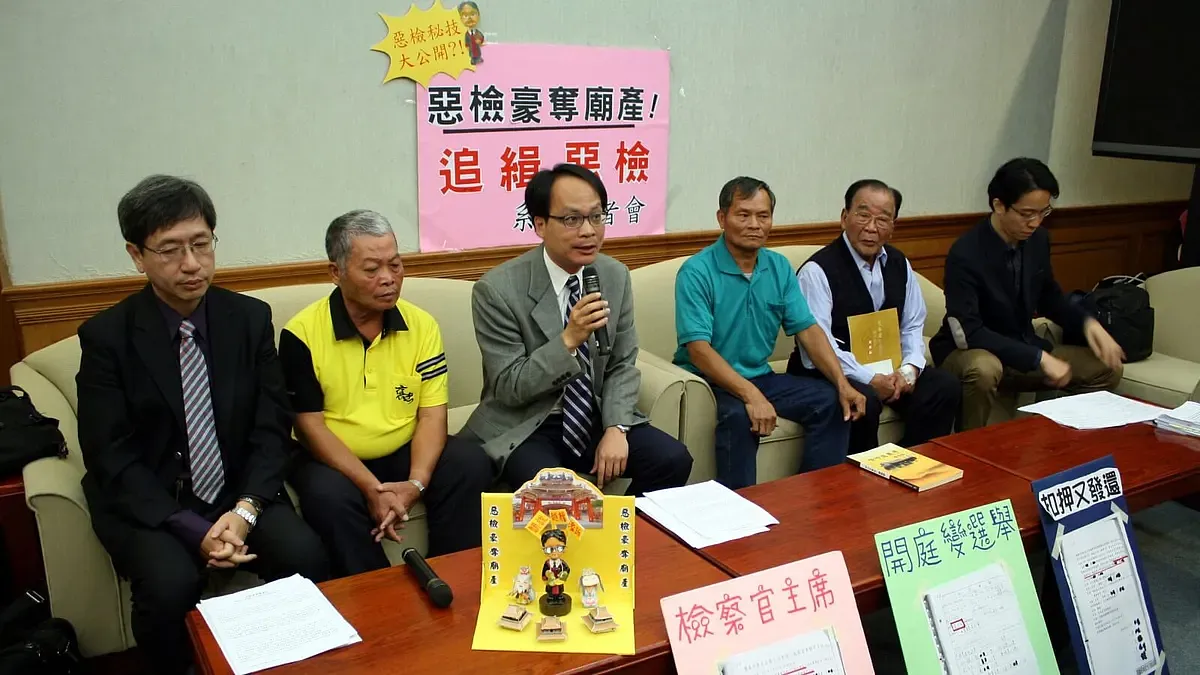
Corrupt Prosecutor Seizes Temple Property! Exposing Corrupt Prosecutor's Secret Techniques? "Hounding Corrupt Prosecutors" Press Conference Series (VI)
Today, our Foundation is releasing details of Prosecutor Wu Wen-cheng's abuse of power, and the affected party is…