
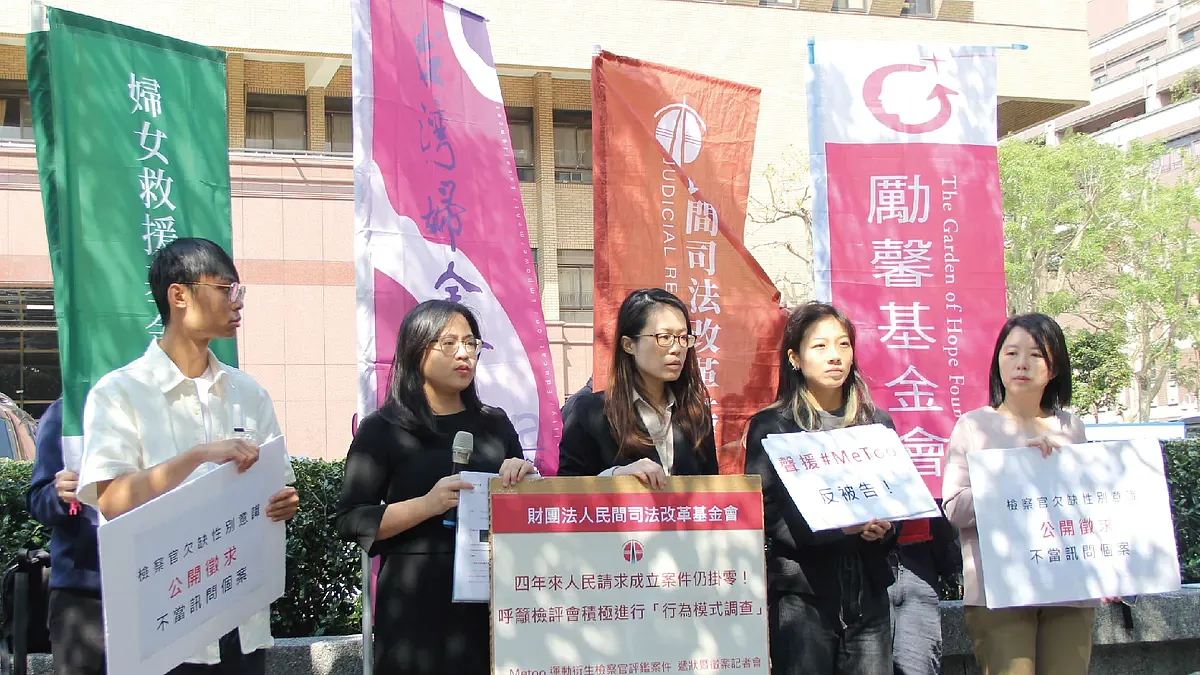
Press Release | Four Years On and Citizen-Initiated Cases Still Stand at Zero: Calling on the Prosecutor Evaluation Commission to Actively Conduct Behavioral Pattern Investigations | #MeToo Movement-Derived Prosecutor Evaluation Case Filing and Call for Submissions Press Conference
Last edited: 2026-07-27
Taiwan's #MeToo movement opened with the public speaking out of a political worker, and subsequent reports on #MeToo cases flooded media headlines. From politics to media, arts, film and television, the judiciary, sports, campuses, and other fields, an increasing number of sexual assault and sexual harassment victims bravely spoke out to expose their experiences and stories. However, many victims began facing judicial counterattacks from perpetrators, such as accusing the victims' #MeToo statements of being defamatory through the offense of defamation under the Criminal Code, or demanding compensation through civil tort lawsuits.
More than four years have passed since the amendment of the Judges Act, yet the Prosecutor Evaluation Commission has not yet made a single decision to substantiate a citizen-requested case. The Foundation received this grievance from the concerned parties regarding improper treatment such as poor attitude and gender questioning received during the prosecutor's interrogation, and submitted an evaluation request today, calling on the Prosecutor Evaluation Commission to actively investigate:
1. Over Four Years Since the Amendment of the Judges Act, Citizen-Requested Evaluation Cases Substantiated by the PEC Remain at Zero; the PEC Should Actively Conduct Behavioral Pattern Investigations
On July 17, 2019, the Judges Act was amended and passed through three readings, officially taking effect on July 17, 2020. The most significant reform of the new law lies in granting citizens the direct right to file grievances against judges or prosecutors with the "Evaluation Commission," eliminating the need for civil society organizations to act as proxies in requesting evaluations. However, while there are 11 prosecutor evaluation cases that have been substantiated, not a single one is an evaluation case substantiated upon a citizen's request (details can be found in the "Four-Year Observation Report on the Amendment of the Judges Act" and Symposium Records released by our Foundation last December). As shown in our Foundation's previous anniversary reports (First Anniversary Report, Second Anniversary Report), this substantiation rate is not only lower than the substantiation rate during the period of the old law when the Judicial Reform Foundation could still act as an evaluation-requesting entity, but it also falls far short of similar mechanisms in the UK.
In response to this, in addition to continuing our advocacy since the post-amendment period for actively retrieving audio recordings and allowing the public to state their opinions, our Foundation once again calls upon the PEC not to adopt a passive attitude of "no complaint, no action" when facing public grievances, but to actively conduct the behavioral pattern investigations explicitly stipulated in Article 35, Paragraph 6 of the Judges Act, referencing internal and external evaluation information of the court (whether from holders of disciplinary supervisory power or information collected by local bar associations) to observe the "overall personality profile" of the evaluated person. Every evaluation request is an opportunity to uncover problems. However, compared to the period when civic groups could request evaluations, the information in citizens' hands severely lacks horizontal integration. When the Evaluation Commission relinquishes this proactive investigative authority, it will inevitably lead to a weakening of its function, making it difficult to serve as a cornerstone for maintaining public trust in the judiciary.
2. Cases Involving Gender Discrimination Specifically Warrant Behavioral Pattern Investigations
Our Foundation received a grievance that in June 2023, during Taiwan's #MeToo movement, in order to bring visibility to the experiences of sexual assault/sexual harassment victims, Li Tzu-tung (李紫彤), Yen I-sheng (嚴毅昇), and several friends who also posted online—who are present at today's press conference—mentioned on Facebook that they had personally witnessed and heard Walis Nokan (Chinese name: Wu Chün-chieh, hereinafter referred to as Wu Chün-chieh) sexually harass a young female attendee in November 2021, and were consequently sued by Wu Chün-chieh. The case was handled by Prosecutor Ch'en of the Taichung District Prosecutors Office (i.e., the evaluated prosecutor; the evaluation request form with personal data redacted is attached), and the parties ultimately received a final disposition of non-prosecution.
The judicial investigation process is protracted. Over the year and a half since the #MeToo incident occurred, the public has rarely noticed the subsequent expenditure of immense effort and time by victims, speakers, supporters, and even prosecutorial agencies. Although the two parties present today are grateful that after the transfer of jurisdiction, other prosecutors concluded this case with non-prosecution, they reported to the Judicial Reform Foundation that Prosecutor Ch'en, who was in charge of interrogating them during the interrogation sessions on November 27, 2023, and December 21, 2023, frequently adopted a tough, impatient, and poor tone, repeatedly interrupted the parties' statements, and made biased remarks stemming from gender stereotypes. For instance: "I am no interest in knowing your background story!", "Answer whatever is asked!", "That is irrelevant, I am not asking about this, I am not interested, just answer whether you can say for sure it is true?", and "The other party is a famous figure in the literary world, is it appropriate for you to do this?" Furthermore, the prosecutor repeatedly asked one of the parties whether she was a woman, which not only left her deeply perplexed as to the correlation between her gender and the elements of defamation, but also led her to believe that the prosecutor held the implication that only a specific gender, such as women, could feel uncomfortable about sexual harassment, thus constituting language tainted by gender discrimination.
In particular, this case was not an ordinary defamation case, but a derivative case where citizens, after supporting victims who struggled to find a voice under a patriarchal structure during the #MeToo movement, were subjected to judicial prosecution by powerful individuals. Although the parties ultimately received a non-prosecution disposition, for the public, justice does not mean "as long as you are fine in the end." Experiencing the lack of gender sensitivity and poor attitude from judicial personnel during the questioning and handling stages of the investigation phase still leaves them worried that the same handling model might cause secondary trauma to sexual harassment victims in other #MeToo-derived defamation cases.
3. Open Call for Individual Cases of Improper Questioning Involving Gender Discrimination by Prosecutors
The parties believe that Prosecutor Ch'en's conduct during the court sessions was indeed objectionable, and they have exhausted the information at hand to prove it, submitting it to the PEC today for reference. However, because complainants in non-prosecution cases cannot obtain case files and court session audio recordings, your Commission must still retrieve the interrogation room disc to clarify the matter. Therefore, the requesters specifically petitioned in their written submission for the following:
- Retrieve the court session audio recordings of this case: Ex officio retrieval of the court session audio recordings of this case pursuant to Article 41-1, Paragraph 1 of the Judges Act, and granting the requester the opportunity to review, transcribe, copy, or record the aforementioned investigative data obtained pursuant to Article 41-1, Paragraph 4 of the Judges Act, as well as an opportunity to express opinions.
- Request your Commission to conduct a behavioral pattern investigation: Specific practices include, for example, conducting random checks at the Taichung District Prosecutors Office on the court audio recordings of the evaluated prosecutor regarding gender-related cases in recent years (including defamation cases arising from accusations of sexual harassment like this one) to understand the experiences of the public and lawyers in the interrogation room, thereby evaluating the frequency and severity of inappropriate speech and conduct as a basis for the severity of disciplinary action.
- Should the evaluated prosecutor submit a written opinion, request your Commission to deliver the evaluated prosecutor's written opinion to the requester pursuant to Article 41-1, Paragraph 3 of the Judges Act.
- Request your Commission to notify the requester to attend the commission to state their opinions pursuant to Article 41-1, Paragraph 2 of the Judges Act.
If, after reviewing the case files and discs, the parties and their legal representatives deem it unnecessary to request an evaluation, they will file a written motion to withdraw the evaluation request.
We also make an open call to the public: if you have encountered similar situations, you may file a grievance with the Judicial Reform Foundation (Judicial Reform ER). The Judicial Reform Foundation will assist citizens in clarifying whether their situations match common evaluation typologies, or use such information as part of behavioral pattern investigations to be provided to evaluation commissioners for joint investigation, thereby safeguarding public rights and interests.
Statements by Attendees
It has been nearly two years since the #MeToo movement, and fewer people continue to care after the news cycle passes. But last year, when we were discussing the challenges of the post-#MeToo era, we stated at the press conference that the first phase involves victims stepping forward and social welfare organizations receiving them, but in the second phase, legal problems follow. Whether it is a minority of victims having the strength to hold perpetrators accountable and file lawsuits, or victims and supporters standing around them getting sued instead, everyone is watching the performance of the judicial system. The Judicial Reform Foundation wants to particularly emphasize that we are a country with a Judges Act, and the Judges Act deals with people. Therefore, coming here after the case has concluded is not about disputing the outcome of the case—in fact, our parties have all already received non-prosecution. However, regarding the judicial procedures they experienced, they felt it necessary to come to the PEC. During the first, second, and fourth anniversaries of the amendment of the Judges Act, the Judicial Reform Foundation released observation reports, and we saw that although the public can finally request evaluations, to this day, not a single citizen-requested case has been substantiated by the PEC. We want to remind and call upon the public that citizens lack the ability to horizontally compare and collect more case files; it is up to the Evaluation Commission, as a public agency, to treat public requests as an opportunity and, through the behavioral pattern investigations explicitly stipulated in the Judges Act, horizontally observe whether this person has been plagued by complaints from lawyers and parties in the local area, or whether colleagues within the prosecutor's office have long known about his poor attitude. Coming to the PEC today and filing documents openly is done in the hope that the PEC will take this seriously. Thank you.~Statement by Attorney Li Ming-ju (李明洳), Deputy Executive Director of the Judicial Reform Foundation
I remember during the #MeToo movement, the two parties present here along with three other parties jointly witnessed, heard, and forwarded to Facebook the incident where this Walis Nokan sexually harassed a young woman at a certain meeting. He was subsequently sued for defamation by Walis Nokan. During the interrogation session, the prosecutor asked our Mr. Yen whether she was a female, and asked the other party, "You are a famous figure in the literary world, is it appropriate for you to speak like this?" Language filled with gender and status discrimination appeared during the prosecutor's investigation, which filled us with grief. We worry that many victims of sexual harassment will suffer secondary victimization by the judiciary. Therefore, we are making an open call here: members of the public with similar experiences, please file a grievance on our official website, and let us hand in hand build a gender-equal judicial environment.~Statement by Attorney Lin Szu-yü (林思宇), Pro Bono Attorney for the Judicial Reform Foundation Evaluation Group
Dear media friends and members of the public concerned about this incident, hello, I am Li Tzu-tung.
On November 28, 2021, at a semi-public event in Fuhsing Township, Taoyuan, I witnessed writer Walis Nokan (Chinese name Wu Chün-chieh) engage in inappropriate physical behavior toward a woman beside him.
Over a year later, encouraged by Taiwan's #MeToo wave in 2023, I mustered the courage to expose this matter on social media. However, Wu Chün-chieh showed no remorse whatsoever, and instead countersued me and five netizens who cared about the case for defamation, attempting to suppress voices through judicial means.
Today, I stand here also hoping to share my experience and make an appeal to the judicial institution, the Prosecutor Evaluation Commission, and the general public concerned about this issue:
First, judicial institutions should strengthen their understanding and discussion of SLAPP lawsuits to prevent the judiciary from degenerating into a tool for suppressing survivors. The #MeToo movement opened up a channel of expression outside the judicial system, allowing survivors to expose their experiences through social media and whisper networks. However, many survivors only formally entered the judicial procedure after the #MeToo movement. In one scenario, they muster the courage under the support of friends, family, and social atmosphere to report the case anew and formally accuse the perpetrator. But a more common situation is that perpetrators not only fail to repent, but instead leverage their power advantages to counterattack survivors, whistleblowers, and supporters through criminal or civil lawsuits, reducing the judicial system to a tool for suppressing victims.
What is a SLAPP lawsuit? Its full name is Strategic Lawsuit Against Public Participation. It operates by powerful individuals forcing survivors, whistleblowers, and even supporters to pay high legal costs and endure protracted litigation processes through criminal or civil lawsuits, wearing down their physical and mental health until they are ultimately forced into silence. Once a lawsuit is launched, not only are the parties oppressed, but it may also create a chilling effect on others concerned about the event, bringing social discussion to an abrupt halt. This is not just my personal experience; many #MeToo speakers, journalists, and human rights defenders have encountered similar situations.
In Taiwan, preventive mechanisms against SLAPP lawsuits are still in the discussion stage and have not yet formed complete legal protections. This means that any speaker attempting to expose injustice may face the backlash of the judicial system.
Throughout this process of being countersued, my fellow netizens and I remained constantly on edge. Wu Chün-chieh could adopt a two-pronged strategy through SLAPP lawsuits, suing netizens on a massive, blanket scale. Just imagine, if anyone shared my post witnessing the incident and their comment was slightly overly aggressive or poorly phrased, leading to the establishment of any defamation charge, he could thereby claim to the outside world that this was a "defamation" dispute, thereby shifting the focus and obscuring the fact that he engaged in inappropriate physical conduct toward someone else.
Furthermore, throughout the entire investigation process, Wu Chün-chieh never once personally appeared in court. However, when we ultimately all received non-prosecution dispositions, he claimed to friends and family that "the massive lawsuits were not filed by him."
Such behaviors show that not only does he show no remorse for his actions, but he also maliciously abuses judicial resources, evades subsequent responsibility, and suppresses #MeToo speakers step by step. Second, the PEC should actively review whether prosecutors and judges possess gender consciousness during the investigation process, whether they keep pace with the times, understand social and ethnic backgrounds, and avoid causing secondary victimization to survivors. After this case was transferred to another jurisdiction, although other prosecutors concluded the case with non-prosecution, I and the other defendants still suffered extreme psychological pressure. Prosecutor Ch'en adopted a tough attitude during the interrogation sessions on November 27, 2023, and December 21, 2023, questioning us with gender-discriminatory and stereotypical remarks such as: "The other party is a well-known figure in the literary world, is it appropriate for you to do this?" "Are you guys just keyboard warriors by posting casually like this on the internet?" and even repeatedly asking about the gender of the eyewitness, demonstrating ignorance of the #MeToo movement and bias on gender issues. Therefore, what I want to ask is: Does the judicial system truly understand the meaning of the #MeToo movement? Does it truly understand the plight of survivors?
The core of the #MeToo movement is precisely that seeking help for sexual harassment cases within the judicial system is a dead end. If prosecutors and judges lack a basic understanding of gender issues during investigations, ignore the social context of the case, and even inflict secondary victimization on survivors, it will ultimately only make it harder for survivors to speak out while allowing perpetrators to continue suppressing the truth through judicial power.
Finally, the third point: many #MeToo survivors and supporters are facing or about to complete judicial procedures for their spoken words, yet encounter improper treatment during investigations. The Judicial Reform Foundation is openly soliciting cases of improper interrogations; #MeToo survivors and speakers who have had such experiences can report them to the Judicial Reform Foundation to prevent judges and prosecutors from further infringing upon the rights and interests of survivors.
Lastly, the judiciary should be the last line of defense guarding human rights, not a weapon for perpetrators.
This matter—from witnessing it in 2021, speaking out in 2023, to the judicial backlash in 2024—made me see one thing clearly: Taiwan's judicial environment still has vast room for improvement.
Hopefully, what the judicial system should do is:
1. The PEC should face up to the harms of SLAPP lawsuits and discuss concrete preventive mechanisms.
2. The PEC should ensure that prosecutors and judges possess gender consciousness and up-to-date social and ethnic sensitivity, preventing survivors from enduring secondary victimization in judicial procedures.
3. If you encounter improper interrogation during judicial procedures, please bravely report it to the Judicial Reform Foundation so these issues become visible and the system truly changes.
The judiciary should be the last line of defense for human rights, not a weapon used by perpetrators to silence survivors.
Thank you all.~Statement by Party Li Tzu-tung
Dear media friends, hello! My name is Yen I-sheng, an indigenous youth and a writer. Standing here today, I want to tell everyone that before being a writer, we are all human beings first. Our individual actions should not be borne by our ethnic culture, and some people are adept at using ethnic culture, or arbitrarily using ethnic culture as a guarantee of their own moral credibility, attempting to loosen other people's moral judgment standards. As one of the eyewitnesses to the sexual harassment incident, I want to tell everyone that this was not the first time I faced sexual-related harassment and harm at such close range. Although as a heterosexual male, I frequently hear about harassment and even sexual violence incidents, and many people dare not speak out or remain silent due to interpersonal relationships or working fields. When going through the lawsuit with Mr. Wu Chün-chieh, Prosecutor Ch'en's questioning approach fell into the mindset that only victims can be complainants, or believed that only females would be sensitive to sexual violence and sexual harassment-related matters? I believe prosecutors should first recognize the need to inquire about the event process and solicit evidence, rather than first questioning gender, and fail to be sensitive to the height of their position while being negligent, subjecting multiple interrogated individuals to verbal humiliation. At the time, several of us "defendants" in the interrogation room were first checked by Prosecutor Ch'en: "Which one is Yen I-sheng? Is she a female?" questioning whether my name was female, subconsciously determining that only females would have a reaction, and then adding another sentence, "Do you know what kind of behavior it is when you casually post on the internet like this? Keyboard warriors." Through this incident, I also came to recognize more deeply that the degree of attention paid by the investigation environment to the #MeToo movement also depends on what kind of prosecutor we encounter, and it made me re-recognize that the speed and sensitivity of the judicial end's response to situations of individuals suffering sexual-related harm can still be improved and made more sensitive. Finally, I also appeal that any speech speaking out for #MeToo should not be arbitrarily and maliciously sued by those in power, and prosecutors should strictly adhere to their professional duties, avoiding emotional interrogations to ensure judicial professionalism and the true meaning of the law in maintaining social order. ~Statement by Party Yen I-sheng
The harm inflicted by judicial personnel on #MeToo speakers is not limited to the verbal insults and gender discrimination described by the two parties above. Last year, we also had a case where a #MeToo speaker was countersued for defamation. Because defamation is an ordinary criminal case, the prosecutor actually made both sides confront each other directly, and the opposing party even brought his own wife as a witness, creating an unfavorable two-on-one confrontation situation that ignored the fact that this case was a defamation case countersued due to the exposure of a sexual assault case. Consequently, the content of the confrontation was entirely related to the sexual assault case, causing the party to be directly humiliated and subsequently triggering trauma. Currently, sexual assault cases can all apply for isolated questioning based on the victim's wishes, which is also a widespread investigative practice. However, the prosecutor in this case lacked gender sensitivity, forcing the victim to face the opposing party and witness's questioning and interrogations directly, subjecting the victim to extreme psychological pressure. This is undoubtedly a wake-up call to our years of advocacy for "gender-friendly justice." First of all, we must affirm the speakers of the #MeToo movement, who not only gave victims of sexual assault and sexual harassment the courage to obtain relief and vindication, but also brought our society an opportunity for reflection and change. However, because sexual assault cases are often difficult to gather evidence for and not easily prosecuted, non-prosecution does not mean nothing happened. Yet these speakers have to face the perpetrator's judicial counterattack, plunging speakers back into oppression. This is an issue we must pay attention to. The Garden of Hope Foundation collaborated with the Kaohsiung Women's Association the year before last to mobilize pro bono attorneys to assist #MeToo speakers countersued for false accusation, defamation, tort damages, etc. So far, about 10 cases have been referred by Garden of Hope, most of which resulted in non-prosecution, with a few still in procedure. Although non-prosecuted, the process was extremely agonizing. Therefore, the Garden of Hope Foundation expects judicial personnel to demonstrate higher gender sensitivity when handling cases involving sexual assault. We still believe that the majority of prosecutors and judicial personnel are friendly, but because a small minority of prosecutors display poor attitudes and biased gender stereotypes during the investigation process, victims suffer secondary victimization and are distanced from the original intention of the #MeToo movement. Finally, we once again call on the PEC to face up to the voices of public requests, strengthen the gender awareness of judicial personnel, understand trauma-informed responses to sexual assault, and make appropriate responses and judgments, so as not to let judicial personnel bring shame together, nor let the judiciary become an instrument of victimization. ~Statement by Wang Shu-fen (王淑芬), Deputy Executive Director of the Garden of Hope Foundation
Practical experience reveals that victims of sexual harassment or sexual assault who bravely speak out about their experiences usually do so out of fear that others will suffer the same harm, thus bravely speaking out to let everyone know. Meanwhile, those who support victims or witness sexual harassment or sexual assault bravely step forward to speak out or expose what they witnessed as a warning or reminder to the public to prevent more people from falling victim to predators. Whether it is victims self-disclosing or bystanders supporting and speaking out, these are all brave acts of crime prevention and protecting potential victims, and they are worthy of praise.
However, the exposed perpetrators utilize the exercise of judicial power to sue victims or surrounding supporters and defenders, demanding them to remain silent.
When judicial personnel face power-based sexual harassment and sexual assault cases, because the perpetrators possess prominent fame or images, they are more prone to myths surrounding sexual harassment or sexual assault, subsequently generating gender-discriminatory remarks or attitudes toward victims or supportive speaking parties. These all constitute severe secondary victimization for the parties involved.
Article 15 of the CEDAW Convention (Convention on the Elimination of All Forms of Discrimination Against Women) and General Recommendation No. 33 concerning women's access to justice both mention that gender discrimination should be prohibited in judicial investigations and trials.
The Awakening Foundation believes that judicial personnel should not exhibit gender-stereotyped discriminatory language or attitudes in investigation and trial proceedings, especially regarding gender-based violence cases. Once discovered, prosecutors or courts should refer them for judicial evaluation and investigation to avoid damaging the judicial image and causing public distrust of the judiciary.~Statement by Tseng Chün-wei (曾峻偉), Supervisor of the Awakening Foundation
Attachments
Public Version of the Evaluation Request Form
Time
March 10, 2025, at 10:00 AM sharp
Location
Main Entrance of the Prosecutor Evaluation Commission, Ministry of Justice (No. 130, Sec. 1, Chungching S. Rd., Chungcheng Dist., Taipei City)
List of Attendees
Attorney Li Ming-ju / Deputy Executive Director, Judicial Reform Foundation
Attorney Lin Szu-yü / Pro Bono Attorney, Evaluation Group, Judicial Reform Foundation
Li Tzu-tung / Party
Yen I-sheng / Party
Wang Shu-fen / Deputy Executive Director, Garden of Hope Foundation
Tseng Chün-wei / Social Work Supervisor, Awakening Foundation
Chen Huei-wen / Executive Secretary, National Alliance of Taiwan Women's Associations
List of Supporters
Nuan Nuan Sunshine Association
Contact Person
Attorney Li Ming-ju / Deputy Executive Director, Judicial Reform Foundation
02-2523-1178 ext. 17
This article is an AI-generated translation of the original Chinese text. In the event of any discrepancy, the Chinese version shall prevail.