

JRF Newsletter
June Newsletter | Can You Spare a Time Slot Between July 8 and August 10? —— 34 Days of Exhibition, 10 Lectures: Witnessing Thirty Years of Taiwan's Judicial Reform
Last edited: 2026-08-22
▌Have you ever imagined what kind of person you would want to be at the age of 30?
"Becoming an Ordinary Person: The 30th Anniversary Special Exhibition of the Judicial Reform Foundation" aims, through retrospective and prospective lenses, to invite audiences to witness the journey of Taiwan's judicial reform over the past thirty years. It shows how these efforts brought about changes that made many essential rights part of the daily life of every "ordinary person," and highlights the footprints left along the way by those who struggled through the process, paving the way for future generations to follow in their footsteps and forge new paths of future change.
This exhibition is both a tribute to the past and a collective vision for the future of judicial reform.
Starting from the Taichung Office of the Judicial Reform Foundation, this exhibition will open on July 8 at the Taipei 228 National Memorial Museum. The exhibition covers many significant judicial reform events, illustrating the historical evolution of Taiwan's vital laws protecting the people's rights, as well as the countless figures who have spoken out for justice.
The Judicial Reform Foundation is currently recruiting docent volunteers to accompany every visitor through these stories, witnessing together the original aspiration of reform and the unfinished road ahead. We will arrange two training sessions for docent volunteers to explain our reform philosophy and exhibition contents. Please click the link below for details.
Becoming an Ordinary Person: The 30th Anniversary Special Exhibition of the Judicial Reform Foundation|Taipei Edition
✹ Exhibition Period|Tuesday, July 8, 2025 to Sunday, August 10, 2025
✹ Opening Hours|Tuesday to Friday 10:00-17:00
✹ Closed|Mondays, and natural disaster closure days announced by the government
✹ Venue|Taipei 228 National Memorial Museum, 3rd Floor Exhibition Area (No. 54, Nanhai Rd., Zhongzheng Dist., Taipei City)
Exhibition Info Lecture Series
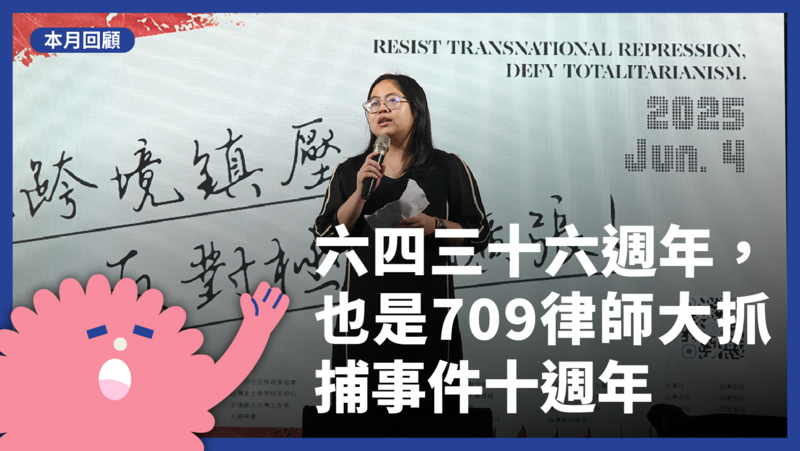
▌The 36th Anniversary of June Fourth and the 10th Anniversary of the July 9 Crackdown on Lawyers | Speech by Attorney Li Ming-ju at the June Fourth Vigil
Hello everyone, I am Lee Ming-ju, Deputy Executive Director of the Judicial Reform Foundation.
This year marks the 36th anniversary of the June Fourth Incident in China. Although the armed suppression and authoritarian rule by the Chinese Communist Party authorities continue to expand everywhere, the spirit of pursuing democracy and freedom embodied by our predecessors in Tiananmen Square in 1989 has never disappeared.
This year also marks the 10th anniversary of the July 9 crackdown on lawyers in China.
Ten years ago, in the early morning of July 9, 2015, the "709 crackdown on Chinese human rights lawyers," a mass arrest of human rights lawyers and citizens that shocked the world, took place. Chinese public security and state security personnel suddenly carried out arrests targeting Attorney Wang Yu of Beijing Fengrui Law Firm, her husband Attorney Bao Longjun, and their son Bao Zhuoxuan (Bao Mengmeng). A total of 316 Chinese human rights lawyers, law firm staff, human rights defenders, and their families were summoned, subjected to forced interrogation, restricted from leaving the country, placed under residential surveillance or criminal detention, or subjected to enforced disappearance and arrest. Among them, 36 were detained or subjected to enforced disappearance.
We have learned that over the past decade, the practicing environment for Chinese human rights lawyers has not only failed to improve but has actually deteriorated further—including movement restrictions, disbarment, travel bans, and harassment directed even at lawyers' families. Beyond daily stalking and harassment, they are frequently forced to move repeatedly because local governments do not want them to remain in the area, using tactics such as compelling landlords to terminate leases and forcing children to transfer schools to compel them to return to their original household registration jurisdictions.
In recent years, the Chinese government's oppression of human rights defenders has extended overseas, carrying out various forms of transnational repression abroad. The latest report released by Freedom House this February shows that 160 incidents of transnational repression occurred globally in 2024, with the Chinese government remaining one of the primary countries executing transnational repression, posing a severe threat to global democracy, human rights, and security. Beyond direct methods such as kidnapping or attacks, the Chinese government also utilizes diplomatic and economic leverage to pressure other countries into repatriating exiles. Freedom House noted that the Chinese government has promoted illegal extraditions or forced deportations in multiple countries, with nations in Southeast Asia and Central Asia frequently becoming primary targets.
Nevertheless, to this day, numerous Chinese human rights lawyers and human rights defenders both at home and abroad remain willing to stand up bravely, expose the truth, voice a demand for justice against government oppression, and seek the international community's attention and support. Such courage appears all the more precious in this dark and uncertain era!
Today, as we gather here, I believe everyone deeply cares about the progress of human rights in China and refuses to give up exploring possibilities. I hope everyone will not forget this group of hardworking individuals. The Judicial Reform Foundation will continue to pay close attention, support the rule of law, and defend democracy. Thank you, everyone!
🔎 Further Reading:
✦ Why are people arrested and sentenced for commemorating June Fourth in China and Hong Kong? What actually happened in Tiananmen Square, Beijing, China on June 4, 1989?
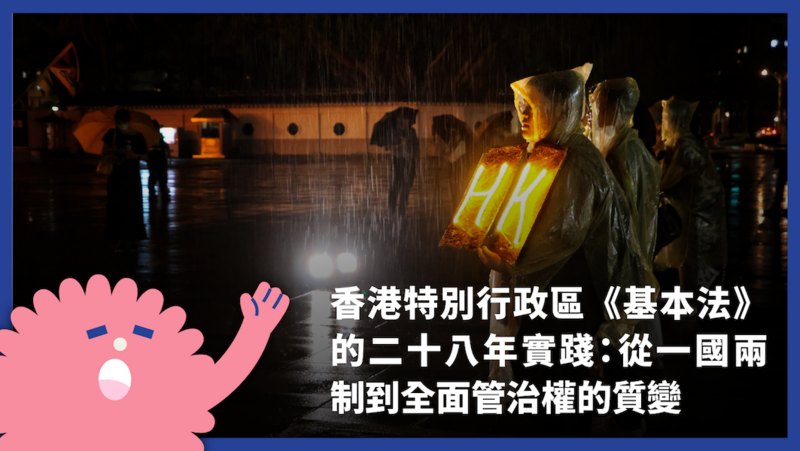
▌The 28-Year Implementation of the Basic Law of the Hong Kong Special Administrative Region: The Qualitative Transformation from "One Country, Two Systems" to "Comprehensive Jurisdiction"
When the Basic Law of the Hong Kong Special Administrative Region of the People's Republic of China was promulgated in 1990 and officially took effect on July 1, 1997, the international community generally focused on whether the "One Country, Two Systems" and "High Degree of Autonomy" promised by the People's Republic of China could ensure Hong Kong's prosperity and stability after the handover of sovereignty, and whether the freedoms and human rights of Hong Kong residents could be substantially guaranteed.
How a country implementing a civil law system and practicing a socialist system could govern, through the rule of law, a capitalist city that had operated under the British common law system for over a century is undoubtedly an extremely rare case in history. More than half of the promise of "unchanged for 50 years" has now passed. At the practical level, preliminary observations and analyses can already be made regarding whether the Basic Law has achieved the consensus reached by the Chinese and British negotiations in 1984.
This article attempts to briefly review several major legal events in the Hong Kong Special Administrative Region since the handover of sovereignty, so as to observe the practical evolution of "One Country, Two Systems" under the constitutional framework of the Basic Law, and further explore its impact on Hong Kong's original values of freedom, democracy, human rights, and the rule of law.
▌Acquittal of Hsieh Ching-piao in Retrial
Hsieh Ching-piao was previously sentenced to 16 years of imprisonment for violating the Narcotics Hazard Prevention Act. Under the law, he no longer held the status of a reservist and was not required to report for educational mobilization. However, because he received a mobilization notice and failed to report, he was convicted by the court of offenses against military service obligations on the grounds that he "failed to report in accordance with the law, rendering the educational mobilization order undeliverable."
To this day (May 9), the prosecutor has still not filed an appeal against the judgment rendered by the Taiwan Chiayi District Court on March 31 (Year 2024 Zai-Tzu No. 2 Judgment). The legal appeal period for this case has expired, and Mr. Hsieh Ching-piao has finally been definitively acquitted. The pro bono defense team is deeply gratified by this outcome and hereby issues the following statement:
1. Relevant authorities should strengthen horizontal integration to prevent further miscarriages of justice.
2. This case was originally "merely" a minor administrative procedural flaw; when the citizen sought relief, they were bounced around between various channels, wasting effort in vain.
3. What kind of miscarriage of justice relief mechanism do the people need? We call for the implementation of the resolutions from the 2017 National Judicial Reform Conference to establish an independently functioning "Miscarriage of Justice Relief Committee" and a "Post-Conviction Review Court for Criminal Cases."
Please click the link below for the full statement.
🔎 Further Reading:
✦ Hsieh Ching-piao Case
✦ Press Conference|Passing the "Four Laws for Exonerating the Wrongfully Convicted" to Open a New Paradigm for Wrongful Conviction Relief: "How Difficult Are Difficult Cases, and Why Are Wrongful Cases Wrongful?" Press Conference Series (III)
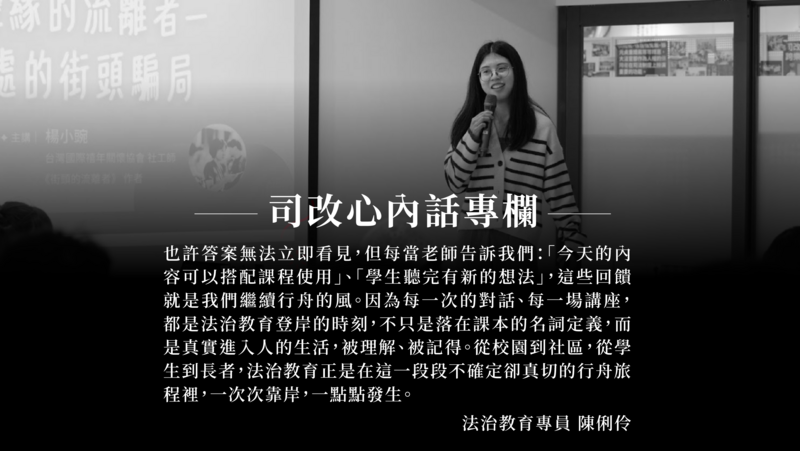
▌Judicial Reform Inner Thoughts Column
Author: Chen Li-ling / Rule of Law Education Specialist
Ever since I became a "Rule of Law Education Specialist," handing out my business card has always sparked all kinds of associations. Some people think I am a teacher, while others guess I am a lawyer. In reality, neither is true; I am simply a worker full of curiosity about the impact of work within school campuses. When most people talk about rule of law education, their first thought is "let's teach students some basic legal common sense." While this is certainly part of our work, the reality of this job is far richer than imagined. We focus not only on students and teachers, and our formats are not limited to lectures; for instance, the "mock trials" we continuously promote aim to let students personally experience the operation of the judicial system and its underlying values through role-playing. Beyond schools, we also step into community colleges and village activity centers, attempting to extend rule of law education into broader spheres of daily life. Although society is gradually reaching a consensus on the importance of rule of law education, questions like "where is it needed" and "how to do it appropriately" still lack standard answers, meaning this work is frequently accompanied by exploration and adjustment.
I remember not long after starting my job, I received a lecture application from a community care station in Shanfu Village, Liuchiu Township, Pingtung County. When I first called the organizing teacher, a sincere voice came from the other end of the line: "Most of the seniors here are 80 or 90 years old, we need to communicate in Taiwanese Hokkien, and many people are very unfamiliar with the law." After hanging up the phone, I immediately discussed with my colleagues who could express themselves clearly in Taiwanese Hokkien and possessed the ability to connect with the seniors' life experiences. With few lecturer candidates to begin with, coupled with the inconvenient transportation to an offshore island, this lecture was a challenge from the very start. Yet, such matchmaking is actually part of our daily work. Before every event, we have detailed discussions with the applying organization about the audience background, because while there are many professionals who "can talk about the law," translating legal knowledge into plain, easily understandable language that truly connects with the target audience's lives is the ideal we constantly strive to pursue.
Later on, we managed to get in touch with Attorney Kuo Hao-jen, who practices in Kaohsiung. After listening to the requirements, he smiled and said, "I usually chat with my grandpa and grandma, so I should be able to handle it." We worked hard to facilitate the cooperation, and this lecture gradually took shape. For such events, we often need to travel across districts and counties/cities, but only by stepping into these places in person can we truly understand that "remote areas" mean more than just geographical distance; they represent the harsh reality of weak transportation resources and inaccessible rule of law education. The teacher from Shanfu Village community said, "As long as you apply, there is hope." This statement was straightforward yet tinged with helplessness. Many communities rely on a single enthusiastic teacher applying independently and gathering resources just to bring rule of law education into village life.
This article is an AI-generated translation of the original Chinese text. In the event of any discrepancy, the Chinese version shall prevail.