
Helping Professions & Criminal Safeguards
The KAI-KAI Case and the Social Worker's Guarantor Status
JRF's Engagement, Stance, and Reform Advocacy
On April 16, 2026, for the first time in Taiwan, a social worker was convicted of negligent homicide, with the judgment establishing the legal interpretation that "social workers hold a guarantor status." This is not merely the conclusion of a single case, but a weather vane for the future boundaries of liability across the entire social work system. The JRF has continuously engaged from legal and institutional perspectives; this page compiles our actions, viewpoints, and reform advocacy.
Case Background
What Happened in the KAI-KAI Case?
In 2023, an infant awaiting adoption nicknamed "KAI-KAI" (real name Liu OO) suffered abuse lasting three months while placed in foster care, dying of hypovolemic shock on December 24 of that year. The exposure of the case sparked intense public shock, making it one of the most prominent child protection incidents in recent years.
The case involves two parallel criminal proceedings: the abusive foster mother Liu OO was charged with murder and sentenced to life imprisonment in the first instance in May 2025; the Child Welfare League Foundation's visiting social worker Ch'en OO was charged with negligent homicide and sentenced to two years' imprisonment in the first instance on April 16, 2026, with the second instance having dismissed the appeal.
Second-instance judgment on January 27, 2026
Currently undergoing second-instance appeal
The core dispute in the social worker's first-instance trial centers on the court's determination that social worker Ch'en held a criminal law "guarantor status" toward KAI-KAI, thereby establishing negligent homicide by omission. This is the first case in Taiwan's judicial history where a social worker was convicted under this interpretation, triggering widespread discussion in the legal and social work communities.
In law, most crimes occur because someone "did something" (commission offenses). However, in certain circumstances, "failing to do something" can also constitute a crime—such as parents abandoning a drowning child without rescuing them. To establish such an "omission offense," a precondition is that the actor has a legal obligation to prevent a specific danger, which is known as "guarantor status." Simply put, guarantor status = duty to act; denying that someone has guarantor status is equivalent to arguing that they have no legal duty to act regarding the occurrence of the result.
JRF Perspective
Why is This a Judicial Reform Issue?
On the surface, the KAI-KAI case is a child protection incident, but it touches upon several fundamental structural issues in criminal justice:
Supervision of Criminal Investigation Procedures
From the investigative stage of this case, there were instances of improper handcuffing. The JRF immediately initiated a petition protesting violations of the principle of non-publicity of investigations, joined by over 200 social work organizations. During the trial, witnesses also reported inaccurate interrogation records and unexplained handwritten notes in the records, prompting our organization to continue monitoring the procedural issues in this case.
Is Criminal Punishment the Right Tool to Fill Gaps in the Social Safety Net?
After a criminal offense occurs, society easily gravitates toward the mindset that "only severe punishment can solve the problem," while in reality, many social reforms require ongoing discussion. For example, in the KAI-KAI case, the arrangement used was temporary childcare prior to the completion of adoption rather than formal "placement," resulting in a complete absence of public sector oversight at the childcare site—no government unit directly tracked KAI-KAI's condition. This gray area has long lacked regulatory governance, serving as one of the critical loopholes that allowed the tragedy to occur.
How the Judiciary and Social Work Professions Can Understand Each Other Amid Social Chain Reactions Triggered by Judicial Judgments
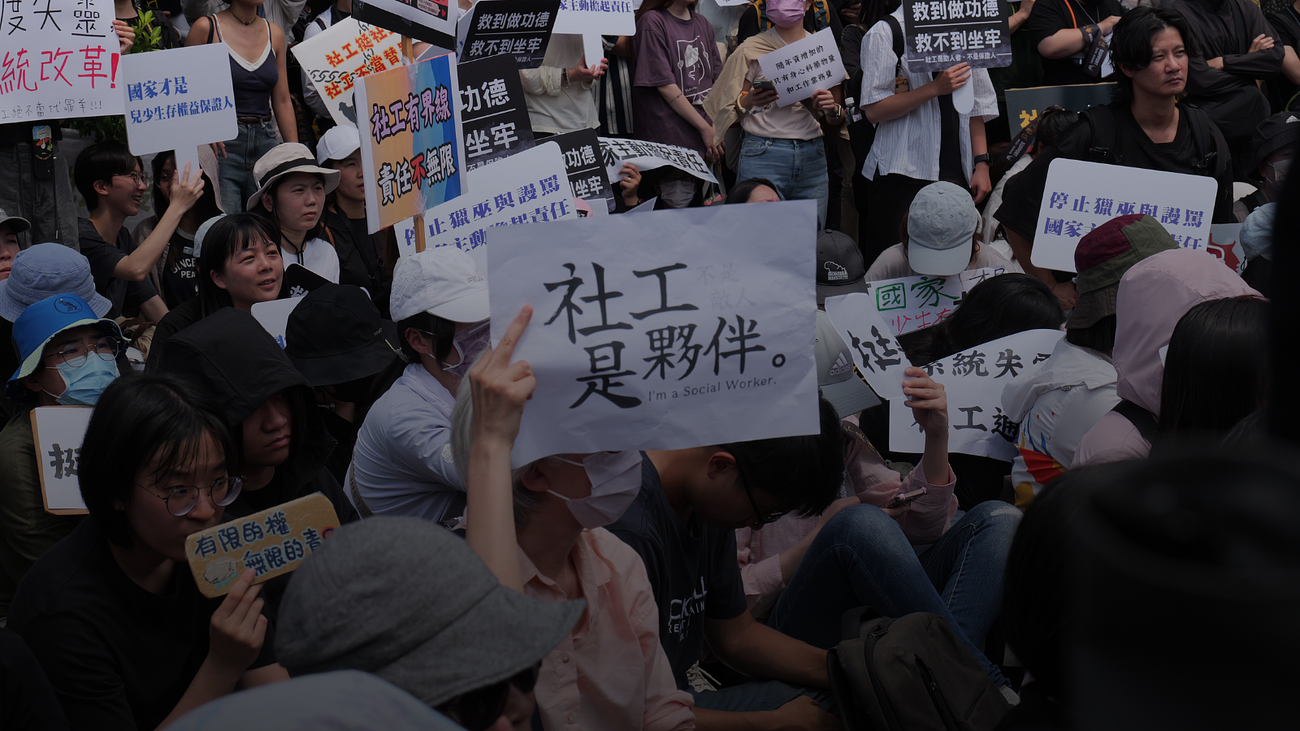
Following the first-instance judgment, over 1,600 social workers across Taiwan took to the streets. While the establishment of judicial trust relies not only on outcomes but also on the cumulative process of court proceedings and court observations, the points in the first-instance judgment text that clashed with social work practice remain a core focus of concern for both law and sociology.
JRF's Actions
How We Engaged with This Issue
Legal Viewpoints and JRF Stance
How Does the Legal Community View This Case?
Following the first-instance judgment, different viewpoints worth sorting out emerged within the legal community. Understanding these differences helps readers grasp the true core controversy of this case.
❶ Guarantor Status Itself is Questionable
- Professor Wang Huang-yu: Social workers are essentially "helpers" and do not have a control relationship with their clients. Cross-institutional cooperation belongs to horizontal division of labor, and the principle of trust can apply, making it unnecessary to take responsibility for the dereliction of duty of other professions.
- Professor Lu Ying-chieh: Based on comparative German law, if social workers are not granted public authority and do not substantively engage in intensive care, they should not be burdened with criminal liability equivalent to "actual protection undertakers."
- Core argument: Without corresponding institutional authority, there should be no guarantor status.
❷ Guarantor Status Exists, but the Assessment of Negligence is the Key
- Denying that social workers have guarantor status logically equates to arguing that social workers have no duty to act whatsoever regarding clients' safety, which is difficult to support.
- The real issue is: Was the court's assessment of "negligence" rigorous? Was there sufficient professional knowledge to support this assessment?
- Another methodological problem: The court's argument for guarantor status focused on "supervision of the foster mother," but the more precise foundation should be the "obligation to visit, observe, and report on the client."
- The court mixed the two analytical levels of guarantor status and negligence, easily causing public misunderstanding.
The first-instance judgment cited the "12 Reminder Indicators for Clinical Presentation of Child and Youth Abuse," determining that the social worker possessed identification capabilities. However, these indicators were originally designed for physicians during examinations rather than as work norms for social workers; furthermore, their release date (October 28, 2023) was later than the timing of social worker Ch'en's previous visits. Expert witness Dr. Lü Li also pointed out in court that child abuse identification is a highly professional judgment: having injuries does not necessarily mean child abuse, and the absence of obvious injuries does not mean child abuse is absent—the ultimate determination in the KAI-KAI case was synthesized from all experts and deduced backward from the result. In a scenario where the foster mother intentionally concealed abuse, expecting frontline social workers to "piece together" the truth based merely on three visits warrants scrutiny regarding its reasonableness.
Characterizing the foster mother as a "source of danger" in the judgment text drew criticism from many, who argued this stigmatizes childcare work. Professor Hsu Wei-kuo further explained that "source of danger" is merely a technical legal term for "risk jurisdiction"—any social division of labor with a certain degree of risk may constitute a source of danger, and the court's purpose is merely to define the risk jurisdiction relationship, rather than morally condemning the relevant behavior. Just as bringing a tenant into one's own house is not a bad thing, the landlord nevertheless remains in a "risk jurisdiction" position regarding the safety of the house. This terminology itself is translated from foreign law and is indeed prone to semantic misunderstandings, which deserves greater caution from legal professionals in communication.
JRF's Core Stance
Continue to Observe Second-Instance Developments Regarding the Assessment of Guarantor Status, Negligence, and Causation
Regardless of the perspective adopted, the first-instance reasoning left room for deep examination. Did the standards for recognizing guarantor status possess a sense of reality? Was the assessment of the negligence threshold grounded in sufficient social work professional knowledge? Was the review of elements such as "avoidability" and "possibility of expectation" sufficient? We look forward to the second instance conducting a more rigorous analysis to avoid inferring liability based on "ex-post result orientation."
Judicial Trust is Accumulated Through Fair Trial Procedures, Not Just Judgment Outcomes
Monitoring of procedures in this case remains unfinished. The first-instance judgment text dismissed suspicions surrounding inaccurate interrogation records by the investigating prosecutor, deeming investigation unnecessary and using simple wording to exclude evidence admissibility. Our organization will continue to monitor this.
Clear Boundaries of Liability Can Stabilize Workforce in the Social Safety Net and Ensure Effective Child Protection Work
Ensuring that every child receives proper protection is the fundamental responsibility of the state. Overloaded caseloads, vacant supervisory positions, unclear cross-institutional divisions of labor, institutional loopholes in adoption and placement... these structural issues existed long before the KAI-KAI case and will not disappear simply by convicting a social worker. Public attention should shift from personal criminal prosecution to the fundamental reconstruction of institutions. Enabling frontline workers to serve their best within a clear and reasonable framework is the fundamental way to stabilize the social safety net.
Further Reading
Related Resources
- Event Sidelights | Having Said So Much, Why Still Incomprehensible?——Dialogue Between Law and Social Work
- The 'Evil' of Omission?——An Introduction to the Contour of 'Guarantor Status' in Our Country's Practice
- When Social Workers Encounter Criminal Cases (Part II)
- Post-Event Press Release | "Who Guarantees Social Workers?" Forum
- Forum Records | Who Guarantees Social Workers? Discussing Social Workers' Legal Rights and Professional Boundaries within the Social Safety Net
- When Social Workers Encounter Criminal Cases
- Interview Summary | What Did the Judgment on the KAI-KAI Case Social Worker Say? Why Does the Social Work Community Backlash? How to Fill Taiwan's Social Safety Net Loopholes?
- Interview Summary | KAI-KAI Case Social Worker Sentenced, Social Worker Bears Guarantor Duty?!
- Taiwan's First Social Worker Convicted of Negligent Homicide—Sentenced to 2 Years in First Instance, Comprehensive Summary of Three Major Controversies
- "The Reporter" Video Interview (YouTube)
- "Public Television Service" Taigi Channel [Taiwan New Horizon] Interview (YouTube)
- "Chih-Chi 77" Mighty My Friend Series Special Interview (YouTube)
- Ministry of Health and Welfare Announces Draft Amendment to the "Protection of Children and Youths Welfare and Rights Act"
- Largest Amendment in 15 Years to Child and Youth Welfare Act Following "KAI-KAI Case," First-Time Inclusion of Child and Youth Work Permit System
- Sentencing of Social Worker in KAI-KAI Case Sparks Controversy, MOHW Plans to Establish Liability Insurance Mechanism Modeled After Medical Disputes
- Full Text of Social Worker Case First-Instance Judgment (Taipei District Court 114 Su 51)
- Full Text of Foster Mother Case Second-Instance Judgment (Taiwan High Court 114 Kuo-Shen-Shang-Chung-Su 4)
- Full Text of Foster Mother Case First-Instance Judgment (Taipei District Court 113 Kuo-Shen-Su 1)
- Control Yuan Investigation Report | Rebuking MOHW, New Taipei City Government, and Taipei City Government, and Forwarding to Judicial Authorities for Reference