Payment Order FAQ
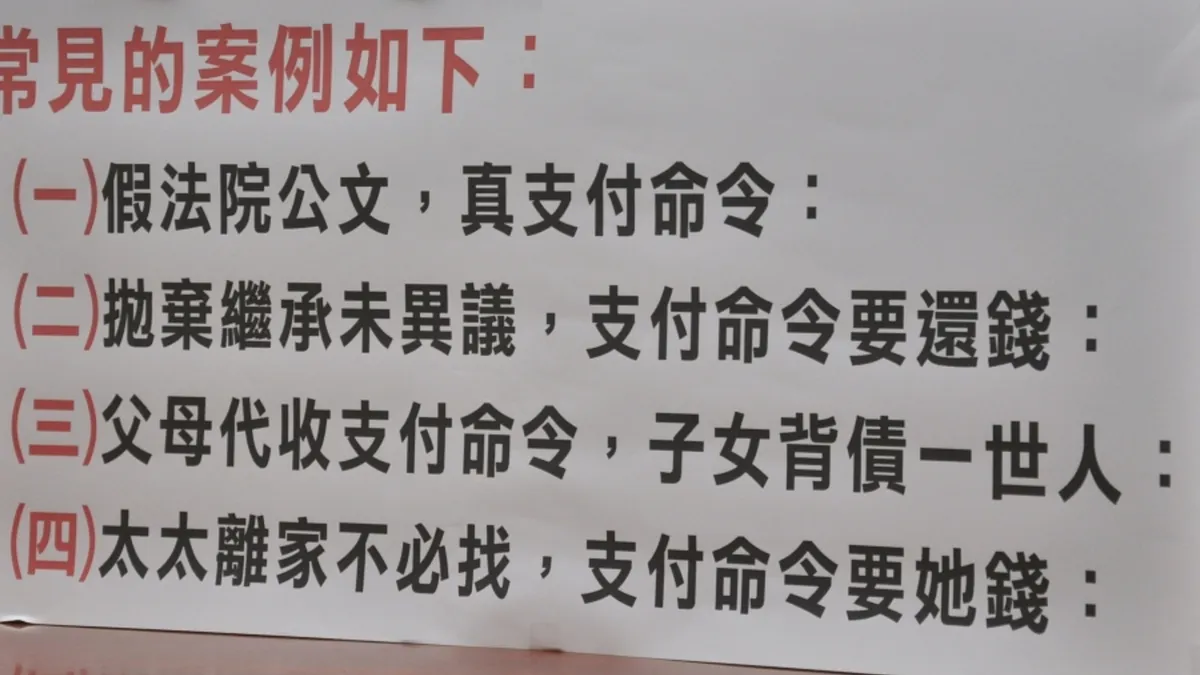
Payment orders are designed to reduce litigation and allow undisputed debts to be settled quickly. In Taiwan, however, they have been exploited by fraud rings. Many people, unaware of how powerful a payment order is, have ended up saddled with debts they never owed, becoming victims of the payment order system. Moreover, before the amendments, the only remedy available was a retrial, and because courts interpreted the grounds for retrial very strictly, setting a high bar for relief, these victims had nowhere to turn and could rarely obtain a remedy.
The recent amendments address these problems. A final payment order no longer has the same effect as a final judgment, and creditors must now make a prima facie showing of their claims. In addition, Article 4-4 was added to the Enforcement Act of the Code of Civil Procedure, creating special grounds for retrial for payment orders that became final before the new law took effect and that would be manifestly unfair to uphold, in keeping with the constitutional guarantee of the right of access to the courts.
This FAQ aims to explain, in plain and concise language, what the amended law provides and what to keep in mind when it applies. It has three parts: the Guide to the New Law briefly introduces the major changes to the payment order system, while the Creditors' Guide and Debtors' Guide answer questions the public may have about the new law from the perspective of creditors and debtors respectively, so that the rights of both sides are fully protected.
Victims of payment orders may refer to "FAQ for Payment Order Victims" to learn about the remedies currently available.
This FAQ was prepared on a tight schedule. If you find any errors or omissions, please let us know, and we will correct and update it as soon as possible.
Guide to the New Law
The old payment order law had loopholes that were abused by bad actors, leaving people saddled with debts they did not owe and with no way to obtain a remedy. The new law closes these loopholes and opens up remedies for debtors, but payment orders remain a highly effective legal tool for creditors to protect their rights. Whether you are a debtor or a creditor, you need to know what the new law provides in order to protect your rights.
※ Note: For the reasons behind the amendments, see "Explanatory Memorandum on the Payment Order Amendments".
The amendments were promulgated by the President on July 1, 2015, and took effect on July 3, 2015. If your payment order became final on or before July 2, 2015, the old law applies. If it became final on or after July 3, 2015, the new law applies.
Text of the new law:
- Code of Civil Procedure http://jirs.judicial.gov.tw/FLAW/FLAWDAT01.asp?lsid=FL001362
- Enforcement Act of the Code of Civil Procedure http://jirs.judicial.gov.tw/FLAW/FLAWDAT01.asp?lsid=FL001363
The amendments made three key changes. First, creditors must now make a prima facie showing to the court of the facts and legal basis of their claims; previously, they only had to briefly state the facts of the claim and bore no burden of proof at all. Second, a payment order is now only enforceable and no longer has res judicata effect. Even after a payment order becomes final, the debtor may still bring an action for a declaratory judgment that the claim does not exist, and the law now expressly provides that the court may allow the debtor to post security to stay enforcement. Third, special grounds for retrial were added for payment orders that became final under the old law, giving victims of the old system more ways to obtain a remedy.
If you dispute the debt, you must file an objection. Under the new law, if a debtor does not file an objection within 20 days of receiving a payment order, the creditor can use the payment order to apply for enforcement against the debtor's property. When you receive a payment order, read it carefully. If you dispute the debt, you must file a written objection with the court within 20 days of receipt; otherwise, your property may be auctioned off.
※ Note: For a sample objection, see the Judicial Yuan's sample court filings (civil procedure).
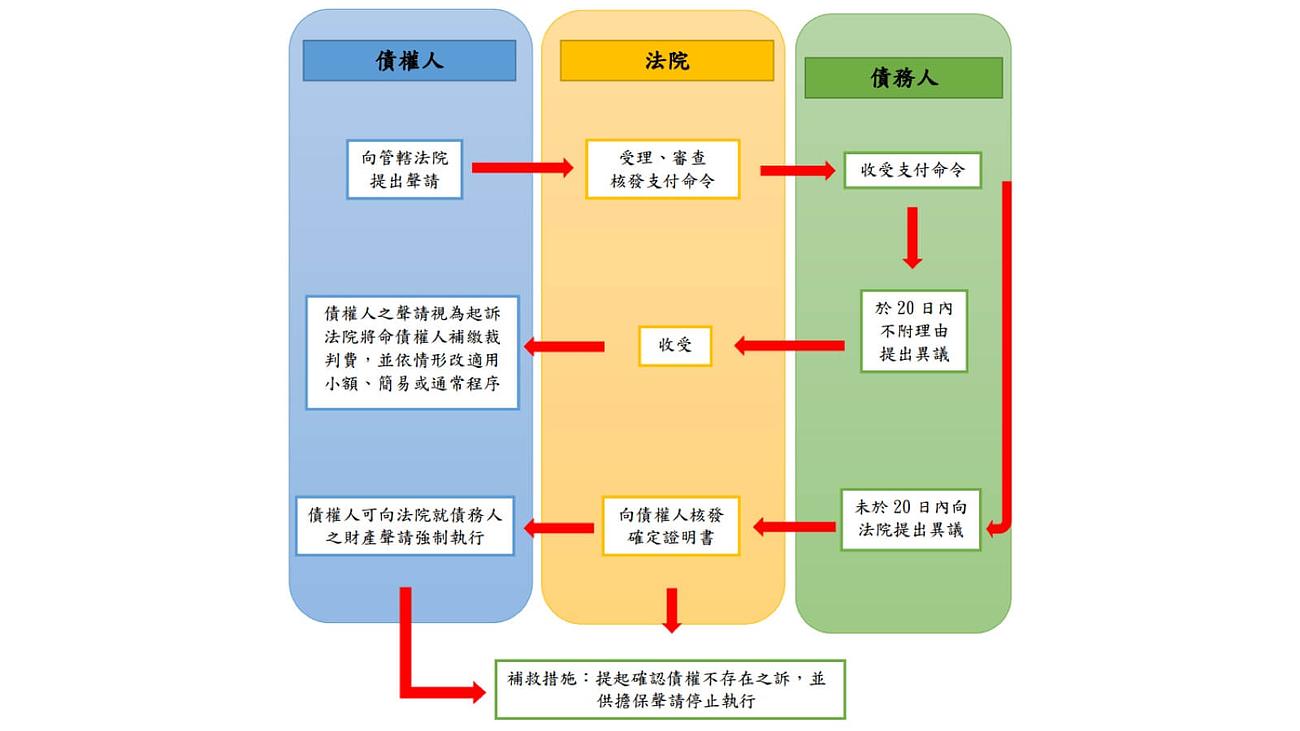
The Code of Civil Procedure provides several types of proceedings. The table below briefly compares their pros and cons to help you choose the one that best suits your needs. Under the new law, payment orders are still the cheapest and fastest option. Where the creditor and debtor do not dispute the debt, a payment order remains the most efficient legal tool for resolving the matter. (See flowchart.)
| Payment Order | Small Claims Proceedings | Summary Proceedings | Ordinary Proceedings | |
| Court Fee | NT$500 | Based on the amount in dispute, with a minimum of NT$1,000 (see Article 77-13 of the Code of Civil Procedure) | ||
| Time Required | Fastest | Fast | Moderate | Longer |
| Standard of Proof | Prima facie showing only | Must prove one's claims with evidence | ||
| Effect of the Decision | The creditor may apply for enforcement, but the debtor may bring an action for a declaratory judgment that the debt does not exist | The creditor may apply for enforcement, and the debtor may no longer bring an action for a declaratory judgment that the debt does not exist | ||
Under the new law, a creditor applying for a payment order must make a prima facie showing of the claim. The creditor must provide evidence of the facts giving rise to the claim against the other party and, where the creditor owes a counter-performance, show that it has been performed, so as to persuade the court that the claim probably exists. If the creditor fails to make this showing, the court may dismiss the application. For the full procedure, see Articles 508, 509, and 511 of the Code of Civil Procedure.
The rules on service of and objections to payment orders were not changed; the procedure is the same as under the old law. If you receive a payment order and dispute the debt, you must file an objection within 20 days. Always open and read court documents carefully as soon as you receive them. If you do not live at your registered household address, check regularly whether any court documents have been delivered there. If you receive court documents on behalf of a relative, housemate, or employer, let that person know as soon as possible, so that the 20-day objection period does not lapse and their property is not put at risk of auction.
If no objection is filed within 20 days, the payment order becomes final. The debtor may still bring an action for a declaratory judgment that the debt does not exist and apply to the court to post security to stay enforcement, but must first pay the court fees and the security. We therefore still recommend that debtors who dispute a payment order file an objection right away; it is the simplest and fastest way to resolve the problem.
If you are eligible for legal aid, you may, under Article 65 of the Legal Aid Act, ask the Legal Aid Foundation to provide a letter of guarantee in place of all or part of the security. If you are not eligible for legal aid, you may ask the court to reduce the amount of security when you apply for a stay of enforcement.
※ Legal Aid Foundation website: http://www.laf.org.tw/
Creditors' Guide
Under the old law, a final payment order had the same effect as a final judgment, meaning it was both res judicata and enforceable. Res judicata effect barred the debtor from asking the court to decide the same matter again, while enforceability allowed the creditor to use the final payment order to apply to the court for enforcement.
Under the new law, a final payment order is still enforceable, so the creditor can still use it to apply for enforcement against the debtor's property. But because it no longer has res judicata effect, the debtor may bring a new action on the same matter, asking the court to decide, based on the evidence presented by both sides, whether the debt really exists.
Yes. Although payment orders no longer have res judicata effect, they are still enforceable once final, so creditors can still use them to apply to the court for enforcement against the debtor's property. Where both sides agree that the debt exists and on its amount, but the debtor has not repaid it for some reason, obtaining an enforceable payment order is still an effective way to resolve the matter.
The advantage of a payment order is that a creditor can obtain, relatively quickly and with low court fees, a ruling that can be used to apply for enforcement against the debtor's property. Under the new law, however, a payment order is only enforceable and no longer has res judicata effect, so even a debtor who did not object during the payment order proceedings can later bring an action for a declaratory judgment. Payment orders are therefore less suitable for disputed cases, which may simply lead to further litigation. Where there is little dispute between the parties, however, a payment order is a good way to obtain a ruling that can later be used to apply for enforcement.
The Code of Civil Procedure provides different procedures for different kinds of problems, each with its own pros and cons. The right approach is to choose the procedure best suited to your situation. Payment orders are the fastest and simplest civil procedure, designed for simple cases in which the parties do not dispute the debt. Filing a lawsuit in every case would not only keep your problem from being resolved quickly but also waste judicial resources.
There is nothing wrong with the payment order system itself; the problem was that fraud rings abused it. Now that the law has been amended, we encourage the public to make good use of payment orders, which save time and effort and allow problems to be resolved quickly.
- Prepare an application for a payment order. Blank forms can be downloaded from the Judicial Yuan's website.
- The application must state the following:
- The names and addresses of both parties and of any legal representatives.
- What is being claimed and in what amount.
- The basis and facts of the claim, and, where the creditor owes a counter-performance, how it has been performed.
- A request that a payment order be issued.
- The court with jurisdiction. (Payment order proceedings are subject to exclusive jurisdiction. If you apply to a court without jurisdiction, it will simply dismiss your application and will not transfer the case.)
- Submit documents and evidence sufficient to make a prima facie showing of your claim.
- Attach one copy of the application and supporting materials for each debtor.
- Pay the application fee of NT$500.
- Note that you may not apply for a payment order if you owe a counter-performance that you have not yet performed, or if the order would have to be served abroad or by public notice.
If the debtor does not file a valid objection within the 20-day period, the court will issue a certificate of finality for the payment order. The creditor can then prepare an application for enforcement and, together with the payment order and the certificate of finality and payment of the enforcement fee, apply to the court for enforcement against the debtor to satisfy the claim. Note: For sample filings, see http://www.judicial.gov.tw/assist/assist03/assist03-04.asp.
Debtors' Guide
It depends on the date the payment order became final. The amendments were promulgated by the President on July 1, 2015, and took effect on July 3, 2015. If your payment order became final on or before July 2, 2015, the old law applies; if it became final on or after July 3, 2015, the new law applies.
You do not have to object to every payment order. If you have no doubts about the creditor and the amount stated in the payment order and agree that you owe the debt, there is no need to object. But if you do not know the creditor named in the order, dispute the amount claimed, or have doubts about the underlying debt, you should file an objection with the court as soon as possible. If you really do owe the debt, you can still object, but the matter will then become a lawsuit, so weigh the extra time, effort, and money that litigation may involve before deciding whether to object.
The payment order you receive should state the name of the court, the case number, and the division handling the case. To object, simply write the case number, the division, the parties' personal details, and a statement that you object to the payment order, and file it with the court that issued the order. You do not need to give reasons.
※ Note: For a sample objection, see http://www.judicial.gov.tw/assist/assist03/1-099.doc.
If you do not object within 20 days of receipt, the payment order becomes final when the 20 days are up. The creditor can then use the final payment order to apply to the court for enforcement against your property. The court will seize and auction your property, use the proceeds to pay the creditor, and return only what is left over to you.
If you did not object within 20 days, you can later bring an "action for a declaratory judgment that the debt does not exist." If you win, you will not have to pay the debt imposed by the final payment order.
A court notice of enforcement means that the creditor has applied to the court for enforcement against your property. If the creditor's application is based on a payment order that became final on or after July 3, 2015, you can promptly file a debtor's action objecting to enforcement and apply to the court to post security to stay enforcement. If you find yourself in this situation, we recommend seeking professional help from a lawyer or the Legal Aid Foundation so that you do not miss any deadlines and jeopardize your rights.
This means that the debtor sues in court, asking the court to decide, based on the evidence presented by both sides, whether the debt claimed by the creditor really exists. A debtor who brings this action must pay court fees, which are calculated based on the amount in dispute—that is, the amount of the debt the debtor claims does not exist. (See Article 77-13 of the Code of Civil Procedure.)
If the creditor has already applied for enforcement, the debtor may, after filing a debtor's action objecting to enforcement, apply to the court to post security to stay enforcement. Once the debtor posts security in the amount set by the court, the court will stay the enforcement proceedings. After judgment is given in the debtor's action, the court will decide, based on the outcome, whether enforcement should resume.
Note: For a sample application to stay enforcement, see http://www.judicial.gov.tw/assist/assist03/3-016.doc.
Payment orders that became final on or after July 3, 2015, no longer have res judicata effect. If a payment order has left you with a debt you do not owe, you can simply bring a separate "action for a declaratory judgment that the debt does not exist"; there is no need to petition for a retrial.
A genuine payment order should state the name of the court, the division, and the case number. Look up the court's phone number yourself and call the clerk of that division to confirm that a payment order with that case number exists. If it does, check whether the debt stated in the order is accurate. If you have any doubts about the debt, file an objection as soon as possible within 20 days of receipt.
Although the new law requires creditors to make a prima facie showing—providing enough evidence to persuade the court that the claim probably exists before a payment order is issued—courts may still mistakenly issue payment orders against people who owe nothing. If you receive a payment order and the debt it describes is wrong or made up, file an objection promptly to protect your rights.