
JRF Newsletter
Legislative Briefing on the Amendment to the Order for Payment: Rescuing Victims of Orders for Payment and Ensuring Courts Are No Longer Accomplices to Fraud
Last edited: 2026-08-28
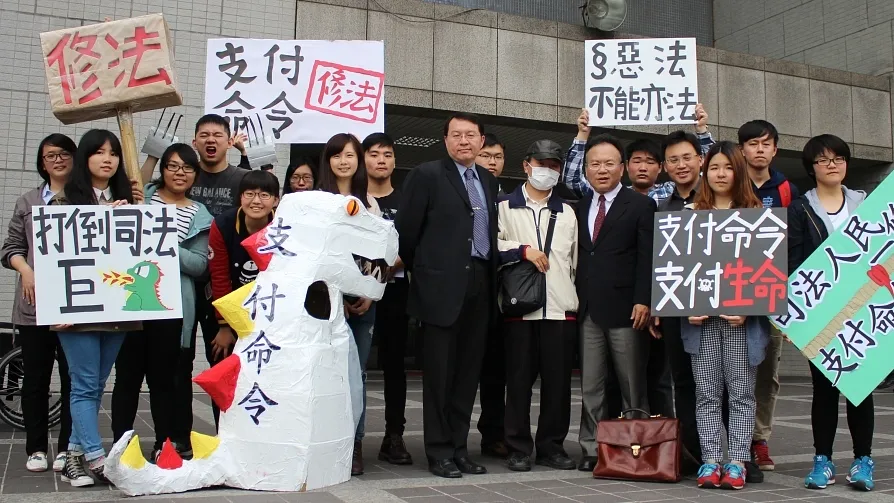
In recent years, the current payment order system has been repeatedly abused in practice—serving as an improper debt collection method for financial institutions, a predatory tool for unlawful actors, and even an instrument of crime for fraud syndicates—resulting in innocent victims across Taiwan and sparking widespread public outcry. In view of this, the Judicial Reform Foundation, together with Legislators Lin Kuo-cheng and Yu Mei-nu, held a press conference on January 13, 2015, proposing draft amendments to Articles 514 and 521 of the Code of Civil Procedure and Articles 4-4 and 12 of the Enforcement Act of the Code of Civil Procedure, while officially establishing an open grievance channel for victims. However, the Judicial Yuan issued a press release the following day opposing these civil society reform proposals.
In response, the Judicial Reform Foundation first submitted a policy briefing paper on January 19 of the same year to counter the Judicial Yuan's position, and subsequently released collected victim cases on March 26, demanding that the judicial authorities put forward solutions, while also adapting these cases into short stories to raise awareness across the internet and Facebook. This civil society momentum for statutory reform further attracted media attention and prompted extensive discussion across diverse sectors of society. After gathering relevant feedback, the Judicial Reform Foundation compiled this legislative policy briefing paper to assist all sectors in gaining an in-depth understanding of the reform demands and to accelerate the legislative process.
Table / Landmark Cases of Having No Where to Appeal Grievances and Being Forced to Repay Debts Never Owed
| Case Story | Adapted Judgment Number | Case Summary | Grounds for Dismissal of Retrial |
|---|---|---|---|
| Why Repay Credit Card Debt When You Didn't Owe Any? | Kaohsiung District Court 100-Tsu-Tzu-No. 1 | Credit card was reported lost and suspended long ago; no actual debt owed | Exceeded the 30-day statutory period |
| Revenge from an Ex-Wife | Shihlin District Court 101-Hu-Tsu-Chien-No. 2 | Credit card applied for under a stolen identity; no actual debt owed | Exceeded the 30-day statutory period |
| Those Who Trust the Courts Are Ultimately Betrayed by the Courts | Taichung District Court 103-Tsu-No. 8 | The forger of the check was convicted with a finalized judgment; no actual debt owed | Exceeded the 5-year statutory period |
| A Sneak Attack from the Most Familiar Stranger | Taoyuan District Court 103-Li-Tsu-Chien-No. 2 | Gifted items already returned; no actual debt owed | Inapplicable to Article 496, Paragraph 1, Subparagraph 13 of the Code of Civil Procedure |
| An Order for Payment Injustice That Sherlock Holmes, Conan, CSI, and Even Dr. Henry Lee Cannot Vindicate | Kaohsiung District Court 102-Hsiung-Tsu-Chien-No. 3 | Non-prosecution disposition verified that the promissory note was forged; no actual debt owed. However, the forger could not be found, making it impossible to obtain a finalized conviction | Inapplicable to Article 496, Paragraph 1, Subparagraph 9 of the Code of Civil Procedure (conflicting with Paragraph 2 of the same Article) |
| Failing a Retrial for an Order for Payment Once Is Not Enough; You Can Fail a Second and Third Time Too | Chiayi District Court 102-Chia-Tsu-Chien-No. 2, 103-Chia-Tsu-Chien-No. 1, 103-Chia-Chien-No. 278, 104-Chia-Tsu-Chien-No. 1 | The forger of the promissory note was convicted with a finalized judgment, and the Chiayi District Court ruled in a separate case that the forged promissory note debt did not exist; no actual debt owed | Exceeded the 30-day statutory period. Inapplicable to Article 496, Paragraph 1, Subparagraph 9 of the Code of Civil Procedure |
| An Order for Payment Injustice That Even a Judge's 'Illegal' Act Could Not 'Unlawfully' Save | Sanchung Summary Court 100-Chung-Tsu-Chien-No. 1, New Taipei District Court 101-Tsu-Chien-Shang-No. 1 | Credit card applied for under a stolen identity; no actual debt owed | Summary court judge excluded Article 496, Paragraph 2 of the Code of Civil Procedure and granted a retrial pursuant to Paragraph 1, Subparagraph 9 of the same Article. The New Taipei District Court deemed this part of the judgment illegal and revoked the original judgment. Inapplicable to Article 496, Paragraph 1, Subparagraph 13 of the same law |
The Dilemma of the Current Order for Payment System
Under the provisions of Article 508 et seq. of the current Code of Civil Procedure, where a creditor's claim has as its subject matter the payment of a certain quantity of money, other fungibles, or securities, the creditor may petition the court to issue a payment order in accordance with the dunning procedure. A debtor may raise an objection without stating reasons to the court that issued the payment order. If the debtor raises an objection within the statutory period of 20 days following the service of the payment order, the payment order shall lose its effect to the extent of the objection. However, if the debtor fails to raise an objection within the aforementioned statutory period, the payment order shall have the same effect as an irrevocably binding judgment. The function of this dunning procedure is to facilitate creditors who anticipate that debtors will not contest their claims to swiftly and simply obtain titles of execution for compulsory execution to realize their claims, while saving time and expenses for the parties and the court and achieving procedural economy.
However, judicial practice in recent times has frequently seen fraud syndicates exploit structural deficiencies in the current dunning procedure. They first repeatedly send fabricated official documents in the name of the court to citizens. If citizens disregard them, the fraud syndicate subsequently uses forged documents to petition the court for the issuance of a genuine and valid payment order. At this juncture, if citizens mistakenly believe it is another fake document and fail to raise an objection within the statutory period of 20 days, the fraud syndicate utilizes the irrevocably binding payment order to execute against the citizens' property. The occurrence of such cases is primarily attributable to the overly lenient standards for issuing payment orders, the excessively absolute legal effect conferred upon payment orders not objected to by debtors, and post-judgment relief mechanisms that are overly stringent and effectively rendered futile, leaving victims of payment orders with no redress for their grievances and reducing the courts to accomplices in fraud.————————
Table / Statistics on District Court Order for Payment Cases
| Year | Cases Concluded | Cases Granted | Cases Revoked via Retrial | Retrial Revocation Rate (Revoked/Granted) |
|---|---|---|---|---|
| 2009 | 482,158 | 469,560 | 2 | 4.3 PPM |
| 2010 | 445,941 | 432,858 | 2 | 4.6 PPM |
| 2011 | 409,642 | 394,489 | 0 | 0 |
| 2012 | 452,230 | 436,085 | 5 | 11.5 PPM |
| 2013 | 419,749 | 401,865 | 4 | 10 PPM |
| 2014 (Jan-Oct) | 321,383 | 303,607 | 0 | 0 |
| Average | 432,563 | 416,531 | 2.2 | 5.3 PPM |
Restoring Due Process to Summary Proceedings: The Case Against Granting Res Judicata Effect to Unreviewed Payment Orders
Article 521, Paragraph 1 of the Code of Civil Procedure provides: "Where a debtor fails to raise a lawful objection to a payment order within the statutory period, the payment order shall have the same effect as an irrevocably binding judgment." The effects possessed by an irrevocably binding civil judgment are formal finality and substantive finality (res judicata). Under the legal effect of res judicata, not only are the parties prohibited from initiating further litigation regarding the disputed legal relationship, but when that legal relationship is used as a means of offensive or defensive argument in other lawsuits, the court is likewise precluded from making findings contrary to the intent of that binding judgment. The arising of such powerful res judicata effect has as its legitimizing foundation the substantive examination throughout normal relief procedures up to the second and third instances, wherein the parties, by virtue of their procedural party rights, are capable of exerting their utmost efforts to assert and defend their rights, and the court investigates evidence, establishes facts, and applies the law.
However, in the issuance of a payment order, the court does not conduct a substantive examination into the substantive legal relationship between the creditor and the debtor. Conferring res judicata effect upon a legal relationship that has undergone no substantive examination merely because the debtor failed to raise a lawful objection within the statutory period—thereby cutting off the possibility for the debtor to petition the court for an examination into their grounds of defense—not only severely infringes upon the debtor's right to be heard and the minimum procedural safeguards conferred upon parties by the Code of Civil Procedure, but also raises serious constitutional concerns regarding the violation of the constitutional mandate guaranteeing the right to institute legal proceedings.
The Transfer of Issuance Powers to Judicial Associates Without Corresponding Adjustments to Legal Effect
On February 5, 2009, the Judicial Yuan promulgated the Directions for Judicial Associates in Handling Dunning Procedures, transferring the authority to issue payment orders—originally vested in judges—to judicial associates, which in fact substantially altered the legal nature of payment orders. However, according to the collateral resolution of the 713th meeting of the Judicial Yuan Civil Procedure Law Research and Amendment Committee in 2000: "If the dunning procedure is handled pursuant to the provisions of Article 508, Paragraph 2 or by persons other than judges, there should be a meticulous procedural design, and consideration should be given as to whether its effect should be the same as that provided in Article 521, Paragraph 1." The rationale was that participating committee members such as Professor Chiu Lien-gong, Professor Chen Rong-tzong, and Grand Justice Sun Sen-yen had expressed significant doubts regarding whether the strength of effect and the procedural safeguards were adequate when payment orders were issued by persons other than judges. In comparative legislation, compared with payment orders issued by judicial assistants (Rechtspfleger) in Germany and payment orders issued by court clerks in Japan, both possess only executory power, which is significantly distinct from irrevocably binding final judgments rendered by judges in those nations. Following the transfer of payment order issuance to judicial associates in Taiwan, the intent of the aforementioned collateral resolution should be implemented immediately by enacting corresponding amendments to the procedural safeguard mechanisms and legal effects of payment orders, resolving the legal disorder of judicial associates acting as judges.
The Retrial Remedy Mechanism for Payment Orders: Rendered Wholly Ineffective in Practice
Against an irrevocably binding payment order, a debtor may indeed seek relief by initiating an action for retrial pursuant to Article 521, Paragraph 2 of the Code of Civil Procedure; however, this remains restricted to cases where one of the circumstances prescribed in Article 496, Paragraph 1 of the same Code exists. Nevertheless, a retrial is an extraordinary relief procedure based on the grounds that an irrevocably binding final judgment possesses serious procedural defects or that abnormal circumstances existed in the foundation of the judgment affecting its correctness, which inherently conflicts with the nature of dunning procedures. Coupled with the courts' increasingly narrow interpretations regarding the application of Article 521, Paragraph 2 of the Code of Civil Procedure, this retrial relief mechanism has been rendered wholly ineffective.
The following details the actual circumstances of debtors initiating retrials against payment orders under the respective subparagraphs of Article 496, Paragraph 1 of the Code of Civil Procedure, citing judgments of the Taipei District Court as examples for reference:
Circumstances of initiating a retrial pursuant to Subparagraph 1 of Paragraph 1 of Article 496: "Where the application of laws and regulations is manifestly erroneous":Debtors are unable to initiate a retrial pursuant to this subparagraph. Prevailing judicial opinions maintain that the manifest error in the application of laws and regulations referred to in Article 496, Paragraph 1, Subparagraph 1 of the Code of Civil Procedure is strictly limited to instances where the existence of a ground for retrial regarding manifest error in the application of laws and regulations is readily discernible from the content of the payment order itself. That is, it refers to cases where the court, when conducting a formal review of whether to issue the payment order based on the matters claimed by the creditor and the documentary evidence submitted, committed a manifest error regarding whether the general requirements for the establishment of a lawsuit were met and whether there was a violation of the provisions of Articles 508 through 511 of the Code of Civil Procedure. As to whether the claim asserted by the creditor for the petition of the payment order actually exists: because the current Code of Civil Procedure provides that the court is not required to conduct a substantive examination, and the basis upon which the creditor made the claim in the payment order has not undergone judicial investigation, oral argument, factual determination, or application of substantive law, even if the creditor did not in fact possess the right of claim upon which the payment order petition was based, it does not constitute a circumstance of manifest error in the application of laws and regulations. (See Taipei District Court Judgment 2010 Zai-Geng-(1) No. 1 (quashed), Judgment 2009 Bei-Zai-Jian No. 8, Judgment 2009 Bei-Zai-Jian No. 1, and Ruling 2008 Zai No. 8)
Circumstances of initiating a retrial pursuant to Subparagraph 2 of Paragraph 1 of Article 496: "Where the reasons for the judgment are manifestly in contradiction with the main text thereof":Debtors are unable to initiate a retrial pursuant to this subparagraph. Articles 511 and 514 of the Code of Civil Procedure provide that a payment order issued by the court only needs to state the parties and statutory agents, the subject matter of the claim and its quantity, the operative facts of the claim (and the circumstances of performance if there is a counter-performance), the court, and the statement that the debtor shall satisfy the creditor's claim and compensate procedural costs, or otherwise raise an objection to the issuing court within an immutable period of 20 days following the service of the payment order; it does not require the court to attach reasons when issuing a payment order. Naturally, it is impossible for a scenario to arise where the reasons for the judgment are manifestly in contradiction with the main text. An examination reveals that the Taipei District Court historically has no cases where retrial relief was initiated on the grounds of this subparagraph.
Circumstances of initiating a retrial pursuant to Subparagraph 3 of Paragraph 1 of Article 496: "Where the composition of the court rendering the judgment was unlawful":Debtors are unable to initiate a retrial pursuant to this subparagraph. In the context of initiating a retrial against an irrevocably binding judgment, the Supreme Court holds that the so-called unlawful composition of the court rendering the judgment refers to circumstances where persons lacking judicial qualifications participated in the debate and judgment, judges who did not participate in oral argument participated in the judgment, or the judges participating in the judgment did not meet the statutory quorum. However, in the context of initiating a retrial against an irrevocably binding payment order, because dunning procedure matters such as the issuance of payment orders have now been transferred to judicial associates pursuant to Article 17-2, Paragraph 1, Subparagraph 1 of the Court Organization Act, and Article 512 of the Code of Civil Procedure provides that the court shall rule on the petition for a payment order without interrogating the debtor, the Supreme Court's legal opinion defining unlawful composition as "persons lacking judicial qualifications participating in the debate and judgment, judges who did not participate in oral argument participating in the judgment, or judges participating in the judgment falling short of the statutory quorum" is manifestly inapplicable to the current procedure for issuing payment orders. It is virtually inconceivable that citizens could initiate retrial relief against an irrevocably binding payment order based on the grounds of this subparagraph. An examination reveals that the Taipei District Court historically has no cases where retrial relief was initiated on the grounds of this subparagraph.
Circumstances of initiating a retrial pursuant to Subparagraph 4 of Paragraph 1 of Article 496: "Where a judge who should have recused himself/herself according to law or judicial ruling participated in the judgment":Debtors are unable to initiate a retrial pursuant to this subparagraph. Article 17-2, Paragraph 1, Subparagraph 1 of the Court Organization Act provides that dunning procedure matters such as issuing payment orders shall be handled by judicial associates. Although judicial associates, pursuant to Article 39 of the Code of Civil Procedure, shall apply mutatis mutandis the provisions of Articles 32 through 38 of the same Code regarding the recusal of court officials, under the current system, payment orders may be issued directly by judicial associates without substantive examination. This departs textually from the requirement of participation in adjudication by a "judge" who should have recused himself/herself. Thus, whether an irrevocably binding payment order under the current system may automatically apply this subparagraph as grounds for retrial remains questionable. Furthermore, because judicial associates are not required to interrogate debtors prior to issuing a payment order, it is exceedingly difficult to imagine how a debtor could petition the court for a ruling ordering the recusal of a judicial associate prior to the issuance of a payment order, thereby leading to a scenario where a judicial associate failed to recuse after being ordered to do so. An examination reveals that the Taipei District Court historically has no cases where retrial relief was initiated on the grounds of this subparagraph.
Circumstances of initiating a retrial pursuant to Subparagraph 5 of Paragraph 1 of Article 496: "Where a party was not lawfully represented in the action":Debtors are unable to initiate a retrial pursuant to this subparagraph. Prevailing judicial opinions maintain that the circumstance of a party not being lawfully represented in the action under Article 496, Paragraph 1, Subparagraph 5 of the Code of Civil Procedure is predicated on the necessity of the party requiring lawful representation by another. If a party is not an individual lacking procedural capacity, there is no need for lawful representation by a statutory agent; if the party additionally did not retain any procedural agent, there is no basis for the occurrence of a lack of lawful representation under this subparagraph. Moreover, the Supreme Court holds that initiating a retrial based on this subparagraph is limited exclusively to the party lacking representative authority. Because prevailing judicial opinions have imposed extensive restrictions on the interpretation of this subparagraph, the Taipei District Court historically has no successful cases of obtaining retrial relief based on this ground. (See Taipei District Court Ruling 2014 Zai-Jian-Kang No. 2 and Ruling 2000 Zai No. 20)
Circumstances of initiating a retrial pursuant to Subparagraph 6 of Paragraph 1 of Article 496: "Where a party, knowing the residence or domicile of the opposing party, alleged that the opposing party's whereabouts were unknown and engaged in litigation therewith; provided, however, that this shall not apply if the opposing party has recognized the litigation proceedings":Debtors are unable to initiate a retrial pursuant to this subparagraph. Prevailing judicial opinions maintain that the circumstance under Article 496, Paragraph 1, Subparagraph 6 of the Code of Civil Procedure where a party knows the residence or domicile of the opposing party but alleges that their whereabouts are unknown to engage in litigation requires that the party subjectively had actual knowledge of the opposing party's residence or domicile, deliberately made untrue statements alleging unknown whereabouts to litigate, and deceptively petitioned the court for service by publication, exploiting the fact that service by publication is seldom noticed by the opposing party to deprive them of the opportunity to participate in oral arguments and present statements in their own interest. However, under Article 509 of the current Code of Civil Procedure, payment orders may not be served by publication in the first place. Therefore, it is entirely impossible for the ground for retrial described in this subparagraph to occur in relation to an irrevocably binding payment order. This ground for retrial is completely illusory with respect to the legal redress of debtors under binding payment orders. (See Taipei District Court Judgment 2013 Bei-Zai-Xiao No. 3, Judgment 2012 Bei-Zai No. 1, Judgment 2010 Zai No. 2, and Ruling 2009 Zai No. 1)
Circumstances of initiating a retrial pursuant to Subparagraph 7 of Paragraph 1 of Article 496: "Where a judge who participated in rendering the judgment committed a criminal offense regarding the action in violation of official duties, or received a disciplinary sanction regarding the action in violation of official duties, sufficient to affect the original judgment":Debtors are unable to initiate a retrial pursuant to this subparagraph. Article 17-2, Paragraph 1, Subparagraph 1 of the Court Organization Act provides that dunning procedure matters such as issuing payment orders are handled by judicial associates; thus, under the current system, payment orders are issued by judicial associates, which textually conflicts with the requirement of a "judge" participating in rendering the judgment under this subparagraph. Whether an irrevocably binding payment order under the current system can automatically apply this subparagraph as grounds for retrial is not without doubt. Furthermore, the current Code of Civil Procedure contains only a handful of provisions regarding dunning procedures in Articles 508 through 521. Creditors are not required to submit corresponding evidence to substantiate their claims when petitioning for a payment order, and judicial associates may issue payment orders directly without substantive examination. It is virtually inconceivable that a judicial associate would commit a criminal offense in violation of official duties when issuing a payment order, or receive a disciplinary sanction regarding the issuance of a payment order in violation of official duties sufficient to affect the original payment order. An examination reveals that the Taipei District Court historically has no cases where retrial relief was initiated on the grounds of this subparagraph.
Circumstances of initiating a retrial pursuant to Subparagraph 8 of Paragraph 1 of Article 496: "Where an agent of a party, or the opposing party or his/her agent, engaged in criminally punishable conduct regarding the action, which affected the judgment":Debtors have previously succeeded in initiating retrials pursuant to this subparagraph. Prevailing judicial opinions maintain that criminally punishable conduct affecting the judgment by an agent of a party, or the opposing party or his/her agent regarding the action under Article 496, Paragraph 1, Subparagraph 8 of the Code of Civil Procedure must be limited to conduct occurring in relation to that specific action. Furthermore, pursuant to Paragraph 2 of the same Article, it is limited to instances where such conduct has received an irrevocably binding criminal judgment of conviction, or where the criminal proceedings cannot be initiated or continued due to reasons other than insufficient evidence; otherwise, it may not serve as a ground for retrial. An examination reveals a case in the Taipei District Court where the evidence attached by a creditor when petitioning for a payment order—including a joint construction agreement, checks, and remittance slips—involved the debtor's former statutory representative and other directors acting on a general criminal intent for unlawful gains. After receiving remittances and check payments made by the creditor, they agreed to sign the joint construction agreement with the creditor, committing acts in breach of their duties and causing damage to the debtor. The debtor's former statutory representative and directors were convicted of breach of trust by an irrevocably binding criminal judgment. The debtor consequently initiated a retrial against the irrevocably binding payment order on the grounds of this subparagraph and succeeded in obtaining a favorable judgment granting relief. However, the current Code of Civil Procedure provides that creditors are not required to submit corresponding evidence to substantiate their claims when petitioning for a payment order, and judicial associates may issue them directly without substantive examination. While the creditor in the aforementioned successful relief case did submit evidence related to the breach of trust committed by the debtor's agent (such as the joint construction agreement, checks, and remittance slips), since such evidence was never substantively examined by the judicial associate, how could it have affected the issuance of the payment order? Although a debtor has previously obtained relief based on this subparagraph, whether this rationale can become a consistent opinion in judicial practice remains to be seen. (See Taipei District Court Judgment 2014 Zai No. 13, Judgment 2006 Zai-Geng-(2) No. 1, Judgment 2006 Zhong-Zai-Geng-(1) No. 1, Ruling 2005 Zai-Geng-(1) No. 1, Ruling 2004 Zhong-Zai No. 3, and Ruling 2003 Sheng-Zai No. 53 (quashed))
Circumstances of initiating a retrial pursuant to Subparagraph 9 of Paragraph 1 of Article 496: "Where evidentiary material on which the judgment was based was forged or altered":Debtors are unable to initiate a retrial pursuant to this subparagraph. Prevailing judicial opinions maintain that under Article 496, Paragraph 2 of the Code of Civil Procedure, when initiating a retrial under Article 496, Paragraph 1, Subparagraph 9, the debtor must bear the burden of proving that the creditor committed a criminal offense by forging or altering documents and that a judgment of conviction was rendered. Meeting this burden of proof is already no easy task for the debtor. However, even if the debtor can prove that the creditor was convicted of a criminal offense for forging or altering documents, according to the Supreme Court's opinion, because the Code of Civil Procedure provides that a creditor is not required to provide proof for asserted facts when petitioning for a payment order, whether the creditor attached debt certificates upon petition is irrelevant to whether the payment order should be granted. Even if the debt certificates attached by the creditor were forged, it still does not satisfy the requirements of this subparagraph. Because judicial practice routinely cites this Supreme Court opinion, debtors are practically precluded from obtaining relief under this subparagraph. (See Taipei District Court Judgment 2014 Zai No. 13, Judgment 2010 Bei-Zai-Jian No. 12, Judgment 2009 Shen-Zai No. 23, Judgment 2006 Zai-Geng-(2) No. 1, and Judgment 2006 Zhong-Zai-Geng-(1) No. 1)
Circumstances of initiating a retrial pursuant to Subparagraph 10 of Paragraph 1 of Article 496: "Where a witness, expert witness, interpreter, party, or statutory agent made false statements under oath regarding testimony, expert opinion, interpretation, or related matters on which the judgment was based":Debtors are unable to initiate a retrial pursuant to this subparagraph. Article 511 of the Code of Civil Procedureprovides that when petitioning for a payment order, the creditor only needs to state the parties and statutory agents, the subject matter of the claim and its quantity, the operative facts of the claim (and the performance status if there is a counter-performance), and the court, without needing to submit corresponding evidence to substantiate the claim. Article 512 of the same Code provides that the court shall rule on the petition for a payment order without interrogating the debtor. Therefore, under the current system, because no substantive investigative proceedings take place prior to the issuance of a payment order, there is no basis for the occurrence of false statements under oath by a witness, expert witness, interpreter, party, or statutory agent regarding testimony, expert opinion, interpretation, or related matters on which the judgment was based as specified in this subparagraph. Furthermore, an examination reveals that the Taipei District Court historically has no cases where retrial relief was initiated on the grounds of this subparagraph.
Circumstances of initiating a retrial pursuant to Subparagraph 11 of Paragraph 1 of Article 496: "Where a civil, criminal, or administrative litigation judgment, or other judicial ruling or administrative disposition on which the judgment was based, has been altered by a subsequent irrevocably binding judicial ruling or administrative disposition":Debtors have previously succeeded in initiating retrials pursuant to this subparagraph. In that case, the creditor petitioned for the issuance of a payment order by submitting an indictment from the Taipei District Prosecutors Office as evidence, asserting that a third party was suspected of committing business embezzlement and that the debtor should be held jointly and severally liable for damages with the third party. The court issued the payment order accordingly, which promptly became irrevocably binding. Subsequently, regarding the criminal charges of business embezzlement against the third party, the Criminal Division of the Taipei District Court and the Criminal Division of the Taiwan High Court rendered judgments acquitting the third party, which became final. The debtor then initiated a retrial against the binding payment order based on this subparagraph citing the aforementioned grounds. The Taipei District Court held that since the third party had not committed the business embezzlement alleged by the creditor, the third party and the debtor were naturally not jointly and severally liable to the counterparty; that is, the contents of the Taipei District Prosecutors Office indictment serving as the foundation of the binding payment order in dispute had been found differently by the subsequent final criminal judgment of the Taiwan High Court. Since the contents of the indictment had been altered, the binding payment order in dispute possessed the ground for retrial under Article 496, Paragraph 1, Subparagraph 11 of the Code of Civil Procedure, and the court quashed the original irrevocably binding payment order. This case was highly extraordinary and worthy of reference. (See Taipei District Court Ruling 2001 Zai No. 17 (quashed))
Circumstances of initiating a retrial pursuant to Subparagraph 12 of Paragraph 1 of Article 496: "Where a party discovers an earlier irrevocably binding judgment, settlement, or mediation regarding the same subject matter of the action, or is entitled to utilize such judgment, settlement, or mediation":Debtors have previously succeeded in initiating retrials pursuant to this subparagraph. Prevailing judicial opinions maintain that the circumstance under Article 496, Paragraph 1, Subparagraph 12 of the Code of Civil Procedure concerning an earlier binding judgment, settlement, or mediation—or entitlement to utilize such judgment, settlement, or mediation—is predicated on the identity of the subject matter between the prior and subsequent actions, and the debtor must prove that prior to the creditor's petition for the payment order, an irrevocably binding judgment, settlement, or mediation existed regarding the same subject matter or was available for use. An examination reveals that in the Taipei District Court, a creditor petitioned for a payment order based on the operative facts that a third party had assigned a gifted time-deposit claim to the creditor. The original debtor of the time deposit had died, and the payment order debtor was the heir of the original debtor who inherited the entire estate, thus bearing joint and several liability under Article 1153 of the Civil Code. However, the creditor had previously filed a lawsuit for debt clearance based on the same operative facts, and that action was dismissed with finality by judgments of the Kaohsiung District Court and the Kaohsiung Branch of the Taiwan High Court. Relying on the same operative facts after the dismissal of the debt clearance action had become final, the creditor petitioned the Taipei District Court to issue a payment order against the debtor. Although the debtor failed to raise a lawful objection within the statutory period—giving it the same effect as an irrevocably binding judgment—the payment order in dispute was clearly a re-petition regarding the same subject matter that was already subject to an earlier irrevocably binding judgment. It therefore constituted the circumstance under Article 496, Paragraph 1, Subparagraph 12 of the Code of Civil Procedure, manifestly violating the principle of non bis in idem, and the original binding payment order was quashed. This represents an active manifestation of the res judicata effect and reflects a consistent opinion in judicial practice. (See Taipei District Court Judgment 2012 Zai No. 26 (quashed), Judgment 2011 Zai No. 8, and Judgment 2010 Bei-Zai-Jian No. 12)
Circumstances of initiating a retrial pursuant to Subparagraph 13 of Paragraph 1 of Article 496: "Where a party discovers evidentiary material that was not considered, or is entitled to utilize such material; provided, however, that this shall be limited to circumstances where a more favorable judicial ruling could have been obtained if such material had been considered":Debtors are unable to initiate a retrial pursuant to this subparagraph. Prevailing judicial opinions maintain that Article 511 of the Code of Civil Procedure provides that when petitioning for a payment order, in addition to identifying the parties and the court, a creditor only needs to state the subject matter of the claim, its quantity, the operative facts of the claim, and the declaration requesting the issuance of a payment order. In other words, a payment order involves only a formal examination of the matters claimed by the creditor and the documentary evidence submitted, differing fundamentally from judgments rendered through oral arguments that require substantive examination. The ground for retrial under this subparagraph regarding the discovery or entitlement to utilize unconsidered evidentiary material is limited to evidentiary material that already existed prior to the conclusion of oral arguments in the factual trial of the prior proceedings but was not considered. Since the issuance of a payment order does not undergo the substantive examination of oral argument proceedings, an irrevocably binding payment order by nature leaves no room for the application mutatis mutandis of this retrial ground. This ground for retrial is completely illusory with respect to the legal redress of debtors under binding payment orders. (See Taipei District Court Ruling 2014 Zai-Geng-(1) No. 3, Judgment 2014 Zai No. 3, Ruling 2013 Zai No. 15, Judgment 2013 Zai No. 14, Judgment 2012 Bei-Zai No. 1, Ruling 2011 Zai No. 22, Judgment 2011 Zai No. 8, Judgment 2009 Bei-Zai-Jian No. 8, Judgment 2009 Bei-Zai-Jian No. 1, Ruling 2009 Shen-Zai No. 2, Judgment 2007 Zai No. 29, Judgment 2006 Zai-Geng-(2) No. 1, Judgment 2006 Zhong-Zai-Geng-(1) No. 1, and Ruling 2001 Zai-Yi No. 48)
The foregoing analysis demonstrates that the retrial mechanism for payment orders is structurally deficient. Compounded by judicial precedents that improperly elevate the threshold for legal remedies, the proportion of debtors in Taiwan who successfully quashed binding payment orders through retrial procedures over the past five years is a mere 5.3 per million. These data demonstrate that, aside from a handful of cases attracting media attention or isolated legal opinions expressed by individual judges, the current retrial system fails to deliver substantive relief and urgently requires systemic review and reform.
Table / Judicial Opinions on Initiating Retrials Against Payment Orders
| Code of Civil Procedure Article 496 | Retrial Circumstance | Taipei District Court Reference Judgment Number |
|---|---|---|
| Paragraph 1, Subparagraph 1 | Cannot Retrial | 99-Tsu-Keng-(I)-No. 1, 98-Pei-Tsu-Chien-No. 8, 98-Pei-Tsu-Chien-No. 1, 97-Tsu-No. 8 |
| Paragraph 1, Subparagraph 2 | Cannot Retrial | No judgments found |
| Paragraph 1, Subparagraph 3 | Cannot Retrial | No judgments found |
| Paragraph 1, Subparagraph 4 | Cannot Retrial | No judgments found |
| Paragraph 1, Subparagraph 5 | Cannot Retrial | 103-Tsu-Chien-Kang-No. 2, 89-Tsu-No. 20 |
| Paragraph 1, Subparagraph 6 | Cannot Retrial | 102-Pei-Tsu-Hsiao-No. 3, 101-Pei-Tsu-No. 1, 99-Tsu-No. 2, 98-Tsu-No. 1 |
| Paragraph 1, Subparagraph 7 | Cannot Retrial | No judgments found |
| Paragraph 1, Subparagraph 8 | Can Retrial | 103-Tsu-No. 13, 95-Tsu-Keng-(II)-No. 1, 95-Chung-Tsu-Keng-(I)-No. 1, 94-Tsu-Keng-(I)-No. 1 (revoked), 93-Chung-Tsu-No. 3, 92-Sheng-Tsu-No. 53 (revoked) |
| Paragraph 1, Subparagraph 9 | Cannot Retrial | 103-Tsu-No. 13, 99-Pei-Tsu-Chien-No. 12, 98-Shen-Tsu-No. 23, 95-Tsu-Keng-(II)-No. 1, 95-Chung-Tsu-Keng-(I)-No. 1 |
| Paragraph 1, Subparagraph 10 | Cannot Retrial | No judgments found |
| Paragraph 1, Subparagraph 11 | Can Retrial | 90-Tsu-No. 17 (revoked) |
| Paragraph 1, Subparagraph 12 | Can Retrial | 101-Tsu-No. 26 (revoked), 100-Tsu-No. 8, 99-Pei-Tsu-Chien-No. 12 |
| Paragraph 1, Subparagraph 13 | Cannot Retrial | 103-Tsu-Keng-(I)-No. 3, 103-Tsu-No. 3, 102-Tsu-No. 15, 102-Tsu-No. 14, 101-Pei-Tsu-No. 1, 100-Tsu-No. 22, 100-Tsu-No. 8, 98-Pei-Tsu-Chien-No. 8, 98-Pei-Tsu-Chien-No. 1, 98-Shen-Tsu-No. 2, 96-Tsu-No. 29, 95-Tsu-Keng-(II)-No. 1, 95-Chung-Tsu-Keng-(I)-No. 1, 90-Tsu-Yi-No. 48 |
An Overview of the Judicial Reform Foundation's Draft Amendment
To rectify the structural defects in the current payment order system, the Judicial Reform Foundation has formulated draft amendments to Articles 514 and 521 of the Code of Civil Procedure, as well as newly added Articles 4-4 and 12 of the Enforcement Act of the Code of Civil Procedure. The main points are as follows:
Amendments to Article 521, Paragraphs 1 and 2 of the Code of Civil Procedure: Amending the provision so that an irrevocably binding payment order shall only serve as a title of execution and shall not possess substantive finality (res judicata).
Addition of Article 521, Paragraph 3 of the Code of Civil Procedure: Adding a legal remedy permitting the debtor to initiate an action for confirmation of the non-existence of the claim stated in the payment order, and to petition the court for a ruling to stay compulsory execution upon providing appropriate and reliable security.
Addition of Article 4-4, Paragraphs 3 and 5 of the Enforcement Act of the Code of Civil Procedure: Adding a two-year transitional period during which payment orders that became irrevocably binding under the former law may, within two years from the implementation of the new law, be challenged through actions for retrial to revoke the original binding payment orders on grounds such as: "evidentiary material submitted by the creditor in the dunning procedure was forged or altered," "the debtor was a person without legal capacity or with limited legal capacity at the time of service of the payment order and failed to raise an objection within the statutory period prior to the implementation of the amendment," "there exists evidence that would result in a more favorable judicial ruling," or "the circumstances are manifestly unfair or unlawful." Furthermore, in consideration of legal stability, where a debtor has already satisfied or partially satisfied the debt after the payment order became irrevocably binding, no further legal remedies may be sought.
Regarding the concern over whether amending the irrevocably binding payment order to possess solely executory power without res judicata effect would cause a substantial surge in court caseloads and undermine litigation economy, reference may be made to the current implementation of the "compulsory execution pursuant to court ruling on promissory notes" system. Article 123 of the Negotiable Instruments Act provides that when a holder exercises the right of recourse against the maker of a promissory note, the holder may petition the court for a ruling and then proceed with compulsory execution. That is, a promissory note ruled upon by the court possesses executory power, making promissory notes widely used by financial institutions and commercial firms as an indispensable category of securities in contemporary commercial society. In reality, promissory notes have not caused holders to abandon petitioning for promissory note rulings to initiate substantive court lawsuits directly simply because such rulings possess only executory power rather than res judicata effect. Viewed from this perspective, it can be inferred that even if an irrevocably binding payment order is amended to possess only executory power, it still maintains a high degree of convenience and coercive force compared to directly filing a lawsuit in court. This is sufficient to sustain creditors' willingness to utilize the procedure, and a drastic surge in court litigation should not occur. Furthermore, this reform can prevent unlawful actors from maliciously petitioning for payment orders, thereby protecting innocent citizens from harm.
In addition to reforming the defects of the current system, opportunities for legal relief should also be extended to citizens who suffered harm under the existing payment order system in the past. However, to mitigate the impact of the reform, the draft amendment proposed by the Judicial Reform Foundation establishes a two-year transitional clause enabling debtors, within the statutory period, to file actions for retrial against irrevocably binding payment orders, thereby extinguishing non-existent debts and escaping hardship. In addition, drawing upon the legislative model of the 2009 statutory limited succession amendment to the Civil Code, debtors may not seek retrial relief for debts that have already been settled, so as to maintain legal stability.
The payment order system originated in the 1970s and undeniably made its contribution under the socio-economic backdrop of that era. Today, however, the rampant abuses arising from payment orders have far exceeded the original legislative expectations, creating an urgent need for immediate review and amendment. Germany and Japan also amended their laws in 1996 and 1998, respectively, to remedy structural deficiencies in their systems. Scholars in Taiwanese legal academia have also advocated that reforms to the dunning procedure could draw upon the two-stage model in current German law—namely, issuing a payment order first, followed by an execution order, thereby granting debtors two opportunities to object and providing fuller protection of their rights. While the intent of this reform direction is commendable, substantial differences exist between the German legal framework and Taiwan's current system; it would require sweeping alterations to relevant provisions across the Code of Civil Procedure and the Compulsory Enforcement Act, incurring enormous reform costs. The draft amendment proposed by the Judicial Reform Foundation modifies only four statutory provisions, pragmatically reforming judicial abuses upon the foundation of the existing legal framework.
Now Is the Critical Moment to Reform the Payment Order Mechanism
While the current payment order system facilitates the exercise of rights by creditors, judicial organs may rely on the rationale that the system diverts and reduces case volume, raising concerns that amending unobjected payment orders to possess solely executory power without res judicata effect will cause an influx of non-contentious matters into court litigation and harm litigation economy. However, observing the parallel mechanism of promissory note rulings—which undergo only formal review and possess only executory power, yet holders still apply for promissory note rulings rather than directly initiating substantive litigation—the concerns of the judicial organs are likely excessive and trapped in the logical leap that all irrevocably binding payment orders will lead to substantive lawsuits.
In any event, the pursuit and execution of summary proceedings must not serve as a justifiable basis for depriving citizens of the procedural safeguards of their constitutionally guaranteed right to institute legal proceedings, nor can case diversion ever justify conferring res judicata effect upon binding payment orders. It is no wonder scholars have observed: "The extensive diversion of cases through dunning procedures indicates that the judicial system has completely abandoned its gatekeeping role regarding whether rights and obligations between the state and private individuals lawfully exist, which also contradicts the intent of mandatory prohibitions or nullity norms in state legislative policy. We call upon judicial organs to continue gatekeeping whether substantive rights and obligations between parties lawfully exist, rather than merely aspiring to divert cases through dunning procedures while forsaking the judicial task of conducting reasoned review that is due in the resolution of civil disputes." (See Yang Shu-wen, On the Procedural Safeguards for the Counterparty in Dunning Procedures: Centering on the Enrichment of Reasoned Review—Record of the 122nd Symposium of the Civil Procedure Law Study Group, Taiwan Law Journal, Issue 236, October 2014, p. 227.)
The procedural design of payment orders, which tilts excessively in favor of creditors, not only severely deprives debtors of the procedural safeguards due under their right to institute legal proceedings, but has also degenerated into a tool for fraud syndicates to achieve their aims. Furthermore, any counterparty who misses the opportunity to raise an objection for any reason may fall victim as a result. Over the long term, not only will the rights of citizens lack legal protection, but public trust in the judiciary will be further eroded. The experiences of victims reported in the media may represent merely individual cases among more than 400,000 payment order cases handled by the courts annually; however, a single defective payment order for which no legal remedy exists may carry a lifetime of unbearable suffering and despair for a debtor. The payment order mechanism has reached a point where thorough review and amendment are indispensable; now is the optimal moment to reform the system.
Order for Payment Amendment Team
(Ordered by the stroke count of names)
- Wang Yün-chieh
- Chiang Li-wei
- Wu Chün-ta
- Li I-ting
- Lin Hsin-hui
- Lin Kang-hui
- Lin I-chih
- Lin Ching-yao
- Chiu Po-jung
- National University of Kaohsiung Legal Aid Society
- Tseng Chiung-yao
- Huang Wei-ting
- Yeh Hsiao-tzu
- Liu Che-hung
- Liu Chia-jung
- Tsai Huan-wen
- Hsiao I-min
- Providence University Legal Aid Society
- Wei Hsiao-lan
- Su Yü-ming
This article is an AI-generated translation of the original Chinese text. In the event of any discrepancy, the Chinese version shall prevail.
