

JRF Newsletter
February E-Paper | To Forget Is to Be an Accomplice, to Remember Is to Resist
Last edited: 2026-11-04
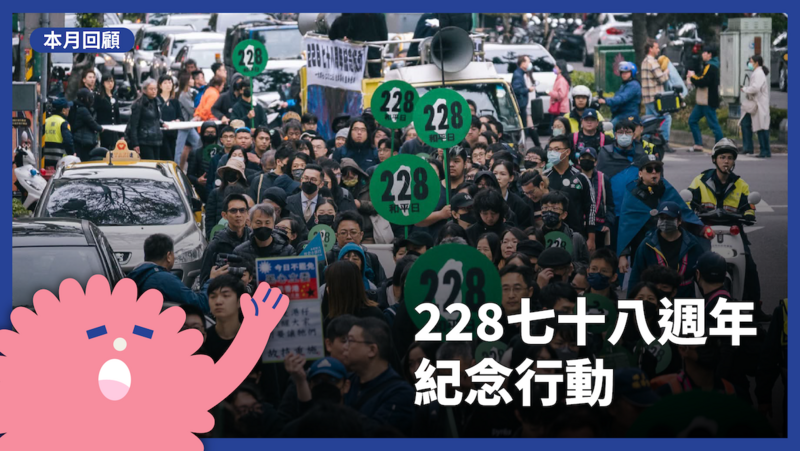
On February 22, more than 70 organizations jointly initiated the '228・0 Commemorative Action,' with over 600 citizens taking to the streets to mourn the February 28 Incident and call for the deepening of transitional justice. The march set off from Jih-Hsin Elementary School, calling out names and mourning victims along the route. Passing by multiple historical sites, the march finally arrived at the Executive Yuan, where activists delivered a declaration in Seediq, Taiwanese Hokkien, Hakka, and Mandarin, emphasizing historical memory and democratic values.
The February 28 Incident is one of the deepest collective traumas in Taiwan's history, not only taking countless lives but also shaping decades of subsequent social development and political systems. However, the memory of this tragedy is being diluted amid calls by certain politicians to 'let go of hatred,' marginalized by the joy of long holidays and the annoyance of highway traffic jams, and rendered distant and blurry by the honking of motorbikes during the 28 February marches. Without memory and reflection, we risk allowing history to repeat itself.
78 years later, with the truth of the February 28 Incident still unclear, we continue to talk about 228. Collective memory is an essential foundation for national identity; if we cannot collectively understand the history of 228, it is difficult to build an identity for our own country. Only when 228 becomes a shared memory of the Taiwanese people can it be transformed into the driving force to defend democracy and human rights, preventing society from repeating past mistakes. Commemorating 228 is not only mourning past victims, but also ensuring that we do not let Taiwan plunge back into the darkness of authoritarian rule.
After the Lunar New Year holiday, the Taipei International Book Exhibition kicked off in full swing.
The Judicial Reform Foundation (JRF) held two seminars on wrongful convictions at the 'Read-Write Citizen Book Fair.' The first was given by JRF Executive Committee Member, Attorney Lo K'ai, who assisted in the Wang Lung-ch'ang case. He shared the ins and outs of the case, the various difficulties encountered during the rescue efforts, and why he still chose to persist to the end to speak up for the innocent. The second was given by wrongful conviction exoneratee and JRF Development Resources Manager Su Chien-ho, who shared the plight of victims of wrongful conviction, why he devoted himself to judicial reform after exoneration, and how he views his own life and continues to move forward with love.
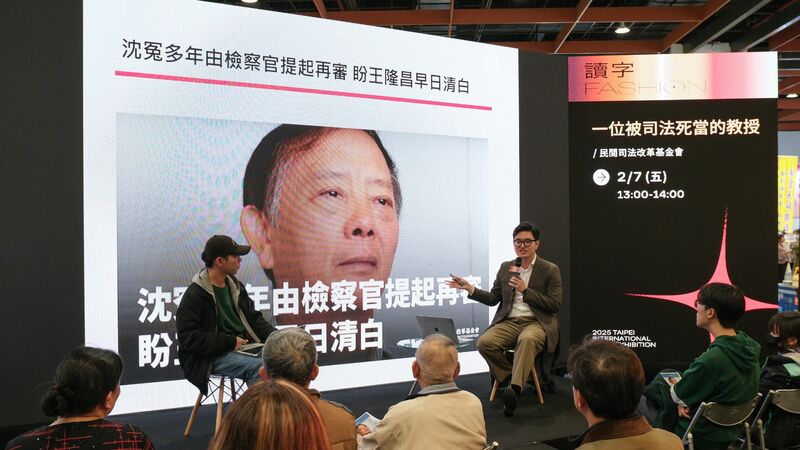
From Professor to Prisoner?! Reflections Behind the Wang Lung-ch'ang Case
P'eng Shih-han / Department of Law, Ming Chuan University, JRF Legal Intern
A single judgment struck like a fierce storm, instantly destroying this scholar's life. His friends and relatives were shocked, his students could not believe it, and even those who participated in the case back then felt puzzled. Why was an innocent professor still sent to prison without any solid evidence? His family endured endless pain and social blame; his students lost the guiding light of their future; and colleagues who once fought by his side could only helplessly watch him walk into the abyss of darkness.
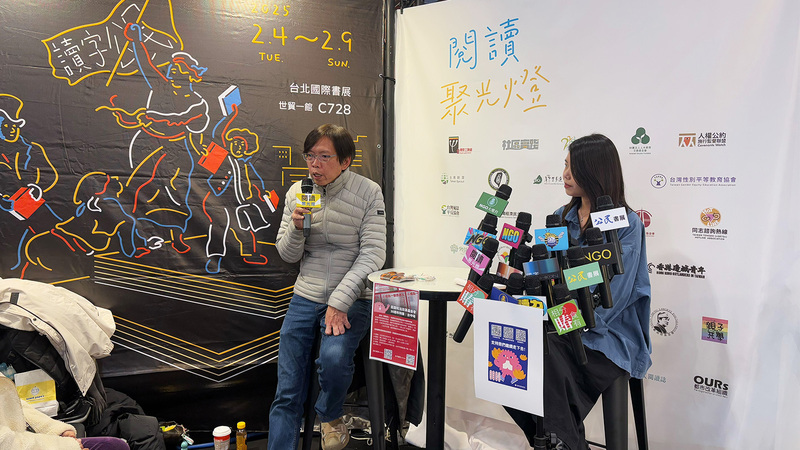
Su Chien-ho on Judicial Human Rights and Me
Chang Hsin-jung / Department of Law, National Cheng Kung University, JRF Legal Intern
After Su Chien-ho's acquittal was finalized in 2012, he was restricted from leaving the country in 2014 because his criminal record had not been expunged. He had to apply to clear the record himself. During the 21 years of tangled litigation, his father passed away, and his family fell deeply into debt due to running around for lawsuits. His own physical health was poor as a result of torture in prison.
What was chilling was that on the day of his release from prison, the National Taxation Bureau still called to demand 170,000 NTD in overdue taxes accumulated during the litigation period. Fortunately, the Humanistic Education Foundation raised 200,000 NTD to help him tide over the crisis. However, financial problems were not the only challenge. After getting out of prison, Su Chien-ho faced not only livelihood difficulties, but also strange looks from society. Some people held prejudices against victims of wrongful conviction, believing that even after exoneration, they could hardly clear themselves of suspicion. This labeling made it even harder for Su Chien-ho to reintegrate into society.
Ever since the JRF participated in the digital ID card litigation in 2020, we have consistently demanded that the government handle and utilize citizens' personal data and digital footprints with the least intrusive means. In 2022, when the government promoted the 'Digital Intermediary Services Act,' we actively participated in discussions, engaged in deep thinking, and sought a balance between freedom of speech and platform order. In recent years, we have further established the 'Digital Rule of Law Group' to deliberate on enacting a 'Digital Basic Act' to address current rapidly evolving digital challenges.
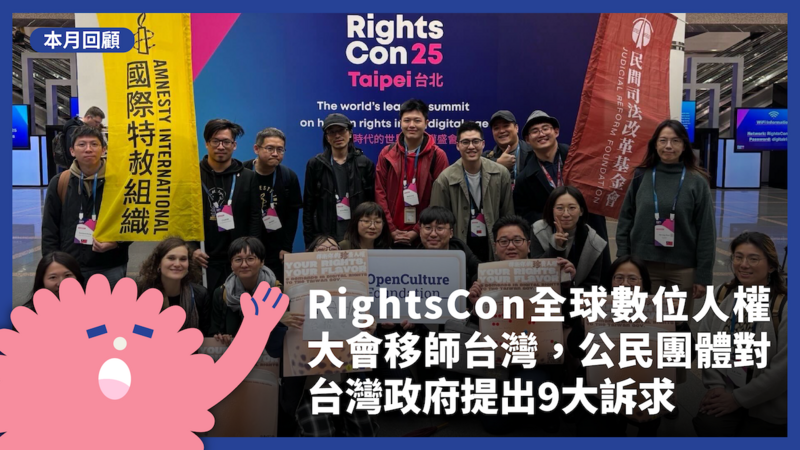
On February 24 this year, RightsCon, the global digital human rights summit organized by the international organization Access Now, was held in Taiwan for the first time, taking place over four days at the Taipei International Convention Center. Civil society organizations, government agencies, and tech companies including Meta from over a hundred countries gathered to discuss the human rights impacts brought by technologies such as artificial intelligence, digital platforms, and data security. Taiwanese groups concerned with digital human rights issues also put forward nine core demands at the summit, urging the Taiwanese government to propose more comprehensive regulations and policies.
The 9 core demands put forward by local civil society organizations, including the Judicial Reform Foundation, Open Culture Foundation, Taiwan Association for Human Rights, and Amnesty International Taiwan, cover digital rights, personal data protection, internet access, digital platforms, artificial intelligence, human rights due diligence, and open source.
➤ Press Release | Global Digital Human Rights Summit Moves to Taiwan; Civil Groups Put Forward 9 Major Demands to Taiwanese Government
➤ Joint Statement Flyer (Bilingual Chinese-English Edition)
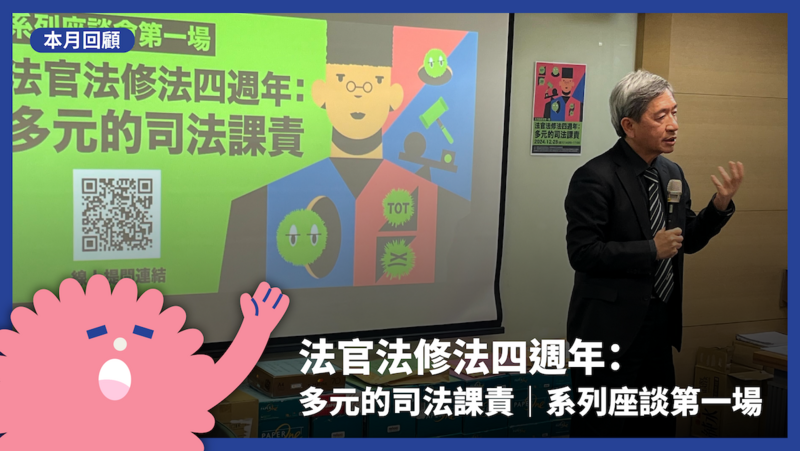
The JRF has long cared about the supervision of incompetent judicial officers. To foster a dialogue on shared expectations and improvement goals for judicial professional ethics across subjects, objects, and methods, we co-hosted the series of seminars titled 【Fourth Anniversary of the Judges Act Amendments: Diverse Judicial Accountability】 with the Judicial Reform Committee of the Taiwan Bar Association, discussing 'supervision mechanisms for incompetent judicial officers' and 'attorneys' self-discipline and external regulation.'
First Half
Moderator: Attorney Chiang Jung-hsiang / Convener, Judicial Reform Committee, Taiwan Bar Association
Regarding whether individual case evaluations are helpful for incompetent judges or prosecutors and prosecutor supervision, we have expectations that judges can exercise impartial and independent trials in accordance with the law. However, impartial and independence does not mean letting a judge be completely free from constraints inside or outside the trial; constraints should come from the judge's own judicial ability and self-discipline.
Report: Attorney Li Ming-ju / Deputy Executive Director, JRF
The JRF announced at the seminar the 'Civilian Annual Observation Report on the Fourth Anniversary of the Implementation of the New Judges Act,' pointing out three old clichés: requests by citizens for individual cases remain difficult to establish; 'no evaluation' decisions are mostly given because requests are 'based on legal interpretations' or 'manifestly lacking in merit'; most accusers receive 'no evaluation' decisions; and the anonymous mechanism for resolution documents is virtually non-existent.
Report: Li Hung-yi / Investigation Specialist, Control Yuan
Returning to the original intention, the purpose of evaluation and disciplinary action (quoted from the legislative reasoning of the Judges Act) is not to evaluate or blame judges' individual wrongful acts one by one, but to comprehensively evaluate the personality manifested by all of a judge's wrongful acts to determine the responsibility the judge should bear. When it is already known that an evaluated judge has other circumstances subject to evaluation, they shall be investigated and deliberated together to achieve procedural economy and immediate evidence collection.
Discussant: Chiang Shih-ming / Professor, College of Law, National Chengchi University
Taking American standards as an example, if a California judge commits a legal error, it can be reviewed in exceptional circumstances, such as repetitive errors. Other examples include abuse of authority, contempt for fundamental rights, intentional malicious illegal intent, and any purpose other than the faithful fulfillment of judicial tasks. These behaviors must be uncovered and stopped.
Discussant: Attorney Ch'ien Chien-jung / Former Judge, Supreme Court
Finding evaluation channels right now is very unfriendly to the public, and the most knowledgeable and capable civil groups have been removed from being applicants. Excluding the JRF causes evaluation to wither and achieves the goals of high-ranking officials in the Judicial Yuan; we should move toward a dual-prosecutor system. Currently, the most frequent referrals are made by the Judicial Yuan itself to the Evaluation Commission. However, in practice, the Judicial Yuan itself can directly refer cases to the Control Yuan or the Disciplinary Court. The Judicial Yuan dares not decide to submit cases to the Personnel Review Committee, making the Personnel Review Committee the most important driving engine. The matter of the referral authority needs to be reviewed.
For the complete content, please see ➤'Civilian Annual Observation Report on the Fourth Anniversary of the Implementation of the New Judges Act'
Second Half
Moderator: Attorney Huang Hsu-t'ien / Chairperson, JRF
When the JRF first proposed the draft, we hoped for a comprehensive evaluation, but it did not receive official support. There was a time when assessments were carried out, but the effect was very poor. Before the Judges Act amendments, there were individual case evaluations and something similar to comprehensive evaluation, but comprehensive evaluation no longer officially exists. The speakers we invited came from units that had some form of comprehensive evaluation to review and understand judges, so it is particularly worthwhile to share and exchange views with everyone.
Report: Attorney Huang Sheng-fen / Convener, Judicial Reform Committee, Taichung Bar Association
The Taichung Bar Association only published the top five best-performing agencies. Among those evaluated, those with lower scores indeed had some problematic performance, proving that poorly performing judges and prosecutors can be highlighted through evaluation methods, especially when the sample size is sufficient. It is worth noting that those with lower scores also served as presiding judges or chief judges, showing that the courts' selection for presiding judges or chief judges is decoupled from evaluations.
Report: Attorney Liang Chih-wei / Guest, Judicial Reform Committee, Kaohsiung Bar Association
The Kaohsiung Bar Association conducted evaluations in 2017, and the results came out in 2019, followed by the Judges Act amendments. Currently, we want to promote transformation and launch an App which is currently in the testing phase. We hope the Taiwan Bar Association can take the lead in promoting digitalized evaluation.
Discussant: Attorney Cheng Chia-hui / Convener, Judicial Reform Committee, Tainan Bar Association
To encourage attorneys to participate more, the incentive bonus, which was originally issued once a year, was changed to be issued twice a year—in the first and second halves. However, we found that it is still the same group of people participating, which is the current dilemma we face. The evaluation results are not comprehensively published; only the top performers are published on the website. Lower scores are not published, but we take the evaluation report to pay courtesy visits to the courts and prosecutors' offices.
Discussant: Attorney Lin Yung-sung / Standing Director, JRF
Taiwan currently suffers from low public trust in the judiciary. Although citizens directly request individual case evaluations, not a single case has been referred to the Judicial Court. Judicial performance evaluations lack objective and fair assessments, the quality gap in judges' service performance is too wide, and incompetent judges lack an elimination mechanism. Taiwan indeed needs a comprehensive evaluation or assessment system for judges.
➤ Seminar Records | 【Fourth Anniversary of the Judges Act Amendments: Diverse Judicial Accountability】 Seminar Series Session 1
➤ Seminar Sidelights | 【Fourth Anniversary of the Judges Act Amendments: Diverse Judicial Accountability】 Seminar Series Session 1
This article is an AI-generated translation of the original Chinese text. In the event of any discrepancy, the Chinese version shall prevail.