
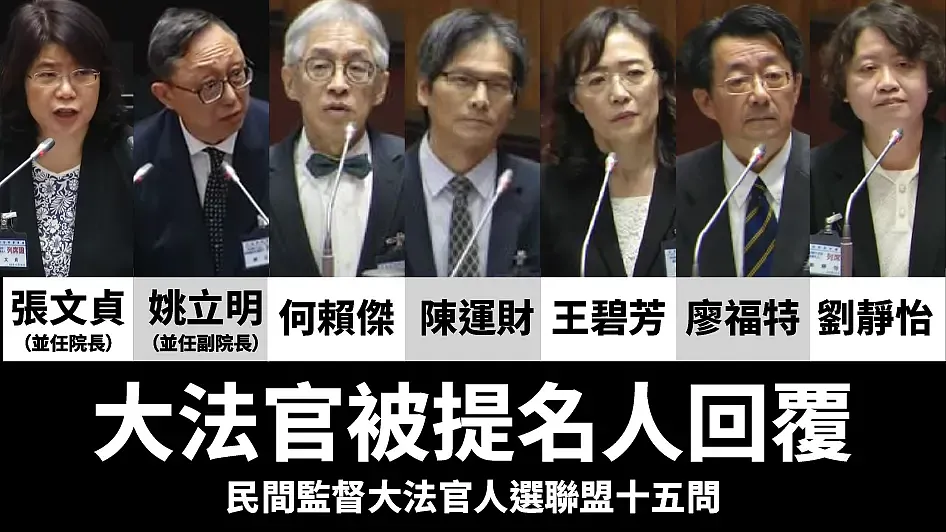
Grand Justice Nominees Respond to the Fifteen Questions from the Alliance for Monitoring Grand Justice Nominees
Last edited: 2026-07-27
On August 30, President Lai Ching-te formally nominated Professor Chang Wen-chen, Yao Li-ming, Professor Ho Lai-chieh, Professor Ch'en Yün-ts'ai, Judge Wang Pi-fang, Researcher Liao Fu-t'e, and Professor Liu Ching-ih as Justices of the Judicial Yuan, among whom Professor Chang Wen-chen was designated as the President of the Judicial Yuan, and Judge Yao Li-ming as the Vice President of the Judicial Yuan.
Following the confirmation of the nominees, the Alliance for Monitoring Grand Justice Nominees proposed 15 joint questions to the 7 nominees on October 9, along with additional questions specifically for the President and Vice President nominees. It is hoped that through the responses to these questions, the public can understand the nominees' dedication to constitutional rights.
By December 16, the Secretariat received responses from all nominees. The content of each nominee's response is attached via the links provided for public review.
| Grand Justice Nominee | Response Status | Link |
|---|---|---|
| Chang Wen-chen (also serving as President) | Responded | Web Version | PDF Download |
| Yao Li-ming (also serving as Vice President) | Responded | Web Version | PDF Download |
| Ho Lai-chieh | Responded | Web Version | PDF Download |
| Ch'en Yün-ts'ai | Responded | Web Version | PDF Download |
| Wang Pi-fang | Responded | Web Version | PDF Download |
| Liao Fu-t'e | Responded | Web Version | PDF Download |
| Liu Ching-ih | Responded | Web Version | PDF Download |
Joint Questions for Grand Justice Nominees (15 Questions)
-
Focus on Human Rights and Constitutional Issues
1. Looking ahead to your eight-year term, what do you consider to be the most indicative (or your most concerned) constitutional issue or fundamental human rights protection issue?
2. Regarding previously rendered Judicial Yuan Interpretations or Constitutional Court judgments, could you provide an example to explain how you would adopt a different conclusion or a different line of legal reasoning?
3. Are there any constitutional or human rights issues on which you hold a firm constitutional conviction in your mind, yet they diverge to a certain extent from current stable mainstream views or legal orders, or remain subjects of diverse and divergent views in society?
-
International Human Rights Covenants and Constitutional Review
4. Paragraph 16 of the Concluding Observations of the 2022 International Review Committee on International Human Rights Covenants states: “…In cases of conflict between existing or subsequently enacted laws and the two Covenants, the status of the two Covenants must be further clarified. The Review Committee emphasizes that the two Covenants, as the most important human rights covenants of the United Nations, should be given priority.” Do you believe that domesticated international human rights covenants should take precedence when in conflict with domestic laws? Or, in the event of a conflict, should the standard of constitutional review be elevated? What is the relationship between the list of rights in international human rights covenants and the categories and content of fundamental rights in our country?
5. Paragraph 3 of General Comment No. 6 on the Convention on the Rights of Persons with Disabilities (CRPD), which has been successfully domesticated, further points out: “…the denial of reasonable accommodation constitutes discrimination.” Do you believe that the content of this General Comment has legal binding force? In constitutional review, do you consider laws or judgments that violate the “principle of reasonable accommodation” to be infringements upon the right to equality, and should they be subject to strict scrutiny?
-
Referendums and Constitutional Review
6. Article 12 of the Additional Articles of the Constitution stipulates that amendments to the Constitution shall be subject to the procedure of a proposal by the Legislative Yuan and a citizen referendum. The constitutional amendment referendum on “18-year-old citizens' suffrage” held in 2022 failed to pass because it did not reach the passage threshold. From the perspective of the current constitutional amendment procedures and the practice of the aforementioned referendum, do you think the current procedures and thresholds for constitutional amendment are appropriate? How do you evaluate their impact on Taiwan’s democratic operation? Does Article 12 of the Additional Articles of the Constitution raise any unconstitutionality concerns?
7. Following the promulgation of Judicial Yuan Interpretation No. 748, certain groups opposed to same-sex marriage submitted a referendum proposal to the Central Election Commission (CEC) in January 2018 (questioning whether same-sex marriage should be defined and protected by the Civil Code), and the referendum was held on November 24 of the same year. Regarding the administrative disposition by the CEC announcing the formation of the referendum proposal, certain individuals identifying as interested parties filed a revocation lawsuit as plaintiffs with the Taipei High Administrative Court prior to the voting, and applied for a suspension of the execution of the referendum procedure. The case was finalized on May 29, 2020, after the Supreme Administrative Court dismissed the plaintiffs' appeal in Judgment No. 300 (2020), holding that the plaintiffs were not interested parties, lacked subjective public rights, lacked the standing to sue, and that the protection norm theory was not applicable. It additionally pointed out that even if a referendum proposal violates the Indigenous Peoples Basic Act, the CEC only has the discretionary power not to approve its proposal formation, and by law prosecutors possess the standing to sue, whereas indigenous peoples themselves do not. What are your views on the aforementioned opinion that even if an interested party's rights are directly infringed, they still lack the standing to sue? Regarding a referendum proposal with a high probability of unconstitutionality, how can and should the provisional injunction system stipulated in Article 43 of the Constitutional Court Procedure Act be applied?
-
State Duty to Protect and Constitutional Review
8. Currently, there is still no explicit legal protection for the de facto spousal relationships of heterosexual or homosexual cohabiting partners. Given the current status in our legal system where such relationships are not explicitly protected, do you believe this constitutes unconstitutional “legislative omission”? Beyond this, what other “legislative omission” statuses in the current situation do you think have the potential to be evaluated as unconstitutional?
9. Laws related to social assistance prioritize the prevention of abuses and establish fictitious income and total family income calculation rules that do not reflect the economic reality of impoverished individuals, resulting in a severe underestimation of our country’s impoverished population. Despite the existence of exception clauses (Article 539), this still leads to situations where individuals who, for various reasons, no longer maintain contact with their families of origin, or cannot or are unwilling to obtain support from them (such as domestic violence survivors or adult homosexuals), are unable to apply for social assistance when facing living difficulties. From the perspective of our Constitution and constitutional jurisprudence in protecting the social rights of the people, how should constitutional review be conducted regarding legislative or administrative omissions where the state provides insufficient protection to vulnerable groups? Regarding the aforementioned issues concerning the social assistance system, have the right to life and other fundamental rights of the people been infringed?
10. In legal issues involving climate and environmental change, infringements upon people's rights often stem not from the active deeds of public authority, but from state omissions or insufficient actions (such as carbon emission policies). In scenarios of extreme weather where rights are about to be or are being infringed upon for vulnerable groups, do you believe these groups or interested parties possess the standing to sue to compel the state to fulfill its duty to protection? If the system fails to provide appropriate relief channels, does this infringe upon the people’s right to litigation?
-
Gender Identity and Fundamental Rights Protection
11. Judicial Yuan Interpretation No. 748 points out that differential treatment based on “sexual orientation” falls within the scope of the right to equality guaranteed by Article 7 of the Constitution and should be subject to a stricter standard of review. Do you believe that our Constitution guarantees people’s “gender identity”? What is the basis and extent of such protection? Regarding differential treatment based on “gender identity” as a classification standard, what standard of review do you think should be adopted? Do you believe that the “sexual autonomy” guaranteed to the people by the Constitution includes the “right to self-determination of gender”? What is your opinion on “legal gender recognition without surgery” (where completing gender-affirming surgery is not a mandatory prerequisite for applying to change gender registration)? If you are in favor of legal gender recognition without surgery, do you believe that changing gender registration still requires other conditions (such as a psychiatric diagnosis certificate)? Or do you support “freedom of gender recognition”?
-
Land Expropriation and Fundamental Rights Protection
12. In recent years, land development for major national infrastructure projects has heavily relied on district expropriation (such as the Taoyuan Aerotropolis, Taipei Shilin Shezizidao development project, MRT development projects, and railway projects), causing infringements upon people’s rights to housing and property. Do you think that citing “national economic development” alone is sufficient to constitute the public interest objective for the state to initiate expropriation? Is the “district expropriation” adopted in our legal system unconstitutional? When disputes involve evicting residents living on state-owned land, do you believe the state may purely stand on the footing of a private party to assert its ownership rights without needing to consider the infringement of public authority upon the residents’ fundamental rights, such as the right to housing?
-
Protection of Prisoners' Rights
13. Judicial Yuan Interpretation No. 755 holds that prohibiting criminal inmates from seeking remedies when prison management measures unlawfully infringe upon their rights and such infringement is not explicitly minor is unconstitutional. Questions:
(1) An inmate petitioned a civil society organization, pointing out that prison personnel had inspected their correspondence. The prison subsequently penalized the inmate on the grounds that no such incident was found and that the inmate had “damaged the reputation of prison personnel.” In this regard, do you consider the prison’s punishment of the inmate appropriate? Does it violate the provisions of Article 91 of the Enforcement Act of the Prison Act?
(2) What are your views on the current situation where inmates in our country are unable to vote due to their factual confinement?
-
Equality and Anti-Discrimination
14. Regarding cases where a public university expels a student due to severe discrimination, if such discriminatory conduct has already been determined by other competent authorities and “their educational opportunities should be restored,” can the administrative court revoke the unlawful expulsion decision made by the public university, regardless of whether it has become final? If revocation is not permitted, how should the court’s judgment protect the rights and interests of the discriminated student?
15. To enact an “Anti-Discrimination Act,” the government commissioned the research project “Whether Our Country Should Enact a Comprehensive Anti-Discrimination Act and Legislative Recommendations” in 2018, and its final report proposed a draft consisting of 67 articles. However, the “Draft Anti-Discrimination Act” announced by the Executive Yuan in May 2024 differs considerably in content from the research project’s draft. What are your opinions on the enactment of an “Anti-Discrimination Act”? Beyond clarifying claims for damages resulting from discriminatory acts, what else should the “Anti-Discrimination Act” encompass?
Joint Questions for the Nominees for President and Vice President of the Judicial Yuan (7 Questions)
1. In recent government public satisfaction surveys, the item with the highest dissatisfaction is “judicial reform.” In your view, what are the causes behind the public’s low level of trust in the judiciary, and how should this be improved?
2. There has always been a phenomenon in the legal community where different agencies and organizations find it difficult to reach a consensus on specific controversial issues. How do you plan to foster dialogue and communication among various agencies and organizations (such as the public, judges, civic organizations, and the Ministry of Justice)?
3. During the National Judicial Reform Conference held in 2016, you served as a member of “Panel 1: Judiciary Protecting Crime Victims and Vulnerable Groups.” What are your views on the resolutions and implementation of this panel? Regarding the many important resolutions among the 326 resolutions of that conference that remain unimplemented, how do you think they should be promoted?
4. Regarding the resources currently invested by the government in judicial trials, do you consider them sufficient? What are your views on the planning or increase of the judicial budget?
5. Currently, when the Judicial Yuan proposes reforms in the form of bills, it publishes drafts and legislative explanations, but does not simultaneously release detailed policy impact assessments, making it difficult for various sectors of society to evaluate their impact. For example, when the Judicial Yuan passed the draft regarding the “pyramid-shaped litigation system” in 2021, it did not simultaneously detail how the restriction of the right of appeal might affect the rights and interests of the people, nor how relevant supporting measures would mitigate the impact. How do you believe the Judicial Yuan should communicate judicial policy reforms with the public? When proposing major amendments to laws, should a “policy and human rights impact assessment” be submitted concurrently?
6. Regarding the current issue of overwork within the judicial system, what do you consider to be the crux of the problem? Under the premise of maintaining the protection of people's rights and interests, what measures do you believe should be taken to reasonably alleviate the judicial burden? What are your thoughts on rationalizing case burdens while simultaneously fulfilling the goals of continuing education and training for judges?
7. What are your views on the implementation of the “Lay Assessor System” up to the present? What are your thoughts on continuing to promote reforms in the criminal litigation system (such as the system of non-transfer of case files and evidence)?
Questions for Nominee Yao Li-ming (2 Questions)
1. According to the National Central Library Periodical Index System, you have only published one law-related article since 2007. Thereafter, your focus has primarily been on political work. In contrast, Taiwan’s judicial environment and legal doctrines have undergone significant changes and advancements over the past 20 years. How would you explain to the public that you possess sufficient academic capability and professionalism to shoulder the responsibilities and authority of constitutional interpretation?
2. You served as the campaign headquarters director-general for the current President in 2023. How would you explain to the public that, while holding the offices of Vice President of the Judicial Yuan and Grand Justice, you will remain transcendent of partisan stances and impartially exercise your official powers?
This article is an AI-generated translation of the original Chinese text. In the event of any discrepancy, the Chinese version shall prevail.
