
Litigation Audiovisual Records Act
Defendant: I will not appeal further, and I request permission to withdraw my appeal. (The defendant filled out a written motion to withdraw the appeal in court, which was attached to the case file.)
This single line in the transcript makes it look "beyond doubt" that the defendant herself asked to withdraw the appeal. The reality, however, was quite different:
Judge: The lower court has already reduced your sentence! And it can be commuted to a fine, so just go earn some money and pay it off. Here in Taiwan you even get to appeal—would they let you appeal in mainland China? Is that plain enough for you? Do you understand?
A-mei: Thank you.
Judge: To put it bluntly, appealing like this is just a waste of everyone's time. Just withdraw it. You won't have to keep coming to court; just wait until the prosecutor notifies you to pay the fine, borrow some money to pay it off, and then you'll be free and clear.
A-mei: Thank you, I understand. But actually, if you check the recording, it shows very clearly that it wasn't me.
Judge: So now you're saying the lower court got it wrong! That this part shouldn't have been used against you—but other evidence could still prove it, and I might even give you a heavier sentence. I'm being straight with you: if you appeal, that's the risk you take. I've said everything I can to help you.
A-mei: I don't want to appeal anymore. Like you said, it's the same whether I appeal or not. I just beg the judge to show mercy—could you possibly reduce my sentence by a few months?
Judge: Impossible. Probation is out of the question, let alone a few months off. This isn't a vegetable market. Taiwan's courts are not a vegetable market. Taiwan's courts are more humane than mainland China's—you can communicate and speak your mind here—but this is still not a vegetable market.
A-mei: Then I'll just borrow money to pay the fine...
This is a case of a judge improperly inducing and coaxing a defendant into withdrawing an appeal—a reality that cannot be discerned at all from the transcript.
Discrepancies between transcripts and what actually happens during questioning are quite common; in particular, problematic questioning is often left out of the record altogether. That is why it is crucial for parties to have access to the audio and video recordings of police and prosecutorial interrogations and of court proceedings. Only in this way can what actually happened be reconstructed, and only then can it be verified whether there are serious inaccuracies in the transcripts, improper interrogation, improper conduct of proceedings, poor courtroom demeanor, or other problems.
JRF took note of the difficulties in obtaining litigation audiovisual records as early as 2000. At the time, Article 7, Paragraph 1 of the Regulations on Court Recordings provided that once an appeal or interlocutory appeal was filed, the court recordings could be erased 10 days after the appeal period for that instance had expired. As a result, recordings might be erased after an appeal was filed, making it impossible to cross-check the accuracy of the transcripts. JRF therefore recommended that recordings be erased only after a judgment becomes final, and the regulations were successfully amended accordingly in 2001. Later, after the 2003 amendment to the Code of Criminal Procedure required that the interrogation of defendants be recorded in full, the Ministry of Justice questioned whether defense counsel should be allowed to make copies of interrogation recordings. In 2004, JRF wrote to the Judicial Yuan arguing that interrogation recordings should be subject to the same rules as ordinary file review and that defense counsel should be permitted to copy them. The Judicial Yuan replied in agreement.
Official policy began restricting access to litigation audiovisual records around the time of the 2009 amendment to the Regulations on Court Recordings. The fundamental shift at that time was that litigation audiovisual records were no longer regarded as part of the case file, and therefore could no longer be obtained under the ordinary file-review rules. The new regulations limited the release of court recordings to cases where it was "necessary for verifying the transcript and approved by the court." This provoked a backlash from the legal profession. On March 20, 2009, JRF, together with the Taiwan Bar Association and the Taipei Bar Association, issued a joint statement firmly asserting that copying recording discs is a right of the parties, not a favor granted by the court, and questioning whether the amendment was opening a back door for the courts to evade public oversight.
Although this temporarily blocked the amendment, in 2013 the Judicial Yuan pressed ahead regardless, replacing the regulations with the Regulations on Court Recordings and Their Utilization and Preservation. Under the new regulations, an application for a court recording disc required the "written consent of the persons who made statements in court" and was limited to cases where it was "necessary to assert or protect the applicant's legal interests." This severely restricted parties' ability to obtain court recording discs. First, parties had to obtain the written consent of those who made statements in court "on their own." Yet at the time of the application, it was sometimes impossible to reach those persons, or the applicant and those persons were in strongly opposing positions, making consent difficult to obtain. For instance, JRF once encountered a case in which a defendant applied for a court recording disc, and the complainant stated outright, "I will absolutely not let him use my data to make any arguments."
Moreover, the vague legal standard of "necessity to assert or protect legal interests" gave courts considerable room to refuse to release recordings. In fact, even before the new regulations, courts would deny applications for court recordings on the grounds that the applicant could not point to specific errors or omissions in the transcript and had only claimed in general terms that the transcript was inaccurate—an argument that makes little sense. Human memory is limited, and over time people are very likely to forget what actually happened at a hearing. The reasonable approach, therefore, is simply to give parties access to court recordings so they can check the transcripts for errors or omissions. JRF already strongly disagreed with existing practice; the new regulations merely gave courts an even more convenient justification for denying applications, which, in JRF's view, was a major step backward.
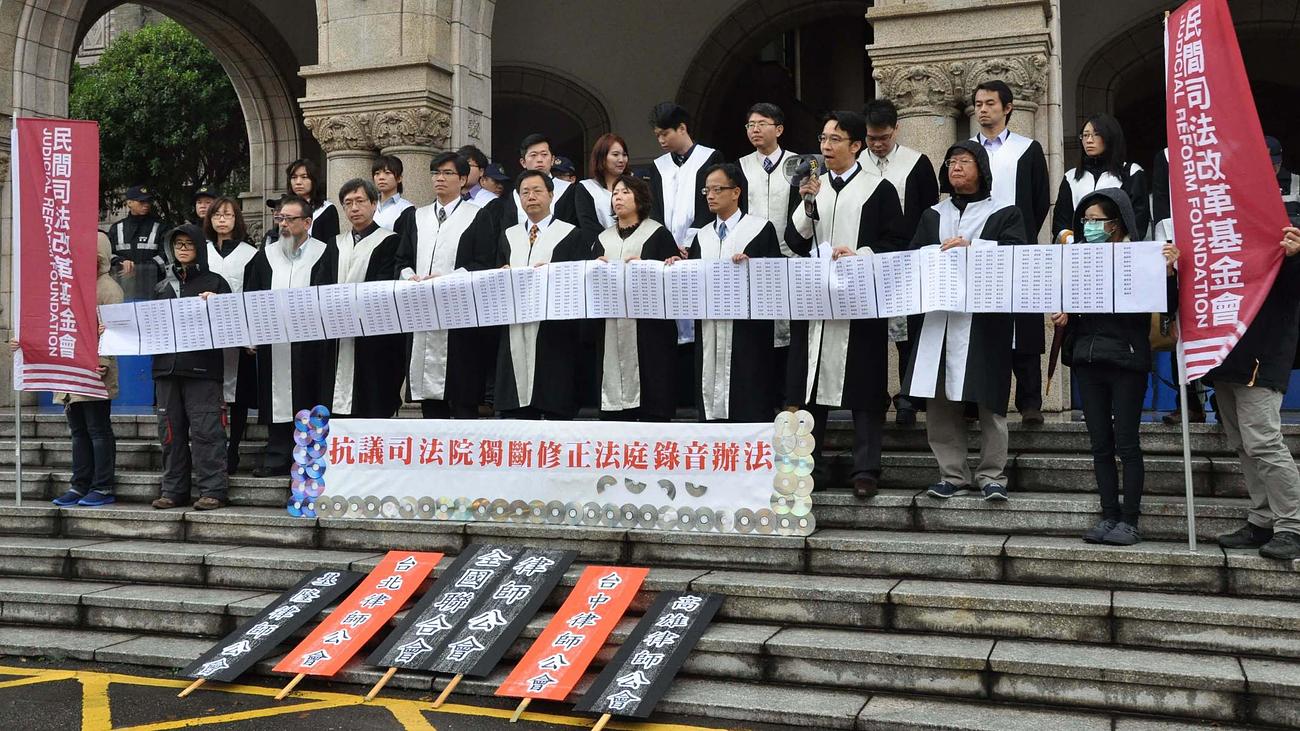
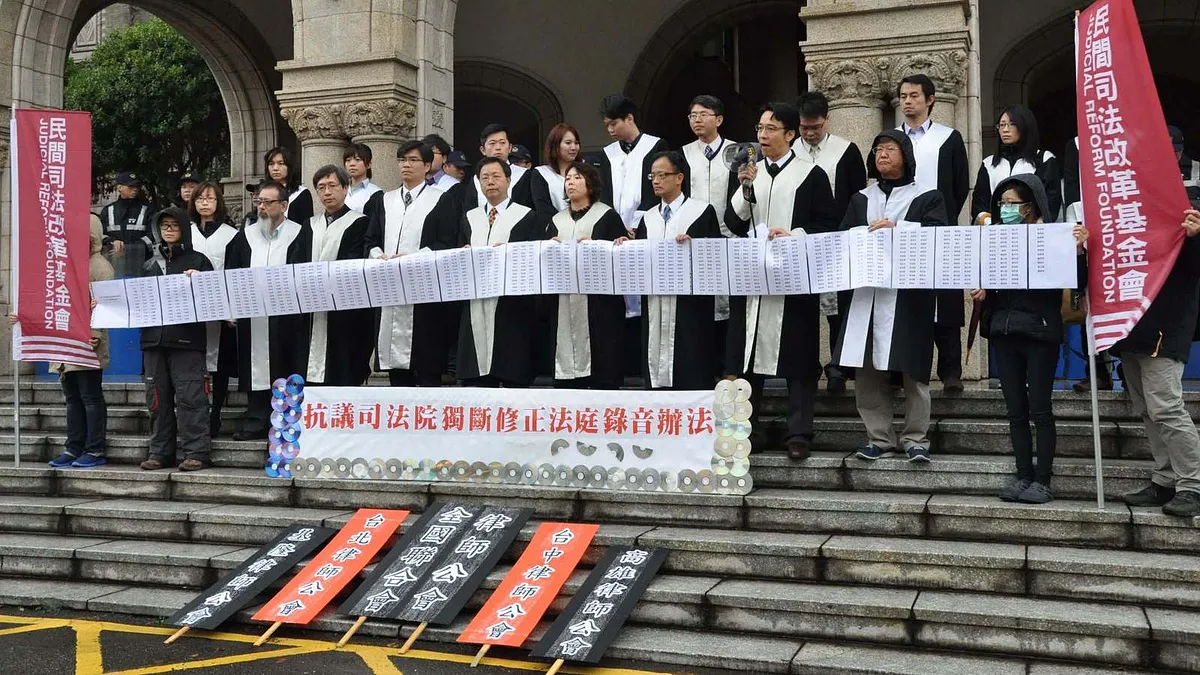
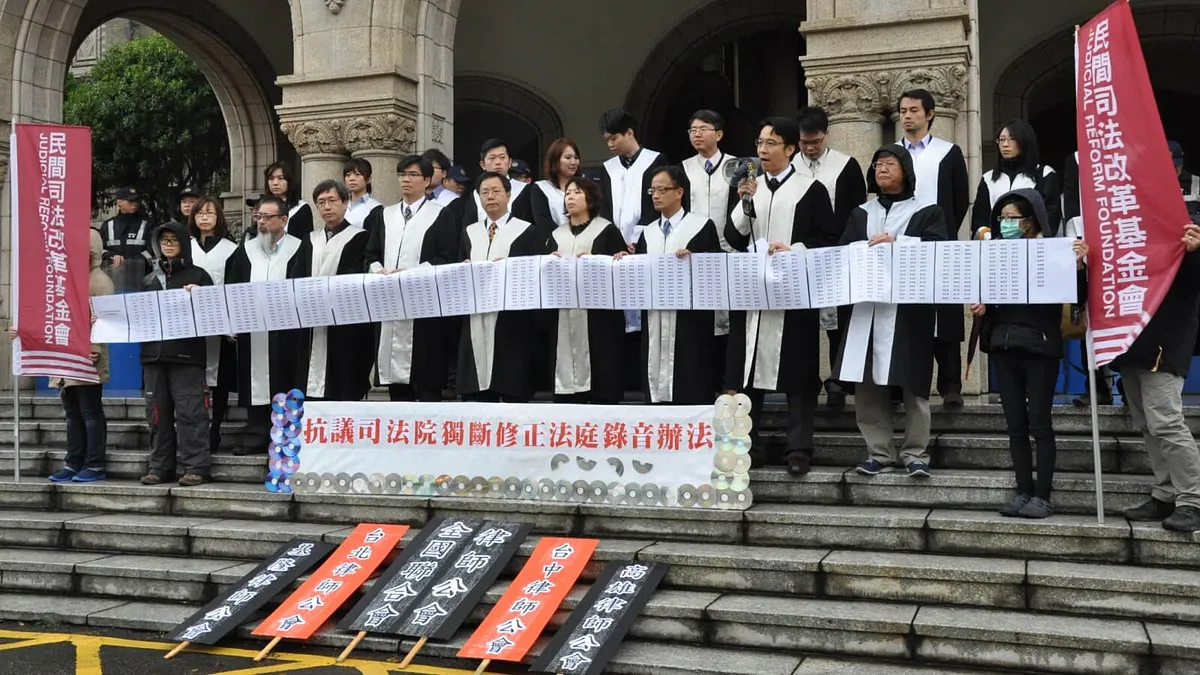
Consequently, on January 9, 2014, JRF, together with the Taiwan Bar Association and several local bar associations, protested outside the Judicial Yuan against its unilateral revision of the court recording regulations. JRF and the bar associations then shifted strategy, seeking to establish a clear statutory basis for obtaining court recordings in order to counter the Judicial Yuan's actions. This ultimately led to the enactment of Articles 90-1 through 90-4 of the Court Organization Act.
Originally, JRF and the bar associations had pushed for a dedicated statute on litigation audiovisual records. They hoped it would clearly provide that litigation audiovisual records be obtained and preserved in the same way as ordinary case files, and even extend the right to apply to others taking part in court proceedings who need the recordings to protect their rights or legal interests. However, the push for a dedicated statute did not succeed. In the newly added Articles 90-1 through 90-4 of the Court Organization Act, they did manage to secure two points: that the release of court recording discs does not require the written consent of those who made statements in court—which was written into the legislative explanation—and that a party may file an interlocutory appeal if the court denies an application for court recordings. The wording "assert or protect legal interests," however, was retained in Article 90-1 of the Court Organization Act.
In addition, Article 90-4 of the Court Organization Act introduced penalties for publicly broadcasting court recordings. This was clearly aimed at JRF's practice of publishing litigation audiovisual records to hold the judiciary accountable. JRF had previously published several recordings showing improper interrogation and poor courtroom demeanor, which provoked considerable resentment among officials, who argued that this damaged public confidence in the judiciary and constituted an improper use of litigation audiovisual records. That is why this article was added.
As for the long-term direction of judicial reform, JRF still maintains that a dedicated statute—a "Litigation Audiovisual Records Act"—should be enacted. Litigation audiovisual records should be obtained and preserved in the same way as ordinary case files. The personality and privacy rights of those who appear in such recordings should be protected under the relevant provisions of the Personal Data Protection Act, the Criminal Code, and the Civil Code. This would strike a balance between the parties' procedural rights, public oversight of the judiciary, and the personality and privacy rights of others who made statements in court.
2015
Is It Reasonable to Sentence Anyone Who Publishes Court Recordings to Imprisonment? ~ Joint Statement Opposing the Draft Article 90-4 of the Court Organization Act
Public trial is the most fundamental principle of the rule of law. Except for cases where open trials are explicitly…
2014
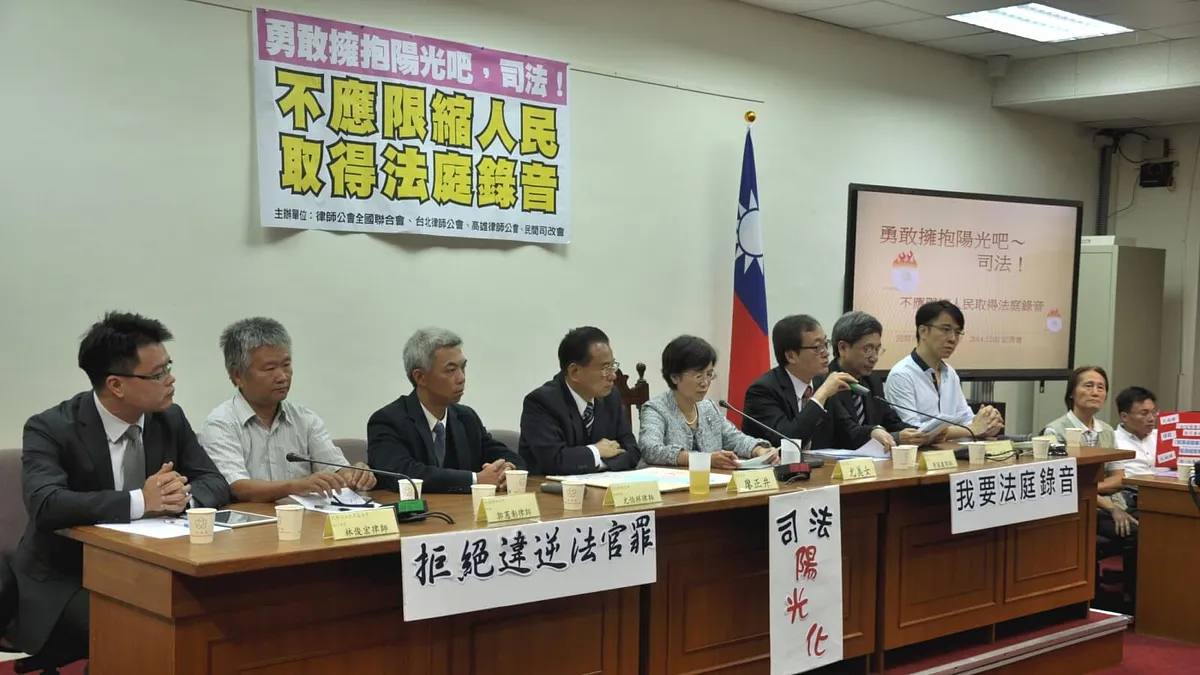
Embrace the Sunshine, Judiciary! ~ Press Conference on Opposing the Restriction of People's Access to Court Recordings
On October 25, 2013, the Judicial Yuan arbitrarily promulgated the "Regulations Governing Court Recordings and Their…
2014
Joint Press Conference Protesting the Judicial Yuan's Arbitrary Amendment of the Regulations on Court Audio Recording
Disregarding widespread opposition from all sectors, the Judicial Yuan promulgated the Regulations on Court Audio…

2009
Copying Audio Recordings is a Right of Litigants, Not a Favor from the Court
The Judicial Yuan recently issued a press release proposing a draft amendment to the Regulations Governing Court Audio…