
Prosecutor System Reform
Criminal proceedings involve three key actors: judges, defense lawyers, and prosecutors. Judges weigh the evidence, find the facts, and adjudicate independently in accordance with the law. Defense lawyers represent suspects and defendants, holding the criminal justice system to the requirements of procedural and substantive justice in order to protect human rights. Prosecutors represent the public interest on behalf of the State, investigate and prosecute crimes, and present the prosecution's case in court.
According to Ministry of Justice statistics for 2014, there were 1,398 prosecutors in total: 1,182 at district prosecutors offices, 194 at high prosecutors offices, and 22 at the Supreme Prosecutors Office. Prosecutors offices at every level divide their prosecutors by function into investigating prosecutors, trial prosecutors, and enforcement prosecutors. Investigating prosecutors conduct criminal investigations and decide, based on the evidence, whether to indict suspects. Once a suspect has been indicted, trial prosecutors present the evidence in court and argue the case against the defendant. Enforcement prosecutors oversee the execution of sentences after judgments become final.
Prosecutors at All Levels, 2014
| Prosecutor General / Chief Prosecutors | Head Prosecutors | Prosecutors | Total | |
| District Prosecutors Offices | 21 | 150 | 1,011 | 1,182 |
| High Prosecutors Offices | 6 | 19 | 169 | 194 |
| Supreme Prosecutors Office | 1 | 3 | 18 | 22 |
| Total | 28 | 172 | 1,198 | 1,398 |
(Source: Ministry of Justice, Number of Prosecutors at Prosecutorial Agencies at All Levels)
Past Reforms of the Prosecution Service
In the past, prosecutors did not have to appear in court to argue their cases after filing an indictment. In the past, superiors' instructions to prosecutors on how to handle cases took place entirely behind closed doors. In the past, investigations into major cases could hardly be conducted independently. In the past, the Prosecutor General was appointed at the sole discretion of one person.
It was not until after 2000 that reforms of the prosecution service got under way, achieving results in stages:
-
2003 Amendment to the Code of Criminal Procedure
- Court proceedings adopted a "modified adversarial system," requiring prosecutors to appear in court and argue their cases. Prosecutors offices accordingly set up trial divisions, whose trial prosecutors appear in court.
-
2006 Amendment to the Court Organization Act
- The Prosecutor General, previously appointed directly by the President, now requires the consent of the Legislative Yuan, and the Prosecutor General's term of office was guaranteed, with the aim of making the position independent and impartial.
- A written-instruction requirement was added, under which the Prosecutor General and chief prosecutors are in principle to issue directions and assignments in writing.
- A Special Investigation Division was created within the Supreme Prosecutors Office to investigate corruption by the head of state, central government officials, and senior military officers, as well as major criminal cases of national significance.
- A Prosecutors Personnel Review Committee was established within the Ministry of Justice to review the transfer and promotion of prosecutors.
-
2011 Enactment of the Judges Act
- The safeguards for prosecutors were written into law.
- Prosecutors' meetings were introduced to promote internal democracy within the prosecution service.
- An evaluation system for prosecutors was introduced to remove unfit prosecutors.
Although the prosecution service has undergone major changes, many problems have yet to be addressed. Reform is still a work in progress.
What Are the Problems?
The Prosecutor General is currently nominated by the President and confirmed by the Legislative Yuan, whereas the Minister of Justice is simply appointed by the Premier without legislative confirmation. The Prosecutor General thus has a considerably stronger democratic mandate. Institutionally, however, the Prosecutor General is subordinate to the Minister of Justice, who has administrative supervisory authority over prosecutors offices at every level and may set criminal policy guidelines that all prosecutors nationwide must follow. If the Minister of Justice and the Prosecutor General disagree on how to implement criminal policy, who should bear ultimate responsibility—the Minister, who lacks a democratic mandate, or the Prosecutor General, who has one but serves a fixed term and is no longer answerable to the legislature?
In the past, a superior often needed only to say a word for frontline prosecutors to fall in line, and if something went wrong, the prosecutor handling the case took the blame. After years of reform efforts, the written-instruction requirement was finally written into the 2006 amendment to the Court Organization Act, and the Judges Act passed in 2011 expressly provided that "orders shall be given in writing with reasons." Yet despite these explicit legal provisions, superiors continue to give oral instructions on cases in practice, fueling persistent public suspicion of political interference in investigations. If the written-instruction requirement is not enforced and responsibility cannot be clearly assigned, how can prosecutors be expected to resist political pressure and handle cases independently?
District prosecutors offices divide their prosecutors by function into three groups: investigation, trial, and enforcement. Investigating prosecutors make up roughly two-thirds of each office's prosecutors. Because prosecutors at the high prosecutors offices and above generally do not conduct investigations, almost all criminal investigations nationwide are handled by just over 700 investigating prosecutors at the district level. With nearly two million investigation cases a year, each investigating prosecutor's workload has long far exceeded what is manageable. By contrast, prosecutors at the high prosecutors offices and above need only appear in court to argue cases, so their workload is much lighter—so much so that these offices have been mocked as "retirement homes."
Moreover, before a judgment becomes final, a single case passes through the hands of several different prosecutors: the investigating prosecutor, and then the trial prosecutors at the first, second, and third instances. But can trial prosecutors know the facts and details of a case as well as the investigating prosecutor does? And when a defendant is acquitted, who should be held responsible? The investigating prosecutor who gathered the evidence? The trial prosecutor at first instance? At second instance? Or at the final instance?
Because workloads are so unevenly distributed, frontline investigating prosecutors are eager to move up to the high prosecutors offices, and prosecutors who see themselves as "judicial officers" have developed the kind of careerist culture common in the civil service. On the prosecutorial career ladder, the position of head prosecutor is a necessary step toward becoming a prosecutor at a high prosecutors office. At present, head prosecutors are appointed by the Minister of Justice from a shortlist drawn up by the Prosecutors Personnel Review Committee containing 1.5 times as many candidates as there are posts (in practice, often more). Getting onto the shortlist, let alone being chosen by the Minister, requires a concrete record of achievement—namely, experience handling "major cases." For a district prosecutor, being assigned a high-profile case is therefore a decisive boost to promotion prospects. Yet which cases a prosecutor may or may not handle is sometimes in the hands of the chief prosecutor, who has the power to assign cases and can give high-profile ones to the prosecutors they trust most. Winning the chief prosecutor's trust thus becomes a prosecutor's first priority for advancement. And because the Minister of Justice has the final say in selection, avoiding a "bad" impression in the Minister's eyes is also crucial. When rumors of political interference in investigations are rife, they may sometimes simply reflect prosecutors second-guessing what their superiors want. As long as this careerist culture persists, how can prosecutors be expected to handle cases independently and fearlessly, guided only by their conviction in the law?
The appointment, removal, transfer, suspension, dismissal, promotion, performance review, rewards, and discipline of prosecutors are all decided by the Prosecutors Personnel Review Committee. The Committee currently has 17 members: four representatives appointed by the Minister of Justice, the Prosecutor General and three representatives appointed by the Prosecutor General, and nine representatives elected by all prosecutors. It is chaired by a deputy minister with the status of a judge or prosecutor, appointed by the Minister of Justice. In short, every current member of the Committee is a prosecutor. Why is this a problem? Setting aside the influence the Minister of Justice and the Prosecutor General wield within the Committee, can a personnel committee made up entirely of prosecutors really judge whether prosecutors are fit for office without being swayed by professional self-interest, and reach decisions that convince the public and meet society's expectations?
What We Can Do
In line with the government's policy of streamlining and flattening its organization, the prosecution service should be restructured into two tiers: a national prosecutors office and regional prosecutors offices. Abolishing the high prosecutors offices, which serve little purpose at present, would free up underused staff, address the shortage of frontline investigating prosecutors, and even out the distribution of work, allowing the prosecution service to perform its proper functions.
So that responsibility for every case can be clearly assigned, the current separation of investigation and trial work should be replaced by an integrated system in which the same prosecutor handles a case from investigation and indictment through to final judgment. This would also avoid the waste of trial prosecutors at each instance having to review the case file all over again.
The head prosecutor position was originally meant to lead teams of prosecutors in handling cases, but in practice it has become a stepping stone to promotion, distorting its original purpose. To keep prosecutors from catering to their superiors' preferences for the sake of promotion, the head prosecutor position should be abolished and replaced by a senior prosecutor system. Any prosecutor who meets objective criteria could become a senior prosecutor, and team leaders would be elected by the prosecutors of each office from among the senior prosecutors. This would both discourage prosecutors from currying favor with superiors and deepen internal democracy within the prosecution service.
The written-instruction requirement has gone unenforced since it was codified in 2006 because frontline prosecutors have no means of standing up to their superiors. To make the requirement effective, frontline prosecutors should be given the power to refer their chief prosecutor for evaluation: if a chief prosecutor directs or reassigns a case but refuses to put instructions in writing, the prosecutor handling the case could refer the chief prosecutor for evaluation on that basis, bringing transparency to supervisory oversight.
The Judges Act of 2011 provided for prosecutors' meetings for the first time, but in practice most prosecutors offices have not held them. The law should therefore require prosecutors' meetings to be held every month, so that internal democracy within the prosecution service becomes a reality.
Although the prosecution service is an agency under the Ministry of Justice, the Prosecutor General is nominated by the President and confirmed by the Legislative Yuan, giving the Prosecutor General greater democratic legitimacy than the Minister of Justice. This makes it difficult for the Minister to hold their own against the Prosecutor General when implementing criminal policy. To normalize the relationship between the two, the Minister of Justice should have the power to propose candidates for Prosecutor General; after approval by the Executive Yuan, the Premier would nominate the candidate for confirmation by the Legislative Yuan.
As the highest administrative supervisory authority over prosecutors offices at all levels, the Ministry of Justice may not direct individual cases, but the Minister must bear political responsibility for the success or failure of prosecutorial policy as a whole. So that criminal policy can be implemented smoothly, the Minister of Justice should be given greater authority over the appointment of the heads of prosecutors offices, ensuring political accountability.
The Minister of Justice is a political appointee who bears political responsibility for implementing policy. The Prosecutor General, as head of all prosecutors nationwide and responsible for overseeing prosecutorial practice, may consult chief prosecutors across the country and the prosecutors handling the relevant cases on the Minister's general directives or legal opinions to determine whether a policy can be implemented. When the Minister and the Prosecutor General disagree on criminal policy, there should be an established mechanism for communication so that responsibility can be clearly assigned.
To build a sound personnel system that promotes the best prosecutors and removes the unfit, the Prosecutors Personnel Review Committee should include outside members. Bringing in outside members would make the Committee more diverse and representative, reduce the influence of factional interests, strengthen prosecutors' independence in exercising their powers, and make the Committee's decisions more objective.
The Evaluation System for Prosecutors
In 2010, a series of bribery scandals involving groups of judges and prosecutors shocked Taiwanese society. That same year, in the Jiaxian child sexual assault case, the court found that the act had "not been against the victim's will," sparking the White Rose Movement and a petition calling for the judges to step down. Riding this wave of public anger, the draft Judges Act, which had languished in the Legislative Yuan for more than a decade, finally passed its third reading on June 14, 2011, and the Prosecutors' Code of Ethics was adopted the following year, marking an important milestone in judicial reform. During the eight years from 2012 to 2020 (under the old system), the Prosecutors Evaluation Commission handled a total of 56 cases and upheld 16, which the Ministry of Justice then referred to the Control Yuan for review or to the Prosecutors Personnel Review Committee for deliberation. Of these 16 cases, 9 had been filed by us.
Summary of Prosecutor Evaluation Cases under the Old System
To hold unfit prosecutors to account, during the old system we also helped members of the public file evaluation requests in specific cases through our complaint center. We received a total of 1,527 complaints from the public and, after review, filed 42 requests with the Prosecutors Evaluation Commission. Of the 16 cases that were upheld, 9 had been filed by us. The complaints we received are summarized below:
| Year | Complaints about Prosecutors Received | Requests Filed with the Commission | Filing Rate |
| 2012 | 68 | 2 | 2.94% |
| 2013 | 88 | 19 | 20.45% |
| 2014 | 74 | 3 | 24.32% |
| 2015 | 79 | 172 | 6.33% |
| 2016 | 73 | 0 | 0% |
| 2017 | 100 | 2 | 2% |
| 2018 | 93 | 1 | 1.08% |
| 2019 | 126 | 1 | 0.79% |
| 2022 | 13 | 1 | 7.69% |
The Second Major Amendment to the Judges Act
Nine years later, the Judges Act was substantially amended. A key reform allowed parties to request evaluations directly; at the same time, however, the amendment removed civil society organizations' standing to request evaluations and abolished the comprehensive evaluation system.
Yet as of the end of 2023, "only one" evaluation request filed by a member of the public had been upheld. In response to the problems that emerged under the new system, in December 2022 we put forward seven recommendations to make the amended evaluation system more effective (see our first-year and second-year observation reports).
In addition, after the major misconduct scandal involving Shih Mu-chin broke in 2020, JRF proposed a draft amendment to the Judges Act on supervisory oversight. It sets out the standards that court presidents and chief prosecutors must meet to serve as role models for all judges and prosecutors, and adds provisions allowing the Judicial Yuan and the Ministry of Justice to remove court presidents and chief prosecutors who are "unfit," with the grounds for unfitness expressly including violations of the Code of Judicial Conduct or the Prosecutors' Code of Ethics.
Abolishing the Judicial Immunity Clause in the State Compensation Act
Taiwan's State Compensation Act currently follows the theory of vicarious state liability, which assesses liability on the basis of the individual public official's conduct, and Article 13 sharply limits the circumstances in which judges and prosecutors can give rise to liability. As a result, it is very difficult for victims to obtain state compensation for wrongs committed by judicial authorities.
In 2023, we proposed a civil society draft amendment that would adopt the theory of direct state liability, delete the special privilege in Article 13, and subject courts and prosecutors' offices to the general standard of state compensation liability. We also stressed that the grounds for state liability arising from the conduct of judges and prosecutors should draw on the relevant provisions of the Judges Act. Examples include a judge who, in violation of procedural rules, lets the parties agree to suspend proceedings without explaining the legal consequences, so that the suit is deemed withdrawn and the parties' rights are harmed; or a prosecutor who files an indictment or requests a summary judgment without ever summoning the parties, a serious procedural failure that harms the defendant's rights.
Ultimate Goal: Enacting a Prosecutors Office Organization Act and a Prosecutors Act
2006
Establishing a New Paradigm for the Exercise of the Legislative Consent Power: The Appointment of the Prosecutor-General as the Litmus Test
Pursuant to Paragraph 7, Article 66 of the newly amended Court Organization Act revised on January 13, the…
2006
Press Release: A Prosecutor-General Who Vows Allegiance to the People
The amendment to the Court Organization Act was passed on January 13, 2006, and promulgated by the President to take…
2006
Appointing a Prosecutor-General Expected by the People
In the 33rd year of Kuang-hsu in the late Ching dynasty (1907), the Ching government modeled its judicial system on…
2006
Independent Yet Insular Judiciary: Press Conference on the "Top 10 Judicial News Stories of 2005"
The year 2005 came to a close amidst the brilliant fireworks of Taipei 101 and the gasps of hundreds of thousands of…
2006
Do Not Become a "Stumbling Block" to Reform
The draft amendments to the prosecutor provisions of the Court Organization Act entered their second round of…
2005
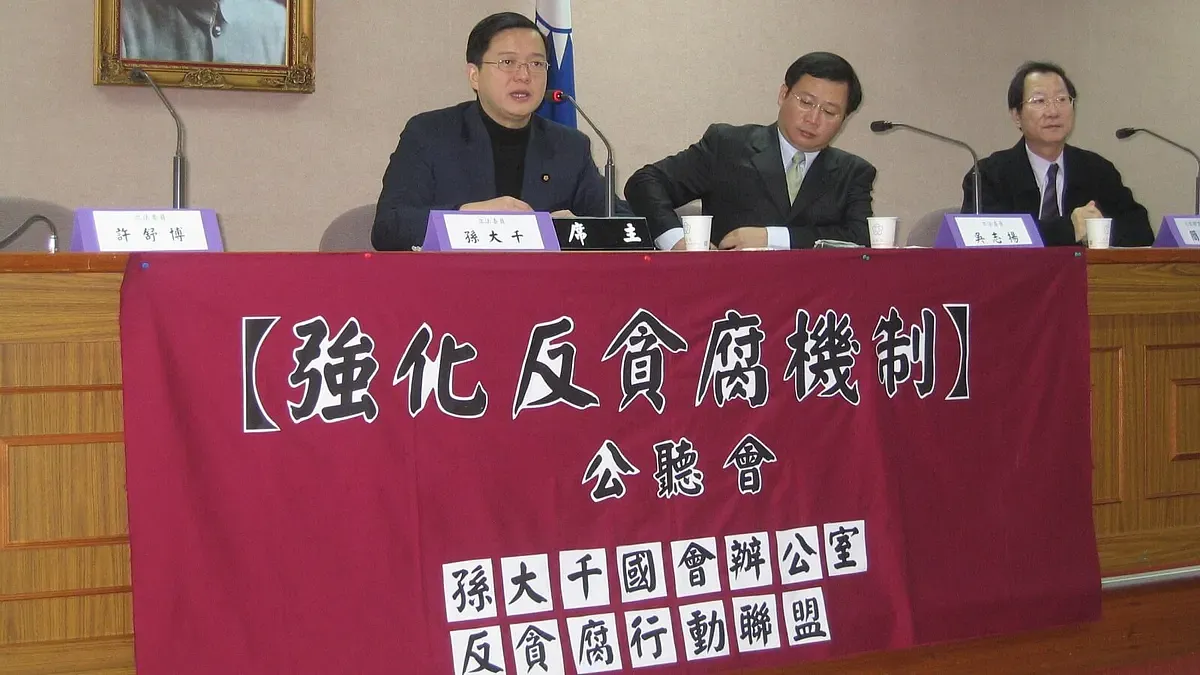
Who Supports Corruption and Fears Reform?
On December 13, the Alliance hoped that during the party caucus negotiations on the Court Organization Act, an…
2005
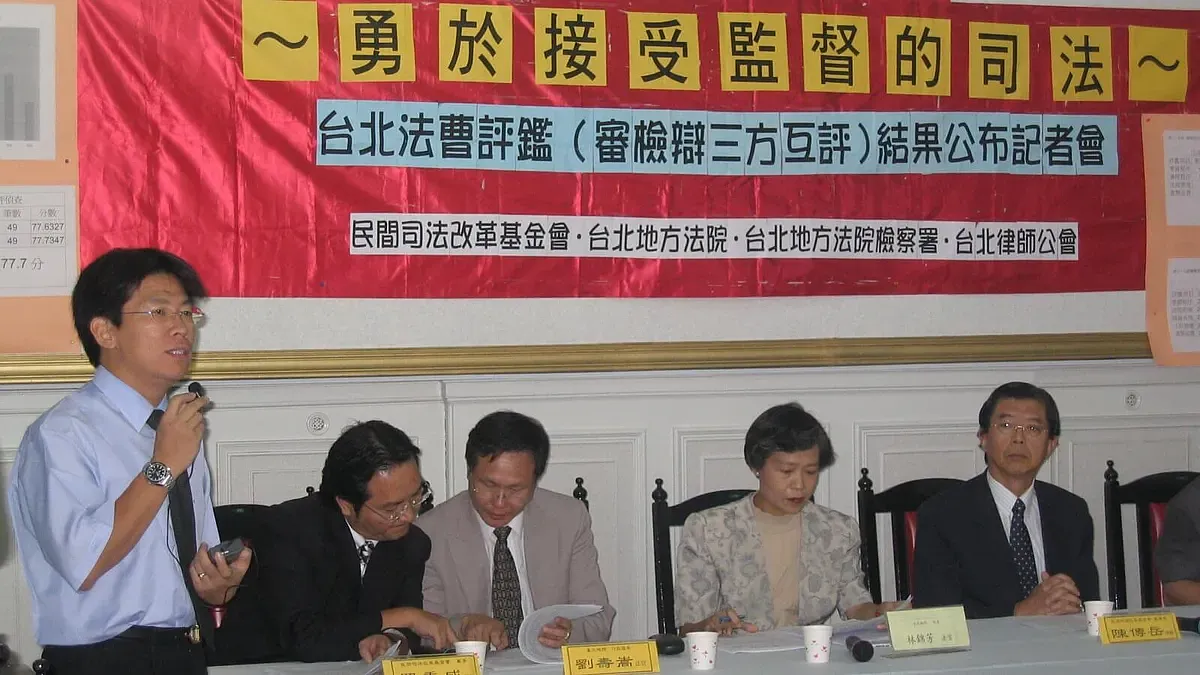
A Judiciary Courageous in Accepting Oversight: Press Conference on the Results of the Taipei Jurist Association (Mutual Evaluation Among Judges, Prosecutors, and Defense Attorneys)
As early as 1992 (ROC Year 81), the late Lin Min-sheng (林敏生), former chairperson of the Taipei Bar Association,…
2005
Statement by the Judicial Reform Foundation Regarding Recent Judicial Integrity Scandals
According to reports, former Yunlin District Prosecutors Office prosecutor Hsu Wei-yu (徐維嶽), who previously handled the…
2005
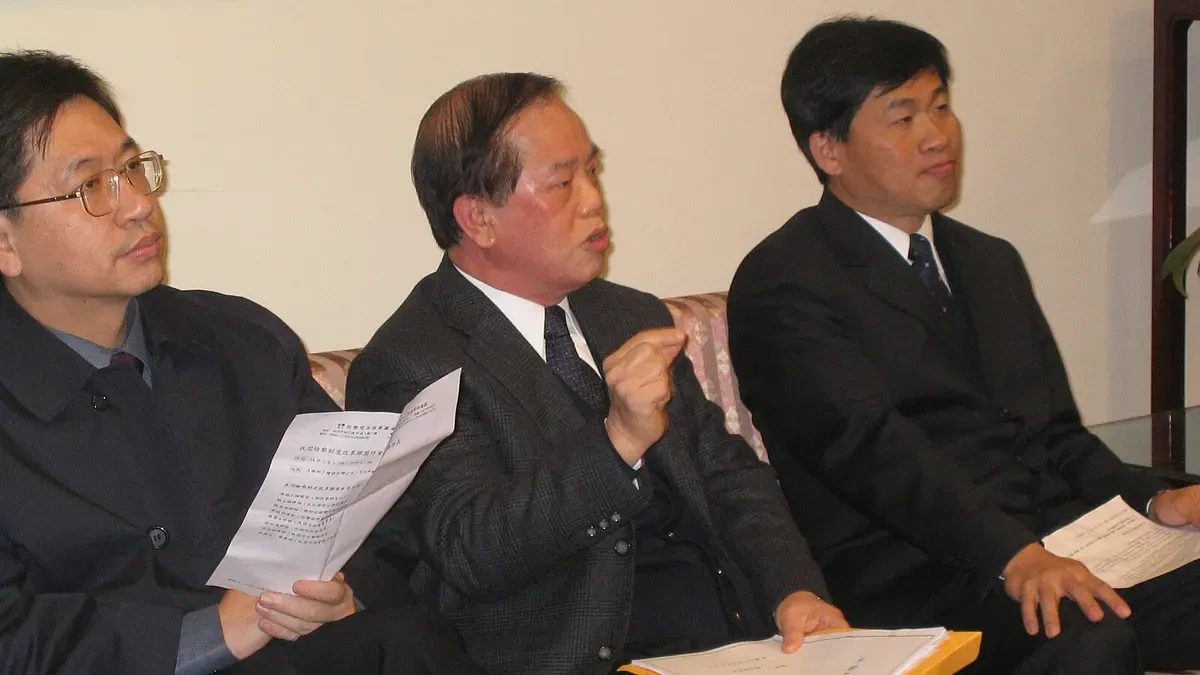
Civilian Prosecutor System Reform Alliance Visits Minister of Justice
Representatives of the Civilian Prosecutor System Reform Alliance visited Minister of Justice Shih Mao-lin at 5:00 PM…
2005
Expectations for the New Minister of Justice
Following Hsieh Chang-t'ing's confirmation to form a cabinet, he has been consulting candidates for cabinet positions.…
2005
"Freeze! I am a Legislator!"
During the Legislative Yuan's negotiation of the central government general budget for fiscal year 2005 on the 13th of…
2004
The Abuse and Misuse of the Principle of Prosecutorial Unity: Lessons from Japan's Lockheed Scandal
Legal systems exist in response to the spatial-temporal and qualitative-quantitative variations of the society of their…