
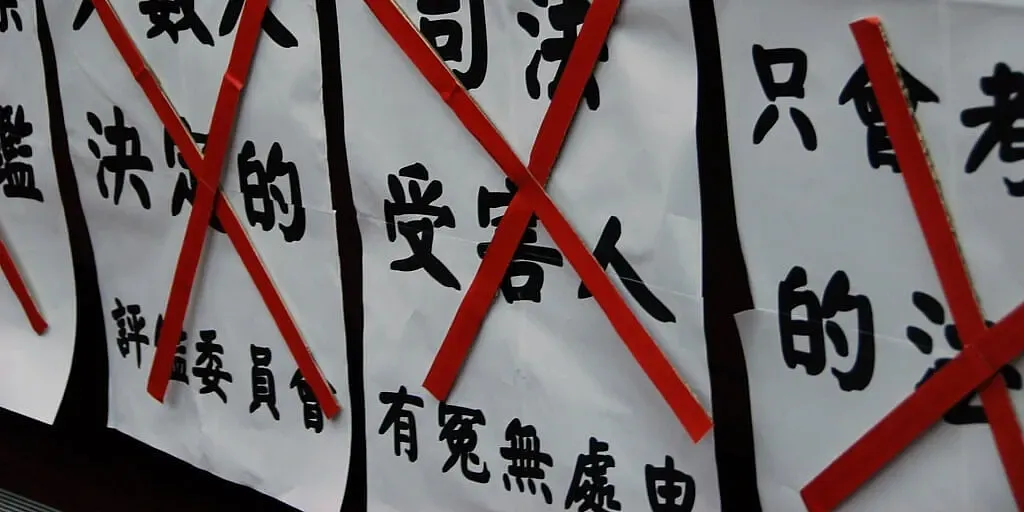
(Legacy) Introduction to the JRF Complaint Center
Last edited: 2026-11-03
Taipei Complaint Center
※ Appointments by phone are required before visiting. Cases will be officially accepted only upon receipt of physical mail.
Taichung Complaint Center
※ Appointments by phone are required before visiting. Cases will be officially accepted only upon receipt of physical mail.
If you need to "report incompetent judges or prosecutors", seek "wrongful conviction rescue", or have experienced "unlawful police violence", you can seek help from the JRF Complaint Center.
-
Reporting Incompetent Judges or Prosecutors
If you believe that a judge or prosecutor has committed any illegality or dereliction of duty while handling your case, you may file a grievance. The types of cases that are more likely to succeed and lead to disciplinary action against a judge or prosecutor are primarily:
-
Violation of Procedural Regulations
A judge or prosecutor violates mandatory procedural rules leaving no room for discretion, thereby harming your rights and interests. For example, according to Point 166 of the Directions for Courts Handling Criminal Procedure, when a judge asks a defendant whether they intend to withdraw an appeal, they must not use methods of inducement. However, a judge provided incorrect information to a defendant, telling him that his case could be commuted to community service, thereby inducing him to withdraw his appeal. Only after withdrawing the appeal did the defendant discover that his case was ineligible for community service in the first place (refer to Resolution Ping-Tzu No. 1 of 2012).
-
Inappropriate Demeanor
For instance, a prosecutor shouting at a defendant, "I really want to lock you up," "I'm going to fight you to the finish," or "Let's duel in the courtroom" (refer to JRF press conference "Angry Bird Prosecutors? Total Fools! Press Conference on 'Arrogant and Overbearing Prosecutors'"). However, under current evaluation practices, unless the demeanor is truly atrocious, inappropriate demeanor usually needs to be accompanied by a violation of procedural regulations that harms your rights to successfully warrant a grievance.
You may also refer to the individual case evaluation resolutions rendered by the Judges Evaluation Committee and the Prosecutors Evaluation Committee to understand whether your filed case has a chance of success.
Please note that pursuant to Article 36 of the current Judges Act, there is a time limit for filing grievances against judges and prosecutors. In principle, a grievance must be filed within 2 years starting from the date the case left the hands of the target judge or prosecutor. We believe this provision is unreasonable, and the Judicial Reform Foundation is currently advocating for legislative amendments to extend the statute of limitations for grievances.
Additionally, filing a grievance against incompetent judges or prosecutors basically cannot affect the judgment outcome of the case.
-
-
Wrongful Conviction Rescue
How to File a Grievance
Please mail photocopies of all materials concerning the case to our Complaint Center. The required materials are as follows:
-
Grievance Letter
Briefly state the main points of the grievance and the facts of the case. All grievance matters and information will be kept strictly confidential, but the complainant must file under their real name and provide contact information (Download Grievance Letter Template Format).
-
Photocopies of All Materials and Audio-Visual Discs Related to the Grounds for Grievance
If you wish to have an in-person interview at the Complaint Center, please call our staff in advance to make an appointment, and we will schedule a meeting time.
Individual Case Evaluation Request Procedure

After receiving grievances from the public via telephone, written submissions, or in-person interviews, and before deciding whether to submit an individual case evaluation request to the Judges Evaluation Committee or Prosecutors Evaluation Committee, the Judicial Reform Foundation goes through the following five review procedures, detailed as follows:
-
Case Intake by Complaint Center Specialists
The JRF has two Complaint Center specialists to receive public grievances (including written submissions, phone calls, and in-person visits). Upon intake, specialists will initially clarify the core points of the public's grievance and determine whether it constitutes an individual case evaluation petition, an application for exoneration assistance, legal consultation, or personal reform suggestions.
-
Assignment to Pro Bono Review Lawyers
If the Complaint Center specialist confirms that the public's complaint indeed constitutes an individual case evaluation event and falls within the statute of limitations for individual case evaluations, the case is assigned to our pro bono review lawyers for examination. They will draft a "Preliminary Legal Review Opinion" and submit it to the Individual Case Evaluation Group for deliberation.
-
Deliberation by the Individual Case Evaluation Group
The JRF recruits lawyers and scholars to form the Individual Case Evaluation Group, which holds evaluation meetings once a month. Based on the preliminary legal review opinions drafted by pro bono lawyers and the case files submitted by the parties involved, the group discusses and resolves whether to file an individual case evaluation request or take other supervisory actions (such as petitioning the Control Yuan or speaking out to the public) against the complained judge or prosecutor. If it is deemed necessary to file an individual case evaluation, the matter is submitted to the Standing Executive Meeting for deliberation.
-
Deliberation by the Standing Executive Meeting
The JRF establishes the Standing Executive Committee Meeting, which convenes at the beginning of each month. Deciding whether to file a request for individual case evaluation of a judge or prosecutor is one of the mandatory agenda items for discussion.
-
Drafting Petitions by Full-Time Personnel
Once an individual case evaluation is approved by the Standing Executive Meeting, full-time JRF personnel (full-time staff lawyers or complaint center specialists) draft the formal petition and submit it to the Judges Evaluation Committee and Prosecutors Evaluation Committee.
Statistics on Individual Case Evaluation Volumes and Staffing
| Year | Grievance Calls Answered | Judge Grievances Reviewed | Prosecutor Grievances Reviewed | Judge Evaluation Requests Filed | Prosecutor Evaluation Requests Filed |
| 2012 | 629 | 116 | 68 | 2 | 2 |
| 2013 | 1,455 | 100 | 88 | 7 | 18 |
| 2014 | 1,593 | 112 | 74 | 9 | 18 |
| 2015 | 1,022 | 94 | 79 | 11 | 5 |
| 2016 | 1,135 | 78 | 50 | 3 | 0 |
| 2017 | 2,203 | 78 | 75 | 4 | 2 |
| 2018 | 1,782 | 78 | 72 | 3 | 1 |
| Total | 9819 | 656 | 506 | 39 | 46 |
| Year | Grievance Specialists | Pro Bono Review Lawyers | Evaluation Group Members | Standing Executive Committee Members | Full-Time Drafting Personnel |
| 2017 | 2 | 35 | 35 | 22 | 2 |
Taking 2017 as an example, the JRF Taipei Office answered a total of 8,037 public grievance calls. The contents of these calls may include legal consultations, systemic proposals, requests for assistance, reporting violations of "non-disclosure of investigation" by police, prosecutors, and investigators, constitutional interpretation grievances, wrongful conviction cases, and requests for individual case evaluations of judges/prosecutors. After clarification by Complaint Center specialists, 78 cases involved judge grievances and 75 involved prosecutor grievances. Ultimately, 4 judge evaluation requests and 2 prosecutor evaluation requests were filed.
How to Obtain Complete Case Files
You can obtain complete case file materials through the "file-review" procedure. Below are the file-review procedures for civil cases, administrative litigation cases, and criminal cases:
-
Civil and Administrative Litigation Cases
Citizens can apply to the court for file review on their own, fill out the legal document formats described below, and submit them to the court. Alternatively, applications for file review can be made via fax or email; please consult courts at all levels for specific procedures.
- For civil cases, please visit the Judicial Yuan webpage "Reference Formats for Legal Documents - Civil Litigation Section" and download item No. 35, "Civil Application for File Review"
-
For administrative litigation cases, visit the Judicial Yuan webpage "Reference Formats for Legal Documents - Administrative Litigation Section (including Traffic Adjudication Section)" and download item No. 24, "Request for File Review (Party to the Proceeding)"
-
Criminal Cases
Citizens cannot apply to review files on their own in criminal cases; instead, they must retain a lawyer to apply for file review. If you have already hired a lawyer, you may ask your lawyer to provide the case file. If you have not hired a lawyer and are in poor financial condition, you can apply for assistance in finding a lawyer from the Legal Aid Foundation. Since criminal cases have more restrictions on file review, please refer to the table below to confirm whether you are actually eligible to retain a lawyer for file review:
Eligible for File Review Ineligible for File Review Defendants on trial or prosecutor's agents/private prosecutors Informants Defendants with a final conviction Defendants or informants in cases still under investigation or closed via administrative signature-and-file (administrative closure) Informants/complainants applying for committal to trial against a non-prosecution disposition Defendants acquitted or given a final non-prosecution disposition If you truly cannot obtain any case file materials, please make sure to call the Complaint Center to discuss how to proceed.
 In criminal cases that are "not prosecuted", according to current practical interpretations, they generally fall under the scope of "non-disclosure of investigation", and under legal provisions, case files cannot be obtained. The sole exception is "committal to trial". The procedure for "committal to trial" is: after a case enters the investigative procedure and receives a "non-prosecution" disposition, the complainant may file a motion for re-appeal with the Taiwan High Prosecutors Office. If the result of the re-appeal is to remand the case for continued investigation, the case will return to the local prosecutors office to proceed with the investigation. If the re-appeal is rejected, the complainant may then retain a lawyer to file a motion for "committal to trial" with the court and apply for file review. Currently, in practice, applications by complainants for committal to trial almost always fail; therefore, some lawyers are reluctant to apply on behalf of clients, reasoning that it is merely a futile effort. However, from the perspective of acquiring evidence materials against the complained prosecutor, committal to trial is a very crucial channel. Additionally, if a criminal case is closed via "administrative signature-and-file" (administrative closure), case files cannot be obtained either. "Administrative signature-and-file" is an expedient practice developed within our nation's investigative practice. If a prosecutor believes that a case obviously lacks criminal suspicion or is a repeated complaint, they will not even write a non-prosecution decision letter and will directly close the case. In practice, this situation is also classified under the scope of "non-disclosure of investigation", making it impossible to review the files.
How to Obtain Court or Prosecutorial Interrogation Audio and Video Discs
-
Obtaining Court Audio Discs
Currently, court hearings in Taiwanese courts are audio-recorded only without video, so only court hearing audio discs can be requested. Pursuant to Paragraph 1, Article 90-1 of the Court Act, if parties to a proceeding do so in order to assert or protect their legal interests, they may apply for court permission to deliver the court hearing audio disc starting from the day after the hearing until 6 months after the judgment becomes final. For cases sentenced to death, life imprisonment, or fixed-term imprisonment of 10 years or more, applications can be made up to 2 years after the judgment becomes final.
-
Obtaining Prosecutorial Interrogation Video Discs
Currently, prosecutorial interrogation rooms in Taiwan feature video recording, and video discs of the prosecutorial interrogation can be requested. To review prosecutorial interrogation video discs, one must in principle follow the general criminal case file-review regulations by retaining a lawyer to make the application.
Learn More
"Judges Act Combat Manual"
- Overview
- What to do when encountering incompetent judges or prosecutors?
- File Review
- How to obtain evidence for reporting?
- Institutional Supervision
- Rejecting incompetent judicial officers given to verbal humiliation and emotional outbursts
- Non-disclosure of Investigation
- What to do if a prosecutor violates the non-disclosure of investigation?
- Case Delays
- How to save yourself from delayed cases?
- Judgment Retrieval
- Who messed up the judgment document?
- Retrial
- Disciplining judges and prosecutors, and vindicating wrongful judgments
This article is an AI-generated translation of the original Chinese text. In the event of any discrepancy, the Chinese version shall prevail.