
JRF Newsletter: June 2026
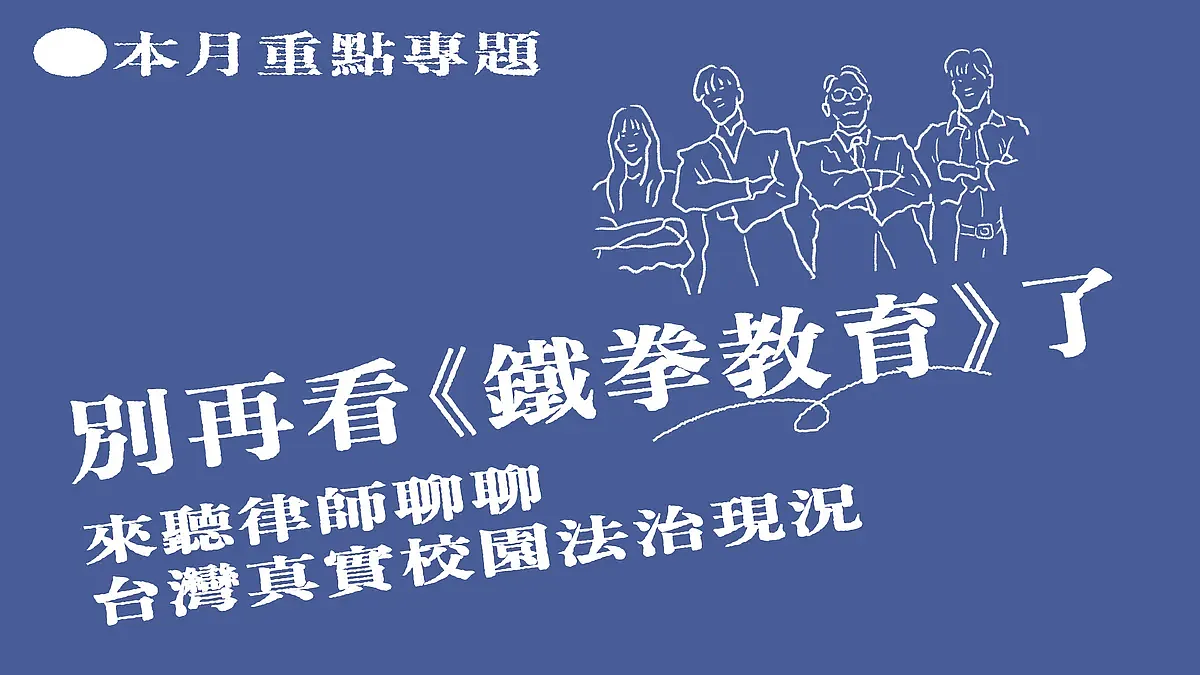
Stop watching "Fist Education", come listen to lawyers discuss the true state of school rule of law in Taiwan
Last edited: 2026-08-28
The Judicial Reform Foundation often gives people the impression that it "only cares about criminal cases," and the wrongful convictions we assist with do indeed focus on finalized criminal cases. However, starting from criminal wrongful convictions, we sometimes see the interplay between cases across different legal systems—for example, how incidental civil actions are determined after a criminal case is finalized, or how administrative decisions and remedies affect the criminal court's citation of evidence.
The latter is particularly exemplified by cases such as that of Hsu Pei-ming, a special education teacher assisted by the Taiwan Association for Innocence and the JRF. As attorney Lee I-ting mentioned in her article "The Inspiration of Failure—Discussing the Relief of Wrongful Cases", because Article 41 of the Gender Equity Education Act (Article 35 at the time of the incident) explicitly stipulates that courts shall consider the investigation reports of gender equity education committees at all levels in determining facts, and in practice, gender equity investigation reports indeed constitute an exception to hearsay and are admissible as evidence. Once a gender equity investigation concludes that sexual assault has been established—such as incomplete gender equity records in Hsu's case, or gender equity committee members failing to recuse themselves when grounds for recusal existed, or the school refusing to provide relevant documents for criminal court investigation—the impact of the administrative investigation may far exceed a simple administrative judgment and affect the criminal case, forcing the defendant to expend double the effort to prove their innocence.
Even administrative litigation unrelated to criminal proceedings does not seem entirely devoid of connection to "wrongful case" discourse.
At the end of last year, a piece of news (2025.12.31 / CNA) caught our attention: "Deputy Minister of Education Chang Liao Wan-chien said today that related amendments to the school affair meeting system are scheduled to be promulgated on January 12, 2026, and will 'consider incorporating' suggestions from educational groups to provide 'wrongful case' compensation fees."
How did this happen?
In 2019, news concerning predatory and incompetent teachers prompted legislative amendments, resulting in the current school affair meetings. This finally strengthened the handling mechanism for incompetent teachers and stands as an important reform hard-won through many painful cases in the educational field.
With this law in effect for less than a decade, when, why, and how did the campus scene become associated with the concept of "wrongful cases"? In this issue of the e-newsletter, we hope to start from the perspective of lawyers to understand this recent rule-of-law controversy arising from campus administrative investigations.

Interviews and Drafting | Su Qiuci, Wu Jinghan, Chiao / Interview Assistance | CC, Tsai Ta-jung, Pan Pei-chen, Chen Liling / Editing | Tsai Ta-jung, Pan Pei-chen, Lee Ming-ru
The Legislative Yuan just held a public hearing on the "Regulations Governing the Dismissal, Non-Renewal, Suspension, or Discontinuation of Teachers in Senior High Schools and Below" (hereinafter the "Dismissal Regulations") and the "Regulations Governing the Performance Evaluation of Teachers in Public Senior High Schools and Below" (hereinafter the "Teacher Evaluation Regulations") on the 15th of this month. Teacher groups called for the "school affair meetings" to be abolished as soon as possible, while parents' and human rights groups argued that school affair meetings remain the only recourse for many vulnerable children and must not be abolished until a better appeal mechanism is established. Until the publication of this e-newsletter, public opinion remains deadlocked over this issue.
In this e-newsletter, we interviewed attorney Weng Kuo-yen, who has long handled teachers' administrative lawsuits, and attorney Hsiao I-hua, who has participated in nearly a hundred campus administrative investigations in central Taiwan this year alone, to chronologically organize the context of this issue.

Author | Wu Jinghan, Chiao (first half), Attorney Chen Linxiang (second half) / Editing | Tsai Ta-jung, Pan Pei-chen, Lee Ming-ru
In addition to first highlighting the key points of this year's legislative amendments and summarizing the commentary of attorneys Weng Kuo-yen and Hsiao I-hua, we also invited retired teacher and practicing attorney Chen Linxiang to comment on the new system and look forward to the future.

On May 25, 2026, the Taiwan High Court rendered Ruling No. 2, Sheng-Tsai-Keng-I, 2026, officially granting a retrial in the Wang Lung-chang case. The pro bono legal team welcomes the ruling and issues the following statement as it continues to assist Professor Wang Lung-chang in seeking exoneration:
1. The original final judgment contains no evidence whatsoever to establish that Wang Lung-chang accepted bribes
In 2012, the Supreme Court dismissed Professor Wang Lung-chang's appeal. The court held that Ret-Ser Engineering Agency (RSEA) had obtained the list of evaluation committee members prior to winning the bid for the Nangang Exhibition Center construction project, and bribed eight evaluation committee members including Professor Wang Lung-chang. Professor Wang Lung-chang was sentenced to a definitive term of 7 years and 8 months of imprisonment. However, apart from the testimony of Huang Weian, the special assistant to the chairman of RSEA who delivered the bribe, there is no evidence whatsoever to prove that Wang Lung-chang accepted a bribe.
The High Court's ruling this time also questions the timing, amount, and method of Huang Weian's testimony in the original final judgment regarding the bribery of Wang Lung-chang, noting that the case lacks communication records, no relevant bribe money was seized, and no bribery fund flows are available for corroboration. There are significant doubts regarding the original final judgment's determination of the fact that Professor Wang Lung-chang accepted bribes, and it is indeed necessary to open a retrial and re-examine the case.
2. Prosecutors and defense jointly facilitate retrial, looking forward to Wang Lung-chang's early exoneration
Because of this case, Professor Wang Lung-chang left Taipei Tech, where he had taught for 39 years, and all his past policy research on national public construction was interrupted. This not only caused severe damage to his personal reputation and innocence, but also resulted in immense losses to the construction and development of the entire country and society. Even though Professor Wang Lung-chang has now completed his sentence, returned to teach at Taipei Tech, and was even awarded the Award for Excellence in Contribution in 2020, gradually resuming his social life, the lost time cannot be recovered. Professor Wang Lung-chang's deepest hope remains that a wrongly judged judiciary can clear his name.
Since this case was investigated by the Control Yuan and raised numerous doubts in 2013, and the Prosecutor-General also filed an extraordinary appeal on his behalf in 2015—which regretfully was dismissed by the Supreme Court at the time—the reason the High Court was able to rule to open a retrial this time, aside from the years of running about and persistence by the pro bono legal team, further illuminates the dawn of the prosecution system's "zero tolerance for wrongful convictions." After the legal team submitted a request for "review of finalized guilty cases" to the Taiwan High Prosecutors Office in 2019, the review committee determined that the case indeed contained numerous major flaws, ultimately leading the prosecutor to actively initiate a retrial for the case.
14 years have passed, and the path to fighting for innocence has never been abandoned. Today's initiation of retrial proceedings marks an important first step on Professor Wang Lung-chang's path to exoneration. The pro bono legal team will continue to devote full effort to the subsequent retrial proceedings, hoping that the court will uphold a fair and objective attitude, carefully examine all evidence and facts in the case, and restore the innocence rightfully due to Professor Wang Lung-chang as soon as possible.

Proofreading | Lee Ming-ru / Editing | Lin Cheng-ching, Chen I-chiuo, Hsieh Yu-hsiu, Lin Yen-yu, Huang Szu-ning, Lin Chun-i, Chang Kai-yu, Lin I-jung, Lin Yun-yen
In January 2026, the issue of surrogacy sparked debate once again in Taiwan. Opponents believe that commercial surrogacy under the operation of standard-form contracts will inevitably impair gender equality and bring exploitation, while supporters mostly believe that comprehensive supporting measures can circumvent related legal risks. Reproduction touches upon many people's sensitive memories and involves gender structures and medical technology, so rational discussion is naturally no easy task. However, whether the presupposition that "comprehensive legislation can avoid risks" holds true and how it might be possible—regardless of one's standpoint—requires a thorough understanding of the current legislative drafts in the Legislative Yuan before one can positively respond to this premise.
Based on its concern for legislative developments in the Legislative Yuan, the JRF Gender Group has compiled relevant legislative amendment updates, bill proposers, and draft versions to highlight the key points for everyone.

Text | Emily C / JRF Volunteer
When the lecturer displayed a photograph of multiple apples placed together and pointed out that not a single apple is symmetrical, it was a moment of sudden realization that nature bestows uniqueness upon every living creature. When people put on glasses of popular aesthetics and look at their own bodies, their gaze strictly scrutinizes and magnifies those parts that do not conform to socially defined beauty. However, the state of the body is fluid and changes across every period (e.g., healthy/sick, young/old, during/outside of menstruation); beauty has never been defined by a single standard. Why not practice viewing our bodies in their natural state?
Text | Volunteer Hsiao / JRF Volunteer
To be honest, I am not usually very good at drawing, and when I first received the drawing paper, I was afraid I would draw something very ugly. But the atmosphere at the venue was very relaxed, and everyone was focused on their own work, which gradually allowed me to let go of my pressure and start enjoying the process. This event had a wonderful core concept—transforming the parts of our bodies we are dissatisfied with into another beautiful imagery. In daily life, we all have some small anxieties about our appearance or figure, and this session happened to give us an opportunity to re-examine these "imperfections".


2026/07/01 (Wed.) 14:50
Court Observation Recruitment
State Compensation Case of "Taiwanese Version of Cambodia Scam"
✹ Location | Civil 6th Court, Taiwan Kaohsiung District Court
(No. 188, Hedong Rd., Qianjin Dist., Kaohsiung City)
✹ Learn about the State Compensation Case of the "Taiwanese Version of Cambodia Scam" ➠ Overview

2026/07/11 (Sat.) 14:00-16:00
Szu-Szu-Ju-TALK
When Justice Meets the Timer: The "Invisible High Wall" of the Right to Prosecute Child Sexual Assault and Wall-Breaking Action
✹ Moderator | Tsai Shang-chien / Chairperson and Attorney, Taiwan Kuang-Huan Association
✹ Speaker | Lin Jui-hsuan / Social Worker, Whole-Heart Trauma Recovery Center, Taiwan Association for Children's Rights Advocacy
✹ Location | Taichung Office, Judicial Reform Foundation
(10F-2, No. 4-33, Sec. 1, Shuangshi Rd., East Dist., Taichung City)

2026/08/20 (Thu.), 25 (Tue.) 14:00-17:00
Teacher Workshop
Su Chien-ho Case · Focus Discussion on Teaching Materials
✹ Target Audience | School teachers interested in teaching controversial issues in the legal field and willing to integrate related case teaching materials into their instruction
✹ Taichung Session Location | Taichung Office, Judicial Reform Foundation (10F-2, No. 4-33, Sec. 1, Shuangshi Rd., East Dist., Taichung City)
✹ Kaohsiung Session Location | Kaohsiung Base, Judicial Reform Foundation (Southern Office of Taiwan Association for Human Rights) (10F-4, No. 157, Yixin 2nd Rd., Qianzhen Dist., Kaohsiung City)

2026/08/23, 24 (Sun., Mon.) 14:00-16:00
Teacher Workshop
2026 Digital Citizenship Seed Teacher Summer Training Camp
✹ Target Audience | Current elementary and junior high school teachers (priority admission for teachers in remote, exceptionally remote, and ultra-remote areas)
✹ Registration Period | From now until July 31, 2026 (Fri.)
✹ Location | Taichung Office, Judicial Reform Foundation (10F-2, No. 4-33, Sec. 1, Shuangshi Rd., East Dist., Taichung City)

This article is an AI-generated translation of the original Chinese text. In the event of any discrepancy, the Chinese version shall prevail.