
Digital Rule of Law
Human rights in the digital age need the protection of law.
From digital ID cards and the National Health Insurance Research Database to technology-assisted investigations, digital platforms, and artificial intelligence, JRF continues to examine how technology reshapes power relations, and advocates for a digital rule of law grounded in privacy, freedom, and due process.
Read the Digital Bill of Rights 中文版
Where It Began | Five Focus Areas | Recent Advocacy | Civic Education | Get Involved
01 / WHERE IT BEGAN
From individual disputes to fundamental digital rights
In this rapidly evolving digital age, Taiwan not only stands at the forefront of technological innovation but also faces intricate challenges at the intersection of law and ethics.
Since 2020, when we joined the litigation concerning digital ID cards, we have been continuously monitoring and urging the government to collect, process, and utilize the personal data and digital footprints of the public in a manner that minimizes intrusion. This focus has not only led us to participate in the constitutional litigation regarding the National Health Insurance Research Database (NHIRD) but also to engage deeply in discussions on technology-assisted investigations and communications surveillance legislation.
In 2022, the government attempted to draw from the regulations of the European Union, proposing a draft of the "Digital Intermediary Services Act." During this pivotal moment, we actively joined the discussion and began to contemplate how to strike a balance between safeguarding freedom of speech and maintaining order on digital platforms.
Currently, we are also highly concerned about the technological changes brought about by generative language models. These models are expected to have far-reaching impacts on our judicial system in the foreseeable future. However, these advanced models could also introduce a series of complex issues, such as the lack of transparency in training data sources, insufficiency of data, and the potential for cognitive biases and inequality to arise as a result.
In summary, Taiwan is at a crossroads of regulatory transformation, and we believe that now is the optimal time to discuss digital fundamental rights and responsibilities at a higher level. Therefore, we are actively promoting discussions on the framework and content of a Digital Basic Law to comprehensively address future digital challenges.
Whether you are a legal expert, a tech specialist, or a citizen concerned about societal development, we sincerely invite you to join this crucial societal dialogue.
The Digital Bill of Rights is an open civil-society initiative. Version 1.1, published by JRF, is still a draft for public consultation, not a law that has been passed or put into effect. We invite citizens to think together: in a digital society, what rights should people enjoy, and what responsibilities should the government bear?
Read and share your views: Digital Bill of Rights (English) | 數位權利法案(中文版)
02 / FIVE FOCUS AREAS
Advancing technology and rights protection together
01 / Personal Data Protection and Privacy
From the eID digital ID card and National Health Insurance Research Database litigation to personal data legislation and the digital credential wallet, we watch whether data is being excessively collected, linked, and used, and whether people can keep control over their own information.
eID Digital ID Card Litigation
02 / Technology-Assisted Investigations and Due Process
We focus on the legal authorization, oversight, and remedies for technology-assisted investigations and communications surveillance, and call for effective limits on the scope of data that investigative agencies may obtain, retain, and use.
Lecture notes: the law of technology-assisted investigations (in Chinese)
03 / Digital Platforms and Freedom of Expression
Building on the 2022 debate over the draft Digital Intermediary Services Act, we continue to follow content governance, website blocking, and child protection. Any measure that restricts speech or access to information must come with due process and safeguards for rights.
Website blocking and due process (in Chinese)
04 / AI and the Justice System
We examine the risks of training data, bias, and inequality in generative AI, as well as the impact of automated decision-making on people's rights, and advocate for the right to be informed, understandable explanations, human review, and effective remedies.
Rights protection after the passage of the AI Basic Act (in Chinese)
05 / A Framework for Fundamental Digital Rights
Through the Digital Bill of Rights, we discuss privacy, minimizing datafication, meaningful alternatives, public participation, and accountability for automated systems, to build a shared framework for a free and democratic digital society.
Digital Bill of Rights: public consultation draft
03 / RECENT ADVOCACY
Our positions, in our public comments
2026.05.15
Age Verification and Access Restrictions for Children and Youth
Responding to the draft amendments to the Protection of Children and Youths Welfare and Rights Act, we called for the law to expressly safeguard privacy, restrict use beyond the stated purpose, and uphold the principle of data minimization, and we examined the procedures and remedies for access restrictions.
2026.03.23
Data Breach Notices Should Let People Guard Against Risks Early
We submitted recommendations on the draft amendments to the Enforcement Rules of the Personal Data Protection Act and the draft regulations on data breach notification and reporting, including assessing how technological development affects de-identification, tiered reporting, individual notification, and ongoing monitoring of a breach's impact.
2026.03.11
Digital Credential Wallets: Can Convenience and Privacy Coexist?
Starting from everyday identity verification, this op-ed discusses the legal and institutional safeguards that selective disclosure requires, so that technical convenience does not mask gaps in the protection of rights.
2026.01.24
Technology-Assisted Investigations: Past, Present, and Future
This lecture reviewed how the legal framework for technology-assisted investigations has developed, discussed limits on obtaining, retaining, and destroying data, and considered how judicial oversight can respond to new investigative methods.
2026.01.07
Website Blocking: Emergency Exceptions Must Not Become the Norm
Starting from the Xiaohongshu (RedNote) incident and the debate over amending the National Security Act, we called for clear standards, independent review, and remedies for website blocking measures, in keeping with the principle of proportionality.
2025.12.23
After the AI Basic Act: Building Concrete Rights Protections
JRF called for the right to be informed, the right to an explanation of decisions, and the right to human review to be written into law, together with equality, remedies, and participation in policymaking, to fill the gaps in AI governance.
Full statement, incl. March 2026 correction (in Chinese)
04 / CIVIC EDUCATION
Bringing the digital rule of law into everyday life and the classroom
Escape to the Last Room: JRF Digital Rule of Law Exhibition
Exhibition closed | 2025.08.05–2026.02.07
Through an exhibition at its Taichung office and a series of talks, JRF invited the public to start from everyday issues such as technology-assisted investigations, digital ID cards, AI, and platform governance, to consider who might threaten our rights and how we can safeguard our freedom together.
Exhibition overview Exhibition records (in Chinese) Talk series (in Chinese)
2026 Digital Citizenship Seed Teacher Summer Training Camp
Dates: August 23–24, 2026. Co-organized by JRF and the Taiwan Network Information Center (TWNIC), the training uses digital discrimination, AI and rights, the right to repair, and the digital environment as teaching themes, so that teachers can bring digital human rights into the classroom.
Training details and event information (in Chinese)
GET INVOLVED
Making fundamental digital rights a shared commitment
Whether you are a legal professional, a technology specialist, or a citizen who cares about social development, you are welcome to read the Digital Bill of Rights, share your views through the comment box on the original page, and support public discussion and advocacy on the digital rule of law.
Read the draft and share your views Donate to JRF How to file a complaint JRF in English
Last updated: October 27, 2026

2023
Press Conference | Three Questions and Three Risks Regarding AI-Drafted Judgments: Reducing burdens while managing AI risks
According to a news report on August 27, 2023, the Judicial Yuan, in order to alleviate the judicial burden, is…

2023
Statement on the Executive Yuan's Amendment Draft to the Personal Data Protection Act: Merely Modifying the Competent Authority and Strengthening Penalties is Insufficient to Ensure Personal Data Protection
On April 13, 2023, the Executive Yuan announced amendments to the Personal Data Protection Act pursuant to…
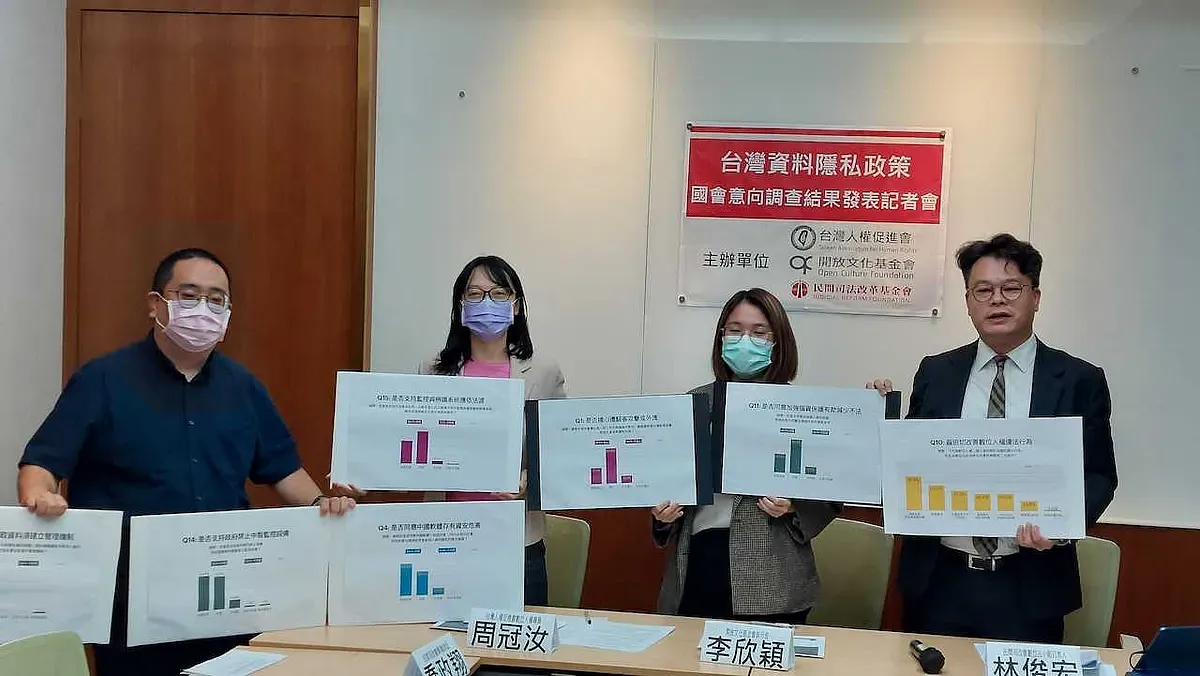
2023
Press Conference | Results of the "Taiwan Data Privacy Policy Congressional Intention Survey" Released
A survey was conducted on the current term of the Legislative Yuan regarding their attitudes toward issues concerning…

2023
Volunteer Lawyer Recruitment | Digital Rule of Law Salon & Empowerment Workshop #TechInvestigation #DigitalIntermediation #eID
Taiwan lacks a privacy protection principle and regulatory mechanism governed by a single statute akin to the European…
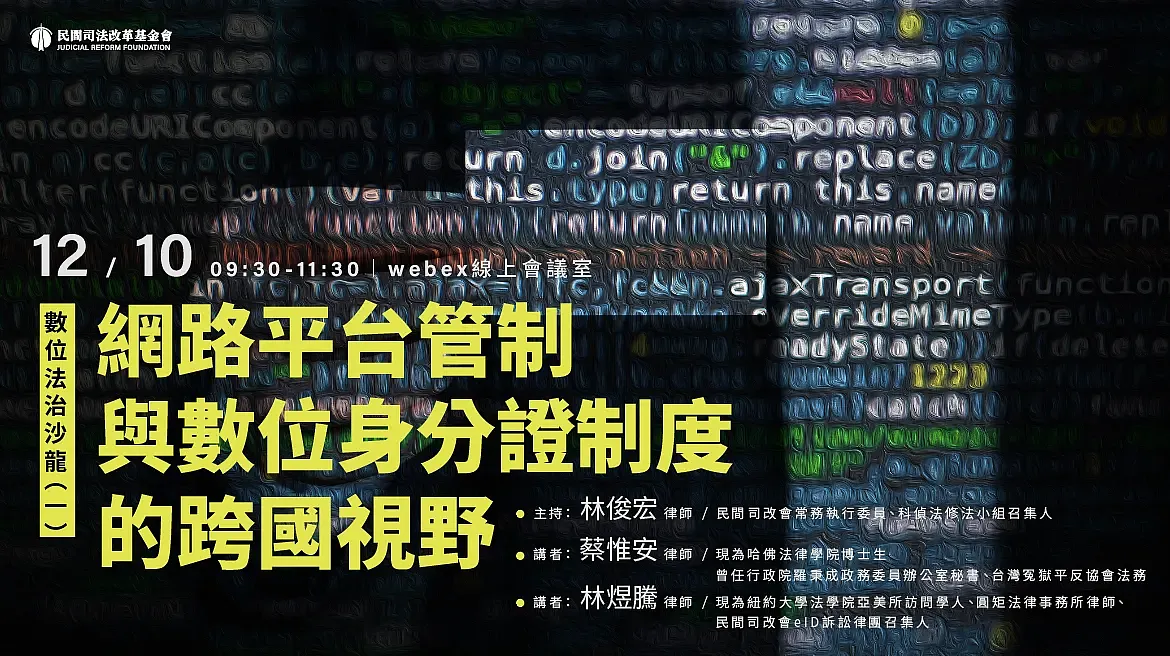
2022
Seminar | Digital Rule of Law Salon (I): Transnational Perspectives on Online Platform Regulation and the Digital ID System
Discussions on digital rule-of-law issues span technical, cybersecurity, legal, and national security dimensions.…

2021
Tech-Law Salon | Online Lecture Series and Events on Technology-Assisted Investigation Reform
Following the Ministry of Justice's draft Technology-Assisted Investigation Act, the JRF's Tech-Law Salon brought…

2021
Seminar Transcript | Tech-Law Salon: Trends in U.S. Technology-Assisted Investigation
Attorney Wang Wei-Hua surveys U.S. Fourth Amendment doctrine relevant to technology-assisted investigation, moving from…

2021
Seminar Transcript | Tech-Law Salon: What Lawyers Should Understand About Technology-Assisted Investigative Methods
In the first Tech-Law Salon session, Attorneys Lin Chun-Hung and Lin Chun-Ju examine technology-assisted investigation…

2021
Sound Laws and Safeguards Are Essential to Prevent Gaps in Pandemic Control-JRF's Four Statements on Police Misuse of 1922 SMS Contact-Tracing Data
In view of the worsening domestic COVID-19 outbreak, the Central Epidemic Command Center (CECC) launched the "1922 SMS…

2020
Event Record | Forum on the Draft Technology-Assisted Investigation Act
The Taipei Bar Association and Judicial Reform Foundation convened this forum to bring together academic,…

2020
Forum | Discussion of the Draft Technology-Assisted Investigation Act
The Ministry of Justice released a draft Technology-Assisted Investigation Act on September 8, 2020. The proposal…

2015
Wiretapping, Exploitation, and K'o P'u
Regarding the shooting at the Emei Parking Lot, after reading the police review report, Mayor K'o had a gut reaction…