
Event Record | National White Paper on Judicial Reform: Two-Year Review Conference
Last edited: 2026-07-27
※ Click the "" icon in the upper right corner of the video above to view the complete playlist of the conference videos.
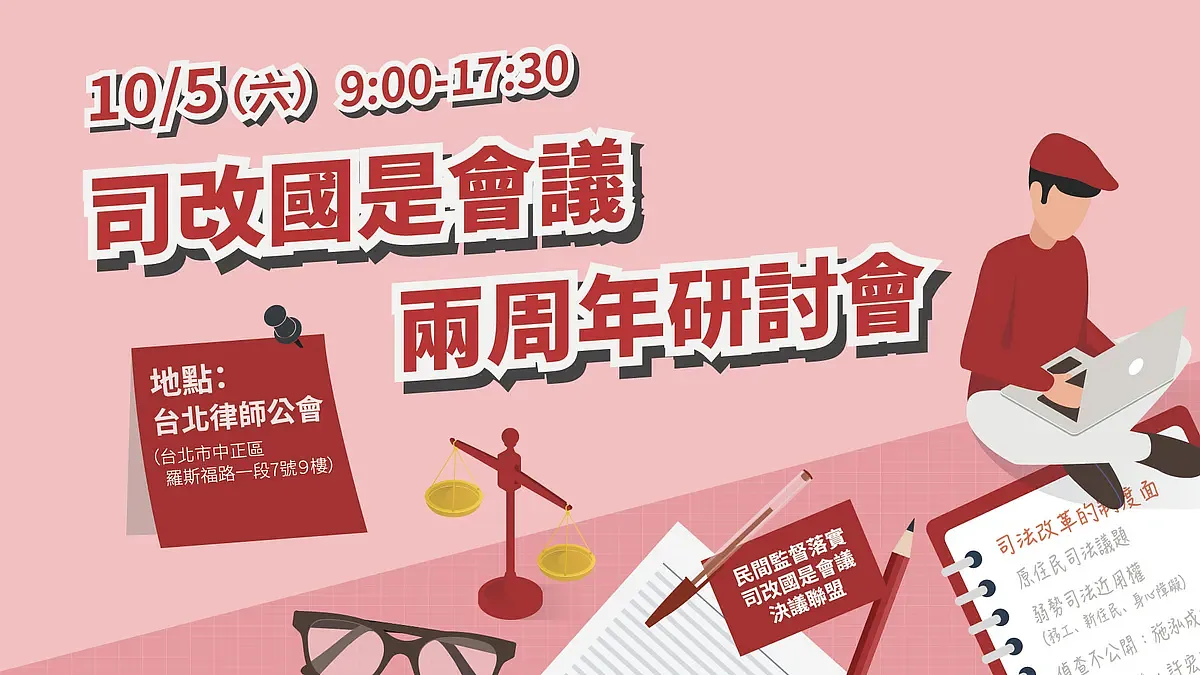
On October 5, the Civil Alliance for Monitoring the Implementation of Resolutions of the National Youth Conference on Judicial Reform held the "National White Paper on Judicial Reform: Two-Year Review Conference" at the Taipei Bar Association. The event invited panel conveners and members of the National White Paper on Judicial Reform, official representatives, and individuals from various sectors concerned with the issue to participate. The conference analyzed how judicial reform can enhance public trust and bridge the gap between the judiciary and the people, while also reviewing the implementation status of key issues. Through this conference, we hope to facilitate mutual exchange, identify problems, and ensure the implementation of judicial reform resolutions.
Opening Remarks


Panel I Resolutions and Implementation of the National Conference on Judicial Reform: Why Haven't They Boosted Public Trust?

Speaker
Wang Chin-shou / Professor, Department of Political Science, National Cheng Kung University; Member, Group 2 of the National Conference on Judicial Reform
Judicial reform has made significant progress. However, as society has become democratic, free, and open, public expectations toward the judiciary have risen increasingly high. Because the pace of judicial reform has failed to keep up with the public's rapid advancement, it has led to disappointment.


Discussant
Lee Chun-yi / Professor, Department and Graduate Institute of Forensic Medicine, College of Medicine, National Taiwan University; Member, Group 1 of the National Conference on Judicial Reform
Enhancing public trust in the judiciary should begin with the consolidation of criminal evidence.

Panel II The Gap Between the People and the Judiciary: Education? Media? Systems? Judicial Culture?

Moderator
Lin Tzyy-jian / Director, Institute of European Studies, Academia Sinica; Convener, Group 2 of the National Conference on Judicial Reform
Professional legal practitioners and non-professionals hold different blueprints for judicial reform. Intellectual collisions between them on judicial reform issues can better present diverse perspectives.

Speaker
Lu Ping / Author, Member, Group 4 of the National Conference on Judicial Reform
Traditional Chinese culture, the role of modern media, and the unfriendly environment within the judicial sector are the reasons for the alienation between the public and the judiciary.

Discussant
Huang Hsu-tian / Director, Citizen and Legal Education Foundation; Member, Group 5 of the National Conference on Judicial Reform
Today's cram-school-style education presents a different authoritarian structure. How can we bridge the gap between the people and the judiciary? We must start with education.


Discussant
Cheng Yu-jen / Judge on Secondment, Department of Judicial Administration, Judicial Yuan
We should increase public concern for issues and encourage contemplation on related matters, but ultimately, we must return to respecting professional competence and establish a robust oversight system.
Seminar I The Institutional Aspect of Judicial Reform


Issue Presentation
Lay Participation: Cheng Wen-lung / Chairman, Taiwan Association for Prisoners' Rights (Note: Association for Jury Trials in Taiwan)
The purpose of judicial reform lies in establishing a fair trial system.

Issue Presentation
Forensic Science: Lee Chun-yi / Professor, Department and Graduate Institute of Forensic Medicine, College of Medicine, National Taiwan University; Member, Group 1 of the National Conference on Judicial Reform
The government should have confidence and determination in the expert evaluations it submits; if a miscarriage of justice occurs, it must show the resolve to actively correct errors.

Issue Presentation
Judges Act: Lü Shao-wei / Pro Bono Lawyer, Judicial Reform Foundation
The key to implementing the amendments to the Judges Act lies in reasonably reducing the workload burdens of judges and prosecutors.

Issue Presentation
Execution of Sentences Act: Yen Szu-yu / Director, Northern Office, Taiwan Association for Human Rights
The rule of law must also apply to prisoners at the very end of the judicial system.

Issue Presentation
Children, Youths, and Gender: Liu Shu-chiung / Associate Professor, Department of Social Work, National Taiwan University; Member, Group 5 of the National Conference on Judicial Reform
The vast majority of resolutions have achieved low completion rates, consisting only of meetings with no substantive progress.

Issue Presentation
Crime Victims' Protection: Wang Wei-chun / Chairman, Association for the Promotion of Children's Rights, R.O.C.; Member, Group 1 of the National Conference on Judicial Reform
We should stand more from the perspective of victims' families; "warm connections" should apply to every government department.

Issue Presentation
Labor Incident Act: Sun Yu-lien / Secretary-General, Taiwan Labor Front; Member, Group 2 of the National Conference on Judicial Reform
Active and proactive engagement from the official sector is crucial during the legislative process.


Official Response
Wu Chiu-hung / Deputy Head, Criminal Department, Judicial Yuan
Progress is not entirely within the control of the Judicial Yuan; it also depends on the progress of joint consultations with the Executive Yuan, as well as the progress and attitude of deliberations in the Legislative Yuan.

Seminar II The Practical Aspect of Judicial Reform

Moderator
Lin Hsin-yi / Executive Director, Taiwan Association to End the Death Penalty
There are still many practical difficulties in promoting judicial reform. We hope to gain a deeper understanding of current judicial challenges through explanations from various fields.

Comprehensive Analysis
Lo Shih-hsiang / Executive Director, Taiwan Innocence Project
The implementation outcomes of the National Conference on Judicial Reform cannot be summed up in a single sentence; not only was there insufficient time, but the scope involved was also overly broad.

Issue Presentation
Indigenous Judicial Issues: Yapasuyongu'e Akuyana (Ch'en Min-yuan) / Chairman, Taiwan Indigenous Peoples Policy Association; Member, Group 1 of the National Conference on Judicial Reform
Indigenous traditional customs can only be truly resolved when considered from the perspective of transitional justice.

Issue Presentation
Access to Justice for Vulnerable Groups: Nguyen Van Hung / Director, Vietnamese Migrant Brides and Workers Office, Catholic Diocese of Hsinchu, Taiwan; Member, Group 1 of the National Conference on Judicial Reform
To guarantee equality for foreign nationals in litigation, our educational system for court interpreters needs improvement.

Issue Presentation
Access to Justice for Vulnerable Groups: Chou Han-wei / CEO, Legal Aid Foundation
The Judicial Yuan must understand the vulnerable current conditions of disadvantaged groups in order to recognize their needs in the courtroom and provide appropriate services.


Issue Presentation
Restorative Justice: Hsu Hung-yu / Deputy Chairperson, Restorative Justice Committee, Taiwan Bar Association
Although restorative justice has increasingly generated positive significance in recent years, insufficient budgets make it difficult to thoroughly institutionalize.

Issue Presentation
Police Performance Metrics and Training: Wang Yu-hao / Board Director, Taiwan Police Work Rights Promotion Association
The government should consider police manpower and establish transparent baseline principles in response to the negative impacts and distorted performance evaluation systems inflicted upon police officers by an excessive obsession with data and case numbers.

Issue Presentation
Environmental Law: Chang Yu-yin / Chairman, Environmental Jurists Association
To effectively curb environmental crimes, reforming the substantive law as the fundamental basis is merely a starting point; the organizational dimension of practical operations must also be perfected.

Official Response
Wang Chun-li / Director, Department of Prosecutorial Affairs, Ministry of Justice
Regarding deficiencies in the legal system, various parties have put forward suggestions which we at the Judicial Yuan will also take into consideration, and we are currently working to gradually amend legal loopholes.

Official Response
Wu Chiu-hung / Deputy Head, Criminal Department, Judicial Yuan
Regarding issues related to the National Conference on Judicial Reform, draft bills with fewer controversies have already been formulated, but controversial issues still await negotiation among the legislative floor parties.

Official Response
Chang Sung-chun / Deputy Head, Department of Judicial Administration, Judicial Yuan
Regarding the excessively low page-view rates of the websites established by the Judicial Yuan, we will conduct a comprehensive review to bridge the distance between the public and the judiciary.
Closing Summary
Closing Summary Lin Yung-sung / Chairman, Judicial Reform Foundation
Whether dealing with completed bills or those still in progress, the Alliance will continue its oversight.
In November, the Alliance will visit various presidential candidates, hoping they will propose white papers on judicial reform to continuously advance judicial reform and provide diverse voices for official reference.
Civil society groups have longer-term observations and can engage in joint discussions or provide recommendations. Although a platform currently exists, we hope to establish a standing committee.
Organizers
Judicial Reform Committee, Taipei Bar Association
Civil Alliance for Monitoring the Implementation of Resolutions of the National Conference on Judicial Reform
This article is an AI-generated translation of the original Chinese text. In the event of any discrepancy, the Chinese version shall prevail.