

2016 Judicial Reform for All Movement
2016 Citizen Judicial Reform Movement
In 2016, the Judicial Reform Foundation launched the largest citizen-participatory judicial reform campaign in Taiwan's history. Through online voting, cross-island cycling, and public evaluation meetings, we gathered the public's authentic perceptions of judicial problems, analyzed their causes, and formulated solutions. This effort sought to establish a bottom-up, citizen-driven model for judicial reform and laid an important foundation for the subsequent National Congress on Judicial Reform.
Movement Background
Following the political transition in 2016, public expectations for judicial reform reached an unprecedented high, serving as a critical window of opportunity to advance reform.
For a long time, public dissatisfaction with the judiciary in Taiwan continued to accumulate. Every time a controversial judgment of major significance occurred, public opinion would boil over, only to eventually subside into helpless sighs. The Judicial Reform Foundation realized that merely responding passively to individual cases could not truly drive systematic reform. Transforming public sentiment into concrete directions for reform was the core question addressed by this movement.
The "Citizen Judicial Reform Movement" advanced through three stages: "Identifying Problems → Analyzing Causes → Proposing Solutions." It attempted to anchor reform in grassroots problems and introduced both legal and non-legal professionals to jointly evaluate them, breaking the habit of legal professionals talking only among themselves.
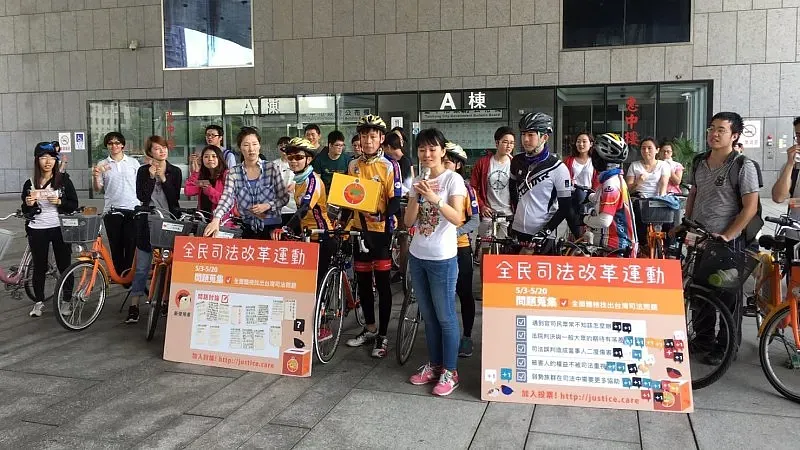
Established an online platform inviting the public to propose and vote on the judicial problems they felt most urgently needed resolution. Concurrently, a cross-island cycling tour was undertaken to visit courts across Taiwan and listen to local voices.
Convened an evaluation panel consisting of judges, prosecutors, defense attorneys, scholars, and individuals from non-legal backgrounds to conduct multi-perspective causal analyses of the judicial problems voted on by the public, with non-legal professionals making up more than half of the panel.
Proposed solutions one by one for each problem's cause, evaluated their pros and cons alongside execution difficulties, and hosted the "Judicial Reform Knock Knock" seminar series to promote and discuss them deeply within various communities.
Although this movement did not run its full course because its schedule later overlapped with the official National Congress on Judicial Reform and resources were limited, its innovative model of citizen participation, its focus on the quality of police interrogation, and its role as a benchmark for comparison during the 2017 National Congress on Judicial Reform left a profound and lasting impact.
Pre-launch Phase: Expectations and Demands for the New Government
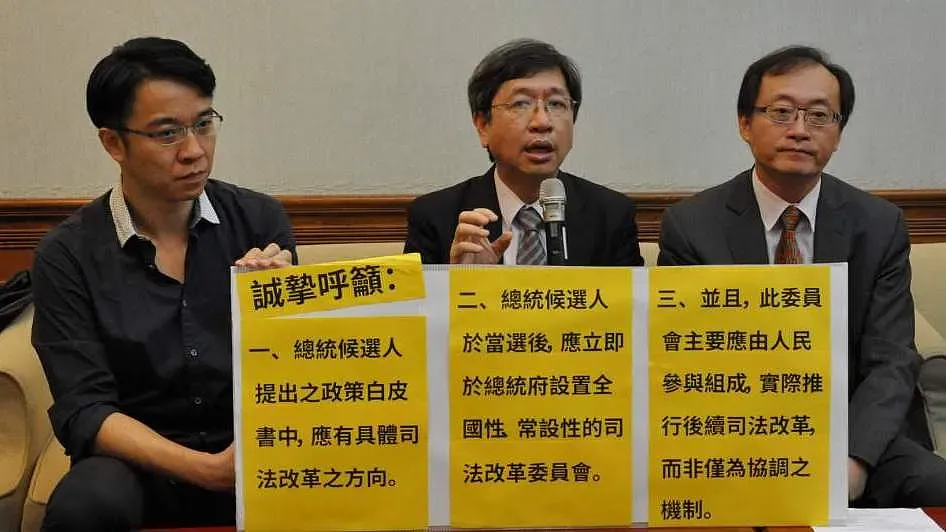
Amidst the political transition in May 2016, the Judicial Reform Foundation publicly presented judicial reform demands to the new president and ignited the atmosphere for reform discussions through commentary articles.
Stage 1: Gathering Problems──Public Voting and Cross-Island Cycling
In May 2016, the movement officially launched. The Judicial Reform Foundation established an online voting platform and simultaneously initiated the "Cross-Island Cycling Tour: Express Delivery of Local Judicial Reform Opinions" campaign, visiting courts across Taiwan over 13 days to deliver grassroots voices directly to the Presidential Office.
Stage 2: Analyzing Causes──Multi-Perspective Evaluation
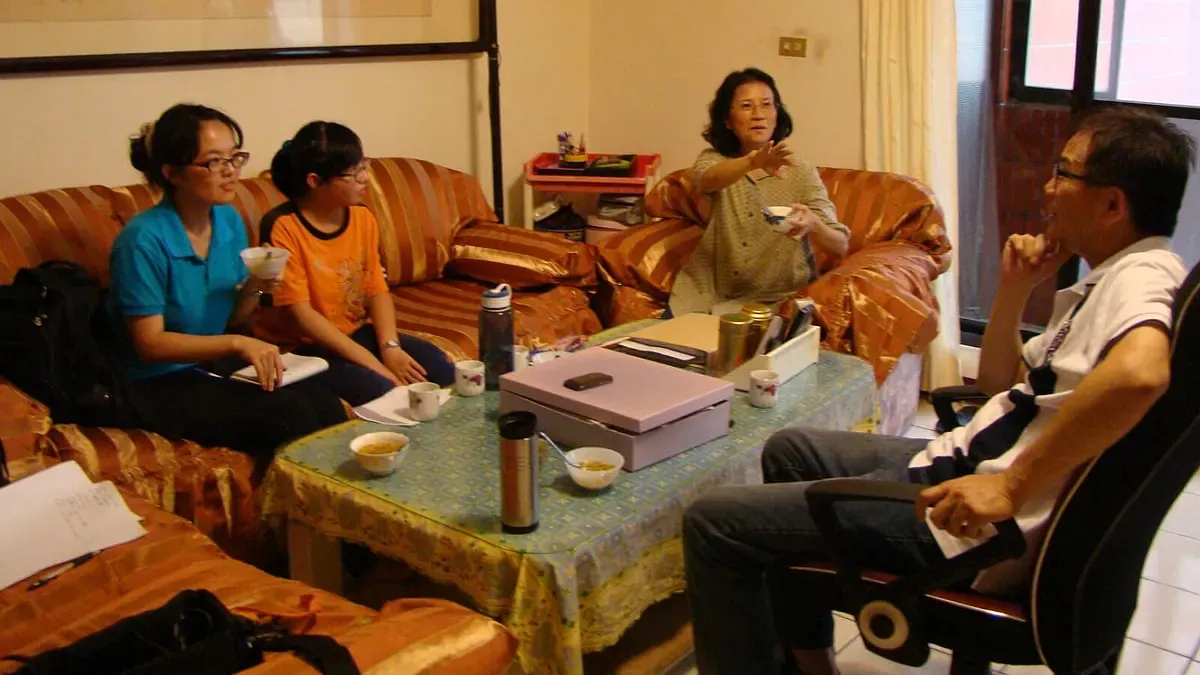
From June to July 2016, experts from legal and non-legal backgrounds were invited to convene two evaluation meetings to conduct causal analyses on problems voted on by the public, with the entire process broadcasted live.
Stage 3: Finding Solutions──Seminar Series and Annual Results
In the second half of 2016, the Judicial Reform Foundation held the "Judicial Reform Knock Knock" seminar series, entering various communities to promote discussions, and consolidated the whole year's movement results at the end of the year.
2016 Citizen Judicial Reform Movement Annual Special Issue
Synthesizing the results of the whole year's movement, including public-voted problems, causal analysis reports, cycling tour records, and concrete recommendations for judicial reform, this is the most complete documentary record of this citizen movement.
Publication Date: 2016-10-01 | Judicial Reform Foundation
Follow-up Impact: Becoming a Benchmark for Comparison for the National Congress on Judicial Reform
In 2017, the official National Congress on Judicial Reform was convened. Using the results of the 2016 Citizen Judicial Reform Movement as a yardstick, the Judicial Reform Foundation continuously tracked and monitored whether reform commitments were being implemented.
Judicial Reform Never Stops
The 2016 Citizen Judicial Reform Movement pioneered a new model of citizen participation in judicial reform. In 2017, the National Congress on Judicial Reform took over the baton, but whether the reform commitments will be implemented still relies on continued civil monitoring.
2017 Judicial Reform Resolutions: Monitoring and Implementation 1999 National Conference on Judicial Reform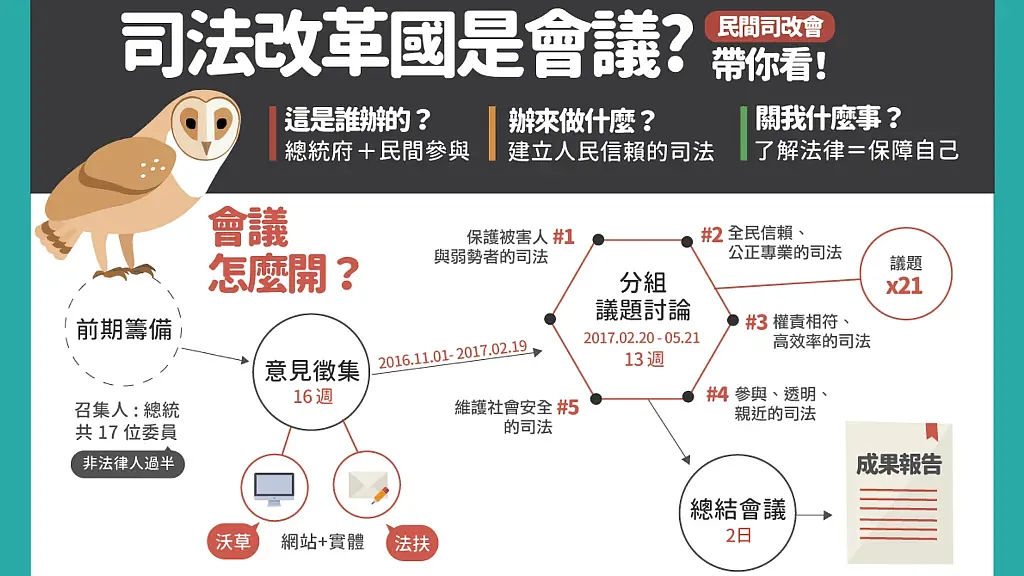
2017
The Metrics of Success and Failure for the National White Paper on Judicial Reform: A Comparative Analysis with the JRF's '2016 National Judicial Reform Movement'
The "prototype" of the National Judicial Reform Movement can be described as an attempt by the JRF to "build on the…

2016
Judicial Reform Grounded in Dialogue Based on "Sympathetic Understanding"
Media reporters are on the front lines of society reporting on issues related to the law that they witness firsthand.…

2016
Judicial Reform Amidst the Wave of Openness
The biggest difference between the meetings held during the citizen-led judicial reform movement and past judicial…
2016
Judicial Reform Involving Non-Lawyers is Quite Different
When discussing judicial reform, legal professionals have traditionally believed it to be a specialized domain that…

2016
Unlocking the Intractable Knot Between the Judiciary and the People
Two recent, highly controversial judicial rulings are the Supreme Court's final verdict sentencing a defendant to life…

2016
Do Not Say the Public Has No Vision for the Judiciary
On May 20, the day of President Tsai Ing-wen's inauguration, the "Cycling Around the Island: Delivering Local Judicial…
2016
An Ordinary Life, a Vindicated Injustice: How Difficult Is It? An Interview and Documentary on the Wrongful Conviction of Offense of Undue Enrichment
Mr. Liu Hsiang-heng was born in Taichung, a place where seasons are spring-like year-round, and where his parents…

2016
Blind Spots and Perspectives in Offense of Favoritism Cases: From the Distinction Between Practical Logic and Scientific Logic
Judges who have long engaged in legal practice are unlikely to have the time to read literature related to the social…

2016
Please! Can a Judicial Reform "Conference" Really Be Held Like This?
There are numerous issues in judicial reform, and most stakeholders may not be internet users. If the internet-using…
2015
The New President's Soft Target—Judicial Reform
Looking ahead to the 2016 presidential election, the candidates boil down to just a few familiar faces. Regardless of…